AI Jobs Shock 2026 — Payrolls +162,000 vs Information Jobs -23,000 (Views 0)
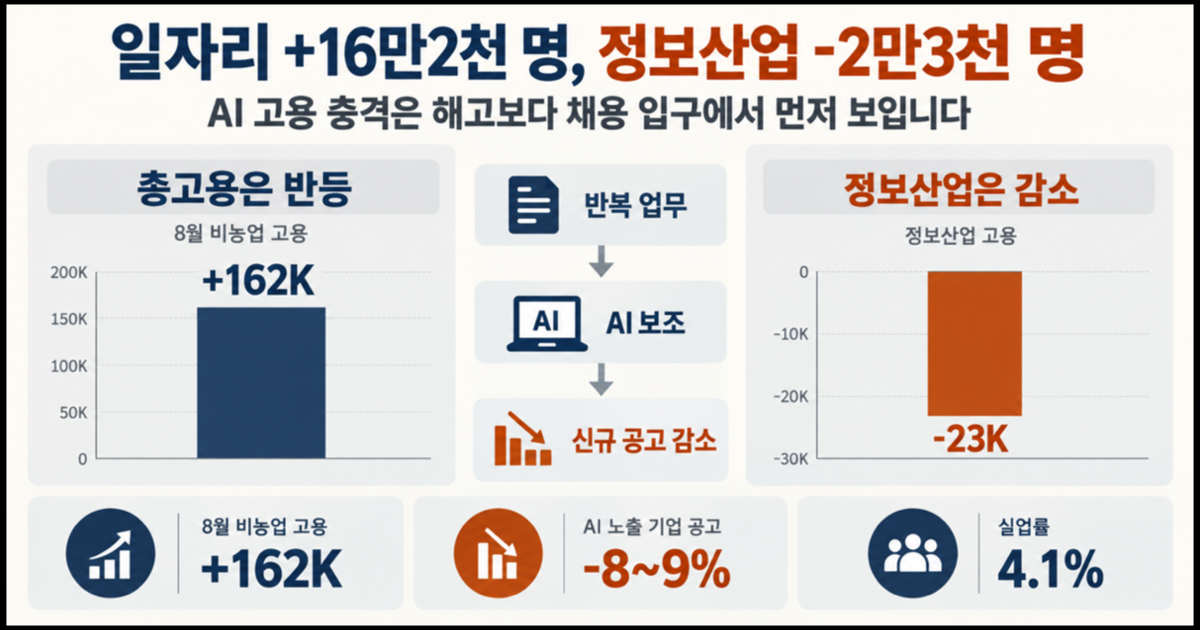
The AI jobs shock of 2026 is not a story of America losing jobs. Nonfarm payrolls rose by 162,000 in August, while information-sector employment fell by 23,000. The labor market is growing in aggregate even as the entrance to digital office work narrows.
How can both happen at once? Restaurants and schools hired more people. Separate research found weaker demand for new hires at firms more exposed to automatable work. The distinction between what the data shows and what it might mean matters here.
One boundary matters. A single jobs report cannot prove that AI eliminated 23,000 positions. The information category also includes telecom, publishing and broadcasting. Separate Federal Reserve Bank research released the same week does, however, show that weaker job postings can precede layoffs in AI-exposed work.
162,000 jobs added — mostly in restaurants and schools
The Bureau of Labor Statistics reported an unchanged 4.1% unemployment rate. Average hourly earnings rose 0.3% from July and 3.1% from a year earlier. The number working part time for economic reasons fell by 414,000. At first glance, this is a healthy report.
The gains were uneven. Food services and drinking places added 59,000 jobs, and local-government education added 42,000, largely reversing a prior-month decline. Manufacturing added 16,000. Information lost 23,000.
August payroll change by industry
ThousandsAI jobs shock 2026 bar chart of August US payroll changes by industry. Seasonally adjusted, BLS. Local education largely reversed a prior decline.
Within information, computing infrastructure, data processing and web hosting lost 8,000 jobs; publishing lost 7,000; broadcasting and content lost 5,000. More server spending does not automatically require payrolls to rise at the same speed. Automation, restructuring and changing media demand can occur together.
Why hiring slows before layoffs arrive
Layoffs are costly. They involve severance, lost knowledge and weaker morale. Leaving a vacancy unfilled or skipping an entry-level recruiting class is easier. Once AI handles part of a workflow, management first asks whether the next hire is still necessary.
The Dallas Fed analyzed millions of online postings. Existing firms with greater AI exposure reduced postings by about 5–6% by mid-2024 and 8–9% by early 2026. This was not only an AI-native startup effect; incumbent firms changed their demand too.
How AI first appears in hiring
FlowFlow diagram from AI task automation to fewer job postings. Mechanism based on Dallas Fed evidence; the final two steps are interpretation.
The limits matter. The study focuses on Texas, and online postings underrepresent farming, construction and personal services. It does not show that total US employment fell 8–9%. It shows weaker relative demand for work whose tasks are more automatable.
AI splits jobs into tasks before replacing occupations
A job is a bundle of tasks. A journalist gathers information, interviews sources, drafts copy and checks facts. AI may assist with a draft without replacing reporting or accountability. Firms automate repeatable pieces and shift people toward judgment and customer interaction.
A St. Louis Fed study surveyed nearly 14,000 workers. In more than 80% of occupations, at least one in five workers used AI. Adoption was broad. Yet fewer than 3% of tasks had AI-use rates above 50%. Depth remained shallow.
AI use is broad but still shallow
CompareOccupations: broad
Tasks: shallow
Comparison of broad occupational AI adoption and shallow task-level use. St. Louis Fed survey of nearly 14,000 workers, Aug. 2025–May 2026.
That distinction drives earnings. If subscriptions rise but work hours do not fall, AI is simply another expense. If the same staff serves more customers or ships products sooner, revenue per employee rises. Investors should track labor cost as a share of sales, revenue per employee and operating margin—not the phrase “we use AI.”
Margins can improve while consumption weakens
The first channel is profit margin. Software, platforms and finance can slow hiring for document-heavy work. If revenue holds, operating profit benefits. But worse service or overloaded staff can erase the savings.
The second channel is consumption. Restaurant hiring supports current household income. Fewer entry-level office openings can delay a graduate’s first paycheck, and later paychecks delay cars, housing and durable-goods purchases. Aggregate employment can look fine while the composition of spending changes.
A Boston Fed survey found that workers worried about personally losing a job to AI rose from 5% in late 2024 to just over 10% in late 2025. This is not evidence of mass layoffs. It is a reason to watch whether uncertainty raises precautionary saving and delays spending.
Why did stocks fall on good jobs news?
On September 4, the S&P 500 fell 0.4%, the Nasdaq lost 0.3%, and the two-year Treasury yield rose to 4.37%. Strong employment gives the central bank more room to keep rates high while fighting inflation. Growth stocks are especially sensitive because higher discount rates reduce the present value of distant profits.
AI firms face the opposite force too. If they slow hiring while growing sales, expected profits improve. Markets are balancing the rate path against the earnings path. Strong employment is not automatically bearish, and weaker hiring is not automatically bullish.
Korean chips, internet and gaming are different AI trades
For Korean semiconductor companies, US AI capital spending is the more direct variable. Demand for memory used in GPUs and servers matters. Our H200 supply-chain map explains the mechanism. One month of weaker information employment does not prove weaker chip demand.
Internet, gaming and content companies face a different test. AI can cut translation, design-draft and support costs, but flat sales make that a cost story, not a growth story. Quarterly reports should show whether labor cost ratios and margins improve alongside users and payments.
When volatility rises, separate the rate channel from the profit channel. Our semiconductor bottleneck analysis shows why supply scarcity and valuation pressure can coexist.
The next jobs report, postings and revenue per employee are the fork in the road
First, watch whether information employment falls again. Second, pair job openings and graduate unemployment with unemployment claims, because AI pressure may appear at the hiring gate before the layoff line. Third, test company claims against revenue per employee and labor cost ratios.
- Verified: August payrolls +162,000; information employment -23,000
- Research finding: postings at more AI-exposed firms down 8–9% by early 2026
- Still inference: that these shifts automatically become nationwide layoffs or Korean corporate profits
My read is that the first scene of the AI jobs shock of 2026 looks less like a factory emptying overnight and more like an office quietly declining to open the next junior role. That may be gentle cost control for a firm, but it delays the first paycheck—and consumption—for the economy. This is not investment advice.
The AI jobs shock may appear in missing job postings before it appears in layoffs.
Sources
AI 고용 충격 2026 — 일자리 +16만2천 vs 정보산업 -2만3천, 무슨 일이 벌어졌나 (조회수 0)
AI 고용 충격 2026은 ‘미국 일자리가 줄었다’는 이야기가 아닙니다. 8월 비농업 고용은 16만2천 명 늘었지만 정보산업에서는 2만3천 명이 줄었습니다. 전체 고용은 살아 있는데 디지털 사무직의 입구가 좁아지는 반전입니다.
왜 둘이 동시에 움직였을까요? 음식점과 학교는 사람을 더 뽑았습니다. 반면 반복 업무를 AI로 처리할 가능성이 큰 기업에서는 신규 채용 수요가 약해졌다는 연구 결과가 나왔습니다. 어디까지가 확인된 숫자이고 어디부터가 해석인지 구분할 필요가 있습니다.
먼저 선을 그어 두겠습니다. 한 달 고용보고서만으로 AI가 2만3천 개 일자리를 없앴다고 말할 수는 없습니다. 업종 분류에는 통신·출판·방송도 섞여 있습니다. 다만 같은 주에 나온 연방준비은행 연구가 ‘해고보다 채용공고 감소가 먼저 나타난다’는 별도의 증거를 보여줬습니다.
16만2천 명이 늘었는데 음식점·학교에만 쏠렸습니다
미 노동통계국(BLS)에 따르면 8월 실업률은 4.1%로 그대로였습니다. 시간당 평균임금은 한 달 전보다 0.3%, 1년 전보다 3.1% 올랐습니다. 경제적 이유로 원치 않는 시간제 근무를 한 사람도 41만4천 명 줄었습니다. 여기까지만 보면 노동시장은 꽤 건강합니다.
하지만 일자리가 생긴 곳은 고르지 않았습니다. 음식점·주점이 5만9천 명, 지방정부 교육이 4만2천 명을 보탰습니다. 교육 고용은 전월 감소를 대부분 되돌린 수치입니다. 제조업은 1만6천 명 늘었지만 정보산업은 2만3천 명 줄었습니다.
8월 업종별 고용 증감
천 명AI 고용 충격 2026 미국 8월 업종별 고용 증감 막대그래프. 계절조정, BLS. 지방정부 교육은 전월 감소를 대부분 되돌림.
정보산업 안에서도 컴퓨팅 인프라·데이터 처리·웹호스팅이 8천 명, 출판이 7천 명, 방송·콘텐츠가 5천 명 줄었습니다. 서버 투자가 늘었다고 서버를 운영하는 사람 수도 같은 속도로 늘어나는 것은 아니라는 뜻입니다. 자동화와 사업 재편, 콘텐츠 수요 변화가 한 업종 안에서 같이 움직입니다.
왜 해고보다 신규 채용이 먼저 줄어들까
기업 입장에서 사람을 내보내는 일은 비쌉니다. 퇴직 비용이 들고 조직 분위기도 흔들립니다. 반면 비어 있는 자리를 채우지 않거나 신입 공고를 한 번 건너뛰는 결정은 훨씬 쉽습니다. AI가 업무의 일부를 맡기 시작하면 기업은 먼저 ‘이번에도 한 명을 더 뽑아야 하나’를 다시 계산합니다.
댈러스 연은은 수백만 건의 온라인 채용공고를 분석했습니다. AI에 많이 노출된 기존 기업의 공고는 2024년 중반 5~6%, 2026년 초에는 8~9% 줄었습니다. 감소 폭이 커졌다는 점이 중요합니다. AI로 처음부터 설계된 신생기업만의 현상이 아니라 기존 기업에서도 나타났습니다.
AI가 채용에 먼저 나타나는 경로
구조AI 업무 자동화가 신규 채용공고 감소로 이어지는 흐름도. 댈러스 연은 결과를 바탕으로 한 작동 경로. 마지막 두 단계는 해석입니다.
여기에는 주의할 점도 있습니다. 이 연구는 텍사스 중심이며 온라인 공고는 농업·건설·개인서비스를 충분히 담지 못합니다. 그래서 ‘미국 일자리 전체가 8~9% 줄었다’고 읽으면 틀립니다. 확인된 것은 AI에 노출된 직무의 신규 수요가 상대적으로 약해졌다는 사실입니다.
AI는 직업을 통째로 없애기보다 일을 잘게 나눕니다
직업은 여러 업무를 묶어 놓은 꾸러미입니다. 기자라면 취재, 자료 검색, 초안 작성, 사실 확인을 함께 합니다. AI가 초안을 돕는다고 취재와 책임까지 한꺼번에 사라지지는 않습니다. 기업은 반복 가능한 부분을 자동화하고, 사람에게는 판단과 고객 대응을 더 맡깁니다.
세인트루이스 연은이 약 1만4천 명을 조사한 결과, 전체 직업의 80% 이상에서 근로자 5명 중 최소 1명이 AI를 썼습니다. 넓게 퍼졌습니다. 그런데 전체 업무 과제 가운데 AI 사용률이 50%를 넘는 것은 3%도 되지 않았습니다. 깊이는 아직 얕습니다.
AI 사용은 넓지만 아직 얕습니다
개념 비교직업 단위: 넓게 확산
업무 단위: 깊이는 제한
직업별 AI 사용 확산과 업무별 사용 깊이를 비교한 표. 세인트루이스 연은, 2025년 8월~2026년 5월 약 1만4천 명 조사.
이 차이가 기업 실적의 핵심입니다. AI 구독료만 늘고 작업 시간이 줄지 않으면 비용만 추가됩니다. 반대로 같은 인원이 더 많은 고객을 처리하거나 제품 출시를 앞당기면 직원 1명당 매출이 오릅니다. 투자자는 ‘AI를 쓴다’는 발표보다 매출 대비 인건비, 직원 1명당 매출, 영업이익률을 봐야 합니다.
기업 실적은 좋아져도 소비는 약해질 수 있습니다
첫 번째 경로는 이익률입니다. 소프트웨어·플랫폼·금융처럼 문서와 데이터 업무가 많은 회사는 신규 채용을 늦춰 비용 증가를 막을 수 있습니다. 매출이 유지된다면 영업이익에는 도움이 됩니다. 다만 고객 서비스가 나빠지거나 기존 직원의 일이 과해지면 절감 효과는 오래가지 못합니다.
두 번째 경로는 소비입니다. 음식점 고용 증가는 당장의 가계소득을 받칩니다. 반면 초급 사무직 공고가 줄면 졸업생이 첫 직장을 얻는 데 더 오래 걸립니다. 취업 시기가 늦어지면 자동차·주거·내구재 소비도 뒤로 밀립니다. 총고용이 괜찮아도 소비의 구성은 달라질 수 있습니다.
보스턴 연은 조사에서도 AI 때문에 자기 일자리를 잃을까 걱정한 근로자는 2024년 말 5%에서 2025년 말 10%를 조금 넘는 수준으로 늘었습니다. 그렇다고 대규모 해고가 확인된 것은 아닙니다. 불안이 커지면 가계가 저축을 늘리고 지출을 늦출 수 있다는 점이 경기 경로의 변수입니다.
좋은 고용 뉴스에 왜 미국 주식은 내렸나
9월 4일 S&P 500은 0.4%, 나스닥은 0.3% 내렸고 미국 2년 만기 국채 수익률은 4.37%로 올랐습니다. 고용이 예상보다 강하면 중앙은행이 물가를 잡기 위해 높은 금리를 더 오래 유지할 여지가 생깁니다. 미래 이익의 현재 가치를 크게 보는 성장주는 할인율 상승에 특히 민감합니다.
그런데 AI 기업에는 반대 힘도 있습니다. 채용을 줄이면서 매출을 키우면 미래 이익 전망이 좋아집니다. 결국 주가는 ‘금리가 얼마나 오르나’와 ‘AI가 실제 이익을 얼마나 늘리나’ 사이에서 움직입니다. 강한 고용이 무조건 주가 악재도, AI 채용 감소가 무조건 주가 호재도 아닌 이유입니다.
한국 반도체·인터넷·게임주는 같은 AI 수혜주가 아닙니다
한국 반도체 기업에는 미국의 AI 설비투자가 더 직접적입니다. GPU와 서버에 들어가는 메모리 수요가 유지되는지가 중요합니다. 관련 구조는 H200 공급망 31개 기업 분석에서 더 자세히 볼 수 있습니다. 미국 정보산업 고용 감소만으로 반도체 수요 둔화를 단정할 수는 없습니다.
인터넷·게임·콘텐츠 기업에는 계산이 다릅니다. AI로 번역, 디자인 초안, 고객 응대 비용을 낮출 수 있지만 매출이 그대로라면 비용 절감 이상의 성장 이야기는 없습니다. 분기 실적에서 인건비율과 영업이익률이 함께 좋아지는지, 이용자와 결제액까지 늘어나는지 확인해야 합니다.
시장 변동성이 커질 때는 금리와 이익 경로를 나눠 보는 편이 좋습니다. 반도체 조정과 병목 해설처럼 공급 병목의 수혜와 높은 할인율의 부담은 동시에 나타날 수 있습니다.
다음 고용보고서·채용공고·1인당 매출이 갈림길입니다
첫째, 다음 고용보고서에서 정보산업 감소가 이어지는지 봐야 합니다. 둘째, 신규 실업수당보다 채용공고와 청년 실업률을 함께 봐야 합니다. AI 충격은 해고보다 입구에서 먼저 보일 수 있기 때문입니다. 셋째, 기업 실적에서 직원 1명당 매출과 인건비율이 실제로 개선되는지 확인해야 합니다.
- 확인된 사실: 8월 총고용 +16만2천 명, 정보산업 -2만3천 명
- 확인된 연구: AI 노출 기업의 채용공고가 2026년 초 8~9% 감소
- 아직 추론: 이 변화가 미국 전체 해고나 한국 기업 이익으로 곧바로 이어진다는 주장
제 판단은 이렇습니다. AI 고용 충격 2026의 첫 장면은 ‘사람이 한꺼번에 사라지는 공장’보다 ‘신입 채용 버튼을 누르지 않는 사무실’에 가깝습니다. 기업에는 조용한 비용 절감이지만, 경제 전체에는 첫 직장과 소비의 출발점이 늦어지는 변화입니다. 이 글은 투자 권유가 아닙니다.
AI 고용 충격은 해고 통계보다 채용 공고의 빈자리에서 먼저 보일 수 있습니다.
답글 남기기