Deep-Foam Photolithography — What Changed With 20,000-DPI Inkless Plastic?
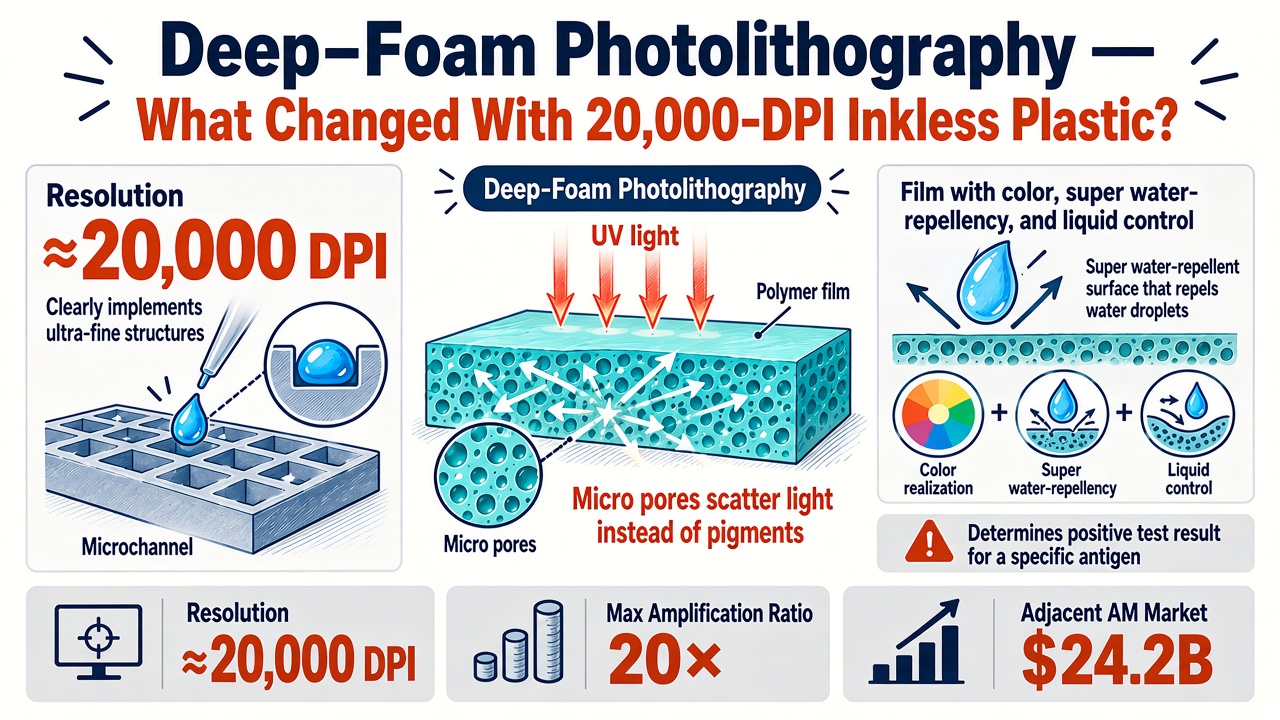
Researchers made microscopic air pockets inside plastic and printed at roughly 20,000 dpi without ink. The Tokyo Metropolitan University and Kyoto University team published deep-foam photolithography in Nature on 9 September 2026. The same polymer-film platform also demonstrated superhydrophobic surfaces and picolitre liquid capture. It changes how light and water behave by restructuring the plastic itself.
The headline resolution is striking, but process integration is the more important story. A manufacturer might eventually combine steps now used separately for printing, coating, surface texturing and microfluidic patterning. This article separates what the paper demonstrated from projections about cost and industrial impact.
How does deep-foam photolithography print a polymer?
Photolithography transfers a pattern into a material with light. It is familiar from semiconductor fabrication, but this method selectively foams a polymer rather than etching a circuit. The researchers exposed a photosensitized film to deeply penetrating ultraviolet A light.
Illumination cuts some long polymer chains while crosslinking others into a network. A weak solvent then penetrates the film. The mobile fragments and restraining network interact to nucleate, expand and, under selected conditions, collapse pores.
Bread bubbles offer a simple analogy, with one crucial difference: this film does not rise uniformly. The light pattern determines where micrometre-scale regions expand or collapse. The actual mechanism combines photochemistry, solvent permeation and polymer viscoelasticity.
-
1
UV-A exposure
Light enters the film
-
2
Scission + crosslinking
Fragments and network form
-
3
Weak solvent enters
Pores nucleate and expand
-
4
Controlled collapse
Tune colour, height and wetting
Why do white and diffractive colours appear without ink?
White paint normally relies on pigment particles that scatter many wavelengths. Deep-foam photolithography uses a disordered population of tiny pores instead. Like the scales of an ultra-white beetle, the material’s own structure scatters light and creates structural white.
The Nature paper reports white and greyscale inkless printing at about 20,000 dpi, with patterns fine enough to produce diffractive colour. Selectively collapsing pores also creates hierarchical roughness and lotus-like superhydrophobicity.
Conventional inkjet adds colourants, water-repellent coatings add a chemical layer, and 3D printers deposit material layer by layer. DFP changes the internal structure of an existing film. That lets one substrate carry optical, height, wetting and fluid-handling functions.
Conventional stack
Add ink or pigment
Colour
Repellence · Separate coating
Shape · Etch, mould or deposit
Deep-foam route
Pores scatter light
Colour
Repellence · Texture repels water
Shape · Locally foam the film
Aspect ratios of 20 and picolitre capture — what is proven and what is missing
The process worked across amorphous and semi-crystalline polymers and patterned both films and fibres. Expanded and collapsed foams reached aspect ratios up to 20. Aspect ratio compares height with width, so this means tall, narrow structures could be formed.
The team also patterned wetting behaviour to confine picolitre volumes of liquid and colloidal material. A picolitre is one trillionth of a litre. Placing such small samples at defined locations could matter for diagnostic chips and chemical analysis.
The boundary matters. The paper establishes a mechanism and prototype capabilities. The public abstract does not establish factory throughput, cost per square metre, years of outdoor durability, or food and medical-contact safety. Commercial printing has not been displaced.
Where could fewer process steps cut costs?
Manufacturing economics is not just a resin price. Every pass through a factory can add equipment, alignment, cleaning, drying, inspection and scrap. If one patterning step can create colour, water repellence and fluid guidance, avoided process steps may matter more than a few grams of polymer.
Security printing and smart packaging are an early candidate. Fine 20,000-dpi patterns and angle-dependent diffractive colours could support difficult-to-copy marks. Durable pigment-free white might also reduce ink inventories and drying while placing authentication and water repellence on one film.
Textiles and surface materials are another possibility. The university release points to potential replacement of metallic pigments and PFAS water repellents. PFAS offer strong oil and water resistance but face pressure because of environmental persistence. Matching durability with a simpler material stack could reduce coating and compliance costs, but that remains a projection.
Microfluidic diagnostics present a third route. Micromoulding serves mass production well but tooling makes redesign costly and slow. Silicon and glass methods require cleanrooms and etching. One review compared Pyrex substrate costs of 10–20 cents per square centimetre with 0.2–2 cents for PMMA. Patterning channels and wetting on inexpensive polymers could shorten prototyping cycles for low-volume diagnostic devices.
-
1
Integrate functions
Colour + wetting + fluids
-
2
Fewer steps
Less coating, alignment, drying
-
3
Higher productivity
Faster design changes
-
4
New products
Labels, chips and textiles
The $24.2 billion additive-manufacturing market — DFP has no defined share yet
Wohlers Associates and ASTM International valued global additive-manufacturing revenue at $24.2 billion in 2025, up 10.9%. Services grew 15.5%, while system sales rose 3.6%. That suggests spending is shifting toward productive use of installed capacity rather than machines alone.
It is not DFP’s market size. DFP is distinct from conventional additive manufacturing and is not yet a commercial product. The figure only shows adjacent demand for flexible digital manufacturing. A direct forecast requires throughput, equipment cost, yield and customer-qualification data.
Potential beneficiaries are better described by function than ticker symbol: UV exposure and optics suppliers, functional-polymer and photosensitizer makers, roll-to-roll equipment builders, security-printing companies and lab-on-chip manufacturers. Pigment, ink and PFAS-coating suppliers could face competition if functions migrate to physical structure. All of this depends on successful scale-up.
Four questions will decide commercialization
Making one attractive laboratory pattern is different from producing millions of identical pieces. For DFP to become an industrial technology, repeatability and throughput must be quantified alongside resolution.
- Can pore size and colour stay uniform across wide films and continuous fibres?
- How quickly and safely can UV exposure, solvent permeation and recovery run?
- Do colour and water repellence survive abrasion, washing, sunlight and temperature cycling?
- Will residual photosensitizer and solvent pass medical, food, textile and recycling requirements?
Standards matter too. ASTM stresses that repeatable additive manufacturing needs standards, certification and qualification. Customers need shared measurements for reflectance, contact angle, channel dimensions and lifetime before they can write reliable supply contracts.
The same manufacturing lesson appears in our screen-printed solar-cell analysis and waste-heat cooling analysis. Strong material performance does not create a market by itself; a cheap and repeatable process does.
My view is that deep-foam photolithography is not mainly a sharper printer. It is a possible manufacturing platform that combines optical, water-repellent and microfluidic functions in one plastic sheet. Twenty thousand dpi announces the science. Throughput, defect rate, lifetime and cost per square metre will decide the business.
This article does not recommend buying or selling any security. Base investment decisions on your own analysis and qualified professional advice.
Twenty thousand dpi is the science number. Throughput, defects, lifetime and cost per square metre are the business numbers.
Sources and further reading
- Nature — Foaming photopolymers as a high-resolution biomimetic printing platform
- Tokyo Metropolitan University — Official research release
- Wohlers Associates/ASTM — Additive manufacturing market at $24.2B
- Annual Reviews — Digital Manufacturing for Microfluidics
- Micromachines — Fabrication Methods for Microfluidic Devices
- ASTM — Advanced Manufacturing Impact Report
For information only — this is not a recommendation to buy or sell any asset.
Comments 0