Ammonia Hydrogen Extraction at 250°C — Inside Nature’s 4× Electrochemical Membrane
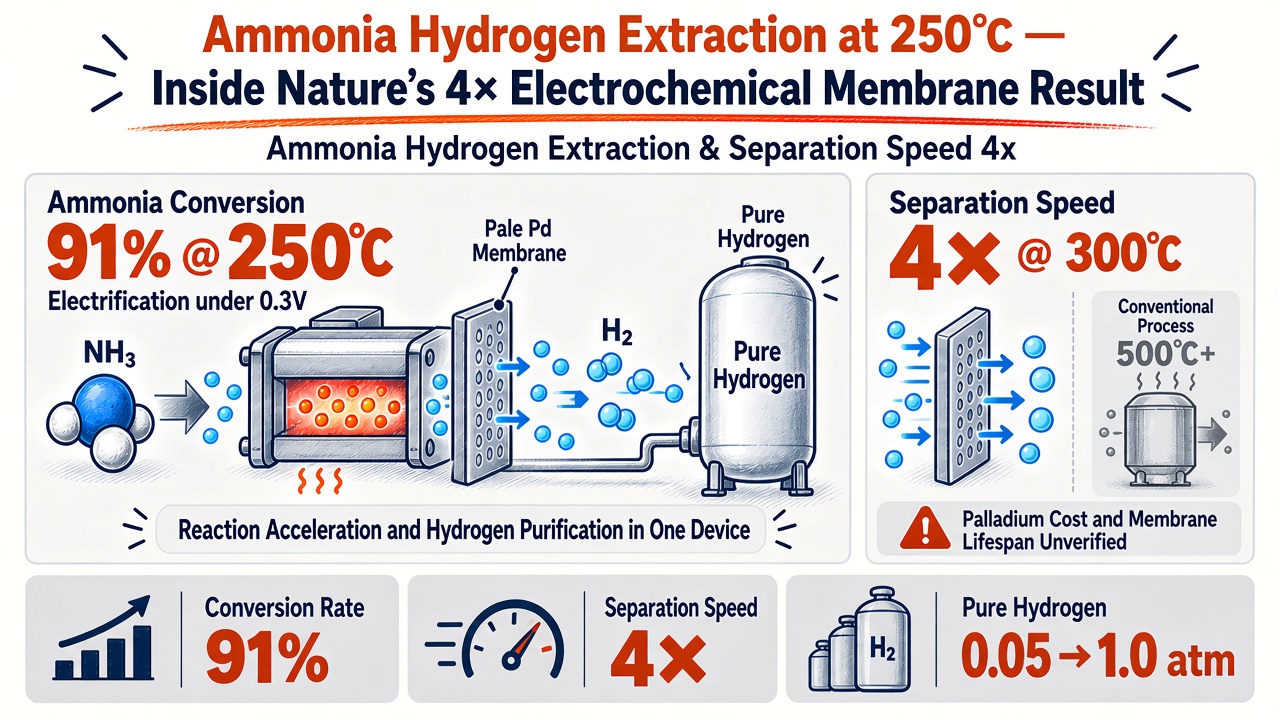
Ammonia hydrogen extraction just produced a set of unusually consequential numbers. A Nature paper published on 9 September 2026 reports up to 91% ammonia conversion at 250°C and a fourfold increase in hydrogen-separation rate at 300°C versus pressure-driven operation. More importantly, the device promotes the reaction and purifies hydrogen in one unit. This article explains what changed and what still has to be proven before the idea can lower delivered hydrogen costs.
The boundary matters. This is a laboratory proof of concept, not a commercial cost report. The paper establishes temperature, conversion and separation performance. Lower capital costs, new port markets and corporate beneficiaries remain conditional forecasts.
Why is extracting hydrogen from ammonia so difficult?
Hydrogen is light but awkward to move. Shipping useful quantities requires high-pressure compression or cooling close to −253°C for liquefaction. Both routes consume energy and need specialized equipment.
Ammonia offers another route. It already moves globally as a fertilizer feedstock and can carry hydrogen in chemical bonds. The difficult step comes at the destination: cracking ammonia back into nitrogen and hydrogen. Conventional systems generally need temperatures above 500°C for high rates and conversion, while the product stream still requires purification to remove nitrogen and residual ammonia.
In practical terms, the package travels well but is expensive to open and sort. Heat, purification, compression and safety equipment all appear in the delivered price of hydrogen. A cheap voyage does not solve the economics if recovery at the destination remains costly.
-
1
Ship ammonia
Liquid storage
-
2
Crack above 500°C
H₂ + N₂ produced
-
3
Downstream cleanup
Remove residual NH₃
-
4
Pure hydrogen
Compress and use
How does the electrochemical palladium membrane differ?
Conventional palladium membranes also exploit palladium’s ability to pass hydrogen selectively. They usually rely on a difference in hydrogen partial pressure across the membrane. The driving force weakens when hydrogen is dilute or the recovery side reaches a higher pressure, while thinner high-flux membranes may sacrifice mechanical stability.
The MIT device turns a palladium-based membrane into the anode of a molten-hydroxide electrochemical cell. Hydrogen arriving at the membrane separates into protons and electrons. They travel through the electrolyte and external circuit, respectively, then recombine at the cathode as pure hydrogen gas.
Voltage, rather than a pressure gradient, pulls the hydrogen across. The researchers reached diffusion-limited transport at an anode potential below 0.3 V. They enriched hydrogen from a mixture with a hydrogen partial pressure of 0.05 atmosphere into a pure stream at 1 atmosphere.
-
1
Catalytic reaction
H₂ released from NH₃
-
2
Pd membrane anode
Selects hydrogen
-
3
Electrochemical transfer
Driven below 0.3 V
-
4
Pure H₂ reforms
1-atm stream
The membrane also changes the reaction. Removing hydrogen as soon as it forms reduces product inhibition and shifts the equilibrium toward further dehydrogenation. The membrane is therefore an active pump, not merely a filter.
Coupled to catalysts, the device achieved up to 91% ammonia conversion and 94% methylcyclohexane conversion at 250°C. At 300°C, hydrogen separation was four times faster than in pressure-driven operation. Those results came from distinct experimental conditions; they do not mean every part of a commercial process becomes four times better.
Where could costs fall?
Heat is the most immediate possible saving. Moving from above 500°C toward 200–300°C could reduce demands on burners, insulation and high-temperature components. It could also make industrial waste heat more useful. The device consumes electricity, however, so any fair comparison must subtract electrochemical power use from thermal savings.
Process integration offers another route to lower costs. Today’s chain can include cracking, contaminant removal, hydrogen purification and compression. Selective extraction inside the reactor could eliminate or shrink some downstream equipment, piping and maintenance points. That matters most where footprint and purity carry a premium, including ports, refuelling depots and semiconductor plants.
Productivity could improve as well. Immediate hydrogen removal may deliver more conversion from a smaller reactor and reduce recycle loads. It could also support distributed production: carry ammonia over long distances, then recover hydrogen near the point of use.
Heat and pressure led
Temperature · Typically above 500°C
Separation · Pressure + cleanup
Equipment · Multiple stages
Cost driver · Heat, cleanup, compression
Electrochemical Pd membrane
Temperature · 250°C experiment
Separation · Active pump + purification
Equipment · Potential integration
New cost driver · Power, Pd, membrane life
These are engineering pathways, not measured savings. The paper does not report cost per kilogram, plant capital expenditure or full-system efficiency. Ammonia and electricity prices, palladium loading, membrane replacement, catalyst life and utilization will decide the commercial outcome.
Industry is already funding ammonia cracking
Commercial activity is moving ahead. Air Liquide says it commissioned an industrial-scale pilot in Antwerp-Bruges in November 2025 with capacity to crack 30 tonnes of ammonia per day. thyssenkrupp Uhde and Uniper target the end of 2026 for a large German demonstration plant. These are not the same technology as the Nature device. They show that ammonia-to-hydrogen recovery is already becoming a field of plant competition.
The EU-funded COUPLE project is a closer industrial analogue. It combines palladium membrane reactors with proton-ceramic electrochemical reactors and targets 100 kg of high-purity, pressurized hydrogen per day for 5,000 hours. The 2026–2028 project has nearly €6 million in EU support. Its architecture differs, but its integration of membranes, electrochemistry, compression and heat management points in a similar direction.
There is a Korean connection as well. KBR and ISU Chemical signed a memorandum in 2023 and announced plans for a commercial Ulsan ammonia-cracking unit producing 10 tonnes of hydrogen per day. JERA and Samsung C&T signed a July 2026 memorandum to explore more resilient hydrogen and ammonia value chains. For import-dependent Japan and Korea, recovering hydrogen near ports or industrial users could add a valuable supply option.
The engineering logic connects with our earlier analysis of waste-heat-driven cooling: a lower-temperature cracker may have more opportunities for heat integration. On the demand side, our AI semiconductor supply-chain guide explains why high-purity process gases matter. Actual winners cannot be identified until membrane and system performance are demonstrated at scale.
Hydrogen demand tops 100 million tonnes, but clean supply is 1%
Global hydrogen demand exceeded 100 million tonnes in 2025, according to the IEA. Low-emissions supply was only about 1 million tonnes. Most demand still comes from refining and chemicals. The missing market is not hydrogen itself; it is competitively priced low-emissions hydrogen.
Investment momentum has also weakened. The IEA counts 27 million tonnes of announced low-emissions production for 2030, but projects committed or judged likely to operate fell from 10 million tonnes in the previous assessment to just over 6 million tonnes. Costs, uncertain offtake, regulation and infrastructure are delaying projects.
Recovery technology sits directly inside that gap. Ammonia could connect low-cost renewable production regions with demand centres through established shipping and storage practices. If cracking remains expensive, however, ammonia may be attractive as fertilizer or direct fuel while losing ground as a hydrogen carrier.
Four tests before commercialization
Palladium is the first obstacle. It passes hydrogen extremely well but is an expensive precious metal. The team is working to reduce palladium loading. Any thinner or alloyed membrane must preserve both performance and life.
- Durability: membranes must survive thousands of hours and repeated thermal cycling without cracking or losing flux.
- Contaminants: catalysts and membranes must tolerate process impurities while keeping residual ammonia within end-use specifications.
- Net efficiency: saved heat must exceed the electricity and balance-of-plant losses introduced by electrochemical pumping.
- Scale and safety: throughput must rise with membrane area, while toxic ammonia is handled safely near ports and demand centres.
The most useful milestones are therefore tonnes per day, more than 5,000 hours of continuous operation, verified hydrogen purity and residual ammonia, and recovery cost per kilogram excluding ammonia feedstock. Those figures will permit a real comparison with conventional crackers, liquid hydrogen and other carriers. This article does not recommend buying or selling any security or asset.
What the paper proves—and what remains a forecast
The demonstrated facts are strong: low voltage actively drove hydrogen through a palladium membrane, dilute hydrogen became a pure 1-atmosphere stream, and high conversion of ammonia and methylcyclohexane occurred at 250°C. Reaction promotion and separation worked together.
The economic claims remain conditional. Smaller plants, lower recovery costs, new markets at ports and distributed users, and partial displacement of high-temperature crackers and purification equipment all depend on palladium loading, long-term durability and real power consumption.
The research matters less because it makes more hydrogen than because it changes the final recovery step from a problem governed mainly by heat and pressure into one that can be controlled electrochemically. Hydrogen economics are decided by the cost of usable gas at the customer’s site. This paper offers a new design for reducing that final price tag.
250°C and 4× are the science numbers. Membrane life, power, throughput and recovery cost per kilogram are the business numbers.
Sources and further reading
- Nature — Anodic Pd membrane H₂ extraction enhances thermochemical dehydrogenation
- MIT News — An electrochemical approach turns ammonia into pure hydrogen
- IEA — Global Hydrogen Review 2026, Executive summary
- EU Clean Hydrogen Partnership — COUPLE project
- Air Liquide — Ammonia cracking industrial-scale pilot
- thyssenkrupp Uhde — Ammonia cracking demonstration
- JERA — Hydrogen and ammonia value-chain MoU with Samsung C&T
- KBR — Ammonia cracking unit with ISU Chemical
For information only — this is not a recommendation to buy or sell any asset.
Comments 0