ADC Cancer Drugs — From 180 to 2,000 Targets, Nature BTR Opens a New Market
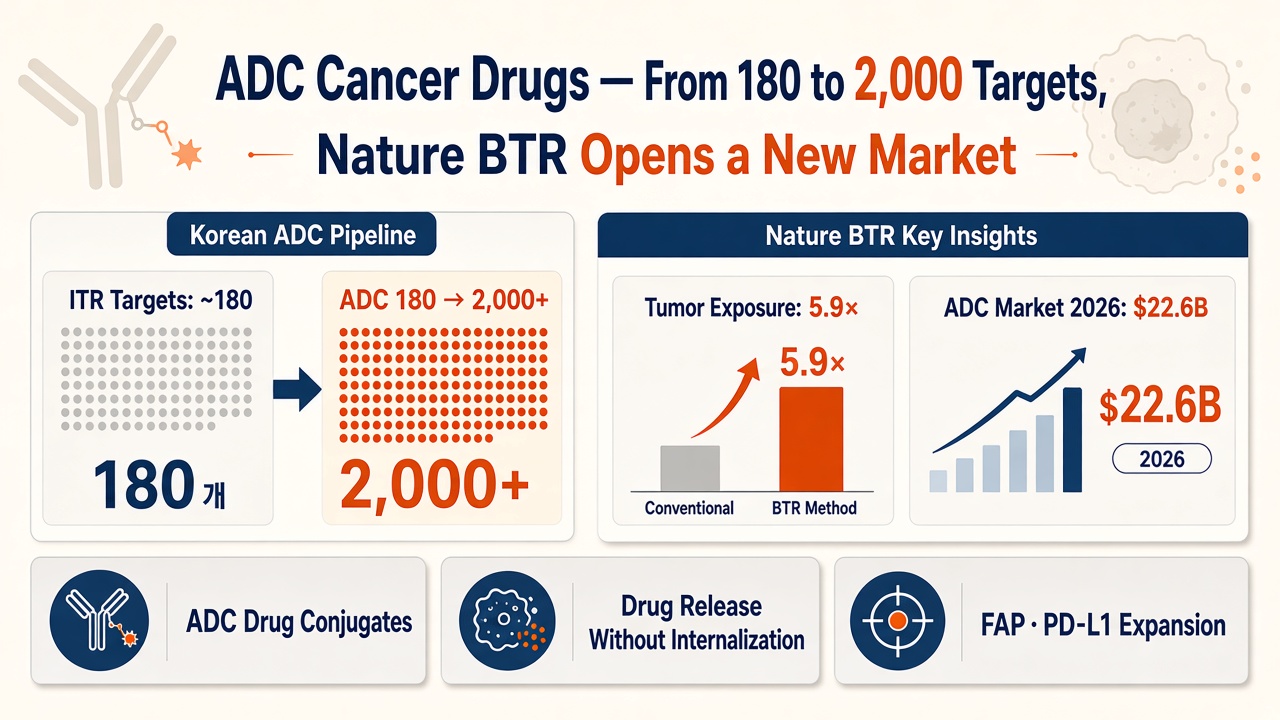
The ADC (antibody-drug conjugate) market may reach about $22.6 billion in 2026 — roughly ₩31 trillion. Yet drug developers have crowded into only ~180 of more than 2,000 membrane protein targets, because classical ADCs need efficient cell internalization. A Nature paper published August 26, 2026 proposes BTR (binding-to-release), releasing drug at the binding pocket without endocytosis, and reported 5.9× higher tumor drug exposure in animal models.
Below we unpack ADC vs BTR, labeling peer-reviewed facts separately from market forecasts. Not medical or investment advice.
What is an ADC — the guided-missile drug
An ADC links a tumor-seeking antibody to a cytotoxic payload through a cleavable linker. The antibody binds a surface protein on cancer cells; the linker breaks and releases the drug, ideally concentrating toxicity in the tumor. Enhertu (trastuzumab deruxtecan, Daiichi Sankyo/AstraZeneca) is a flagship example.
ADCs are expensive because manufacturing spans antibody production, linker-payload chemistry, and sterile fill-finish — often patient-specific or small-batch. Autologous CAR-T therapy is frequently cited around $400,000 per patient for similar precision-manufacturing reasons. As the market grows, CDMOs and linker specialists capture more value.
Why only ~180 targets — the internalization bottleneck
Most approved ADCs follow ITR (internalization-to-release): the complex enters the cell, traffics to lysosomes, and releases payload inside. Nature’s authors estimate only ~180 of 2,000+ membrane proteins internalize efficiently — about 10%. Development therefore piles onto HER2, TROP2, and a few proven antigens.
Korea’s LigaChem Bio LCB84 (TROP2) and many HER2/Claudin programs sit on the same axis. Limited targets mean fiercer clinical competition, licensing prices, and toxicity risk. Asia Business Daily (Feb 2026) cited industry data projecting a ~$28.5B global ADC market by 2028 — an industry estimate, not a lab result.
ITR (classic ADC)
Requirement · Cell internalizes target
Release · Inside lysosome
Targets · ~180 proteins
Example · HER2, TROP2
BTR (Nature 2026)
Requirement · Binding pocket + reactive residue
Release · Cell surface / peritumor
Targets · Expand beyond ~180
Example · FAP, PD-L1
Nature’s BTR — release without swallowing the cell
BTR (binding-to-release) cleaves the linker when the drug binds its target pocket, using a nearby nucleophilic residue (Tyr745 on FAP in the paper). No endocytosis required. The enabling chemistry is PhoPEx — phosphorus(V)–phenol exchange, inspired by SuFEx click chemistry.
FAP (fibroblast activation protein) is highly expressed on cancer-associated fibroblasts; FAPI PET imaging works across 28+ cancer types. But FAP internalizes poorly, stalling therapeutic conjugates. Clinical candidate OMTX705 achieved disease stabilization in only 26% of patients (cited in the paper) — diagnostic success, therapeutic stall.
BTR bridges that gap. FAP-BTR-SMDC nearly abolished tumor growth in xenograft models; the team extended BTR to PD-L1 and an mRNA-display FAP peptide. These are rodent and cell data — not guaranteed human success.
-
1
1. Circulation
PhoPEx linker stable
-
2
2. Bind
Binds FAP or other target
-
3
3. Proximity
Tyr745 cleaves linker
-
4
4. Release
MMAE payload diffuses
-
5
5. Effect
Tumor growth suppressed (mice)
Paper numbers — 5.9× tumor exposure, cleaner ratios
For industry economics, the key question is how much drug reaches the tumor. FAP-BTR-SMDC showed 5.9× higher MMAE exposure (AUC 0–120h) versus FAP-ITR-SMDC, comparable to an antibody-based FAP-ITR-ADC.
Tumor-to-blood ratio rose 14.7× versus ITR-SMDC and 3.6× versus ITR-ADC. Tumor-to-liver ratios improved 55.1× and 58.7× respectively. Liver uptake matters because hepatotoxicity limits ADC dosing. More drug in tumor, less in blood and liver, can mean higher tolerated doses and potentially more patients per manufacturing batch (inference).
BTR 5.9x tumor exposure and 14.7x tumor-to-blood bar chart. FAP-BTR-SMDC vs FAP-ITR-SMDC, animal models. Nature 2026
ADC market — where the money flows
Market sizing varies by source. Fortune Business Insights: $18.6B (2025) → $22.6B (2026) → $68B (2034), CAGR 14.76%. DataMIntelligence is more conservative at $14.8B (2026). All agree on double-digit growth. The Nature paper cites ~$26B ADC market projections via references — third-party estimates.
If BTR commercializes, three money channels shift: (1) target expansion into poor-internalization antigens; (2) linker IP deals around PhoPEx; (3) format differences — SMDCs are smaller than antibodies, possibly changing CDMO demand (forecast).
Korean biotech is already racing: LigaChem Bio plans up to five IND filings in 2026 with half its 20+ pipelines on novel targets/payloads (Seoul Economic Daily, Jul 2026). ABL Bio filed FDA IND for bispecific ADC ABL209; partner Systimmune reported 100% complete remission for CS5001 in first-line DLBCL (Herald Business). Chong Kun Dang won clinical approval for CKD-703 (Asia Business Daily). BTR could open licensing paths for Korean linker/payload players — but ADC clinical attrition from toxicity remains high industry-wide.
Global ADC market size 2026-2034 bar chart. Fortune Business Insights estimate. Not lab data
ITR vs BTR — why the target map widens
ITR ADCs require targets that cells swallow efficiently. BTR requires tight binding plus a reactive residue in the pocket. Think of ITR as a package that must enter the house before opening; BTR opens at the doorstep.
Scientifically, the addressable target map widens — stromal antigens like FAP and some immune checkpoints where diagnostics work but therapeutic ADCs stalled. Economically, it may ease crowding on HER2/TROP2. BTR favors membrane-permeable payloads (MMAE-class); extracellular release demands careful off-tumor design, which the authors acknowledge.
A parallel Nature story is CELLFIE — CRISPR screens boosting CAR-T (2025). ADCs release drug outside cells; CAR-T arms immune cells — different routes, same oncology map. Our July science-journals economy piece traced where journal headlines point capital next.
Confirmed facts, forecasts, inference — what’s verified
- Confirmed (paper): BTR/PhoPEx chemistry, FAP/PD-L1 preclinical data, 5.9× exposure, 14.7× tumor-to-blood ratios
- Confirmed (paper cites): ~180/2,000+ ITR-compatible targets; OMTX705 26% stabilization
- Forecast (market research): ADC $14.8–22.6B in 2026, $38–68B by 2034–35 — source-dependent
- Forecast (press): Korea ADC ~₩41T by 2028; LigaChem/ABL pipeline expansion
- Inference: target expansion, linker licensing, CDMO shifts if BTR succeeds — clinical proof pending
- Risk: ADC trials often halt on toxicity; this work is preclinical
Nature’s BTR paper proves a design principle in the lab: you need not internalize to release. With the ADC market heading past $200B in aggregate forecasts, the target map may widen far beyond today’s 180. But papers are not prescriptions — clinical, regulatory, and manufacturing walls remain. See our SME and startup policy piece for the jobs side; this article covers biotech R&D spillovers. Consult physicians and official filings for treatment or investment decisions.
180 targets was the map — BTR redraws where the next ADC dollars go.
Sources
- Nature — BTR targeted drug delivery (26 Aug 2026)
- Nature — CELLFIE CRISPR CAR-T (2025)
- Fortune Business Insights — ADC market forecast
- DataMIntelligence — ADC market forecast
- Asia Business Daily — K-Bio ADC market (Feb 2026)
- Seoul Economic Daily — Korea next-gen ADCs (Jul 2026)
- Seoul Economic Daily — LigaChem IND plan
- Herald Business — ABL/Systimmune CS5001 100% CR
- Frontiers — CAR-T automation & cost
- Internal: 2026-09-01-nature-btr-adc-drug-delivery-session-01.md
For information only — this is not a recommendation to buy or sell any asset.
Comments 0