MedGemma medical AI: a 15.5-point chest X-ray gain, but will hospital costs fall?
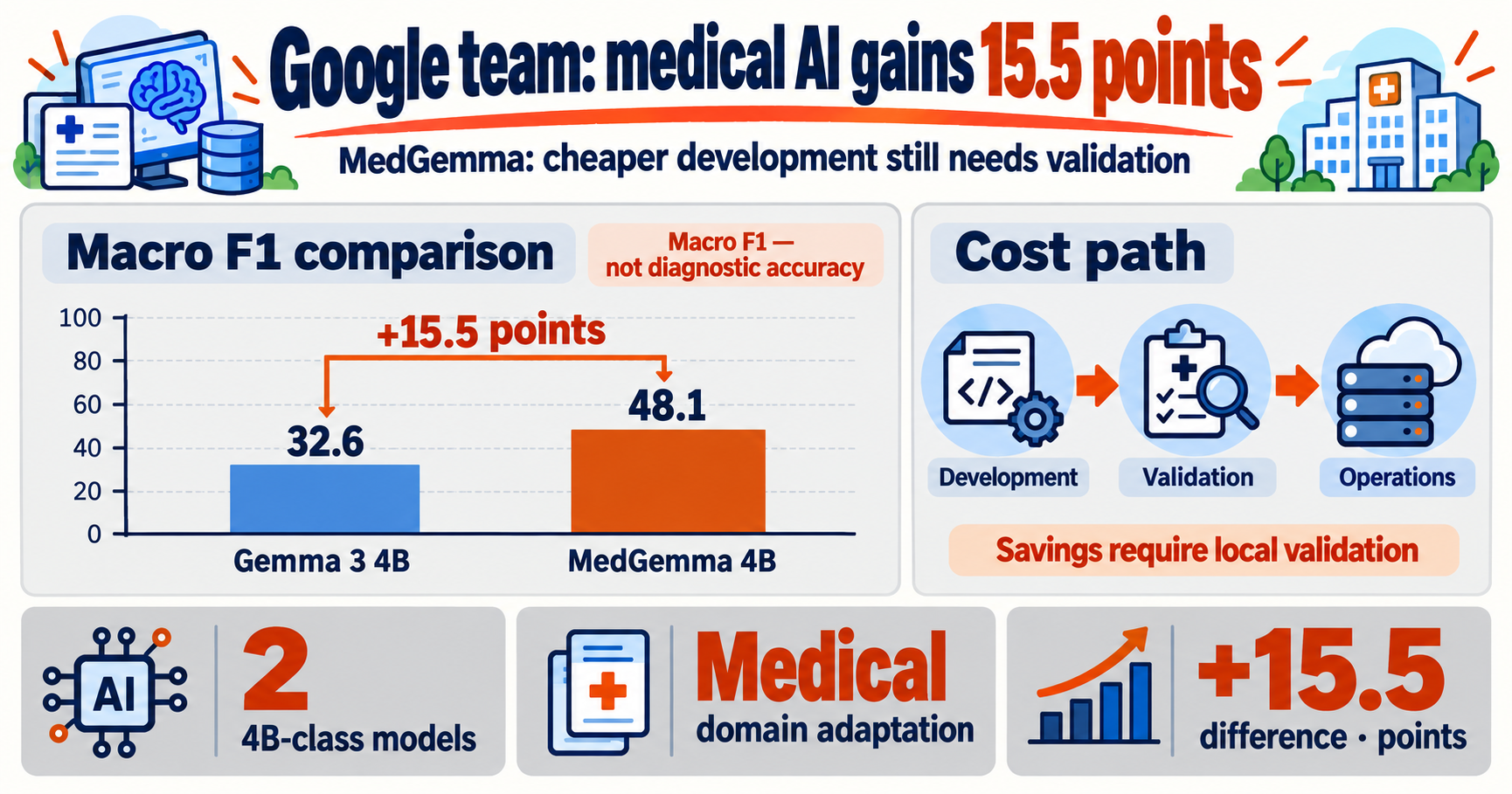
MedGemma, developed by Google researchers including Andrew Sellergren and Lin Yang, could lower the cost of getting a medical AI project started. Their October 6, 2026 Nature Medicine paper reports a 15.5-point gain over a similarly sized general model on one chest X-ray benchmark. For hospitals and developers, the practical question is whether that stronger starting point reduces the work needed to build a useful application. Source: Nature Medicine · 2026-10-06
The publication date is not the launch date. Google began releasing MedGemma in 2025 and introduced MedSigLIP and the multimodal 27B model that July. This is a journal publication, not a first product launch. The analysis below concerns the models in that paper, without importing capabilities or results from the later MedGemma 1.5 release. Source: Google Research · 2025-07-09
Who built MedGemma at Google
Sellergren, Yang and Sahar Kazemzadeh contributed to study design and technical implementation. Corresponding author David F. Steiner also contributed clinical guidance and data acquisition. The collaboration brought Google Research and Google DeepMind together, combining model development with clinical expertise. Source: 논문 저자 기여 / Author contributions
Yang was first author and Sellergren a coauthor of the 2024 Med-Gemini work on multimodal medicine. If Med-Gemini showed that a model could read images and medical language together, MedGemma is closer to packaging that ability so outside developers can download it and adapt it to their own problems. Source: Med-Gemini · 2024 preprint
The paper discloses Alphabet funding and that most authors are current or former Google employees. Its benchmarks are evidence about a development platform; replication in other hospitals remains a separate question. Source: 논문 연구비·이해관계 / Disclosures
How MedGemma differs from a general chatbot
The team adapted Gemma 3 with medical images and text. A vision-language model takes an image and can answer questions about it in words. A foundation model provides a reusable starting point for multiple applications. It is different from a finished program designed to detect one specific disease. Source: Google · MedGemma 1 model card
MedSigLIP is an image encoder: it converts visual features into numbers that software can compare. Searching for similar images or classifying them does not necessarily require generating a paragraph. Google distinguishes MedSigLIP for those structured tasks from MedGemma for tasks that need generated text. Source: Google · 모델별 용도 / Model use cases
MedGemma
Generated answers and text
Output
Example · Draft reports and image Q&A
MedSigLIP
Image and text representations
Output
Example · Similarity search and classification
That distinction matters when designing a product. A research image archive may need similarity search without a generated explanation for every result. Running only the components needed for that task could be more economical. This is an engineering inference, however: actual server costs depend on image size, workload, latency and hardware utilization.
What the 15.5-point improvement measures
On CheXpert, Gemma 3 4B scored 32.6 and MedGemma 4B scored 48.1. Both are 4B-class models. The metric is macro F1 across five chest findings: it balances missed findings and false detections within each class, then gives each class equal weight in the average. Source: Nature Medicine · Table 3
Nature Medicine Table 3. Five findings, 0–100 scale, zero-shot generative classification. +15.5 points; not diagnostic accuracy or cost savings.
This is the easiest part to misread. A score of 48.1 does not mean that 48 out of 100 patients were correctly diagnosed. The difference is 15.5 points, not a measured 15.5% improvement in diagnostic accuracy or a 15.5% saving in medical spending. The study treats this data source as outside model development, which still does not establish performance in Korean hospitals. Source: Nature Medicine · Tables 1, 3
The economic test comes after the benchmark. Does review take less time? Do false alarms create additional work? Are important abnormalities still detected? A better average score can produce little additional capacity if a clinician must spend substantial time correcting every output.
Less task data could change the development budget
Yang and colleagues found an advantage for the medical model in fine-tuning experiments using only 10% of the available task data. Fine-tuning means giving an already trained model additional examples for a particular job. This supports a better starting point when examples are scarce; it is not evidence of a 90% reduction in labeling costs. Source: Nature Medicine · Extended Data Fig. 2 / Methods
Labeling means establishing the answers an AI should learn from. Medical images may require specialist review and adjudication of disagreements. If a medically trained model reaches the same target performance with fewer examples or fewer experiments, some of that work could be avoided. This is an economic inference, not a measured cost outcome in the paper.
Using fewer training examples is separate from needing fewer validation cases. Rare conditions, different scanners and different age groups still require representative evaluation. A company that budgets for cheap validation simply because its prototype was cheap could run short of money before launch.
The spending moves through a sequence: start with the released model, adapt it to the intended task, validate and connect it to hospital systems, then monitor errors and manage versions. Net savings equal avoided training and review work minus additional compute, integration, validation and operating costs.
-
1
Reuse the model
Potentially avoid repeated foundational work
-
2
Adapt to the task
Labels, data preparation and evaluation
-
3
Validate and integrate
Measure errors and connect existing systems
-
4
Operate and maintain
Compute, monitoring and update validation
What would make hospitals and clinical trials cheaper?
To translate this study into hospital economics, the first step is a narrowly defined workflow. For a reporting assistant, timing draft generation alone is insufficient. The relevant measure includes clinician review, correction and final sign-off. Productivity improves only if the full task gets shorter without adding an unacceptable error burden.
Saved time does not automatically lower the patient bill. A hospital short of staff may use the released capacity for waiting patients or difficult cases. It could do more work with its existing workforce, while patients wait less. Whether those gains become lower prices depends on contracts and payment arrangements. Lower labor spending and expanded service capacity are different outcomes.
For clinical trials, a possible application is to retrieve records that may meet eligibility criteria or classify research images. That is a prospective use of an image-and-language foundation model, not a result the paper demonstrated. People would still check the shortlist, including missed candidates and unsuitable inclusions. The paper does not establish improved recruitment, shorter trials or reduced trial costs.
There is an industry signal: in its July 2025 announcement, Google said developers at US-based DeepHealth were exploring MedSigLIP for chest X-ray triage and nodule detection. This is a vendor-reported exploration. It does not, by itself, establish paid contracts, regulatory authorization or additional revenue. Source: Google Research · 개발 사례 / Developer examples
Wider access could put price pressure on the initial development of basic imaging AI features. It could also create demand for data preparation, independent validation and ongoing error monitoring. Existing medical AI companies can use the same foundation, so displacement is not inevitable. Competitive advantage may increasingly depend on verified workflow results rather than possession of a model alone.
In Korea, integration and accountability are part of the product
Being able to download the model can help a hospital fix a version and operate it in its own environment. But open access does not mean unrestricted use. HAI-DEF terms impose conditions on use and redistribution, require applicable regulatory authorization, and assign responsibility for outputs and their uses. A model license is separate from medical product authorization. Source: Google · HAI-DEF Terms of Use
Korea’s Digital Medical Products Act took effect on January 24, 2025. MFDS guidance on digital medical device quality management also describes change reviews, including changes such as adding AI or machine-learning functions. The pathway for a particular product depends on its intended purpose and the proposed changes. Publication of a paper does not complete that process. Source: 식약처 · 디지털의료기기 GMP / MFDS
For a hospital, integration is concrete work: retrieve images from its picture archiving and communication system, or PACS; link them correctly with electronic records; and preserve access controls and change histories. Korean reporting language and local imaging practices also need evaluation. These are deployment considerations, not outcomes established for Korea by this study.
Hospital software vendors could build services that display results within existing interfaces and preserve review records. Medical AI companies could differentiate through local data and evaluation experience. A buyer needs more than a working model: the product must also specify who detects errors, corrects them and pays for updates.
Sellergren and Yang’s work offers a stronger starting point for medical AI development. The next numbers to watch are local error rates, total review time and all-in cost per completed task. Improvement across those measures is what would turn a benchmark result into economic value for healthcare. This article explains research; it is not investment advice or a basis for medical decisions.
Medical AI economics must be measured through local error rates, review time and total operating costs.
Sources and further reading
- Nature Medicine (2026-10-06): An open vision-language model for diverse medical applications
- Nature Medicine 최종 논문 PDF: 표 3·Methods·저자 기여
- Google Research (2025-07-09): MedGemma 공개와 개발 사례
- Google: MedGemma 1 model card
- Google: Health AI Developer Foundations Terms of Use
- 식약처: 디지털의료제품 법령 시행에 따른 업무 안내
- 식약처: 디지털의료기기 GMP 안내
- Yang et al. (2024): Advancing Multimodal Medical Capabilities of Gemini
- MedGemma Technical Report v3 (2025-07-12)
For information only — this is not a recommendation to buy or sell any asset.
Comments 0