PFAS destruction — could Yale’s 72-hour experiment change water-treatment waste costs?
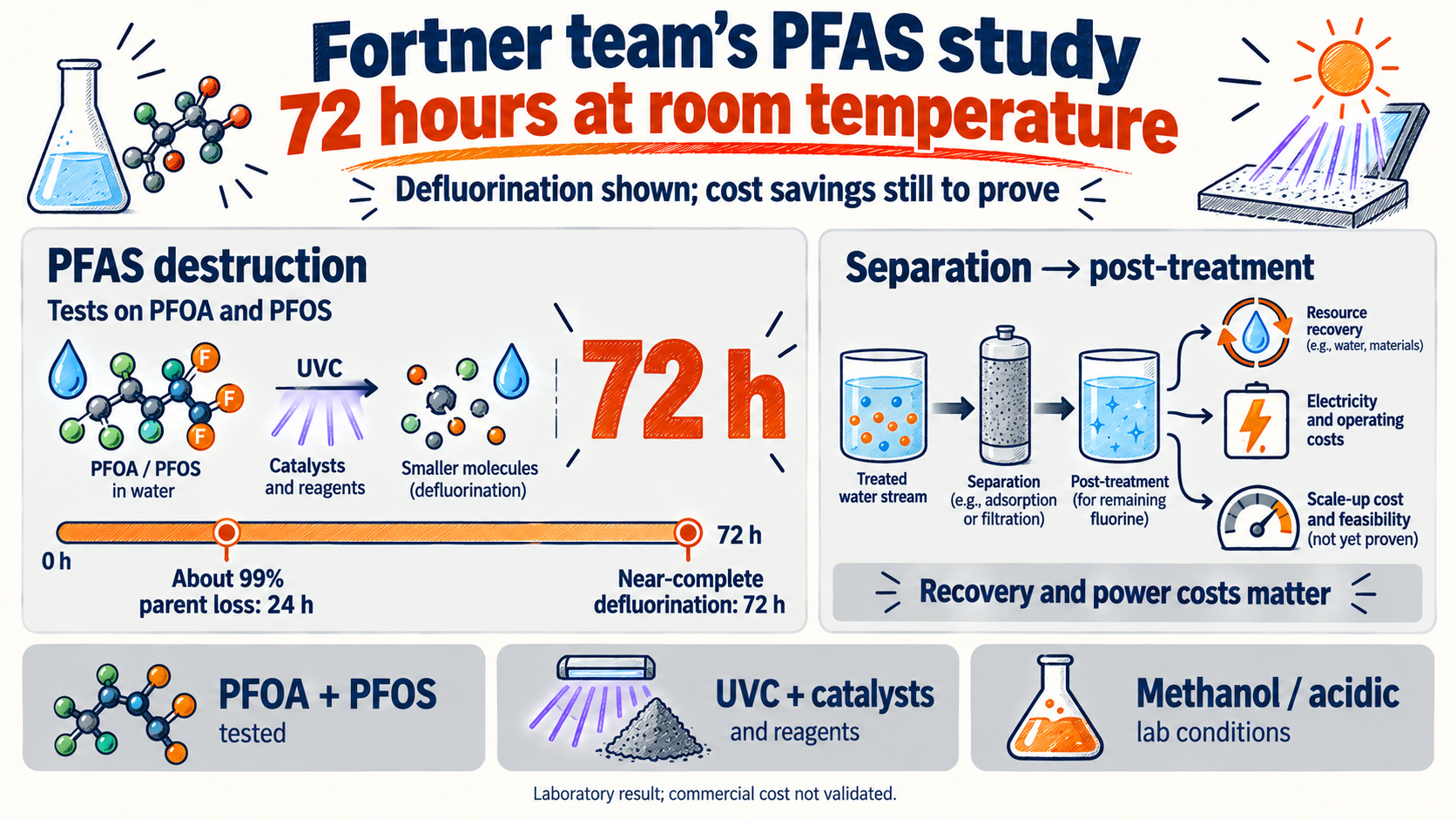
Yale professor John D. Fortner and colleagues have reported a new approach to PFAS destruction. Their September 1 Nature Water paper describes near-complete fluoride release from two target compounds within 72 hours at room temperature. The economic question is what this could change about the waste left after water treatment. Source: Nature Water · 2026-09-01
Removing a contaminant from water does not finish the job. Spent filter media and concentrated waste still need management. That residual-management cost is where Fortner’s approach could matter. A successful reaction, however, does not by itself establish a competitive treatment price.
Fortner’s team — from adsorption to destruction
Fortner is the corresponding author. Equal-contribution first authors Ozce Durak and Seung Soo S. Lee worked on the concept, methods and analysis. Source: 논문 · 저자 기여
Yale chemist James M. Mayer contributed mechanistic analysis; GIST’s Changwoo Kim contributed supervision and review. The collaboration combined materials development with an investigation of what the material actually does. Source: 논문 · 소속 및 기여
Fortner’s lab has also studied how PFAS adsorbs onto porous surfaces. Its 2026 publication list includes work on pore dimensions in amine-functionalized adsorbents. That background provides a useful connection between bringing contaminants to a surface and designing a reaction there. Source: Fortner Lab · Publications
PFAS destruction versus filtration
PFAS is a family of synthetic fluorinated chemicals. For this story, two terms matter: adsorption holds a molecule on a surface; defluorination removes fluorine from that molecule. They describe different tasks.
EPA describes activated carbon, ion-exchange resins and high-pressure membranes as treatment options. Carbon and resins capture PFAS; membranes separate it from water. These approaches can deliver cleaner water while leaving a residual waste problem. Source: EPA · PFAS 수처리 기술
Established separation
Capture or membrane separation
Role
Next task · Manage media or concentrated waste
This photocatalytic study
Light-driven defluorination
Role
Next task · Throughput, recovery and validation
Durak and Lee used palladium or platinum on porous silica. Their proposed mechanism couples light-excited electrons with hydrogen generated at the reaction interface. This offers a route to bond cleavage without heating the entire water volume. Source: Nature Water · 반응 원리
This does not imply that filters become obsolete. A plant could clean the main water stream, concentrate the residual contamination, then treat that smaller stream separately. Whether the combination pays depends on both concentration costs and destruction costs. This is a process-design inference, not a demonstrated result of the paper.
What the 72-hour result means
For PFOA and PFOS under optimized UVC conditions, the parent compounds fell by roughly 99% at 24 hours; fluoride release approached completeness within 72 hours. These are different endpoints. Source: Nature Water · Fig. 2
Optimized UVC tests on PFOA/PFOS with methanol and acidic conditions. Different endpoints, not a threefold speed comparison. Source: Nature Water Fig. 2.
Does disappearance of the original molecule mean treatment is complete? A parent molecule can disappear because it has become an intermediate. Following the fluorine helps distinguish that from extensive bond cleavage. Neither endpoint, by itself, certifies that every PFAS species or the resulting water is harmless.
The experiments used methanol and acidic conditions established with carbon dioxide. No external hydrogen does not mean no chemical or energy input. Methanol quantities are reported inconsistently between the main text/figures and Methods, so this article does not calculate a reagent bill. Source: 논문 · Results 및 Methods
Why room temperature may still be expensive
In practice, a hypothetical plant based on Fortner’s approach would need more than room-temperature operation to keep costs down. Lamps still use electricity and reactors occupy space. How quickly could it process a given volume? Longer treatment times require more liquid inventory.
For a scale illustration only, retaining a flow of 1 m³ per hour for 72 hours requires 72 m³ of liquid inventory by flow times residence time. This is not a commercial reactor design. It ignores light penetration, mixing and real kinetics, but shows why reaction time belongs in the cost discussion.
How long could the catalyst remain useful? Recovery and service life matter alongside the purchase price of palladium or platinum. Losing particles with the treated water would create both replacement costs and a metal-release problem. Immobilizing them might simplify recovery while changing access to light and contaminants. That trade-off needs engineering work.
The useful measure is total cost per cubic metre meeting the treatment target. It must include capital recovery, electricity, reagents, catalyst losses, testing and residual management. Room temperature is a process condition, not a cost estimate.
Could the first market be downstream of filtration?
An existing customer base is visible in industry reporting. Xylem’s 2024 sustainability report says it had completed more than 80 PFAS remediation projects in the United States. That is a historical, company-reported figure, not 2026 new orders. It shows that treatment equipment and services already have buyers. Source: Xylem · 2024 Sustainability Report
If Fortner’s approach works in real wastewater, one plausible entry point would be a unit for concentrated residual liquids. It would process less water than a whole treatment plant. But salts and other organic matter may also concentrate, so a smaller stream is not necessarily an easier feed. This remains a commercial scenario.
-
1
Separate and concentrate
Connect to existing treatment
-
2
Treat residuals on site
Power, catalyst and recovery costs
-
3
Verify and manage residues
Check products and effluent
-
4
Compare total costs
Weigh against avoided off-site costs
Under that scenario, filtration suppliers could bundle downstream equipment with existing services. Catalyst recovery, replacement and analytical testing could create additional work. If on-site treatment reduces off-site shipments, transport and some external disposal demand could decline. The paper does not establish revenue gains for any named company or prove displacement of an existing industry.
Productivity benefits are conditional too. Reliable on-site treatment could reduce storage needs and delays associated with waste collection. Slow reactions or extensive pretreatment could erase those benefits. For Korean environmental equipment firms, the relevant opportunity would depend on sustained performance on customer wastewater, not on a catalyst name alone.
The next evidence Fortner’s approach needs
EPA’s 2026 interim destruction and disposal guidance includes a framework for evaluating new technologies. It neither approves this catalyst nor creates new disposal requirements. Its relevance here is the need for reviewable evidence before a promising reaction becomes a dependable service. Source: EPA · 2026 임시 지침
The next demonstration should establish throughput to a defined endpoint in real wastewater. Catalyst recovery and long-run operating costs would then make a price comparison possible. Residual fluorine, intermediates and metals also need assessment. Improving just one measure would give customers too little basis for changing their process.
Durak and Lee’s work opens a route to attacking persistent bonds with light. Its economic value will depend on what happens next: whether the cost of operating and verifying a new unit is lower than the residual-management costs it avoids. Field evidence for that difference could turn PFAS destruction into a new option within an existing water-service industry.
After the reaction, measure total cost per unit of treated water, including residual management.
Sources and further reading
- Durak et al., Nature Water (2026), PFAS plasmonic defluorination
- Yale Fortner Lab — People
- Yale Fortner Lab — Publications
- US EPA — Reducing PFAS in Drinking Water with Treatment Technologies
- US EPA — 2026 Interim Guidance on PFAS Destruction and Disposal, Fact Sheet
- Xylem 2024 Sustainability Report — PFAS treatment projects
For information only — this is not a recommendation to buy or sell any asset.
Comments 0