Solar desalination 2026 — 19.82 kg a day, but what lowers the water bill?
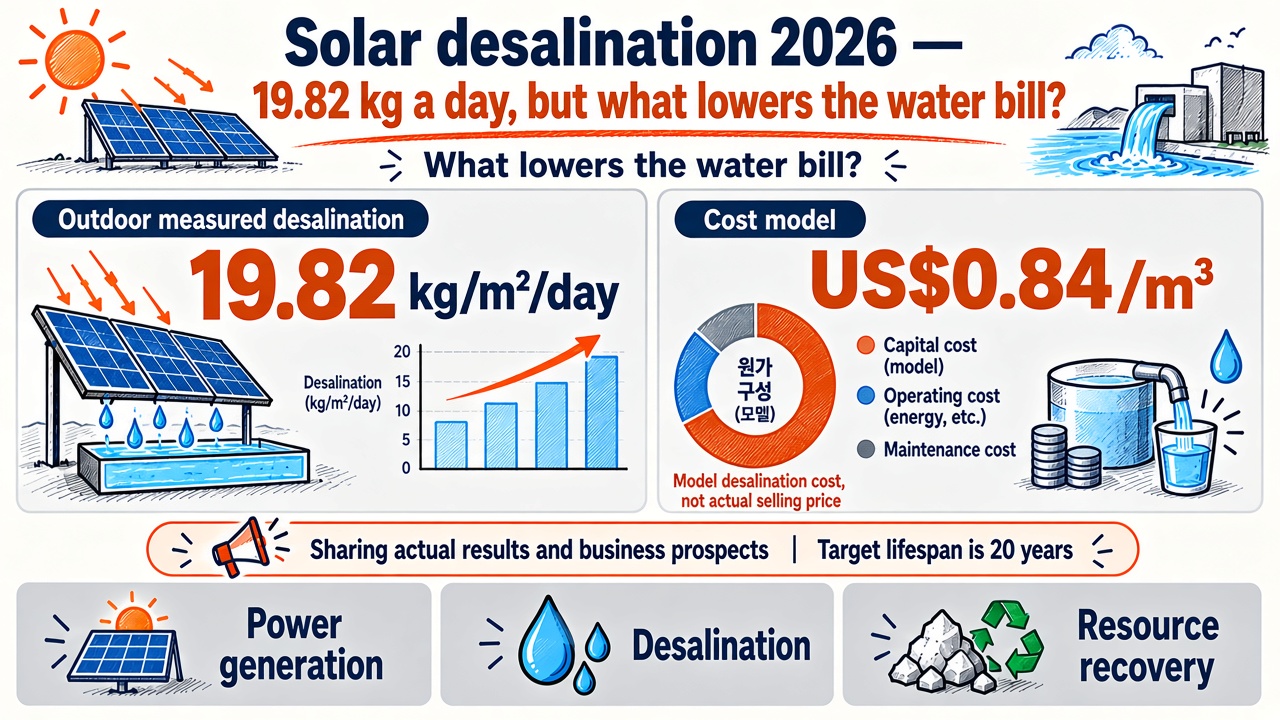
Solar desalination collected 19.82 kg of water per square metre in a day outdoors. The September 1 Nature Water paper combines electricity generation with lithium and uranium adsorption. Could that combination also make water delivery cheaper? Research paper
Consider a small coastal guesthouse that pays to bring in water and connect to electricity. Producing both on site could be attractive. Yet a successful experiment and a dependable utility service are very different propositions.
How solar desalination turns waste heat into water
The ASP device combines photovoltaic waste heat, staged evaporation and ion-binding adsorbents. Heat released when vapour condenses is reused in another stage. Research paper
Two movements matter: heat and dissolved material. Evaporation takes heat; condensation releases it. Sending that released heat into another stage lets the original heat input do more useful work. There is no extra energy appearing from nowhere.
Adsorption means retaining a substance on a surface. Selective capture aims to retain particular ions, rather than collect every dissolved salt. The material must work with the paths taken by water and heat. That makes the arrangement of the device as important as the performance of an isolated material.
-
1
Light → electricity
Electricity is produced; heat remains
-
2
Heat → water separation
Evaporation and condensation reuse heat
-
3
Ions → selective capture
Sale requires further processing and checks
Reverse osmosis uses pressure to push water through a membrane. A combined thermal and recovery system pursues a different integration route. A fair comparison needs equal water quality, delivery location and supply reliability. Laboratory productivity per unit area cannot decide the winner by itself.
The modelled water cost needs a boundary
The paper models water at $0.00084/kg, approximately $0.84/m³. It treats a 20-year service life as a design target, not demonstrated field durability. Research paper
A household tariff includes more than producing water at a device. Storage, distribution and verification also cost money. Construction, finance and backup capacity need to enter a site-specific delivered-water calculation. The quoted model output is not a customer price.
Shared equipment creates an accounting question. Assign all its construction cost to water and the water looks expensive; assign part to electricity and it looks cheaper. Changing that allocation does not, by itself, reduce total cash spending.
An operator needs a whole-system cash account. Can the electricity be used? Can recovered material be sold? How much water remains available after maintenance? Electricity consumed on site can avoid a bill, but the same electricity cannot also be counted as export revenue.
Research model
Product costs under specified assumptions
Scope
Use · Evaluate a design opportunity
Site validation
Include storage, delivery, repairs and backup
Scope
Use · Compare usable revenue and avoided bills with all spending
Recovered material still needs a customer
The following is commercialization analysis, separate from the experimental findings. Capture is followed by separation, refining, testing and transport. A buyer needs an acceptable specification and volume. Small production streams may need aggregation, making collection logistics a major economic variable.
An early business case is more convincing if useful water and electricity carry much of its value. If the project only works after assuming premium mineral revenue, refining partners and buyers become critical. Material sitting in a container is not cash.
Residual brine needs its own account. Capturing a selected ion does not establish that the remaining salts have disappeared. Residue volumes and cleaning streams must be measured before claiming savings on waste management.
A separate University of Rochester report on May 27 described small solar-thermal devices that recover salts as solids. Those results belong to a different system. They cannot establish a waste-free claim for the Nature Water device, but they suggest a useful comparison of residue-management routes. University report
190 TWh of additional demand — where is investment going?
The IEA’s March 2026 analysis projects an additional 190 TWh of global desalination electricity demand by 2035 as capacity expands and technologies electrify. This is a scenario, not observed growth or an estimate of electricity that ASP would save. IEA analysis
In February, Acwa and GIC announced a 25-year power and water purchase agreement for Kuwait’s Az-Zour North Phase 2 & 3. Investment exceeds $4 billion across the combined power and water project, which uses reverse osmosis. This is neither a water-only investment figure nor funding for ASP. Company announcement
The contract duration is revealing. A water customer is purchasing dependable service over many years, not a peak result on a favourable day. New equipment will need a credible account of failure rates, replacement parts, quality checks and recovery time.
Smaller sites may offer the first opening
My assessment is that small sites with expensive water and electricity connections could offer an earlier opening than metropolitan utilities. Islands, standalone coastal facilities and observation stations are possible candidates. This is a hypothesis about avoided costs, not a sales forecast.
Productivity could improve if functions share space and maintenance visits. But close integration can also couple failures: one broken subsystem might stop useful output elsewhere. Replaceable modules and the ability to keep operating during repairs would affect the economics.
Potential businesses extend beyond selling the device: replaceable capture materials, remote quality monitoring and collection services could emerge. Suppliers would need contracts that align durable equipment with customer savings, rather than depend on frequent replacement.
Korean suppliers could explore components or field trials, but the paper does not identify stock-market winners. Supply agreements, trial equipment and verified customer savings would be more useful evidence. This is technology and industry analysis, not an investment recommendation.
Three tests for the next demonstration
First, measure supply across seasons, including weak sunlight and maintenance days. Add water storage and backup supply before deciding whether the economics hold.
Second, record actual cleaning and replacement spending, including labour, consumables and residue handling. Third, measure the output accepted by buyers. Modelled revenue becomes meaningful only when production meets a usable or saleable specification.
The attraction is useful heat and multiple functions at one site. The economic test is the total cost of water delivered to a customer, with electricity and minerals contributing additional value. The next convincing result would be a record of reliable ordinary days.
Evaluate water technology by the total cost of dependable delivery to its customer.
Sources and further reading
- Yu, Ge et al. — Solar-powered resource separator for clean water production, electricity generation and critical resource recovery (Nature Water, 2026-09-01)
- IEA — Wired for water: How electrification is transforming desalination (2026-03-22)
- Acwa–GIC — Az-Zour North Phase 2 & 3 전력·용수 구매계약 (2026-02-03)
- University of Rochester — New method turns ocean water into drinking water, without waste (2026-05-27)
For information only — this is not a recommendation to buy or sell any asset.
Comments 0