BOK Rate Hike 2026 — Why Exports Up 68.7% and CPI at 3.1% Share the Same Root (Views 1)
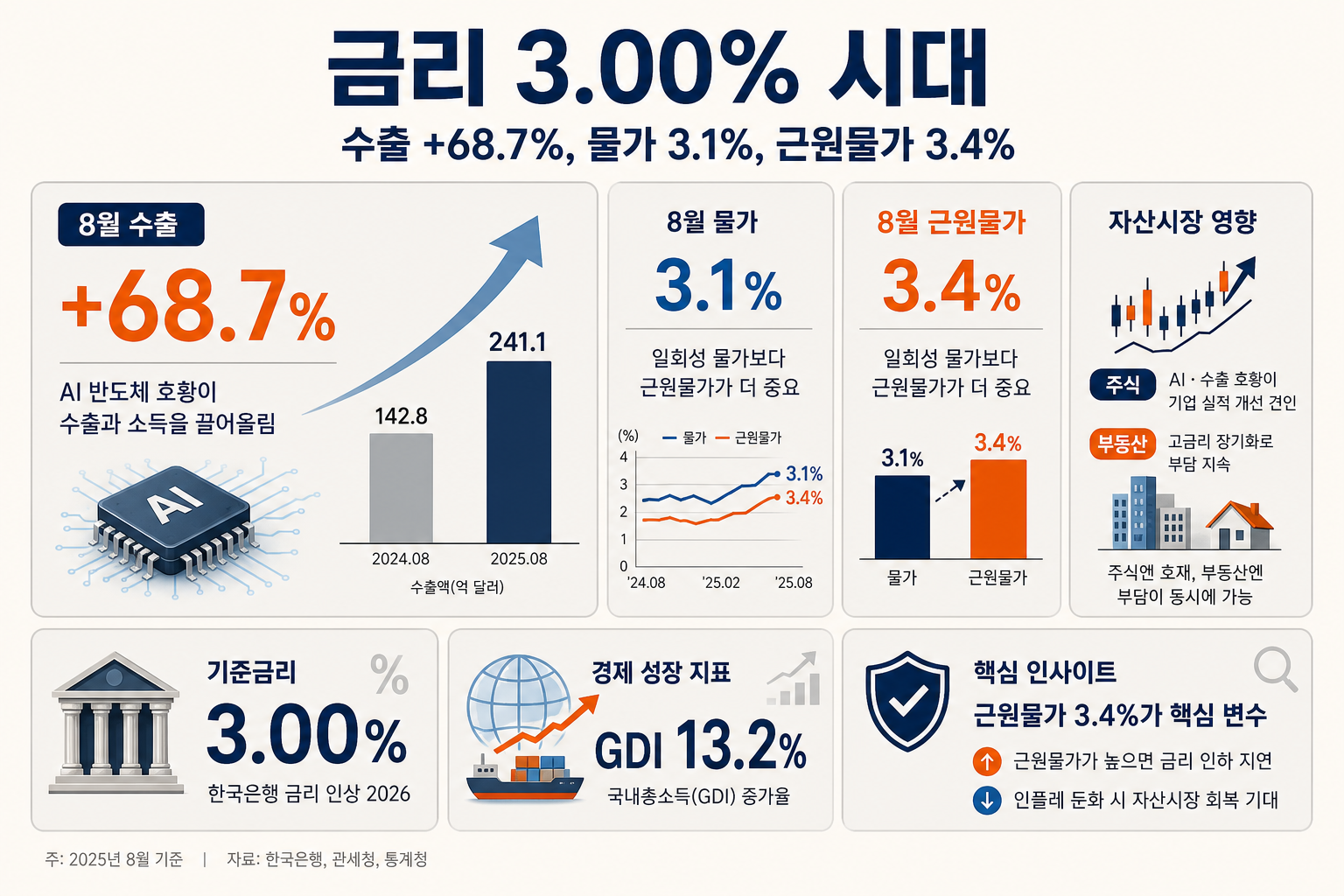
The BOK rate hike 2026 story is bigger than one policy move on August 27, 2026. After the Bank of Korea lifted the base rate to 3.00%, August exports jumped 68.7% year over year in data released on September 1, 2026, and August CPI came in at 3.1% with core CPI at 3.4% in data released on September 2, 2026. Rates, exports, and inflation were not separate stories. They were being driven by the same force.
That force is the global AI investment boom and Korea’s position in memory chips. Rising chip prices lift export income first. Then come bonuses, capex, and regional spending. The tension is that the same income impulse can also feed inflation, household leverage, and asset-market pressure.
Why did the BOK raise rates in August?
In its August 27, 2026 statement, the Bank of Korea said exports were strong, domestic demand was recovering, inflation would stay above the 2% target for a considerable time, and financial stability risks still mattered. This was not a rescue move. It was a cooling move aimed at preventing a strong sector from overheating the broader economy.
The important point is that this was not only an oil story. In the BOK’s English release, July CPI was 2.8% and July core inflation was 2.6%. What worried policymakers was that underlying inflation was already firming before the August CPI rebound. When prices excluding food and energy rise, it usually means demand pressure is spreading more deeply into the economy.
Why would demand pressure rise? Because higher semiconductor prices mean Korea earns more income from the same export machine. The BOK said first-quarter GDP rose 3.8% year over year, but gross domestic income rose 13.2% because terms of trade improved sharply. More income eventually turns into more spending power. The rate hike looks like an attempt to lean against that second-round effect before it becomes broader inflation.
How the chip boom spreads
FlowFlow diagram showing how global AI investment feeds into Korea’s exports and inflation. Conceptual structure; the speed and intensity vary by sector and policy.
Exports 68.7%, CPI 3.1% — what the August data is saying
The trade numbers were hot. In its September 1, 2026 provisional release, the Korea Customs Service said exports rose 68.7% from a year earlier to $98.26 billion, with a trade surplus of $34.75 billion. It also said August marked a record high for the month and for semiconductor exports. Bloomberg and the Wall Street Journal both pointed to AI memory demand as the core driver.
Inflation was more nuanced. KOSTAT said on September 2, 2026 that August CPI rose 3.1% year over year and core CPI rose 3.4%. Reuters reported that public-service prices were pushed up by a 26.7% increase in mobile fees because the comparison base from a year earlier was unusually low. The government said inflation would have been around 2.5% without that one-off effect.
But the underlying signal still strengthened. In KOSTAT’s July CPI release dated August 4, 2026, headline CPI was 2.8% and core CPI was 2.6%. One month later, headline inflation was up 0.3 percentage point and core inflation was up 0.8 point. That is harder to explain away with a telecom base effect alone. Income-led demand and remaining cost pressure are both still working through the system.
The global backdrop cuts both ways. The IMF’s July 2026 update projected world growth at 3.0% and said AI demand was supporting countries embedded in the technology value chain. The World Bank, by contrast, warned in June 2026 that a worse energy shock could pull global growth down to 1.3%. Korea benefits from the good side of the tech cycle while still paying for the bad side of imported energy.
BOK May vs August view
CompareMay 2026
August 2026
Comparison of the BOK’s May and August forecasts for growth and inflation. Based on official BOK forecasts.
Korea’s hottest recent numbers
Bar chartBar chart comparing recent key Korean export and inflation readings. Different indicators, but each shows the recent intensity of Korea’s macro backdrop.
Why doesn’t an export boom feel like a boom for everyone?
Because semiconductors create enormous value added without instantly creating broad employment. A fab can produce very large profits, but it does not hire like services or construction do. That is why export strength and corporate earnings can improve much faster than everyday labor-market conditions.
The BOK’s August 18, 2026 note on youth employment makes that gap concrete. Over the past four years, 285,000 youth jobs disappeared, and 268,000 of them were in industries with high AI exposure. Productivity gains do not automatically translate into entry-level hiring. That helps explain why households can hear about strong GDP without feeling stronger themselves.
That does not mean there is no spillover. In its August 31, 2026 regional note, the BOK estimated that consumption in semiconductor-heavy regions such as Icheon, Hwaseong, and Cheongju was up to 4% higher after bonus payments, with cumulative extra consumption reaching about 1.7 trillion won through end-2026. The money spreads, but it spreads in sequence: profits first, local spending second, broader jobs later.
Strong growth vs slow job transmission
CompareImproves first
Improves later
Concept comparison showing why strong GDP and exports do not translate into broad jobs immediately. A simplified comparison of a semiconductor-led recovery.
Chip gains pile up first at large exporters
The first earnings winners are likely to be semiconductor, power, cooling, packaging, and equipment firms. If memory prices and shipment volumes rise together, profit recovery at core companies such as Samsung Electronics and SK Hynix can be fast. AI server investment lifts an entire infrastructure chain, not just chipmakers.
The harder question is distribution. Customs data on trade by firm size showed that large firms accounted for 75.2% of exports in July, compared with 12.8% for mid-sized firms and 11.8% for SMEs. Rising exports do not mean gains are being shared evenly. A prolonged large-cap boom can widen earnings, wage, and investment gaps across the economy.
This is also why industrial policy keeps leaning so heavily toward semiconductors. The sector matters not only for export value, but also for tax revenue, capital expenditure, the won, equities, and regional spending. The same breadth of influence also means a later slowdown would spread widely.
Where export gains pile up first
Bar chartBar chart showing export shares by firm size. Export shares by firm size for July 2026.
Bullish for stocks, a brake for housing — different endings from the same boom
Consumption is already reacting in selected places. Bonus-heavy regions are seeing stronger spending on cars, appliances, and department stores. But that is still different from saying the whole consumer economy has recovered. It looks more like a targeted income wave than a broad national rebound.
Investment is more direct. If companies believe AI chip demand is structural, they will be reluctant to delay capex even after rates move higher. That means semiconductor-linked investment can remain strong while domestic and rate-sensitive sectors feel pain much sooner. One rate hike can produce very different outcomes across industries.
Asset markets split three ways. Equities may keep rewarding the AI infrastructure chain. The won can benefit from export strength but still stay volatile because of dollar strength and oil risk. Housing and household debt face a clearer brake from a 3.00% policy rate. The same macro boom can be positive for some stocks, negative for property, and only selectively positive for consumption.
Three numbers to watch — core CPI, export breadth, jobs
- First, core CPI. Even if headline inflation eases, core inflation near 3% would keep the BOK from sounding comfortable.
- Second, export breadth. A real broad recovery would mean gains spreading beyond chips into machinery, chemicals, services, and smaller firms.
- Third, jobs. Bonus-led consumption matters, but the more important test is whether youth employment and service hiring begin to improve.
What the data confirms vs what remains inference
- Confirmed fact: The Bank of Korea raised the base rate from 2.75% to 3.00% on August 27, 2026.
- Confirmed fact: August exports rose 68.7% year over year, while August CPI reached 3.1% and core CPI 3.4%.
- Confirmed fact: The BOK identified first-quarter GDP growth of 3.8%, GDI growth of 13.2%, and up to 4% stronger consumption in semiconductor-heavy regions.
- Official outlook: The BOK forecasts 2026 growth at 3.3%, 2027 growth at 2.9%, and core inflation at 2.5% in both years.
- Inference: If chip demand stays strong, corporate earnings and capex can keep rising, but the BOK may struggle to fully close the door on further tightening.
- Inference: Over the next few months, Korea may keep living with strong exports and uncomfortable inflation at the same time, with bigger gaps across sectors and households.
This rate hike looks less like a move to crush growth and more like an attempt to cool a chip-driven income boom before it spreads too far into prices and leverage. Strong exports do not mean everyone benefits right away, and higher inflation does not always come from one cause. The fastest way to read Korea’s next cycle is to watch where semiconductor income is spreading and where it is getting stuck.
This article is economic analysis, not investment advice.
A rate hike is one decision, but the real story is who is earning, who is spending, and where inflation is actually spreading.
Sources
- Bank of Korea — 통화정책방향 (2026.8.27)
- Bank of Korea — Monetary Policy Decision & Opening Remarks (August 27, 2026)
- Bank of Korea — BOK 이슈노트 2026-16
- Korea Customs Service — 2026년 8월 수출입 현황 [잠정치]
- Korea Customs Service — 2026년 7월 월간 수출입 현황 [확정치]
- Korea Customs Service — 2026년 7월 기업규모별 수출입 현황
- KOSTAT — 2026년 7월 소비자물가동향
- KOSTAT — 2026년 8월 소비자물가동향
- Reuters — South Korea inflation quickens on one-off factor
- Financial Times — South Korea raises interest rates to 3% to tame AI-fuelled inflation
- Wall Street Journal — South Korea's Exports Extend Chip-Led Growth in August
- Bloomberg — South Korea's Exports Gather Pace as Chip Boom Powers Ahead
- IMF — World Economic Outlook Update, July 2026
- IMF — G20 statement, September 1, 2026
- World Bank — Global Economic Prospects press release
- Bank of Korea — BOK 이슈노트 2026-20
- Bank of Korea — BOK 이슈노트 2026-19
한국은행 금리 인상 2026 — 수출 68.7%, 물가 3.1%가 같은 뿌리인 이유 (조회수 1)
한국은행 금리 인상 2026 이슈는 2026년 8월 27일 기준금리를 3.00%로 올린 결정 하나로 끝나지 않습니다. 그 뒤 2026년 9월 1일 발표된 8월 수출은 전년 동월 대비 68.7% 뛰었고, 2026년 9월 2일 발표된 8월 소비자물가는 3.1%, 근원물가는 3.4%였습니다. 금리, 수출, 물가가 따로 움직인 것이 아니라 같은 동력에 묶여 있다는 뜻입니다.
그 동력은 글로벌 AI 투자와 한국 반도체입니다. 메모리 가격이 오르고 수출이 늘면 기업이익과 국내 소득이 먼저 커집니다. 그다음 성과급, 설비투자, 일부 지역 소비가 따라옵니다. 좋은 뉴스처럼 들리지만, 중앙은행 눈에는 여기서부터 물가와 가계부채, 자산가격 부담이 같이 커질 수 있습니다.
왜 한국은행은 8월에 금리를 올렸나
한국은행은 2026년 8월 27일 보도자료에서 이유를 비교적 분명하게 적었습니다. 수출 호조와 내수 회복으로 성장세가 예상보다 높고, 물가상승률은 상당 기간 목표인 2%를 웃돌 가능성이 크며, 금융안정 리스크에도 계속 유의해야 한다는 것입니다. 쉽게 말하면 경기가 꺼져서 돈을 풀 상황이 아니라, 한쪽 과열이 더 번지기 전에 속도를 조절할 상황으로 본 것입니다.
여기서 핵심은 이번 인상이 단순한 유가 대응이 아니라는 점입니다. 한국은행 영문 보도자료에 따르면 7월 소비자물가는 2.8%, 근원물가는 2.6%였습니다. 겉으로 보이는 헤드라인 물가보다 더 중요한 것은 근원물가가 다시 올라서고 있었다는 점입니다. 에너지와 식품을 뺀 가격이 오른다는 뜻은 경제 안쪽의 수요 압력이 넓어지고 있다는 뜻이기 때문입니다.
왜 수요 압력이 커질까요. 반도체 가격이 오르면 한국은 같은 양을 팔아도 더 많은 소득을 벌게 됩니다. 한국은행은 1분기 GDP가 전년 동기 대비 3.8% 늘었지만, 교역조건 개선 덕분에 GDI, 즉 실제 국내 소득은 13.2% 증가했다고 봤습니다. 기업이 더 벌고 가계의 구매력이 좋아지면 소비와 자산 수요가 뒤늦게 따라옵니다. 중앙은행이 금리를 올린 것은 이 뒤쪽 파급을 미리 막아보겠다는 뜻에 가깝습니다.
반도체 호황은 이렇게 번집니다
흐름도글로벌 AI 투자에서 한국의 수출과 물가까지 이어지는 반도체 호황의 흐름도. 개념 설명용 구조입니다. 실제 속도와 강도는 업종과 정책에 따라 달라집니다.
수출 68.7%, 물가 3.1% — 8월 숫자가 말하는 것
관세청이 2026년 9월 1일 발표한 8월 잠정치에 따르면 수출은 982.6억달러로 전년 동월 대비 68.7% 늘었습니다. 무역흑자는 347.5억달러였습니다. 8월 기준 역대 최대이고, 관세청은 반도체 수출도 역대 최대라고 설명했습니다. Bloomberg와 WSJ도 이 흐름을 AI용 메모리 반도체가 이끈 결과로 해석했습니다. 한국의 대외 부문이 예상보다 훨씬 뜨겁다는 뜻입니다.
물가는 조금 더 복합적입니다. 통계청 2026년 9월 2일 소비자물가 보도에 따르면 8월 소비자물가는 3.1%, 근원물가는 3.4%였습니다. Reuters 보도에 따르면 휴대전화 요금이 전년 대비 26.7% 올라 공공서비스 물가를 끌어올렸고, 정부는 이 일회성 요인을 빼면 8월 물가가 2.5% 정도였을 것이라고 설명했습니다. 그래서 3.1%라는 숫자만 보고 전부 구조적 인플레이션이라고 말하면 과장일 수 있습니다.
하지만 안심하기도 이릅니다. 통계청이 2026년 8월 4일 발표한 7월 소비자물가동향에 따르면 7월 소비자물가는 2.8%, 근원물가는 2.6%였습니다. 한 달 사이 헤드라인은 0.3%포인트, 근원은 0.8%포인트 올라갔습니다. 특히 근원물가가 더 빠르게 뛰었다는 것은 통신비 기저효과만으로 설명하기 어렵다는 뜻입니다. 소득 개선이 서비스 소비로 번지고, 에너지와 비용 압력도 남아 있다는 해석이 더 맞습니다.
글로벌 배경도 한 방향이 아닙니다. IMF는 2026년 7월 세계경제전망에서 올해 세계 성장률을 3.0%로 제시하며 AI 수요가 기술 가치사슬 국가를 떠받치고 있다고 설명했습니다. 반면 World Bank는 2026년 6월 전망에서 중동발 에너지 충격이 심해지면 올해 세계 성장률이 1.3%까지 떨어질 수 있다고 경고했습니다. 한국은 기술 수요의 수혜를 받는 동시에 에너지 수입국의 부담도 함께 안고 있습니다.
한국은행 5월 vs 8월 시선
전망 비교2026년 5월
2026년 8월
한국은행 5월과 8월 전망의 성장과 물가 변화를 비교한 표. 한국은행 공식 전망치 기준입니다.
최근 한국 경제의 뜨거운 숫자
세로 막대 그래프최근 한국 수출과 물가 관련 핵심 수치를 비교한 막대 그래프. 서로 다른 지표이지만 모두 최근 한국 경제의 강한 압력을 보여주는 증가율 또는 수준입니다.
왜 수출 호황이 모두의 호황은 아닌가
뉴스 헤드라인만 보면 한국 경제 전체가 한꺼번에 뜨거워진 것처럼 보입니다. 그런데 반도체는 부가가치는 크지만 사람을 즉시 많이 뽑는 산업은 아닙니다. 공장 한 곳이 만드는 이익은 커도 서비스업이나 건설업처럼 고용이 넓게 퍼지지는 않습니다. 그래서 수출과 기업 실적이 좋아져도 체감 경기가 바로 살아나지 않을 수 있습니다.
한국은행의 2026년 8월 18일 청년고용 이슈노트는 이 간극을 숫자로 보여줍니다. 최근 4년간 청년 일자리는 28.5만개 줄었고, 그중 26.8만개가 AI 고노출 업종에서 감소했습니다. 생산성이 오른다고 해서 초급 일자리가 자동으로 늘어나는 것은 아니라는 뜻입니다. 기업 실적이 좋아도 청년층이 바로 좋아졌다고 느끼기 어려운 이유가 여기에 있습니다.
그렇다고 낙수효과가 전혀 없는 것도 아닙니다. 한국은행은 2026년 8월 31일 반도체 고노출 지역 이슈노트에서 이천, 화성, 청주 같은 지역의 소비가 성과급 지급 이후 최대 4% 더 높았고, 2025년부터 2026년 말까지 누적 소비 증가액이 1.7조원 정도라고 추정했습니다. 반도체 돈은 퍼지지만 순서가 있습니다. 먼저 기업이익과 임금, 그다음 일부 지역 소비, 마지막이 더 넓은 고용과 서비스업 확산입니다.
좋은 성장과 느린 고용의 차이
구조 비교먼저 좋아지는 것
나중에 따라오는 것
GDP와 수출은 강한데 고용 체감은 늦는 이유를 비교한 개념 표. 반도체 중심 회복의 특징을 단순화한 비교입니다.
반도체 이익은 대기업 75%에 먼저 쌓인다
기업 실적 측면에서는 반도체와 전력, 장비, 소재 기업이 가장 먼저 웃을 가능성이 큽니다. 메모리 가격과 출하가 같이 오르면 삼성전자와 SK하이닉스 같은 핵심 기업의 영업이익이 빠르게 개선됩니다. 데이터센터 증설이 이어지면 전력기기, 냉각, 패키징, 장비 업체까지 주문이 연결됩니다. AI 서버는 칩 한 장만으로 돌아가지 않기 때문입니다.
문제는 이익의 분포입니다. 관세청의 2026년 7월 기업규모별 수출입 통계를 보면 수출 비중은 대기업 75.2%, 중견기업 12.8%, 중소기업 11.8%였습니다. 수출이 늘었다는 말과 이익이 넓게 퍼졌다는 말은 다릅니다. 대기업 중심 호황이 길어질수록 실적 격차, 임금 격차, 투자 여력 격차가 함께 커질 수 있습니다.
이 점은 산업정책에도 중요합니다. 정부가 반도체를 전략 산업으로 밀어주는 이유는 수출액 하나 때문이 아닙니다. 세수, 설비투자, 원화 수급, 증시, 지역 소비까지 연결되기 때문입니다. 반대로 말하면 반도체 사이클이 꺾일 때 충격도 그만큼 넓게 번질 수 있습니다.
수출 호황의 이익은 어디에 먼저 쌓이나
세로 막대 그래프기업규모별 수출 비중을 보여주는 막대 그래프. 2026년 7월 기업규모별 수출 비중입니다.
주식엔 플러스, 부동산엔 브레이크 — 같은 호황의 다른 결말
소비는 이미 일부에서 반응하고 있습니다. 성과급이 들어온 지역에서는 자동차, 가전, 백화점 같은 고가 재량소비가 먼저 살아납니다. 하지만 이것을 전국적 소비 회복으로 바로 읽기는 어렵습니다. 아직은 먼저 돈이 들어온 업종과 지역이 소비를 끌어당기는 모습에 더 가깝습니다.
투자는 더 직접적입니다. 기업이 AI용 반도체 수요를 일시적 유행이 아니라 구조적 수요로 믿을수록 설비투자를 미루기 어렵습니다. 그래서 금리가 올라가도 반도체와 인프라 체인의 투자 의지는 쉽게 꺾이지 않을 수 있습니다. 반면 내수 중심 업종이나 금리 민감 업종은 먼저 부담을 느끼게 됩니다. 같은 금리 인상이라도 업종별 체감은 크게 다를 수 있습니다.
자산시장은 세 갈래로 나뉩니다. 첫째, 증시는 반도체와 AI 인프라 밸류체인에 더 높은 프리미엄을 줄 수 있습니다. 둘째, 원화는 수출 호조의 도움을 받지만 달러 강세와 유가 변수 때문에 여전히 흔들릴 수 있습니다. 셋째, 기준금리 3.00%는 주택시장과 가계부채에는 분명한 제동입니다. 같은 호황이 주식에는 일부 플러스, 부동산에는 일부 마이너스, 소비에는 선택적 플러스로 나타나는 이유입니다.
앞으로 볼 숫자 셋 — 근원물가, 수출 확산, 고용
- 첫째, 근원물가입니다. 헤드라인 물가가 다시 내려와도 근원물가가 3% 안팎에서 버티면 한국은행은 추가 긴축 가능성을 쉽게 접지 못합니다.
- 둘째, 수출 확산입니다. 반도체 밖으로 기계, 화학, 서비스, 중소기업까지 회복이 퍼져야 진짜 넓은 경기 회복이라고 말할 수 있습니다.
- 셋째, 고용입니다. 성과급 기반 소비가 일시적 반짝인지, 청년고용과 서비스업 고용까지 따라오는지 봐야 내수 회복의 질이 보입니다.
데이터가 확인한 것, 아직 추론인 것
- 확인된 사실: 한국은행은 2026년 8월 27일 기준금리를 2.75%에서 3.00%로 올렸습니다.
- 확인된 사실: 한국의 8월 수출은 전년 동월 대비 68.7% 증가했고, 8월 소비자물가는 3.1%, 근원물가는 3.4%였습니다.
- 확인된 사실: 한국은행은 1분기 GDP 3.8%, GDI 13.2% 증가를 확인했고, 반도체 고노출 지역 소비가 최대 4% 더 높다고 분석했습니다.
- 공식 전망: 한국은행은 2026년 성장률을 3.3%, 2027년을 2.9%로 보고, 2026년과 2027년 근원물가를 각각 2.5%로 전망했습니다.
- 추론: 반도체 수요가 계속 강하면 기업 실적과 설비투자는 더 늘 수 있지만, 한국은행이 추가 인상 여지를 완전히 닫기는 어려울 가능성이 큽니다.
- 추론: 앞으로 몇 달은 좋은 수출과 불편한 물가가 같이 가는 국면일 가능성이 높고, 산업별 체감 차이도 더 커질 수 있습니다.
이번 한국은행 금리 인상은 경기를 눌러 죽이기 위한 조치라기보다 반도체 호황이 한국 경제를 너무 한쪽으로 뜨겁게 만드는 속도를 조절하려는 성격이 더 강합니다. 수출이 좋다고 모두가 바로 좋아지는 것도 아니고, 물가가 오른다고 모두 같은 이유로 오르는 것도 아닙니다. 지금은 반도체 수익이 어디로 퍼지고 어디에서 막히는지 보는 것이 한국 경기의 다음 장면을 읽는 가장 빠른 방법입니다.
이 글은 투자 권유가 아니라 최근 경제 구조 변화를 해설한 글입니다.
금리 인상은 결정 하나지만, 진짜 이야기는 누가 벌고 누가 쓰며 물가가 어디로 번지는지에 있습니다.
출처
- Bank of Korea — 통화정책방향 (2026.8.27)
- Bank of Korea — Monetary Policy Decision & Opening Remarks (August 27, 2026)
- Bank of Korea — BOK 이슈노트 2026-16
- Korea Customs Service — 2026년 8월 수출입 현황 [잠정치]
- Korea Customs Service — 2026년 7월 월간 수출입 현황 [확정치]
- Korea Customs Service — 2026년 7월 기업규모별 수출입 현황
- KOSTAT — 2026년 7월 소비자물가동향
- KOSTAT — 2026년 8월 소비자물가동향
- Reuters — South Korea inflation quickens on one-off factor
- Financial Times — South Korea raises interest rates to 3% to tame AI-fuelled inflation
- Wall Street Journal — South Korea's Exports Extend Chip-Led Growth in August
- Bloomberg — South Korea's Exports Gather Pace as Chip Boom Powers Ahead
- IMF — World Economic Outlook Update, July 2026
- IMF — G20 statement, September 1, 2026
- World Bank — Global Economic Prospects press release
- Bank of Korea — BOK 이슈노트 2026-20
- Bank of Korea — BOK 이슈노트 2026-19
답글 남기기