캐나다 내부무역 장벽 — GDP 6.8% 잠재력, 기업 이익은 왜 갈릴까Canada Internal Trade Barriers — A 6.8% GDP Opportunity, Uneven Profits
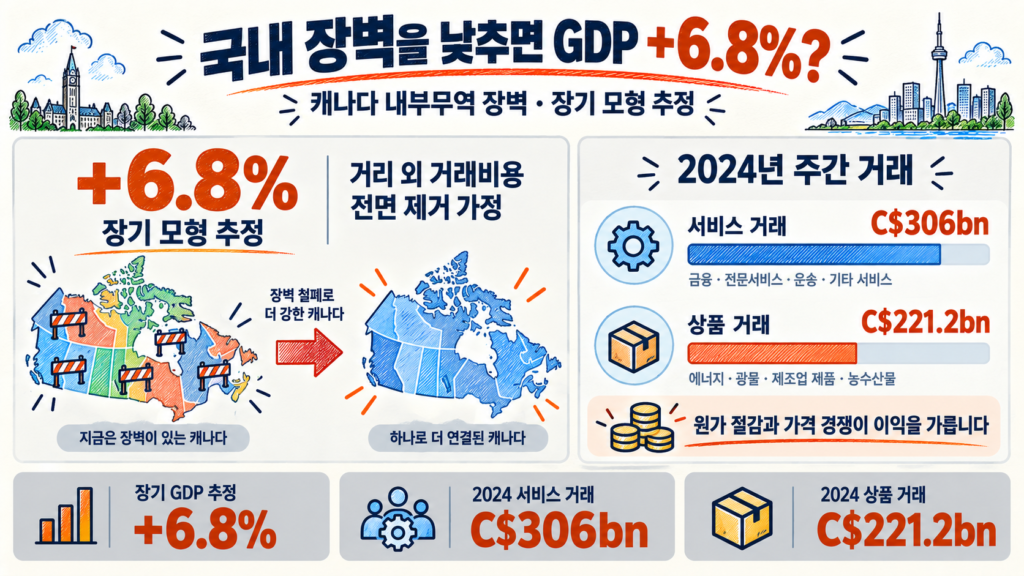
캐나다 내부무역 장벽을 낮추면 경제가 얼마나 커질까요. 9월 18일 나온 IMF 연구는 거리 외 거래비용을 모두 없앨 경우 장기 실질 GDP가 기준보다 6.8% 높아진다고 추정했습니다. 이 숫자를 기업의 인증비, 판매가격, 한국 기업의 현지 사업으로 풀어보면 수혜가 갈리는 이유가 보입니다. IMF 연구 소개
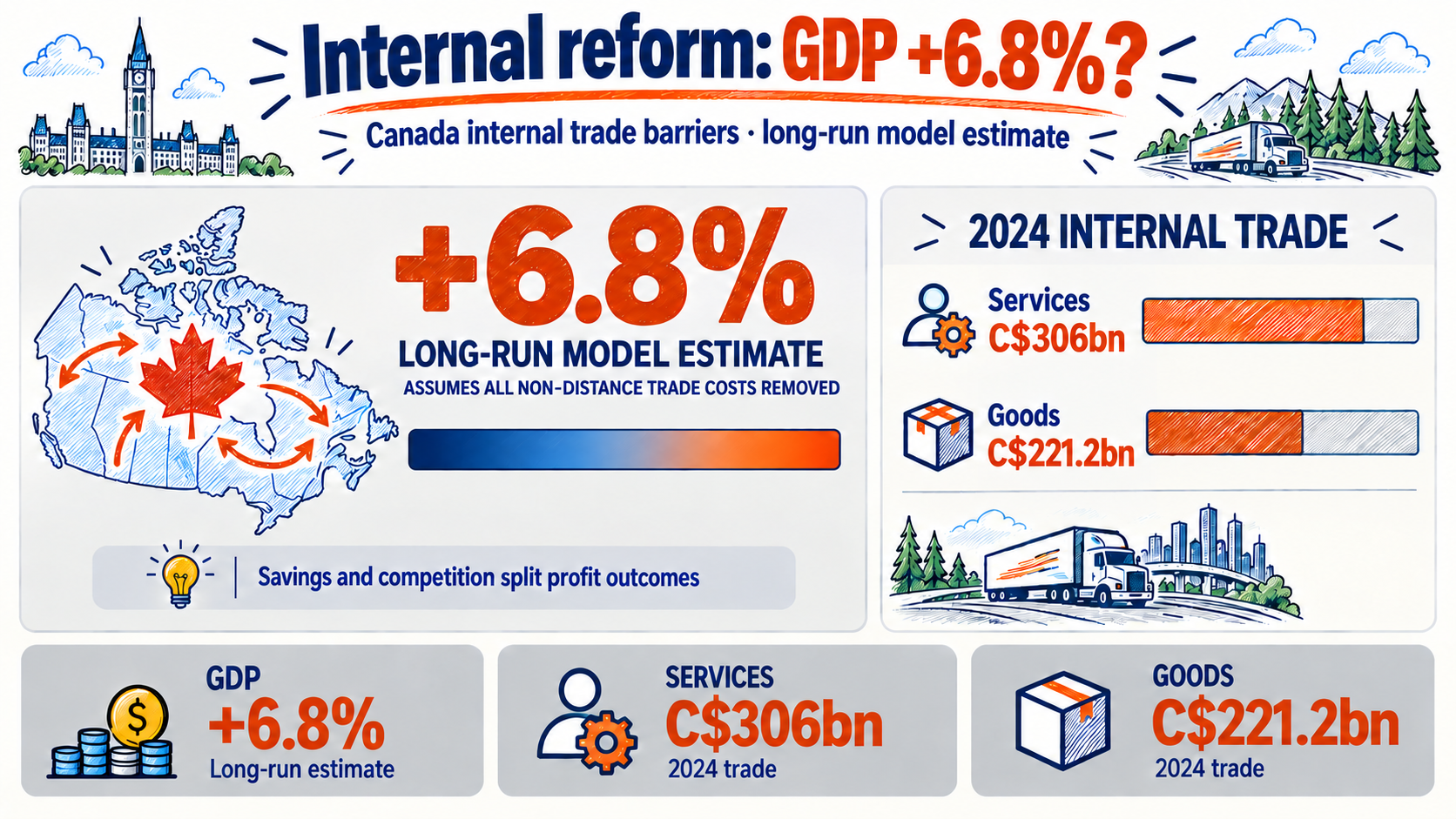
Canada internal trade barriers could have a substantial economic cost. An IMF paper released on September 18 estimates that removing all non-distance trade costs would lift long-run real GDP by 6.8% relative to its baseline. Certification costs, selling prices and local operations help explain why companies would benefit unevenly. IMF paper
다른 나라와 무역협정을 맺는 이야기가 아닙니다. 같은 나라 안에서 옆 지역 고객에게 팔거나 직원을 데려오는 데 드는 비용 이야기입니다. 국경을 넘는 관세에 관심이 쏠릴 때, 국내 시장을 넓히는 정책도 기업의 투자 계산을 바꿀 수 있습니다.
캐나다 내부무역 장벽, 관세가 없는데 왜 비용이 들까요
캐나다 정부 설명에 따르면 주 사이에 관세는 없습니다. 대신 지역마다 다른 규격, 면허, 서류 요건이 거래를 어렵게 합니다. 상품 상호인정 협정도 식품은 제외하고 명시된 예외를 둡니다. 한 지역에서 팔 수 있다는 사실만으로 모든 상품의 전국 판매가 보장되지는 않습니다. 캐나다 정부 설명
예를 들어 이미 고객을 확보한 장비업체가 다른 지역으로 판매망을 넓힌다고 생각해 보겠습니다. 추가 확인 절차 때문에 출시가 늦어지면 담당 직원의 인건비와 창고 비용은 먼저 나갑니다. 주문을 받을 수 있는 날짜가 늦어지는 것만으로도 사업의 수익성이 낮아집니다. 특정 업체 사례가 아니라 비용 구조를 설명하기 위한 예입니다.
이 비용은 판매량이 작은 회사에 더 무겁습니다. 같은 서류 작업을 해도 대기업은 많은 매출에 비용을 나눠 담을 수 있지만, 작은 회사는 적은 주문으로 이를 회수해야 합니다. 절차가 간소해지면 기존 제품을 더 넓은 시장에 팔 여지가 생깁니다. 공장을 새로 짓기 전에 판매 가능한 시장부터 커지는 셈입니다.
6.8%는 내년 성장률이 아닙니다
논문의 숫자는 장기 GDP 수준의 차이입니다. 비용 변화에 거래가 얼마나 반응한다고 가정하느냐에 따라 결과도 달라집니다. 원문 표 8에는 4.2%, 기준 6.8%, 8.8%가 제시돼 있습니다. 확률이나 신뢰구간이 아니라 가정을 바꾼 계산입니다. 논문 표 8, 본문 28쪽
가정에 따라 달라지는 장기 GDP 효과. IMF 표 8. 높은 거래 반응성 4.2%, 기준 6.8%, 낮은 반응성 8.8%. 거리 외 비용 전면 제거 가정. 연간 성장률·신뢰구간이 아닙니다.
따라서 이 수치를 캐나다 기업의 내년 매출 증가율에 넣으면 안 됩니다. 제도가 바뀌어도 거래처를 찾고 직원을 채용하고 시설을 바꾸는 데 시간이 걸립니다. 경제 전체에서 늘어나는 생산과 특정 기업이 얻는 매출 사이에도 경쟁이라는 과정이 있습니다.
거리와 무관한 거래비용이 모두 불필요한 규제라는 뜻도 아닙니다. 지역별 수요와 사업 관행까지 달라질 수 있습니다. 전면 제거라는 계산을 법률 몇 개 폐지하면 받을 확정 수익처럼 읽기보다, 실제 줄일 수 있는 비용이 무엇인지 확인하는 출발점으로 보는 편이 맞습니다.
상품보다 큰 서비스 거래, 제조업 원가에도 들어갑니다
캐나다 통계청의 9월 2일 자료를 보면 2024년 주·준주 사이 거래는 명목 약 5,270억 캐나다달러였습니다. 서비스는 3,060억, 상품은 2,212억 캐나다달러입니다. 전체의 약 58%가 서비스입니다. 발표는 올해지만 거래 기준연도는 2024년이며, 합계는 반올림돼 있습니다. 캐나다 통계청 7~8쪽
주·준주 간 거래는 서비스가 더 큽니다. 캐나다 통계청 2026-09-02 발표, 2024년 명목 거래액. 서비스 306, 상품 221.2. 전체 약 527은 반올림 수치입니다.
완성품이 공장을 떠나기까지 제조업체는 여러 서비스를 삽니다. 설비를 설계하고, 물건을 운송하고, 재고를 관리하고, 대금을 조달하는 일에도 비용이 듭니다. 이런 서비스를 더 좋은 조건으로 살 수 있다면 제품 설계가 그대로여도 총원가는 달라집니다.
소비자에게도 비슷한 일이 생깁니다. 판매업체가 비용 절감분을 가격에 반영하면 같은 소득으로 살 수 있는 물건이 늘어납니다. 다만 절감분이 모두 가격 인하로 이어지지는 않습니다. 소비자 가격까지 보려면 공급업체 수와 경쟁 강도를 함께 봐야 합니다.
투자를 움직이는 것은 줄어든 비용과 늘어난 고객입니다
아래는 자료를 바탕으로 한 경제적 해석입니다. 인증을 반복하는 부담이 줄면 새로운 지역에 진출할 때 필요한 초기 자금이 줄어듭니다. 진출한 뒤에는 고객 수가 늘어 기존 설비를 더 많이 돌릴 수 있습니다. 그 주문이 꾸준히 이어질 때 추가 설비 투자도 설득력을 얻습니다.
-
1
진출 비용 감소
반복 인증·서류 부담 완화
-
2
판매지역 확대
신규 고객과 거래 성사
-
3
기존 설비 활용
주문이 유지돼야 가동 증가
-
4
추가 투자 검토
수익성과 자금 확보가 조건
여기서 순서가 중요합니다. 시장이 열렸다는 이유만으로 기업이 바로 공장을 늘리지는 않습니다. 기존 설비에 여유가 있으면 먼저 가동 시간을 늘릴 수 있습니다. 반대로 새 거래가 늘어도 대금 회수가 늦다면 운전자금, 즉 일상 영업에 묶이는 현금부터 더 필요해집니다.
일자리도 지역별로 다르게 움직일 수 있습니다. 성장하는 사업장은 사람을 더 구하지만, 경쟁에 밀린 사업장은 채용을 줄일 수 있습니다. 필요한 자격을 갖춘 사람이 이동할 수 있어도 주거비나 가족 사정 때문에 실제 이동은 느릴 수 있습니다. 제도와 현장의 속도를 구분해야 하는 이유입니다.
경제에 좋은 변화가 모든 기업 주주에게 좋지는 않습니다
비용이 내려가도 이익이 줄어드는 회사가 나올 수 있습니다. 그동안 경쟁업체가 들어오기 어려워 높은 가격을 받을 수 있었던 회사라면, 시장 개방 뒤 가격을 내려야 할 수 있기 때문입니다. 원가 절감보다 판매가격 하락이 크면 이익률은 낮아집니다.
반대로 제품과 서비스가 경쟁력 있는데 지역을 넓히는 절차가 부담이었던 회사에는 기회가 될 수 있습니다. 같은 관리 조직으로 더 많은 고객을 상대하면 매출 한 단위당 고정비가 낮아집니다. 그렇다고 작은 회사가 모두 이기는 것도 아닙니다. 전국적인 판매망을 갖춘 대기업이 먼저 확장할 수도 있습니다.
새 지역에 진출하는 기업
기존 제품의 판매처 확대
기회
이익 조건 · 확장 비용보다 추가 이익이 커야 함
위험 · 판촉·서비스 비용과 가격 경쟁
지역 내 보호를 받던 기업
외부 서비스·부품 조달 개선
기회
이익 조건 · 원가 절감이 가격 인하 부담보다 커야 함
위험 · 경쟁업체 진입으로 기존 이익률 하락
기업 실적에서 볼 것은 매출 증가만이 아닙니다. 신규 지역에서 얻은 매출에 비해 인증·영업·서비스 비용이 얼마나 들었는지, 가격 인하 뒤에도 이익률을 지켰는지가 더 직접적인 증거입니다. 인수합병으로 전국망을 만들었다면 인수 비용과 통합 비용도 함께 빼고 계산해야 합니다.
한국 기업은 캐나다 진출과 전국 판매를 따로 계산해야 합니다
실제로 시행된 제도의 범위부터 좁혀 볼 필요가 있습니다. 연방의 Free Trade and Labour Mobility in Canada Act와 규정은 2026년 1월 1일 발효됐습니다. 비교 가능한 주 기준을 연방 요건 충족으로 인정하지만, 주·준주의 요건 자체를 없애지는 않습니다. 캐나다 정부 법률 안내
한국에서 캐나다로 수출하는 단계와, 캐나다 안에서 여러 지역에 유통·설치·보수 서비스를 제공하는 단계는 별개입니다. 국내 거래 제도가 바뀐다고 수입통관이나 제품별 의무가 자동으로 사라지는 것은 아닙니다. 이 글도 특정 한국 제품의 자격 충족 여부를 판단하지 않습니다.
경제적 효과를 따져보려면 현지 파트너 계약부터 구체적으로 볼 수 있습니다. 한 지역에 한정된 판매권인지, 다른 지역까지 서비스를 제공할 인력이 있는지, 추가 절차에 드는 시간과 비용은 누가 부담하는지가 중요합니다. 계약상 절감 혜택이 유통업체에만 남으면 한국 제조사의 이익은 거의 달라지지 않을 수 있습니다.
현지 공장을 둔 기업이라면 부품 구입처와 유지보수 업체를 넓힐 가능성을 살펴볼 수 있습니다. 조달 조건이 나아지면 가동 비용이 줄 수 있지만, 새 업체 검증과 품질 관리 비용도 생깁니다. 이는 한국 기업에 적용한 조건부 해석이며, 특정 기업의 수주 증가가 확인됐다는 뜻은 아닙니다.
주가와 경기에서는 발표 이후의 숫자를 봐야 합니다
주식시장은 제도 변화의 기대를 먼저 가격에 반영할 수 있습니다. 하지만 기업가치를 지탱하려면 실제 현금흐름이 뒤따라야 합니다. 전국 확장 계획이 있는 기업이라도 초기 판촉비가 늘거나 경쟁으로 가격이 내려가면 기대했던 이익 개선이 늦어질 수 있습니다.
환율과 금리 방향을 이 연구 하나로 정하기도 어렵습니다. 생산 효율 개선은 비용 부담을 덜 수 있지만, 신규 투자는 자금 수요를 늘릴 수 있습니다. 캐나다달러나 채권금리에는 대외 수요와 통화정책도 작용합니다. 내부시장 개혁의 잠재력을 곧바로 통화 강세나 금리 하락 전망으로 번역할 근거는 부족합니다.
앞으로는 실제 중복 절차가 줄었는지, 기업의 타지역 판매가 늘었는지, 비용 절감이 소비자 가격과 기업 이익 중 어디로 갔는지를 연결해서 볼 필요가 있습니다. 기존 통계는 제도 변화의 효과를 비교할 출발점이지, 이미 성과를 증명한 성적표가 아닙니다.
이 연구가 던지는 질문은 한국에도 유효합니다. 기업이 성장하려고 할 때 새로운 보조금만 필요한지, 이미 만든 제품을 더 넓게 팔고 필요한 서비스를 사는 비용을 줄일 여지가 있는지 묻게 됩니다. 다만 캐나다의 추정치를 한국 GDP에 그대로 적용할 수는 없습니다. 이 글은 경제 구조를 설명하는 분석이며 특정 자산의 매수·매도를 권하지 않습니다.
시장 확대의 가치는 새 고객을 얻는 비용과 경쟁 뒤 남는 이익에서 확인할 수 있습니다.
출처
This is about selling to customers and hiring workers elsewhere in the same country. While international tariffs attract attention, the cost of reaching domestic customers can also change an investment decision. A national market on a map does not necessarily function as one market for a business.
Canada internal trade barriers do not require a tariff
Canada does not levy tariffs between provinces. Different standards, licences and paperwork can still impede trade. The mutual recognition agreement for goods excludes food and retains listed exceptions. Permission to sell in one location does not guarantee unrestricted sales everywhere. Government explanation
Imagine an equipment supplier extending its sales network into another region. An additional compliance review delays the launch, while staff and inventory still need funding. A later date for the first sale makes expansion less attractive. This is an illustrative business example, not a reported company case.
A small supplier has fewer orders over which to spread the same administrative expense. Simplification can therefore make expansion viable before the firm builds a new factory. The immediate change is a larger reachable customer base; additional production capacity becomes a later decision.
The 6.8% estimate is not next year’s growth rate
This is a long-run difference in GDP levels. Table 8 reports 4.2%, a baseline 6.8%, and 8.8% under different assumptions about trade responsiveness. These are sensitivity calculations, not probabilities or a confidence interval. Table 8, printed page 28
Long-run GDP gains vary with assumptions. IMF Table 8. Full removal of non-distance costs. High responsiveness: 4.2%; baseline: 6.8%; low responsiveness: 8.8%. Not annual growth or a confidence interval.
It would be a mistake to put this percentage into a company’s next-year revenue forecast. Finding customers, recruiting workers and adapting facilities take time. Competition also stands between additional output across the economy and the sales captured by a particular firm.
Nor should every cost unrelated to distance be treated as a needless legal restriction. Local demand and business practices can differ too. Complete removal is a useful analytical benchmark, but a business still needs to identify the specific expenses that a feasible reform would eliminate.
Services cross provincial borders—and enter manufacturing costs
Statistics Canada’s September 2 release puts 2024 interprovincial trade at approximately C$527 billion: C$306 billion in services and C$221.2 billion in goods. Services account for about 58%. The data concern 2024, and the headline total is rounded. Statistics Canada, pages 7–8
Services exceed goods in interprovincial trade. Statistics Canada, released September 2, 2026. Nominal 2024 flows: services 306, goods 221.2. Headline total of about 527 is rounded.
A factory buys services as well as materials. Equipment design, transport, inventory management and financing all enter its cost base. Better purchasing terms for those services can change total production costs without changing the product itself.
Consumers benefit if savings reach retail prices, allowing the same income to buy more. But a lower supplier bill does not automatically mean a lower shelf price. How much is passed on depends on competition and on the alternatives available to customers.
Lower costs and more reachable customers can unlock investment
The following is our economic interpretation. Fewer repeated compliance steps reduce the initial cash needed to enter a region. Additional customers can then improve utilisation of existing equipment. Sustained orders, rather than regulatory announcements alone, make additional capacity worth considering.
-
1
Lower entry cost
Less repeated compliance work
-
2
Wider customer reach
Additional customer contracts
-
3
Use existing capacity
Sustained orders lift utilisation
-
4
Consider investment
Profitability and finance are required
The sequence matters. Spare capacity may absorb new orders through longer operating hours, with no immediate factory expansion. And if customers pay slowly, the first additional financing requirement may be working capital—the cash tied up in everyday operations—rather than machinery.
Employment can move unevenly across locations. Expanding businesses may recruit while firms losing customers reduce hiring. Even when qualified workers are permitted to move, housing costs and family constraints can slow actual relocation. Administrative permission and practical adjustment operate on different timelines.
A more efficient economy can still put some profits under pressure
Some companies could lose profit even as costs fall. A business previously sheltered from outside competitors may have to lower prices once entry becomes easier. If selling prices decline more than costs, its margin contracts.
A competitive supplier previously deterred by expansion costs has a different opportunity. Serving more customers with the same management team can reduce fixed costs per sale. That does not mean every small firm wins: an established national operator may be better equipped to expand first.
A competitive entrant
More markets for existing products
Opportunity
Profit condition · Incremental profit exceeds expansion cost
Risk · Launch costs and price competition
A sheltered incumbent
Better access to outside suppliers
Opportunity
Profit condition · Savings exceed pressure on selling prices
Risk · Entry erodes established margins
Revenue growth alone is weak evidence of success. More useful questions concern the compliance, sales and servicing expenses needed to win that revenue, and whether margins survived price competition. A network built through acquisitions also needs to earn back its purchase and integration costs.
For Korean firms, entering Canada and serving it nationally are different tasks
The federal Free Trade and Labour Mobility in Canada Act and its regulations took effect on January 1, 2026. They recognise comparable provincial requirements for federal purposes; they do not remove provincial or territorial requirements themselves. Official guide to the Act
Exporting from Korea and providing distribution, installation and repairs across Canada are separate business tasks. An internal trade reform does not by itself remove import procedures or product-specific obligations. This article does not determine whether a particular Korean product qualifies for any exemption.
The commercial analysis starts with the local partner agreement. Does the distributor cover one region or several? Can its staff service the additional customers? Who pays for additional procedures and delays? If the distributor retains all savings, the Korean manufacturer may capture little extra profit.
For a manufacturer operating locally, more choice among component and maintenance suppliers could lower operating costs. Qualifying new suppliers and maintaining quality also carry expenses. These are conditional implications for Korean businesses, not evidence of announced contract wins.
For markets, follow the operating evidence after the announcement
Equities can price reform expectations before operating results arrive. Eventually, cash flow must support those expectations. Even a company pursuing national expansion can face a slower earnings improvement if launch expenses rise or competition forces price cuts.
The paper alone also cannot establish a currency or bond-market direction. More efficient production can relieve cost pressure while additional investment increases financing demand. External demand and monetary policy matter too. An internal-market reform is insufficient evidence for a simple currency-appreciation or falling-yield forecast.
The useful follow-up is to connect fewer repeated procedures with additional sales across regions, then establish whether savings reached consumers or stayed in company earnings. Historical trade data provide a starting point for comparison, not proof that current reforms have already succeeded.
The broader question is relevant to Korea: does business expansion need another subsidy, or could it benefit from lower costs of reaching customers and buying services? Canada’s estimate cannot be transferred to Korean GDP. This article explains economic mechanisms and does not recommend buying or selling any asset.
Judge market expansion by the cost of reaching new customers and the profit left after competition.
Sources
이 글은 정보 제공 목적이며, 특정 자산의 매수·매도를 권유하지 않습니다.
For information only — this is not a recommendation to buy or sell any asset.
댓글Comments 0