Circadian Soft Robot 2026 — 142 Thermopneumatic Moves Without a Battery (Views 0)
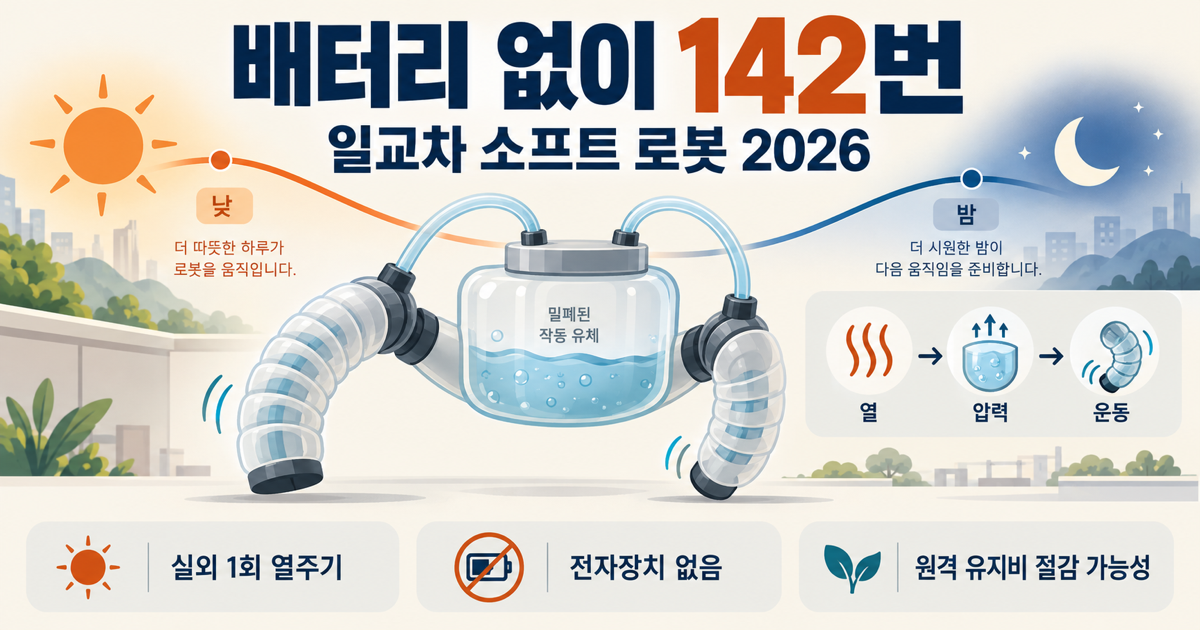
A circadian soft robot used one outdoor day-night thermal cycle to trigger a pneumatic actuator 142 times. The result appeared in Nature Communications on September 7, 2026. The striking part is not raw power: the system stored environmental heat as pressure and used it without a battery or electronic controller.
That does not make it a maintenance-free universal robot. This is still a research demonstration involving a small actuator and a two-limbed soft robot. But it may change the economics of places where sending a worker to replace a battery costs far more than the electricity itself.
The paper’s demonstrated results and the conditional industrial inferences are kept separate below.
How did a circadian soft robot move 142 times?
A pneumatic actuator bends or expands when pressurized. Flexible chambers replace rigid motors and gears, making the technology useful around delicate objects and inside irregular spaces. The inconvenient part is supplying compressed air.
In a laboratory, a pump and hose solve that problem. In the field, a robot may need a gas tank or pump, a battery, and control electronics. The body stays soft while its power system becomes heavy and complicated.
The AMOLF and Eindhoven University of Technology team changed the sequence. A low-boiling-point fluid absorbs light and ambient heat, vaporizes, and creates pressure. Cooling later condenses the fluid. The daily thermal swing becomes an extremely slow charger.
A pneumatic control circuit stores and releases the pressure. Just as an electronic circuit routes current, this circuit routes pressure and airflow. During one real-world thermal cycle, it drove 142 activations of a self-oscillating actuator and powered locomotion in a two-limbed soft robot.
How a daily thermal swing becomes robot motion
Energy flowCircadian soft robot energy flow from heat to pressure and motion. Source: Picella et al., Nature Communications (2026). Simplified.
What changes when solar panels and batteries disappear?
A solar-electric system converts light into electricity, stores it in a battery, and uses a motor or pump to produce pressure and motion. It is versatile, dispatchable, and can also power sensing, computation, and communications.
The thermopneumatic design skips the electrical conversion. Heat creates fluid pressure, and pressure directly moves the soft body. In principle, that can remove panels, power electronics, motorized pumps, and a large battery from simple machines.
The trade-off is substantial. Weather and seasons set the charging rate. The robot cannot necessarily deliver high power on demand, and sophisticated sensing or radio links may still require electricity.
Two routes to off-grid motion
ArchitectureSolar + battery
Circadian thermal
Solar-battery robot compared with a circadian thermopneumatic robot. Thermopneumatics has fewer conversion steps but is slow and weather-dependent.
Its first competitor is therefore not every battery-powered robot. It is the worker who periodically travels to turn a valve, move an indicator, or trigger a small sampler. Waiting is acceptable in those jobs; eliminating the service visit matters more than speed.
The economic case begins with fewer site visits
A small remote device may consume little energy. Yet maintaining hundreds of devices across greenhouses, levees, waterways, or solar farms adds vehicle mileage, labor time, safety equipment, and downtime. Those costs can dwarf the electricity bill.
A thermopneumatic device could extend service intervals by handling one simple motion, such as daily ventilation, changing a mechanical indicator, or activating a sampler. These are candidate applications inferred from the design, not commercial uses validated by the authors.
Savings could come from three places: fewer battery and charging components, fewer maintenance trips, and less downtime caused by depleted power. Leakage, fluid replacement, or short component life would erase those gains.
Where thermopneumatics could enter a 100,000-unit service-robot segment
The International Federation of Robotics reports 102,900 professional transportation and logistics robots sold in 2024, up 14%. Cleaning, agriculture, and search, rescue, and security are other major service categories. These figures come from a supplier sample and are not projections for the entire industry.
Field demand in professional service robots
Transport & logistics, 2024102,900 transportation and logistics service robots sold in 2024, up 14 percent. Source: IFR World Robotics 2025. Supplier-sample data, not an industry-wide estimate or a forecast for this technology.
Those numbers are context, not a sales forecast for circadian robots. Most service robots sold today use electronics and batteries. The addressable slice here is work that tolerates low power and slow cycles but suffers from poor access to electricity and maintenance.
Components may commercialize before complete robots. The supply chain would need durable seals for the working fluid, flexible valves that survive repeated bending, pressure reservoirs, and climate-specific heat-absorbing coatings.
Korea offers plausible test sites in greenhouses, aquaculture, mountain solar installations, and long pipeline networks. Performance through winter and monsoon conditions must be measured first. The paper’s worldwide applicability claim comes from a model, not completed field validation in every climate.
What the paper proves—and what remains unknown
The demonstrated result is clear: the researchers converted daily thermal variation into stored pneumatic energy, triggered an actuator 142 times in one outdoor cycle, and moved a two-limbed robot without repeated manual intervention or electronics.
Long-term sealing, rain and dust tolerance, working-fluid safety, useful load, and lifetime cost remain open. The 142 activations should not be confused with 142 heavy industrial work cycles.
- Output: how much mass moves, and how far?
- Durability: do seals and soft materials survive multiple seasons?
- Climate: does the system charge through cloudy winters and monsoons?
- Economics: do service visits and lifetime costs actually fall?
The first market is work that can wait
Scientifically, the paper treats ordinary environmental temperature variation as a controllable source of motion. From an engineering perspective, it combines harvesting, storage, control, and actuation within a pneumatic architecture.
It is unlikely to replace fast warehouse or surgical robots soon. A better framing is a power and control component for remote machines that only need to move a few times per day.
The important next numbers are not peak speed. They are cycles after one year, maintenance visits avoided, and lifetime cost per device. When those figures arrive, we will know whether an elegant experiment can become a new industrial niche.
For related context, see our articles on waste-heat elastocaloric cooling and explainable autonomous-driving AI. They show two adjacent questions: how ambient energy becomes useful work, and why validation cost matters when autonomous systems leave the lab.
142 activations is the science number. Cycles after one year, service visits avoided, and lifetime cost per device are the business numbers.
Sources
- Nature Communications — Harvesting environmental circadian oscillations for energy autonomy of soft robots
- IFR — World Robotics 2025 Service Robots report
- IFR — World Robotics 2025, Service Robots Executive Summary
- Communications Materials — Bio-inspired autonomy in soft robots
- 내부 글 — 폐열로 냉각을 만드는 형상기억합금
- 내부 글 — 자율주행 AI의 안전 검증
일교차 소프트 로봇 2026 — 배터리 없이 142번 움직인 열공압 시스템 (조회수 0)
일교차 소프트 로봇이 하루 한 번의 실외 온도 변화로 공압 액추에이터를 142번 움직였습니다. 2026년 9월 7일 Nature Communications에 실린 결과입니다. 배터리도 전자 제어장치도 없이 낮에 모은 열을 압력으로 저장했다가 썼다는 점이 핵심입니다.
이 숫자만 보고 충전 없는 만능 로봇이 나왔다고 이해하면 곤란합니다. 아직은 작은 장치와 두 다리 로봇을 움직인 연구 시연입니다. 다만 전기가 싼 곳이 아니라, 사람이 배터리를 갈러 가는 비용이 비싼 곳에서는 계산법이 꽤 달라질 수 있습니다.
아래에서 논문으로 확인된 결과와 산업에 적용할 때의 조건부 추론을 구분합니다.
일교차 소프트 로봇은 어떻게 142번 움직였나
공압 액추에이터는 공기의 압력으로 부풀거나 구부러지는 부품입니다. 딱딱한 모터와 기어 대신 말랑한 관과 주머니가 근육 역할을 합니다. 과일처럼 쉽게 상하는 물체를 잡거나 좁고 굽은 공간을 통과하는 로봇에 잘 맞습니다.
문제는 압축공기입니다. 실험실에서는 외부 펌프에 호스를 연결하면 됩니다. 현장에 보내려면 압축가스통, 펌프, 배터리와 제어 전자장치가 따라붙습니다. 로봇 몸체는 부드러운데 동력 장치는 무겁고 복잡해지는 셈입니다.
AMOLF와 에인트호번공대 연구진은 이 순서를 바꿨습니다. 끓는점이 낮은 유체가 낮 동안 빛과 주변 열을 받으면 기화하면서 압력을 만듭니다. 밤에 온도가 내려가면 다시 응축됩니다. 하루의 가열과 냉각이 아주 느린 충전기가 됩니다.
모은 압력은 공압 제어회로가 정해진 순간에 방출합니다. 전자회로가 전류의 길을 정하듯, 공압회로는 압력과 공기의 길을 정합니다. 연구진은 이 사이클로 실외 한 번의 열주기에서 자가진동 액추에이터를 142회 작동시켰고, 두 다리 소프트 로봇의 이동도 시연했습니다.
하루의 온도 변화가 로봇 동작이 되는 과정
에너지 흐름일교차 소프트 로봇의 열에서 압력과 움직임으로 이어지는 흐름. 출처: Picella et al., Nature Communications (2026). 개념 단순화.
태양광 패널과 배터리를 빼면 무엇이 달라질까
태양광 방식은 빛을 전기로 바꾸고, 배터리에 저장한 뒤, 모터나 펌프로 다시 압력과 움직임을 만듭니다. 범용성이 높고 필요할 때 전력을 꺼내 쓰기 쉽습니다. 센서 계산이나 통신도 같은 전원으로 처리할 수 있습니다.
이번 열공압 방식은 열을 전기로 바꾸는 중간 단계를 건너뜁니다. 열이 유체의 압력을 만들고 그 압력이 곧바로 부드러운 몸체를 움직입니다. 패널, 전력변환 회로, 모터식 펌프와 큰 배터리를 줄일 가능성이 있습니다. 부품 수가 줄면 방수와 조립도 단순해질 여지가 있습니다.
대신 대가가 분명합니다. 하루의 온도 변화는 느리고 날씨와 계절에 따라 달라집니다. 전기를 쓰는 로봇처럼 버튼을 누른 즉시 큰 출력을 오래 내기 어렵습니다. 정밀한 디지털 판단과 통신이 필요한 작업이라면 별도 전원이 다시 필요할 수 있습니다.
두 가지 독립 전원 경로
구조 비교태양광+배터리
일교차 열공압
태양광 배터리 로봇과 일교차 열공압 로봇 비교. 열공압은 단계가 짧지만 느리고 날씨 의존성이 큽니다.
따라서 경쟁 상대를 배터리 로봇 전체로 잡으면 과장입니다. 먼저 겨뤄 볼 상대는 사람이 정기적으로 찾아가 밸브를 돌리거나 표지를 바꾸고, 작은 시료를 채취하는 저빈도 작업입니다. 속도보다 ‘아무도 충전하러 오지 않아도 된다’는 조건이 중요한 시장입니다.
경제성은 전기요금보다 방문 횟수에서 나온다
작은 로봇 한 대가 쓰는 전력은 크지 않을 수 있습니다. 그런데 외딴 온실, 제방, 수로, 태양광 발전단지에 흩어진 장비 수백 대의 배터리를 사람이 교체한다면 이야기가 달라집니다. 차량 이동, 작업자의 시간, 안전 장비, 설비 정지 시간이 전기료보다 커집니다.
열공압 장치가 이런 현장에서 단순한 움직임 하나를 맡으면 유지보수 방문 간격을 늘릴 수 있습니다. 예를 들어 환기구를 하루 주기로 열고 닫거나, 습도 표시판의 위치를 바꾸거나, 작은 샘플러를 작동시키는 일입니다. 이는 연구진이 상용 제품으로 검증한 용도가 아니라 기술 특성에서 도출한 초기 시장 가설입니다.
비용 절감 경로는 세 갈래입니다. 배터리와 충전회로를 줄이는 장치 원가, 교체 방문을 줄이는 운영비, 방전 때문에 장비가 멈추는 시간을 줄이는 생산성입니다. 반대로 밀봉 불량이나 작동유체 교체가 잦다면 이 절감액은 사라집니다.
서비스 로봇 10만 대 시대, 열공압이 먼저 들어갈 곳
국제로봇연맹(IFR) 집계에서 운송·물류용 전문 서비스 로봇은 2024년 10만2,900대 판매돼 전년보다 14% 늘었습니다. 전문 서비스 로봇의 큰 적용군에는 물류뿐 아니라 청소, 농업, 수색·구조·보안도 들어갑니다. 다만 이 숫자는 공급업체 표본 자료이며 산업 전체를 확대한 시장 추정치는 아닙니다.
전문 서비스 로봇 시장의 현장 수요
2024년 운송·물류2024년 운송 물류 서비스 로봇 10만2900대와 14퍼센트 성장. 출처: IFR World Robotics 2025. 공급업체 표본 집계이며, 산업 전체 추정이나 이번 기술의 매출 전망이 아닙니다.
그렇다고 이 시장 숫자를 일교차 로봇의 예상 매출로 읽어서는 안 됩니다. 지금 팔리는 서비스 로봇 대부분은 배터리와 전자장치를 씁니다. 이번 기술이 노릴 수 있는 부분은 그중에서도 출력은 낮아도 되고, 열주기를 기다릴 수 있으며, 전원과 정비 접근성이 나쁜 작업입니다.
기업 입장에서는 완성 로봇보다 부품 시장이 먼저 열릴 수도 있습니다. 저비점 작동유체를 안전하게 담는 밀봉재, 오래 휘어도 새지 않는 연성 밸브, 압력 저장부, 기후별 열흡수 코팅이 필요합니다. 기존 공압 부품 회사와 기능성 소재 회사가 참여할 여지가 생깁니다.
국내 산업과도 접점이 있습니다. 시설원예, 양식장, 산지 태양광, 긴 배관처럼 넓게 흩어진 설비는 순찰과 유지보수 부담이 큽니다. 다만 한국의 겨울과 장마에서도 필요한 압력을 안정적으로 모으는지부터 확인해야 합니다. 연구진의 세계 적용 가능성은 모델 결과이지, 모든 기후에서 끝난 현장 검증이 아닙니다.
논문이 확인한 사실과 아직 모르는 것
확인된 사실은 명확합니다. 연구진은 일주기 열변화를 공압 에너지로 바꾸는 장치와 회로를 만들었습니다. 실외 한 번의 열주기로 액추에이터 142회와 두 다리 로봇의 이동을 보였습니다. 전자장치와 반복적인 사람 개입 없이 작동하는 방향도 제시했습니다.
확인되지 않은 부분도 많습니다. 몇 년 동안 압력이 새지 않는지, 먼지와 비를 맞아도 밸브가 버티는지, 작동유체의 누출과 환경 위험을 어떻게 관리할지, 같은 크기의 태양광·배터리 장치보다 총비용이 싼지는 아직 답이 없습니다. 142회라는 숫자도 무거운 산업 작업 142회를 뜻하지 않습니다.
- 출력: 한 번에 어느 무게를 얼마나 멀리 움직이는가
- 내구성: 계절이 여러 번 바뀌어도 누설과 재료 피로가 없는가
- 기후 적응: 흐린 날·겨울·장마에도 필요한 압력을 모으는가
- 경제성: 설치부터 회수까지 방문 횟수와 총비용이 실제로 줄어드는가
먼저 돈이 될 곳은 ‘느려도 되는 현장’입니다
이 연구의 과학적 의미는 주변의 작은 온도 변화를 버리는 열이 아니라 제어 가능한 운동으로 바꿨다는 데 있습니다. 공학적 의미는 에너지 저장, 제어, 구동을 모두 공압 안에서 묶어 전자장치가 없는 자율 시스템을 보였다는 데 있습니다.
산업적 의미는 더 좁게 봐야 정확합니다. 빠른 물류로봇이나 수술로봇을 곧 대체하는 기술은 아닙니다. 사람이 자주 갈 수 없고 하루에 몇 차례만 움직여도 되는 곳에서 배터리 교체와 배선 비용을 없애는 부품 기술에 가깝습니다.
제가 볼 숫자는 최고 속도가 아닙니다. 1년 뒤에도 몇 번 움직이는지, 유지보수 방문을 몇 회 줄였는지, 장치 한 대의 수명주기 비용이 얼마인지입니다. 이 세 숫자가 나오면 흥미로운 논문이 작은 시장을 만드는 기술로 넘어가기 시작합니다.
관련 배경은 ‘폐열로 냉각을 만드는 형상기억합금’ 글과 ‘자율주행 AI의 안전 검증’ 글에서도 이어서 볼 수 있습니다. 하나는 열을 유용한 일로 바꾸는 다른 경로이고, 다른 하나는 자율 시스템이 현장에 들어갈 때 검증 비용이 왜 중요한지를 설명합니다.
142회는 가능성을 보여 준 과학의 숫자입니다. 사업의 숫자는 1년 뒤 작동 횟수, 줄어든 방문 횟수, 장치 한 대의 수명주기 비용입니다.
출처
- Nature Communications — Harvesting environmental circadian oscillations for energy autonomy of soft robots
- IFR — World Robotics 2025 Service Robots report
- IFR — World Robotics 2025, Service Robots Executive Summary
- Communications Materials — Bio-inspired autonomy in soft robots
- 내부 글 — 폐열로 냉각을 만드는 형상기억합금
- 내부 글 — 자율주행 AI의 안전 검증
답글 남기기