BOK Rate Hike 2026: Why Korea Raised Rates as Chip Exports and Inflation Heated Up (Views 1)
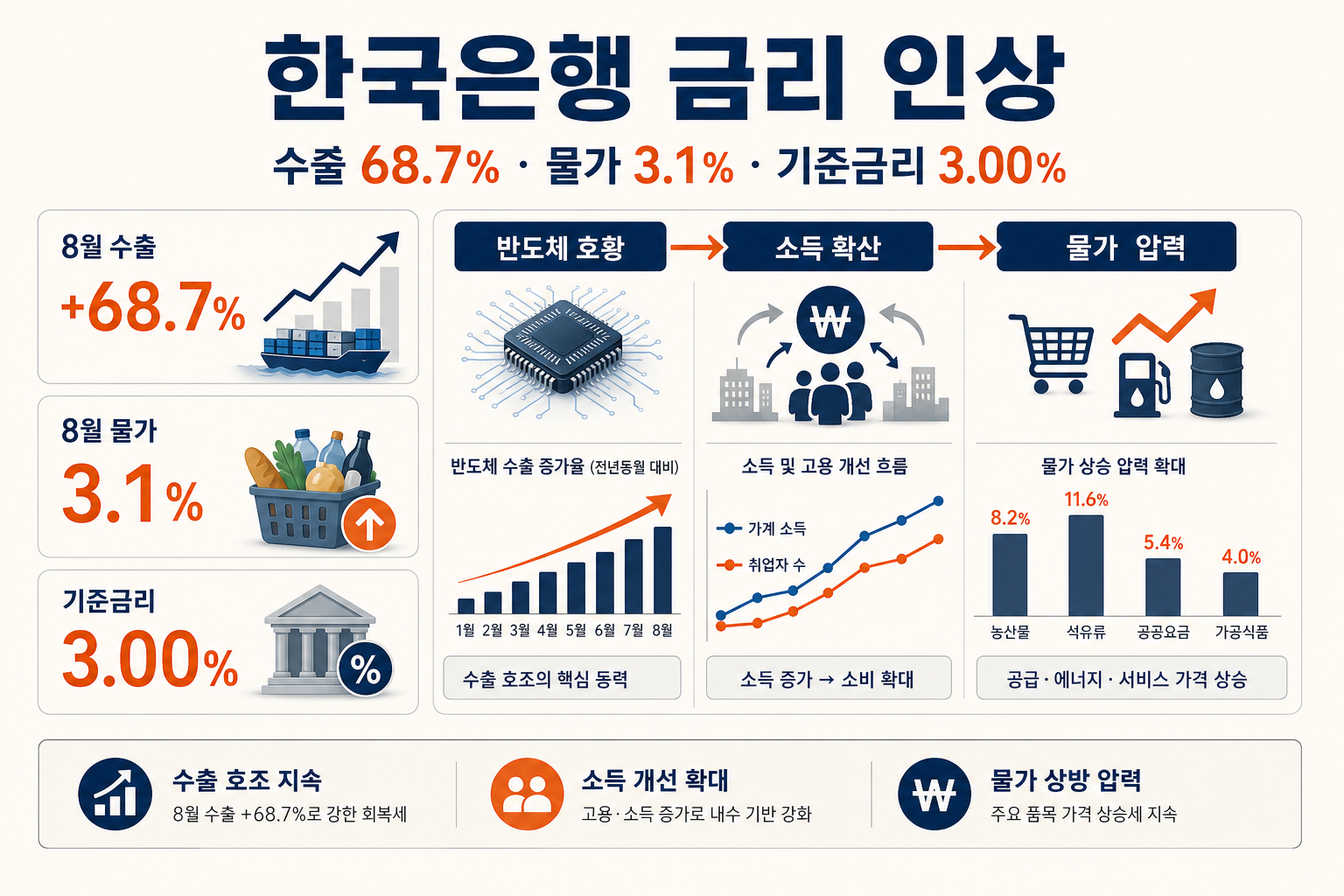
BOK rate hike 2026: what just happened
The story behind the BOK rate hike 2026 is bigger than a policy rate moving to 3.00%. The sequence matters. On August 27, 2026, the Bank of Korea raised rates. On September 1, customs data showed August exports up 68.7%. On September 2, official inflation data showed CPI back at 3.1%. Put together, Korea does not look like an economy tightening into weakness. It looks more like an economy trying to cool one very hot engine before it spills into broader prices and asset markets.
Here are the verified facts. The Bank of Korea lifted its 2026 growth forecast to 3.3% and still sees CPI averaging 2.7% this year. Customs said August exports reached a record 98.3 billion dollars. Official data showed August core CPI at 3.4%. Those are not recession-style numbers. They point to an economy where one sector is still running very hot.
- August 27, 2026: BOK raised the base rate from 2.75% to 3.00%
- September 1, 2026: August exports rose 68.7% year on year to 98.3 billion dollars
- September 2, 2026: August CPI came in at 3.1% and core CPI at 3.4%
- The latest official labor release is for July 2026: jobs rose, but youth unemployment climbed to 6.8%
Why a chip export boom can lead to higher interest rates
The key concept here is gross domestic income, or GDI, rather than just GDP. GDP tells you how much was produced inside the country. GDI tells you how much income that production actually generated at home. When chip prices surge, Korea can earn much more from selling similar volumes abroad. That means stronger corporate profits, bigger bonuses, more tax revenue, and more room for investment.
A Bank of Korea issue note said first-quarter GDP grew 3.8% year on year, but GDI jumped 13.2%. In plain language, the country was not just producing more. It was earning much more from what it produced. Once that income spreads through capex, supplier orders, wages, and local consumption, growth strengthens. But it can also push up housing prices, leverage, and service inflation. That second-stage spillover is what the central bank is trying to manage.
How a chip boom can lead to a rate hike
FlowFlow chart showing how the chip boom moves through exports, income, spending, inflation, and asset markets. A structured view of the Bank of Korea’s argument that better terms of trade and higher income can spill into spending, prices, and asset markets.
The global backdrop reinforces that point. The IMF said in its July 2026 update that global disinflation has stalled. The World Bank warned in June that Middle East tensions and higher energy prices could slow growth while keeping inflation pressure alive. Korea is unusual because it faces that same global inflation backdrop while also benefiting from the AI hardware buildout. It is not simply weak because of the world. It is unevenly strong because it sits inside the AI supply chain.
Which numbers look the hottest right now
Recent data make the heat visible. Export growth is running above 60%, while headline and core inflation remain well above the Bank of Korea’s 2% target. The growth outlook has also been revised up. That mix looks less like a broad slowdown and more like a chip-led boom beginning to affect the wider economy.
Five macro signals
Bar chartBar chart comparing key 2026 Korea macro indicators. August export growth, August CPI and core CPI, the 2026 growth forecast, and first-quarter GDP growth. Based on official releases.
Still, these numbers should not be misread as proof that every household is doing well. July employment rose by only 108,000 from a year earlier, and youth unemployment moved up to 6.8%. The semiconductor cycle is strong, but job creation and day-to-day consumer confidence are following with a lag. Readers who want the broader growth backdrop can also compare this with our earlier note on Korea’s 3.3% growth outlook and semiconductor-led employment gap.
Will chip money flow into consumption or into assets first
A fresh Bank of Korea note offers a useful answer. In semiconductor-exposed regions such as Icheon, Hwaseong, and Cheongju, monthly consumption has run as much as 4% above other regions. The first boost showed up in discretionary items such as cars, appliances, furniture, and department-store spending. That means the chip boom is already starting to spill into domestic demand.
But the same note adds an important condition. The macro effect depends on whether new income goes into consumption or leaks first into asset markets. If it goes into spending, service-sector sales and jobs can broaden. If it goes mainly into property and leverage, housing prices and debt rise faster than the real economy. That is why the Bank of Korea keeps linking inflation with financial stability.
Where chip income goes matters
CompareIf income flows to consumption
If income flows to assets
Comparison chart of chip-boom income flowing into consumption versus asset markets. Based on BOK Issue Note 2026-20 and the August policy statement.
Up to this point, those are the facts. Here is the inference. Household credit rose by 25.9 trillion won in the second quarter to 2,019.8 trillion won, and the Bank of Korea explicitly warned about rapid housing-price gains and stronger household loans in Seoul and surrounding areas. The central bank appears to be watching whether chip income is leaking into real estate faster than it is spreading through everyday consumption.
Why export strength still feels uneven
This cycle has two limits. First, AI spending is concentrating profits in a narrow set of products and companies, especially HBM memory, advanced packaging, and high-end equipment. Second, employment spreads more slowly than profits do. Large-cap earnings can rebound quickly, while jobs and local service demand take more time.
That means earnings will likely remain uneven. Samsung Electronics, SK Hynix, and key suppliers can keep seeing strong cash flow while domestic rate-sensitive sectors such as construction, property, and parts of consumer services face pressure from higher borrowing costs and weaker pricing power. If you also track the currency channel, our recent won-dollar exchange-rate post is useful because a stronger won and higher rates do not help every exporter equally.
Exports are hot, but spillovers move at different speeds
Bar chartBar chart comparing export, import, and cumulative growth rates. Compares August export growth, August import growth, cumulative export growth, the peak regional consumption spillover, and the 2026 consumption spillover ratio.
Customs data show total exports up 68.7% in August, imports up 22.5%, and cumulative exports up 52.8% for the first eight months of 2026. That looks broad on the surface. But the common thread across official reports and major media coverage is that AI-related semiconductors remain the main growth engine. A country powered by one very strong engine can grow fast, but it can also become more volatile.
What a 3% rate means for earnings and asset markets
For corporate earnings, the near-term backdrop still looks favorable for large chipmakers and upper-tier suppliers. Pricing, volume, and AI infrastructure demand are moving in the same direction. But a rate hike also means a higher discount rate, so stronger earnings do not automatically translate into easier market gains.
For industry structure, the key issue is whether the boom broadens from wages and bonuses into hiring, supplier capex, and local services. The Bank of Korea itself argues that the next stage is employment expansion. Without that, the economy gets a profit boom without a fully shared recovery.
For asset markets, forces now move in opposite directions. Higher income can support spending, but a 3.00% policy rate raises borrowing costs. That can cool leveraged housing demand, keep bond markets sensitive to any hint of another hike, and force equity investors to separate chip winners from rate-sensitive laggards even more aggressively.
Three dates matter next. September 9, 2026 for August employment, September 15 for August export and import price data, and the next inflation prints after the telecom base effect fades. If jobs broaden, export prices stay strong, and core inflation remains elevated, the case for more tightening stays alive. If not, August may look more like a front-loaded policy move than the start of an aggressive cycle.
Where the chip money goes decides what comes next
The BOK rate hike 2026 is best understood not as a central bank ignoring weakness, but as a response to a chip-led income surge beginning to spill into inflation, credit, and property markets. The real question now is where the money goes next. If it broadens into jobs and consumption, Korea gets a healthier expansion. If it leaks mainly into assets, the economy may feel more uneven even while headline data stay strong. This article is not a recommendation to buy or sell any security.
Korea is not tightening into weakness. It is tightening because one booming export engine is now strong enough to affect inflation, housing, and asset prices.
Sources
- Bank of Korea – Monetary Policy Decision & Opening Remarks (August 27, 2026)
- Bank of Korea – Economic Outlook (August 2026)
- Bank of Korea – BOK Issue Note 2026-16
- Bank of Korea – BOK Issue Note 2026-20
- Bank of Korea – Household Credits in Q2 2026
- Korea Customs Service – 2026년 8월 수출입 현황 [잠정치]
- MODS/KOSTAT – 2026년 8월 소비자물가동향
- MODS/KOSTAT – 26년 7월 고용동향
- Reuters – BOK delivers back-to-back rate hikes, signals gradual tightening ahead
- Reuters – South Korea’s Aug exports up 68.7% y/y, expand for 15th straight month
- Reuters – South Korea inflation quickens on one-off factor, still lower than expected
- Wall Street Journal – South Korea’s Exports Extend Chip-Led Growth in August
- Bloomberg Law – South Korea’s Exports Gather Pace as Chip Boom Powers Ahead
- Financial Times – South Korea raises interest rates to 3% to tame AI-fuelled inflation
- IMF – World Economic Outlook Update, July 2026
- World Bank – Global Economic Prospects press release
- Internal: research session 2026-09-02
한국은행 금리 인상 2026, 왜 또 올렸나 – 수출 68.7%·물가 3.1% 뒤의 반도체 효과 (조회수 1)
한국은행 금리 인상 2026, 지금 무슨 일이 벌어졌나
한국은행 금리 인상 2026의 핵심은 단순히 금리를 3.00%로 올렸다는 사실이 아닙니다. 2026년 8월 27일 기준금리 인상, 9월 1일 수출 68.7% 급증, 9월 2일 소비자물가 3.1% 재상승이 거의 한 주 안에 이어졌다는 점이 더 중요합니다. 이 세 숫자를 같이 보면, 한국 경제는 약해서 긴축하는 국면이라기보다 반도체 호황의 열기가 물가와 자산시장으로 번지기 전에 속도를 조절하는 국면에 가깝습니다.
확인된 사실부터 보겠습니다. 한국은행은 2026년 성장률 전망치를 3.3%로 높였고, 올해 물가는 평균 2.7%로 예상했습니다. 관세청은 8월 수출이 983억달러로 역대 최대라고 발표했습니다. 국가데이터처는 8월 CPI가 3.1%, 근원물가가 3.4%라고 밝혔습니다. 숫자만 놓고 보면 경기 침체보다 과열 신호가 더 많습니다.
- 2026년 8월 27일: 한국은행 기준금리 2.75% → 3.00% 인상
- 2026년 9월 1일: 8월 수출 983억달러, 전년동월대비 68.7% 증가
- 2026년 9월 2일: 8월 CPI 3.1%, 근원 CPI 3.4% 발표
- 최신 공식 고용지표는 2026년 7월 기준이며, 취업자 수는 늘었지만 청년 실업률은 6.8%로 높아졌습니다
왜 반도체 수출 호황이 금리 인상으로 이어졌나
여기서 가장 중요한 개념은 GDP보다 GDI입니다. GDP는 국내에서 얼마나 생산했는지 보여 주는 숫자입니다. GDI는 그 생산을 통해 실제로 국내에 얼마나 소득이 들어왔는지를 보여 줍니다. 반도체 가격이 많이 오르면 한국은 같은 물량을 팔아도 더 많은 달러를 벌 수 있고, 그만큼 기업 이익과 임금, 세수, 투자 여력이 함께 커집니다.
한국은행 이슈노트 2026-16은 올해 1분기 GDP가 3.8% 늘었지만 GDI는 13.2% 늘었다고 설명했습니다. 쉬운 말로 하면, 생산이 조금 늘어난 정도가 아니라 버는 돈의 속도가 훨씬 빨라졌다는 뜻입니다. 그 돈이 설비투자와 성과급, 협력업체 발주, 지역 상권 소비로 번지면 경기는 좋아집니다. 그런데 동시에 집값, 대출, 서비스 물가까지 자극할 수 있습니다. 중앙은행이 보는 위험은 바로 그 두 번째 단계입니다.
반도체 호황이 금리 인상으로 이어지는 경로
흐름도반도체 호황이 수출과 소득, 소비와 물가, 자산시장으로 번지는 흐름도. 교역조건 개선과 소득 증가가 소비, 물가, 자산시장으로 번질 수 있다는 한국은행 해석을 구조화한 도표입니다.
글로벌 배경도 같습니다. IMF는 2026년 7월 WEO에서 전 세계 디스인플레이션이 멈췄다고 봤고, 세계은행은 중동 리스크가 에너지 가격을 통해 성장을 깎고 물가를 밀어 올릴 수 있다고 경고했습니다. 그런데 한국은 그 와중에 AI 반도체 공급망 덕분에 수출과 소득이 동시에 강합니다. 외부 충격 때문에 모두가 약해지는 나라가 아니라, 일부 산업이 너무 강해서 정책이 더 복잡해진 나라라는 뜻입니다.
숫자로 보면 어디가 가장 뜨거운가
최근 숫자를 한 화면에 놓고 보면 반도체 중심의 열기가 얼마나 강한지 바로 보입니다. 수출 증가율은 60%대를 넘고, 물가와 근원물가도 한국은행 목표인 2%를 웃돌고 있습니다. 성장률 전망 역시 상향 조정됐습니다. 이 조합은 경기 침체형 물가가 아니라, 특정 산업 호황이 경제 전체를 끌어올리는 쪽에 더 가깝습니다.
최근 거시 신호 5개
세로 막대 그래프2026년 한국 주요 거시 지표 상승률 비교 막대그래프. 8월 수출 증가율과 8월 CPI·근원 CPI, 2026 성장률 전망, 1분기 GDP 성장률. 공식 발표치 기준.
다만 이 수치를 곧바로 모든 사람이 잘 산다고 읽으면 곤란합니다. 수출이 68.7% 늘어도 취업자는 7월 기준 10만8천명 증가에 그쳤고, 청년 실업률은 6.8%였습니다. 반도체 업황은 좋지만 일자리와 체감경기, 특히 청년층과 비수도권 서비스업 체감은 훨씬 더디게 따라옵니다. 이 부분은 한국 성장률 3.3%와 고용의 온도 차를 다룬 이전 글과 같이 보면 더 잘 보입니다.
반도체 돈이 소비로 번질까, 자산으로 먼저 갈까
한국은행 이슈노트 2026-20은 이 질문에 꽤 직접적으로 답합니다. 이천·화성·청주 같은 반도체 고노출 지역의 소비는 다른 지역보다 최대 4% 높았습니다. 자동차, 가전, 가구, 백화점 같은 고가 재량소비가 먼저 늘었습니다. 즉 반도체 호황이 이미 내수로 번지기 시작했다는 뜻입니다.
하지만 같은 보고서는 더 중요한 조건도 붙였습니다. 늘어난 소득이 소비로 가느냐, 부동산과 같은 자산시장으로 가느냐에 따라 경제 전체 효과가 크게 달라진다는 점입니다. 소비로 가면 음식점, 유통, 서비스업 매출과 고용이 살아납니다. 자산으로 가면 집값과 대출만 먼저 오르고, 체감경기 확산은 약해질 수 있습니다. 한국은행이 금융안정을 계속 강조하는 이유가 여기 있습니다.
반도체 돈이 어디로 흐르느냐가 중요합니다
개념 비교소비로 흐를 때
자산으로 흐를 때
반도체 호황의 소비 확산과 자산시장 유입을 비교한 도표. 한국은행 이슈노트 2026-20과 통화정책문을 바탕으로 정리했습니다.
여기까지는 사실입니다. 여기서부터는 해석입니다. 2분기 가계신용이 2,019.8조원으로 25.9조원 늘었고, 한국은행은 2026년 8월 27일 통화정책문에서 서울과 수도권 집값 상승, 가계대출 증가를 경계했습니다. 즉 중앙은행은 반도체 돈이 실물 소비보다 부동산 금융으로 더 빠르게 새는지 보고 있다고 보는 편이 맞습니다.
수출이 뛰어도 체감경기가 갈리는 이유
이번 사이클은 좋은 수출이 곧바로 고른 호황으로 이어지지 않는다는 점이 특징입니다. 이유는 두 가지입니다. 첫째, AI 투자 수요는 HBM, 첨단 메모리, 패키징, 장비처럼 특정 구간에 수익을 집중시킵니다. 둘째, 일자리 확산은 이익 확산보다 느립니다. 대기업 실적은 빨리 좋아지지만, 고용과 서비스업 매출은 시차를 두고 따라옵니다.
그래서 기업 실적도 차별화될 가능성이 큽니다. 삼성전자와 SK하이닉스, 핵심 장비·소재 업체는 이익 개선의 속도가 빠를 수 있습니다. 반면 원가 부담이 큰 내수 업종, 금리에 민감한 건설·부동산, 가격 전가력이 약한 중소 서비스업은 압박을 받을 수 있습니다. 환율 축도 함께 보려면 원달러 환율 1300원대 흐름을 다룬 글도 같이 보는 편이 좋습니다.
수출은 뜨겁지만 확산 속도는 다릅니다
세로 막대 그래프수출과 수입, 누적 증가율을 비교한 막대그래프. 8월 총수출 증가율, 8월 수입 증가율, 1~8월 누적 수출 증가율, 고노출 지역 소비 증가율 최대치, 2026년 소비 파급비율을 비교했습니다.
관세청의 8월 잠정치는 총수출 증가율 68.7%, 수입 증가율 22.5%, 1~8월 누적 수출 증가율 52.8%를 보여 줍니다. 숫자만 보면 전면적 호황처럼 보입니다. 하지만 한국은행과 주요 외신이 공통으로 짚는 포인트는 AI 반도체가 성장 엔진의 중심이라는 점입니다. 한 엔진이 너무 강한 경제는 강해 보여도 변동성도 큽니다.
금리 3%가 실적과 자산시장에 남기는 숙제
기업 실적부터 보면, 반도체 대형주와 공급망 상단 기업은 당분간 우호적입니다. 수출 단가와 출하가 같이 받쳐 주는 동안 영업이익과 현금흐름이 개선되기 쉽기 때문입니다. 다만 밸류에이션 부담도 같이 커질 수 있습니다. 한국은행이 금리를 올린다는 말은, 실적은 좋은데 할인율도 올라간다는 뜻이기 때문입니다.
산업 구조 측면에서는 대기업과 지역 상권, 장비·소재 협력업체 사이에 낙수 경로가 생기고 있습니다. 하지만 그 경로가 충분히 넓어지려면 고용이 따라와야 합니다. 한국은행 이슈노트도 다음 단계는 임금이 아니라 고용 확장이라고 봤습니다. 결국 공장 증설, 협력사 투자, 지역 서비스업 확장이 함께 나와야 반도체 호황이 한국 경기 호황으로 번역됩니다.
자산시장에는 엇갈린 힘이 동시에 작동합니다. 성과급과 임금이 늘면 소비가 살아날 수 있습니다. 그런데 금리 3.00%는 대출 이자 부담을 키웁니다. 그래서 주택 매수세와 레버리지 투자는 제동이 걸릴 수 있고, 채권시장은 추가 인상 가능성에 민감해집니다. 주식시장은 반도체 강세와 금리 부담 사이에서 업종별 차별화가 더 커질 가능성이 높습니다.
향후 경기 흐름은 세 가지를 같이 봐야 합니다. 첫째, 2026년 9월 9일 발표될 8월 고용지표에서 고용 확산이 확인되는지입니다. 둘째, 2026년 9월 15일 나올 8월 수출입물가지수에서 수출 가격 강세가 이어지는지입니다. 셋째, 9월 이후 물가에서 통신요금 기저효과가 빠진 뒤에도 근원물가가 높은지입니다. 이 세 가지가 모두 강하면 추가 긴축 가능성이 남고, 반대로 고용과 내수가 약하면 이번 인상이 상당 부분 선제 조치였다는 해석이 힘을 얻을 수 있습니다.
반도체 돈의 행방이 한국 경기를 가른다
이번 한국은행 금리 인상 2026의 본질은 경기 침체를 외면한 긴축이 아니라, AI 반도체 호황이 만들어 낸 소득 증가가 물가와 부동산, 가계대출로 번지기 전에 속도를 관리하는 데 있습니다. 지금은 수출 숫자만 볼 때가 아니라, 그 돈이 고용과 소비로 퍼지는지 아니면 자산시장으로 새는지를 같이 봐야 할 때입니다. 투자 판단 역시 한국이 좋다보다 무슨 돈이 어디로 흐르는가를 먼저 보는 편이 더 정확합니다. 이 글은 특정 종목의 매수·매도를 권유하지 않습니다.
지금 한국은 약해서 금리를 올리는 것이 아니라, 반도체 호황의 온기가 물가와 자산시장까지 번질 만큼 한 축이 너무 뜨거워져서 금리를 올리는 쪽에 가깝습니다.
출처
- Bank of Korea – Monetary Policy Decision & Opening Remarks (August 27, 2026)
- Bank of Korea – Economic Outlook (August 2026)
- Bank of Korea – BOK Issue Note 2026-16
- Bank of Korea – BOK Issue Note 2026-20
- Bank of Korea – Household Credits in Q2 2026
- Korea Customs Service – 2026년 8월 수출입 현황 [잠정치]
- MODS/KOSTAT – 2026년 8월 소비자물가동향
- MODS/KOSTAT – 26년 7월 고용동향
- Reuters – BOK delivers back-to-back rate hikes, signals gradual tightening ahead
- Reuters – South Korea’s Aug exports up 68.7% y/y, expand for 15th straight month
- Reuters – South Korea inflation quickens on one-off factor, still lower than expected
- Wall Street Journal – South Korea’s Exports Extend Chip-Led Growth in August
- Bloomberg Law – South Korea’s Exports Gather Pace as Chip Boom Powers Ahead
- Financial Times – South Korea raises interest rates to 3% to tame AI-fuelled inflation
- IMF – World Economic Outlook Update, July 2026
- World Bank – Global Economic Prospects press release
- Internal: research session 2026-09-02
답글 남기기