USD/KRW Exchange Rate 2026 — 1,386 Won, 11-Month Low: Why It Fell (Views 3)

The USD/KRW exchange rate is back in the headlines. On Aug 19 the weekly close was 1,397.7 won; by Aug 21 it reached 1,386.5 won. A lower number means a stronger won. In June the pair touched the 1,560s—roughly 170 won weaker in about two months.
Many readers ask: “If exports are strong, shouldn’t the won weaken?” This time it’s the opposite because sellers of dollars—exporters and foreign investors—outnumber buyers. Here we cover (1) the latest numbers, (2) why the rate fell, (3) what to watch next, and (4) what it means for daily life and portfolios. This is not FX or investment advice.
At a glance — where USD/KRW stands
- Aug 19 fix 1,397.7 won (−14.1) · first break below 1,400 in ~10.5 months
- Aug 21 fix 1,386.5 won · lowest in ~11 months
- June intraday ~1,561 → August 1,380s: sharp won strength
- KRW/JPY ~872 won per 100 yen — yen and won both firm
USD/KRW path (KRW)
Bar chartUSD/KRW path bar chart — June 1,561 to August 1,386. Bank fixing / weekly close. Aug 21 1,386.5 won per Global Economic · Yonhap.
What “the exchange rate fell” means
When Korean media say the exchange rate “fell,” they mean fewer won are needed to buy one US dollar. At 1,500 won, $100 costs about ₩150,000; at 1,386 won, about ₩138,600. You pay less for the same dollar → the won strengthened.
A rising rate means a weaker won. The “1,600 won” fear many had late last year pointed that way. Today’s market is closer to the opposite: cheaper dollars.
Why it fell — more dollars for sale than buy
FX is a balance of dollar demand vs dollar supply. More demand lifts USD/KRW; more supply pushes it down. Four forces favored supply in August.
First, exporter FX sales (“nego”). Exporters convert export dollars into won. With semiconductors and shipbuilding doing well, corporate dollar sales increased. KB Kookmin economist Moon Jung-hee noted that even modest sales can move the rate when dollar buying interest is thin—in other words, sellers show up but buyers don’t.
Second, Fed rate expectations. If markets price less chance of a September hike, dollar appeal fades and USD/KRW tends to slip.
Third, foreign buying of Korean assets. Stocks and bonds require won. Inflows add won demand—and downward pressure on USD/KRW.
Fourth, large shareholder-return / FX conversion headlines from major chip names (e.g. SK hynix plans) interpreted as extra dollar supply in the near term.
FX drop (won strength) — dollar supply side
FlowFX drop drivers flow — nego, Fed, foreigners, shareholder returns. Main August drivers. Overlap daily; strength varies.
June vs August — what flipped
In early June USD/KRW neared 1,561 as won-weakness fears peaked. Dollar buyers dominated—overseas investment demand, geopolitics, and retail US equity/ETF flows.
By July–August the picture reversed. After the Bank of Korea hike, the rate briefly hit the 1,480s; in August exporter sales plus foreign inflows broke 1,400. Same export boom, different outcome depending on whether firms hold dollars or convert them.
June vs August — supply shift
Side-by-sideJune (weaker won)
August (stronger won)
June vs August FX compare — demand-led to supply-led. Same export boom; corporate/investor behavior flips the direction.
Outlook — 1,350 vs 1,400
Brokers lean toward gradual won strength into year-end. Korea Investment & Securities cut its H2 average to 1,420 won (from 1,470) and sees Q4 near 1,410. iM Securities argues surplus dollar supply could take USD/KRW toward the 1,350s.
That is not a one-way bet. US inflation, oil spikes, rising long Treasury yields, or trade/geopolitical shocks can revive the dollar. KB Kookmin still sees a bounce capped around 1,420–1,430 in adverse scenarios. Hana Bank’s Lee Yu-jeong expects mild won strength but high volatility.
H2 FX outlook (KRW)
Bar chartH2 FX outlook bar — 1,350–1,420 won range. Broker mid-ranges. Can re-rise on shocks.
Daily life and portfolios
Effects differ by profile. Travel and cross-border shopping get cheaper in won terms. Imported goods and energy often look less expensive when converted to won.
Exporters convert the same dollar revenue into fewer won—a 114-won drop from 1,500 to 1,386 trims about ₩11.4 billion per $100 million of sales (before hedges and pricing).
For local investors, US stocks/ETFs can show lower won-denominated returns even if dollar prices are flat—a stronger won cuts the translation effect. Foreign buyers of Korean equities may find local assets cheaper in their home currency.
Checklist — signals that steer USD/KRW
- Continued exporter dollar sales
- Foreign net buying of KOSPI / bonds
- Fed meetings, US CPI/jobs re-strengthening the dollar
- Retail overseas equity/ETF flows re-accelerating (dollar demand ↑)
- Aug 27 BOK rate decision — further hike or pause
Related: USD/KRW breaks 1,500, BOK hike · FX · housing, Korea FX policy tools, US market · DXY. Educational only—not advice.
The rate is one number — who sells dollars, who buys them, and what the Fed does next decide the path.
Sources
- Yonhap — USD/KRW below 1,400 (Aug 19)
- Digital Times — 1,300s entry, year-end outlook
- Global Economic — 1,386.5 won (Aug 21)
- Asia Business Daily — iM 1,350 view
- CEO Magazine — drivers & outlook
- Internal: 2026-08-24-krw-fx-drop-1300s-session-01.md
원달러 환율 2026 — 1,386원·11개월 최저, 왜 떨어지나 (조회수 3)
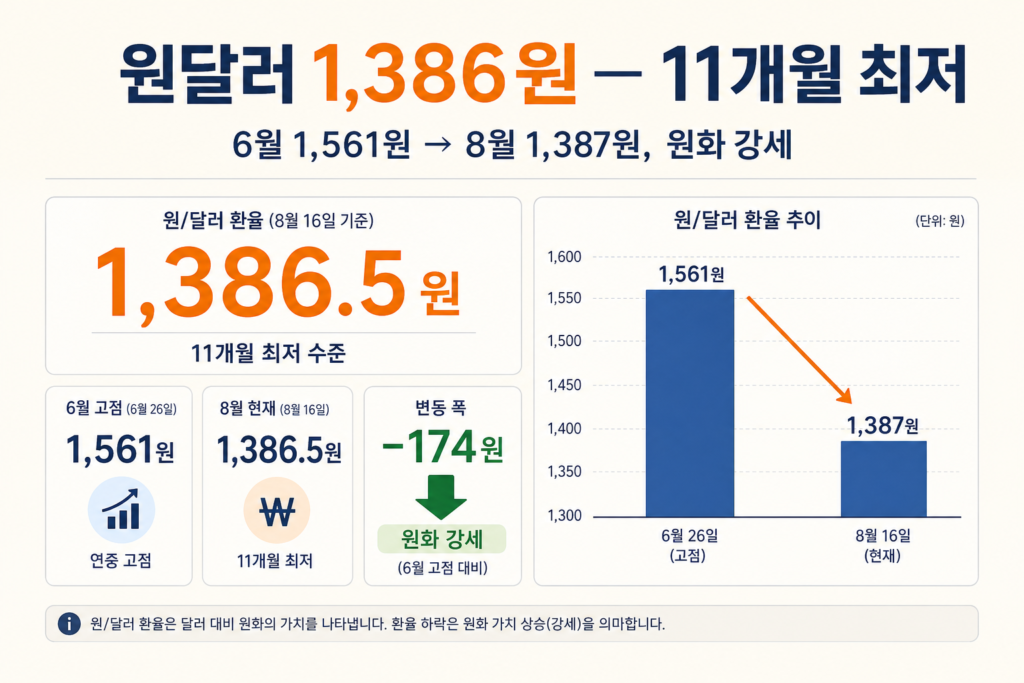
원달러 환율이 다시 화제입니다. 8월 19일 주간 종가 기준 1,397.7원, 21일에는 1,386.5원까지 내렸습니다. 환율 숫자가 작아질수록 원화가 강해진다는 뜻입니다. 6월에는 1,560원대를 터치했는데, 두 달 만에 약 170원 넘게 빠진 셈입니다.
“수출이 늘면 환율도 오르지 않나?”라고 묻는 분이 많습니다. 평소와 반대로 움직이는 이유는, 이번에는 달러를 파는 쪽(수출기업·외국인)이 달러를 사는 쪽보다 많기 때문입니다. 이 글에서는 (1) 최근 숫자, (2) 왜 내려갔는지, (3) 앞으로 볼 변수, (4) 일상·투자에 무엇이 달라지는지를 순서대로 설명합니다. 환전·매수·매도 권유가 아닙니다.
한눈에 — 환율이 어디까지 왔나
- 8/19 기준가 1,397.7원 (−14.1원) · 1,400원선 10개월 반 만 붕괴
- 8/21 기준가 1,386.5원 · 2025년 9월 이후 11개월 만 최저
- 6월 장중 ~1,561원 → 8월 1,380원대: 원화 강세 전환
- 원·엔 100엔당 872원대 — 엔화와 함께 강한 편
원·달러 환율 경로 (원)
세로 막대 그래프원달러 환율 경로 막대그래프 — 6월 1,561원에서 8월 1,386원. 은행 고시 기준가·주간 종가. 8/21 1,386.5원 출처: 글로벌이코노믹·연합뉴스.
환율이 떨어진다는 말, 먼저 정리
뉴스에서 “환율이 떨어졌다”고 하면, 1달러를 살 때 드는 원화가 줄었다는 뜻입니다. 예를 들어 1,500원일 때 100달러를 바꾸려면 15만 원이 필요했는데, 1,386원이면 약 13만 8,600원이면 됩니다. 같은 달러를 더 싸게 산다는 뜻이고, 이때 원화 가치가 올랐다(원화 강세)고 부릅니다.
반대로 환율이 오르면 원화가 약해집니다. 작년 말~올해 초 많은 분이 걱정했던 “1,600원”은 바로 이 방향이었습니다. 지금은 그 걱정의 반대쪽, 즉 달러가 싸진 구간에 가깝습니다.
왜 내려갔나 — 달러를 파는 쪽이 더 많다
외환시장은 결국 달러 수요와 달러 공급의 싸움입니다. 수요가 많으면 환율이 오르고, 공급이 많으면 환율이 내립니다. 8월 들어 공급 쪽이 유리해진 이유는 크게 네 가지입니다.
첫째, 수출기업의 네고입니다. 네고는 수출로 벌어들인 달러를 국내에서 원화로 바꿔 파는 행위입니다. 반도체·조선 업종이 호조를 보이면서, 기업들이 달러를 원화로 바꾸는 물량이 늘었습니다. KB국민은행 문정희 수석은 “매도 물량이 그렇게 많지 않아도, 달러를 사려는 수요가 약하면 환율이 쉽게 밀린다”고 분석했습니다. 즉, 팔 사람은 있는데 사려는 사람이 없으면 환율이 빠르게 내려갈 수 있다는 뜻입니다.
둘째, 연준(Fed·미국 중앙은행) 금리 전망입니다. 9월 FOMC(연준 통화정책 회의)에서 금리를 올리지 않을 가능성이 커지면, 달러 투자 매력이 줄어들고 달러 가치가 약해집니다. 달러가 약해지면 원·달러 환율도 함께 내려가기 쉽습니다.
셋째, 외국인의 국내 자산 매수입니다. 주식·채권을 살려면 원화가 필요합니다. 외국인이 한국 시장에 돈을 넣으면 원화 수요가 늘고, 환율 하락(원화 강세) 압력이 더해집니다.
넷째, 대형 반도체 기업의 주주환원·환전 이슈입니다. SK하이닉스 등 대규모 환전·환원 계획이 시장에서 달러 매도(원화 매수)로 해석되며, 단기적으로 환율을 누르는 요인으로 거론됩니다.
환율 하락(원화 강세) — 달러 공급 축
흐름도환율 하락 요인 흐름도 — 네고, 연준, 외국인, 주주환원. 8월 주요 요인. 동시에 작용하며 강도는 날마다 다름.
6월과 8월 — 무엇이 바뀌었나
6월 초에는 환율이 1,560원대까지 올라가 “원화 약세 공포”가 커졌습니다. 그때는 해외투자용 달러 수요, 지정학 리스크, 국내 투자자들의 미국 주식·ETF 매수 등이 겹치며 달러를 사는 쪽이 우세했습니다.
7~8월에는 그림이 뒤집혔습니다. 한국은행 기준금리 인상(7월) 이후 단기적으로 환율이 1,480원대까지 내려간 적도 있었고, 8월에는 수출 네고와 외국인 유입이 겹치며 1,400원 아래로 내려왔습니다. 같은 ‘수출 호조’라도, 기업이 달러를 들고 버티느냐, 원화로 바꾸느냐에 따라 환율 방향이 달라집니다.
6월 vs 8월 — 수급 전환
나란히 비교6월 (원화 약세)
8월 (원화 강세)
6월 vs 8월 환율 비교 — 달러 수요 우세에서 공급 우세로. 같은 수출 호조라도 기업·투자자 행동에 따라 방향이 달라짐.
앞으로 — 1,350원·1,400원, 어디를 보나
증권가는 연말까지 완만한 하락(원화 강세) 흐름에 무게를 둡니다. 한국투자증권은 하반기 평균 환율 전망을 1,470원에서 1,420원으로 낮췄고, 4분기 1,410원을 제시했습니다. iM증권은 달러 공급 잉여가 이어지면 1,350원대까지 가능하다고 봅니다.
다만 “연말까지 무조건 더 내린다”는 뜻은 아닙니다. 미국 인플레이션 재점화, 국제유가 급등, 미국 장기국채 금리 상승, 대미 통상·지정학 변수가 나오면 달러가 다시 강해질 수 있습니다. KB국민은행은 그런 경우에도 1,420~1,430원대 안에서 움직일 것으로 봤습니다. 하나은행 이유정 연구원은 “연말까지 완만한 원화 강세가 이어질 수 있지만, 변동성은 크다”고 했습니다.
하반기 환율 전망 구간 (원)
세로 막대 그래프하반기 환율 전망 구간 막대그래프 — 1,350~1,420원. 기관 전망 중앙값·범위. 변동성·리스크 시 재상승 가능.
일상·투자 — 무엇이 달라지나
환율 하락(원화 강세)의 영향은 사람마다 다릅니다. 해외여행·해외 직구를 자주 하는 분에게는 같은 달러·엔·유로를 더 적은 원화로 살 수 있어 유리합니다. 수입 원자재·에너지 가격도 원화로 환산하면 부담이 줄어드는 편입니다.
반대로 수출기업은 같은 달러 매출을 원화로 바꿀 때 금액이 줄어듭니다. 환율이 1,500원에서 1,386원으로 114원 떨어지면, 1억 달러 매출은 원화로 약 114억 원 적게 잡힙니다. 다만 실제로는 환헤지(미리 환율을 고정해 두는 계약) 비중, 제품 가격·물량에 따라 체감이 달라집니다.
국내 투자자 입장에서는, 미국 주식·ETF를 원화로 환산한 수익률이 환율 때문에 깎일 수 있습니다. 달러 자산 가격이 그대로여도 원화가 강해지면 원화 기준 평가액은 줄어 보입니다. 반대로 외국인이 국내 주식을 살 때는 원화 강세가 매수 매력을 높일 수 있습니다.
체크리스트 — 환율 방향을 가르는 신호
- 수출기업·대형사 네고(달러 매도) 물량이 이어지는지
- 외국인 코스피·채권 순매수가 지속되는지
- 연준 FOMC·미국 CPI·고용 지표가 달러를 다시 끌어올리는지
- 국내 투자자 해외주식·ETF 매수가 재가속하는지 (달러 수요 ↑)
- 8월 27일 한국은행 금통위 — 추가 금리 인상 여부
관련 글: 원·달러 1,500원 하회, 한은 금리 인상과 환율·주택, 환율 정책 수단, 미국 증시·달러지수(DXY). 이 글은 시장 구조를 설명하기 위한 것이며, 환전·투자 권유가 아닙니다.
환율은 숫자 하나가 아니라, 누가 달러를 파는지·사는지, 연준이 다음에 무엇을 할지가 갈라줍니다.
출처
- Yonhap — USD/KRW below 1,400 (Aug 19)
- Digital Times — 1,300s entry, year-end outlook
- Global Economic — 1,386.5 won (Aug 21)
- Asia Business Daily — iM 1,350 view
- CEO Magazine — drivers & outlook
- Internal: 2026-08-24-krw-fx-drop-1300s-session-01.md
답글 남기기