Cocoa supply chain — how the December 30 EU rules could affect chocolate costs
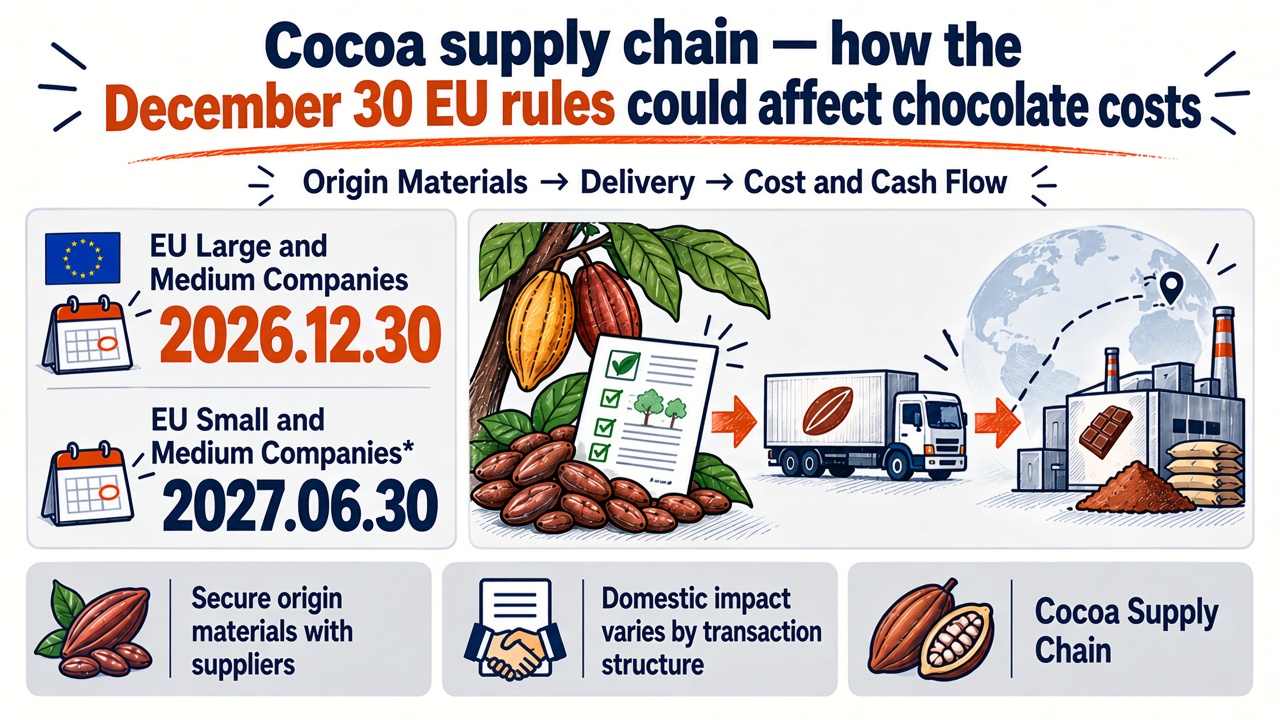
The cocoa supply chain faces a new source of cost. The EU deforestation regulation starts applying to large and medium operators on December 30, 2026. Buying ingredients for chocolate destined for Europe means securing beans and evidence of their origin together. Depending on sourcing arrangements, the cost of that preparation could also reach Korean manufacturers and shoppers.
Reuters reported on September 9 that Ivorian buyers faced difficulties with a new traceability system and equipment. Regulator CCC described the difficulties as not serious. This is a warning about delivery risk, not confirmation of a global shortage.
Why documentation matters to the cocoa supply chain
EUDR is intended to prevent EU consumption from encouraging the conversion of forests into agricultural land. Cocoa and chocolate are among the products covered. The European Commission explains the purpose and scope.
Traceability connects the beans purchased from farms with the material collected, transported, processed and eventually delivered. If records break when different lots are pooled, a buyer may struggle to establish the evidence it needs even when the beans are physically sound. Harvest volume and readily deliverable supply can therefore diverge.
The economic mechanism is extra time spent checking purchases. Buyers may favor suppliers with usable records or defer orders until checks are complete. Beans have not disappeared, but fewer lots may be available on the required schedule. The diagram shows a conditional mechanism, not a measured price increase.
-
1
Record checks
Resolve missing information
-
2
Delivery uncertainty
Orders may be delayed
-
3
Alternative sourcing
Extra charges or inventories
-
4
Cash needs
More working capital may be needed
Why costs can arise before December 30
The official dates are December 30, 2026 for large and medium operators, and June 30, 2027 for micro and small operators. Micro and small operators already covered by the EU Timber Regulation instead start on December 30, 2026. The Commission’s responsibilities page confirms this schedule. We use the official date rather than the January 1 wording in the field report.
Businesses do not normally buy beans and sell the finished chocolate on the same day. Ordering, shipping, processing and storage take time. A company preparing goods for the European market after the deadline has a reason to align procurement contracts and documentation earlier. Preparation costs can precede legal application.
This does not make every chocolate bar sold in Korea directly subject to EU obligations. Direct exposure depends on the product and the business’s role in supplying the EU market. Indirect exposure is different: shared suppliers may adjust delivery schedules or quotations when European buyers change their procurement requirements.
Cash flow can react before reported profit
Suppose a manufacturer buys ingredients early and pays suppliers sooner to guard against late deliveries. The extra inventory reduces the risk of interrupting production. It also leaves less cash available. Working capital is the money committed between buying inputs and collecting payment for the products sold.
Buying inventory does not normally turn the entire purchase into an immediate expense. The relevant cost enters profit as the products are sold. A quarter can therefore show resilient earnings alongside weaker operating cash flow. Longer holding periods also warrant attention to storage and financing costs.
For illustration, suppose cocoa-related ingredients represent 20% of a product’s cost. A 10% increase in their purchase price would raise total cost by roughly 2%, with everything else unchanged. These are hypothetical assumptions, not a Korean company estimate. Recipes, inventories and procurement contracts determine the actual result.
Profit
Purchases are not all immediately expensed
·
· · Related cost recognized as goods sell
Cash
Cash leaves when suppliers are paid
·
· · Long holding periods tie up funds
What this could mean for Korean chocolate prices and food stocks
The Korean implications here are conditional analysis. A buyer’s landed cost combines ingredient prices, exchange rates, freight and supplier charges. A weaker won can increase costs even without a change in the commodity price. Existing stocks and contracts with agreed prices can delay the impact on earnings.
If manufacturers absorb higher costs, profit per unit falls. If they raise prices, shoppers may switch to cheaper products or buy less often. Promotions, pack sizes and product mix offer other ways to respond. A higher shelf price does not by itself establish that a chocolate maker is earning more.
For food equities, revenue growth needs to be read alongside sales volume. Revenue lifted only by price increases is weak evidence of recovering consumption. Whether the cost outlook is already reflected in share prices is a separate question. This report alone cannot establish a direction or fair value for Korean food stocks.
For related transmission mechanisms, see our analysis of India’s GST and business margins and the gap between nominal GDP and real growth.
Who can produce the paperwork may decide who keeps the business
Traceability systems require organized transaction records and training for staff and suppliers. Some preparation costs arise even at low trading volumes. Larger suppliers can spread those costs across more units. Smaller suppliers may have an incentive to use shared systems or work with larger intermediaries.
Investment priorities may shift accordingly. Companies may need to fund data management and supplier support alongside processing equipment. Better-prepared suppliers could retain business while others lose opportunities despite having good beans. This is an inference from the cost structure, not a statistical finding that concentration has already increased.
Adequate stocks can cushion a supply shock. A Mondelez executive told Reuters on September 2 that healthy cocoa inventories could soften the impact of adverse weather on production. That was a corporate assessment of weather risk; it did not establish that those inventories had the records needed for EUDR compliance.
I would put more weight on whether inventory has the records needed for timely delivery than on assurances that stocks are ample.
Three things to watch after bean prices: deliveries, cash flow and sales volume
Watch whether purchasing and delivery delays ease, and whether documented supplies carry longer lead times or extra charges. In company results, read inventory movements, operating cash flow and sales volumes together. Quick adaptation and adequate stocks could limit cost pressure. Persistent delays could instead increase both procurement costs and funding needs.
Cocoa alone cannot explain Korean inflation or the economic cycle. It does illustrate why information that makes a transaction possible can matter alongside physical production. A manufacturer’s resilience depends on timely delivery and cash tied up in procurement as well as the price paid.
Sources checked as of September 16, 2026. Official dates, field reporting, corporate views and conditional analysis are distinguished throughout. This article is not a recommendation to buy or sell any asset.
Reliable deliveries and cash committed to procurement matter alongside the price of beans.
Sources
For information only — this is not a recommendation to buy or sell any asset.
Comments 0