Basel III Final Rules at 75%: How the Output Floor Shapes Korean Bank Lending and Dividends
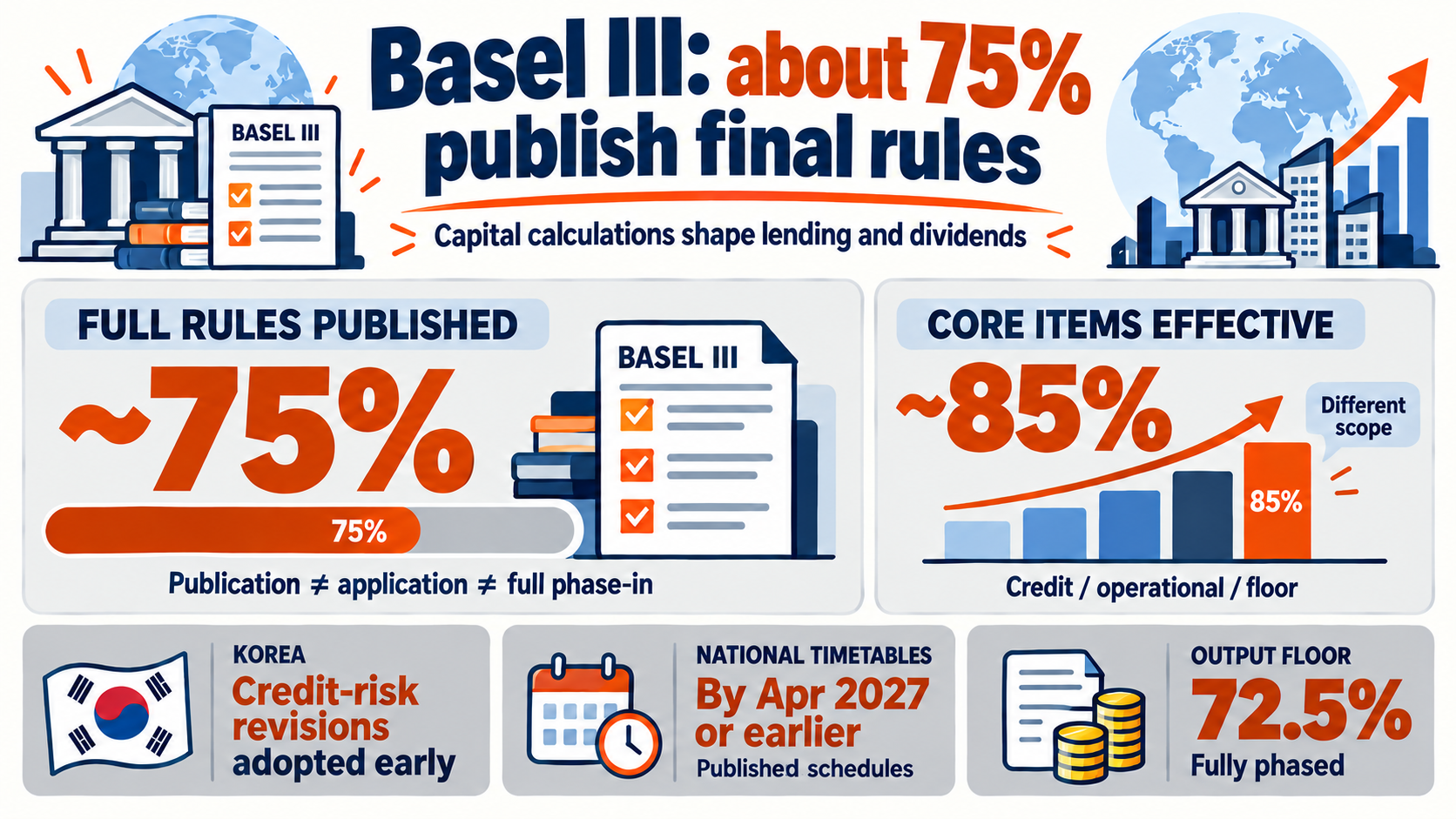
Basel III implementation is advancing: the BIS reported on October 5 that roughly 75% of the Basel Committee’s 27 member jurisdictions had published the full final rules by end-September. For Korean banks, the useful question is how closer capital standards change lending capacity, international competition and dividends. Source: BIS·BCBS — 2026-10-05 이행 점검
A bank can have funding and still face a limit on new lending. Deposits supply cash; equity absorbs losses. These are different resources. The reforms affect how banks allocate a limited amount of loss-absorbing capital across competing business opportunities.
Why 75% published and 85% in force are different milestones
About 75% had published the complete package. Revised credit-risk and operational-risk standards and the output floor were already effective in around 85%. A jurisdiction can implement those elements before completing the entire package. These percentages measure different scopes. Source: BIS·BCBS — 2026-10-05 이행 점검
About 75%
Full final package
Scope
Status · Rules published
Around 85%
Credit, operational risk, floor
Scope
Status · Already effective
Almost all members had announced bank application by April 2027 or earlier. That is an announced timetable, not evidence that every jurisdiction will have identical detailed rules or capital effects on that date. Starting an output floor and completing its phase-in are also separate milestones. Source: BIS·BCBS — 2026-10-05 이행 점검
What the output floor actually limits
Risk-weighted assets, or RWA, adjust exposures for their assessed risk rather than simply adding up loan balances. Common Equity Tier 1, or CET1, is core loss-absorbing capital, including common equity and retained earnings after regulatory adjustments. Dividing CET1 by RWA gives the CET1 capital ratio. Source: BIS — Basel Framework RBC20·RBC30
Banks may use standardised calculations or, where approved, internal models. A very low modelled risk estimate can allow more lending against the same capital. The output floor limits how far model-based capital calculations can fall below a standardised benchmark. Source: BIS — Basel Framework RBC20·RBC30
At full calibration, total RWA cannot fall below 72.5% of the standardised total. This is neither a uniform risk weight for each loan nor a requirement to set aside 72.5% of lending in cash. The Basel reference transition reaches full calibration on January 1, 2028; banks must follow their applicable domestic implementation and transition rules. Source: BIS — Basel Framework RBC20·RBC30 Source: BIS — RBC90 산출하한 경과조치
Consider an illustrative bank with standardised RWA of KRW 100 trillion, pre-floor RWA of KRW 60 trillion and CET1 of KRW 9 trillion. Full calibration raises the denominator to KRW 72.5 trillion. Its ratio falls from 15.0% to about 12.4%, without a new loss. These are hypothetical figures, not a Korean bank forecast or the applicable floor rate for this year.
Same capital, different ratio. Illustration: CET1 KRW 9tn, RWA 60→72.5tn at full 72.5% calibration. Not actual bank data or a 2026 rate. · Axis starts at 11, not zero
If pre-floor RWA already exceeds the floor, the floor creates no additional increase. The same reform therefore need not produce the same change in capital capacity across banks.
Korean banks started in 2020
On June 28, 2020, Korea’s Financial Services Commission announced early adoption of the credit-risk revisions by 15 banks and eight bank holding companies. Its stated purpose was to expand support for the real economy. Parts of the revision lowered capital burdens on corporate lending; “Basel III” does not mean every exposure becomes more expensive. Source: 금융위원회 — 2020-06-28 신용리스크 개편 조기 시행
That historical announcement establishes Korea’s earlier adoption path. It does not establish full implementation of every component across all Korean banks in 2026. Nor does the October BIS update provide enough information to estimate any individual bank’s capital-ratio decline or dividend reduction.
For a Korean financial group, compare pre- and post-floor RWA with capital added through earnings and used for shareholder distributions in its latest disclosures. A ratio improved by shrinking lending has different implications for future growth from one improved by retained profits.
International lending competition goes beyond the quoted rate
The following is conditional analysis. If one lender needs extra capital because its floor binds and a competitor does not, the first may seek a higher spread or a smaller allocation to the same overseas project. More consistent rules can narrow that regulatory gap. Differences in deposits, dollar funding and customer relationships remain.
Branches and locally incorporated subsidiaries also require different analysis. Branch business affects the parent’s capital management, while subsidiaries can face local capital requirements as well. Both consolidated requirements and host rules matter; earlier adoption alone does not determine competitive advantage.
Project finance relies on a project’s future cash generation for repayment. Incomplete construction or uncertain revenue can make capital costs and expected losses harder to cover. Guarantees or syndication may help keep financing available. A developer might instead contribute more equity or delay investment.
-
1
Floor binds
Total RWA increases
-
2
Terms adjust
Review spreads, guarantees, size
-
3
Investment responds
More equity or revised timing
In trade finance, maturity, guarantees and counterparty quality matter. Orders cannot become sales without funding for inputs and the gap before customer payment. Our earlier discussion of diverging goods and services trade focused on demand; banks’ capital allocation concerns the financing needed to fulfil those orders.
If these pressures spread, they can affect interest expense, investment timing and, through suppliers and employment, household consumption. But well-capitalised competitors may replace retreating lenders. The economic result depends on who continues lending, not just on whether a rule has taken effect.
What the Basel chair and the Fed say about safety and credit supply
On September 30, 2026, Basel Committee Chair and Riksbank Governor Erik Thedéen argued that strong regulation still needs strong supervision. Banks meeting minimum ratios can harbour governance and risk-management weaknesses. Implementation percentages are therefore not a score for the banking system’s safety. Source: Erik Thedéen — 2026-09-30 감독 연설
Explaining capital proposals on March 19, 2026, Federal Reserve Vice Chair for Supervision Michelle Bowman argued that excessive requirements on low-risk activity can constrain credit and push business to nonbanks. This describes the rationale for those proposals, not confirmation of a final US rule as of October. Source: Federal Reserve — Michelle Bowman, 2026-03-19
Together, these positions frame the policy trade-off: preserve banks’ ability to lend through losses while avoiding charges that shift activity toward less regulated intermediaries. Our interpretation is that high interest rates or dollar funding costs can compound these capital-allocation pressures; the implementation report itself is not a rate forecast.
Funding liquidity deserves separate attention. The urgent cash needs discussed in our IMF hedge-fund and Treasury-market analysis are connected to, but distinct from, loss-absorbing capital. A healthy capital ratio alone cannot rule out funding problems.
For bank dividends, look beyond net income
A bank needing more capital can retain earnings, reshape assets or raise equity. Dividends and buybacks compete with these uses. Capital conservation buffers sit above minimum requirements and can trigger distribution constraints when depleted. The BIS implementation update itself does not order Korean banks to cut dividends. Source: BIS — Basel Framework RBC20·RBC30
CNN’s Fear & Greed Index stood at 45 on October 9, at the bottom edge of its neutral band, up about five points from a week earlier and 6.8 from a month earlier. GoldKimp’s KOSPI measure was 61.8, in greed territory, on October 6. US sentiment has improved and Korea’s reading is more optimistic, but different methods and dates prevent a like-for-like comparison. Source: CNN Fear & Greed — 2026-10-09 스냅샷 Source: GoldKimp KOSPI F&G — 2026-10-06 스냅샷
Prior-week and prior-month KOSPI readings were unavailable, so we cannot describe a Korean trend. Because 45 sits on the line between fear and neutral, we focus on the score’s direction rather than its label. SentimenTrader’s public Smart Money and Dumb Money Confidence fields and update date were blank when checked, so we cannot say whether institutional and retail sentiment are diverging. Source: SentimenTrader — 공개 페이지 수치 확인 불가
Improving risk appetite may lift expectations for bank distributions. Optimism does not itself fund dividends. The relevant question is how much profit remains after supporting lending growth and capital needs, and how much headroom the bank retains.
International banks are moving toward a more common framework. Korean lenders’ outcomes will depend on winning sound business, limiting losses and building capital within it. In the next disclosures, examine the drivers of RWA, the floor’s effect and post-distribution capital headroom alongside earnings. The hypothetical calculation and conditional analysis are not a recommendation to buy or sell securities.
Sources and references
For information only — this is not a recommendation to buy or sell any asset.
Comments 0