WTO Trade Outlook: Goods Raised to 3.9%, Services Cut to 3.3%—Why Chips and Airlines Diverge
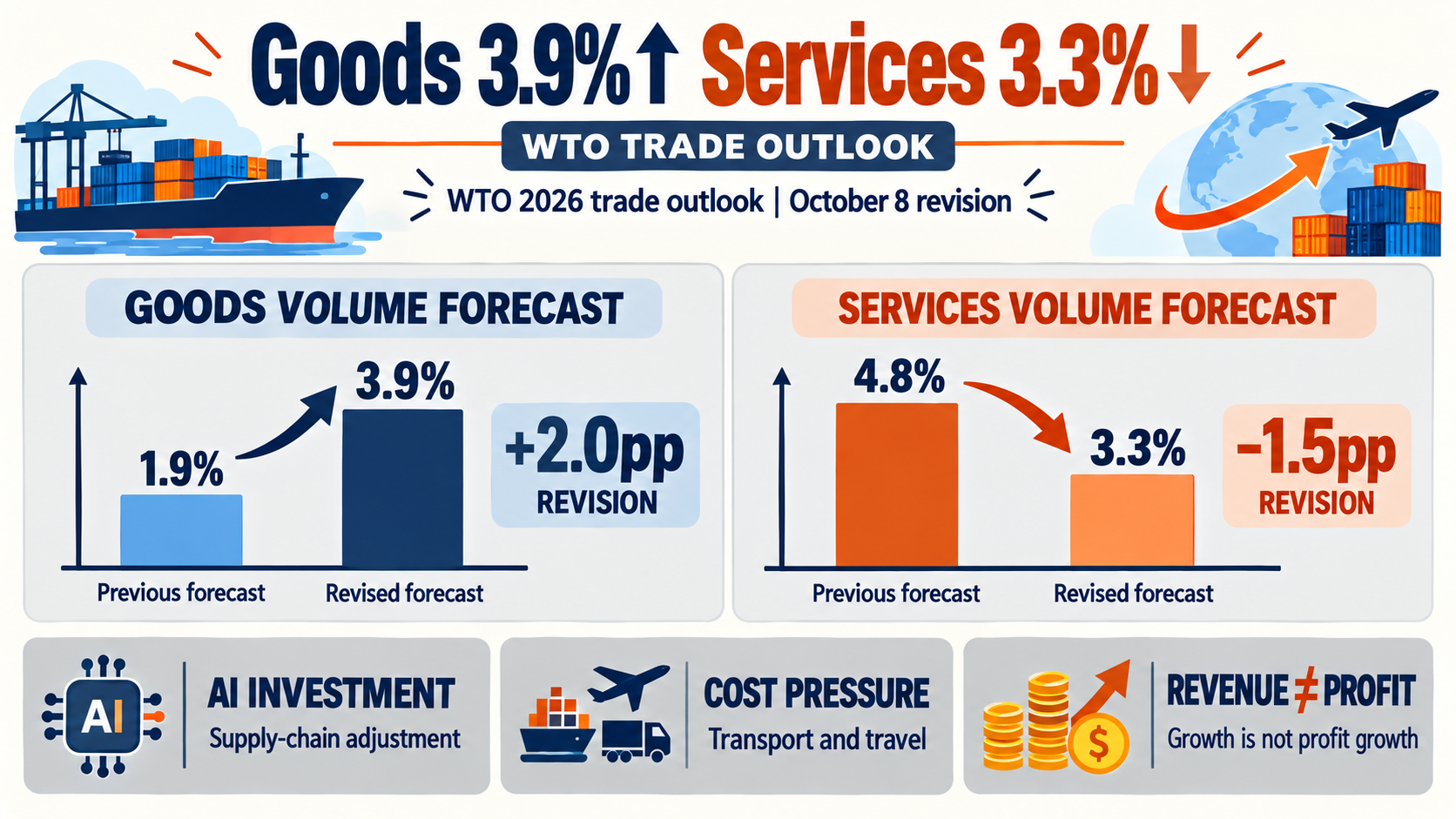
The WTO trade outlook has split in two. On October 8, the organization raised its 2026 merchandise trade volume forecast from 1.9% to 3.9%, while cutting commercial services growth from 4.8% to 3.3%. Stronger chip orders do not necessarily mean stronger airline or travel-company profits. Source: WTO · 2026-10-08
The useful questions are what customers are buying and how much it costs to move goods and people. AI investment can generate orders while energy costs consume profits. Those forces can coexist within the same export recovery.
This article is dated October 10, 2026. WTO projections are forecasts; the implications for Korean companies are conditional analysis, not company earnings guidance or a recommendation to trade.
WTO trade outlook: start with what 3.9% measures
The revisions are +2.0 percentage points for goods and −1.5 points for services. Both refer to price-adjusted volumes. Services are still projected to expand: a downgrade is not a contraction.
2026 trade volume growth forecasts (%). WTO, October 8, 2026. Annual forecasts, not realized results.
A company’s export revenue is different. It depends on quantities, unit prices and currency translation. Selling the same number of memory chips at a higher price lifts dollar revenue. Higher materials, electricity and freight costs can still prevent profits from rising as much.
The global 3.9% forecast cannot be substituted for Korean export growth or a chipmaker’s revenue growth. The global average combines different products and customers. Shipments, selling prices and operating margins deserve separate checks.
Goods can change suppliers; travel faces different constraints
The WTO attributes the goods upgrade to AI investment and supply-chain adjustment, while transport and travel disruption weigh on services. On October 8, Director-General Ngozi Okonjo-Iweala stressed trade’s ability to absorb shocks while emphasizing that the opportunities and damage are unevenly distributed. Source: WTO · 사무총장 발언
Adjustment does not mean the costs disappear. A manufacturer can change suppliers or hold extra inventory to avoid shutting production. Longer delivery times, insurance and inventory financing can leave more cash tied up even while factories keep operating.
Travel has different substitution limits. Detours consume time and fuel and can reduce how many flights an aircraft operates. Higher fares recover some costs but may encourage passengers to postpone a trip or choose a closer destination. A supply constraint can therefore alter household spending choices.
-
1
Route constraints
Detours and longer journeys
-
2
Higher costs
Fuel, insurance and funding
-
3
Pricing response
Recovery versus lost demand
-
4
Spending shifts
Possible delays or closer trips
The same cost mechanism connects to our earlier article on container freight and export margins. Here, the additional question is how much AI-related demand offsets those costs for each industry.
Korean chips and equipment: orders and cash arrive at different times
The WTO executive summary reports a 67% year-on-year rise in the value of AI-enabling goods trade in the first half, accounting for 47% of the increase in total merchandise trade value. That is neither 47% of all trade nor a contribution to volume growth. Source: WTO · Executive summary
For Korean suppliers, this directs attention to advanced memory, server components and manufacturing or testing equipment. An AI label alone proves little. Revenue depends on actual customer orders, product qualification and the ability to deliver capacity on schedule.
A chip producer may benefit relatively quickly from higher shipments or prices at an operating factory. An equipment supplier must wait for the customer’s expansion decision, order, installation and acceptance. Contract terms can delay revenue recognition and payment, so an order increase does not guarantee a same-quarter earnings increase.
Expansion requires cash for machinery and development before all the benefits arrive. Depreciation then spreads equipment costs over its useful life. Added capacity can be an advantage if orders persist; if deliveries are delayed, the additional fixed costs become a burden.
This connects to our earlier analysis of Korea’s uneven export performance. Customer exposure matters more than the headline total. A chip boom need not spread immediately to vehicles, chemicals or consumer goods. Investment and supplier orders can rise before household employment, wages and consumption follow.
Airlines and travel: why higher revenue may disappoint
Airlines can lift revenue through higher fares while fuel and detour costs rise faster. IATA’s June 7 forecast projected 2026 revenue growth of 9.4% against cost growth of 13%. These are older forecasts illustrating the cost mechanism, not October results. Source: IATA · 2026-06-07
In that release, IATA Director General Willie Walsh explained that pricing and efficiency could recover some costs without preserving earlier profitability. For Korean carriers, dollar fuel and lease expenses, route mix and cargo exposure can change the outcome. If the won weakens, dollar revenue and dollar expenses must be assessed together. Source: IATA · Willie Walsh
Carriers transporting AI-related cargo may capture part of the goods boom. A simple chips-win, airlines-lose classification is therefore too crude. Cargo yields must be compared with fuel costs, alongside passenger occupancy and route economics.
Travel agents face a different mix. A more expensive package raises spending per booking but may reduce bookings or increase cancellations. A shift from long-haul trips to nearby destinations could help operators with a wider destination mix. These are possible channels, not claims about current Korean booking results.
Chips and equipment
Shipments, prices, qualification
Revenue
Cash · Acceptance, collections, capex
Risk · Concentrated AI customers
Airlines and travel
Fares, occupancy, bookings
Revenue
Costs · Fuel, FX, route mix
Risk · Pass-through and cancellations
Exports are recovering, but financing costs are not easing
In its September 10 monetary policy report, the Bank of Korea expected resilient growth supported by exports, investment and recovering consumption, while inflation would remain above target for some time. A better WTO goods forecast therefore does not automatically imply easier monetary policy. Source: 한국은행 · 2026-09-10
Read that alongside the WTO’s uneven recovery and Walsh’s cost warning. Better export orders can coexist with pressure on household purchasing power. If interest rates stay elevated, funding a factory or an aircraft remains costly. Demand strength and the cost of serving that demand must be considered together.
Investor sentiment tells a slightly different story. CNN’s Fear & Greed Index read 45 on October 9, up 5.0 points from roughly 40 a week earlier and 6.8 points from 38.2 a month earlier—right on the border between fear and neutral. Korea’s KOSPI Fear & Greed reading from GoldKimp was 61.8, in greed territory, on October 6. The two use different methods and dates, so they cannot be ranked directly. Source: CNN Fear & Greed Source: GoldKimp KOSPI
SentimenTrader’s latest values are not public, so its September 24 readings from a public post serve only as a reference: Smart Money, which tracks experienced investors, at 0.41 (neutral), and Dumb Money, which tracks trend-following retail traders, at 0.35 (pessimistic). On a 0–1 scale and two weeks old, they say little about current flows. Better sentiment does not show that AI orders are turning into profits or that airlines are recovering their costs. Source: SentimenTrader Source: 공개 재게시 · 2026-09-24
Share prices also depend on expectations already embedded in valuations. If strong chip earnings are widely anticipated, good results alone need not produce further gains. For airlines, changes in cost or fare expectations may matter more than the services downgrade by itself.
Export diversification: look beyond the destination country
Selling into several countries may still leave a Korean supplier exposed to one investment cycle. Different destinations can ultimately serve the same large AI customer. Diversification should be assessed across final buyers, product applications and contract durations, as well as geography.
The outlook depends on two conditions. If AI orders persist and fuel or logistics costs stabilize, exporters’ profits and service consumption could improve together. If orders are delayed while costs remain high, expanded manufacturers and services firms with limited pricing power could both suffer. The forecast revision does not settle which path will prevail.
At the next earnings releases, check whether chip and equipment orders turn into deliveries and cash, and whether airline fares outpace fuel and currency costs. For travel operators, bookings and cancellations matter alongside spending per customer. The orders a business receives and the costs it bears explain earnings better than a global trade headline.
Sources and references
- WTO, AI boom and trade resilience, 2026-10-08
- WTO, October 2026 Executive summary
- WTO, Global Trade Outlook and Statistics
- Reuters, WTO upgrades goods trade forecast, 2026-10-08
- IATA, Airline industry outlook, 2026-06-07
- 한국은행, 통화신용정책보고서, 2026-09-10
- CNN Fear & Greed, 2026-10-09
- GoldKimp KOSPI F&G, 2026-10-06
- SentimenTrader, public homepage
- SentimenTrader 공개 게시물 재게시, 2026-09-24
For information only — this is not a recommendation to buy or sell any asset.
Comments 0