Energy Support 2026 — The Earnings Trap Behind 240+ Measures
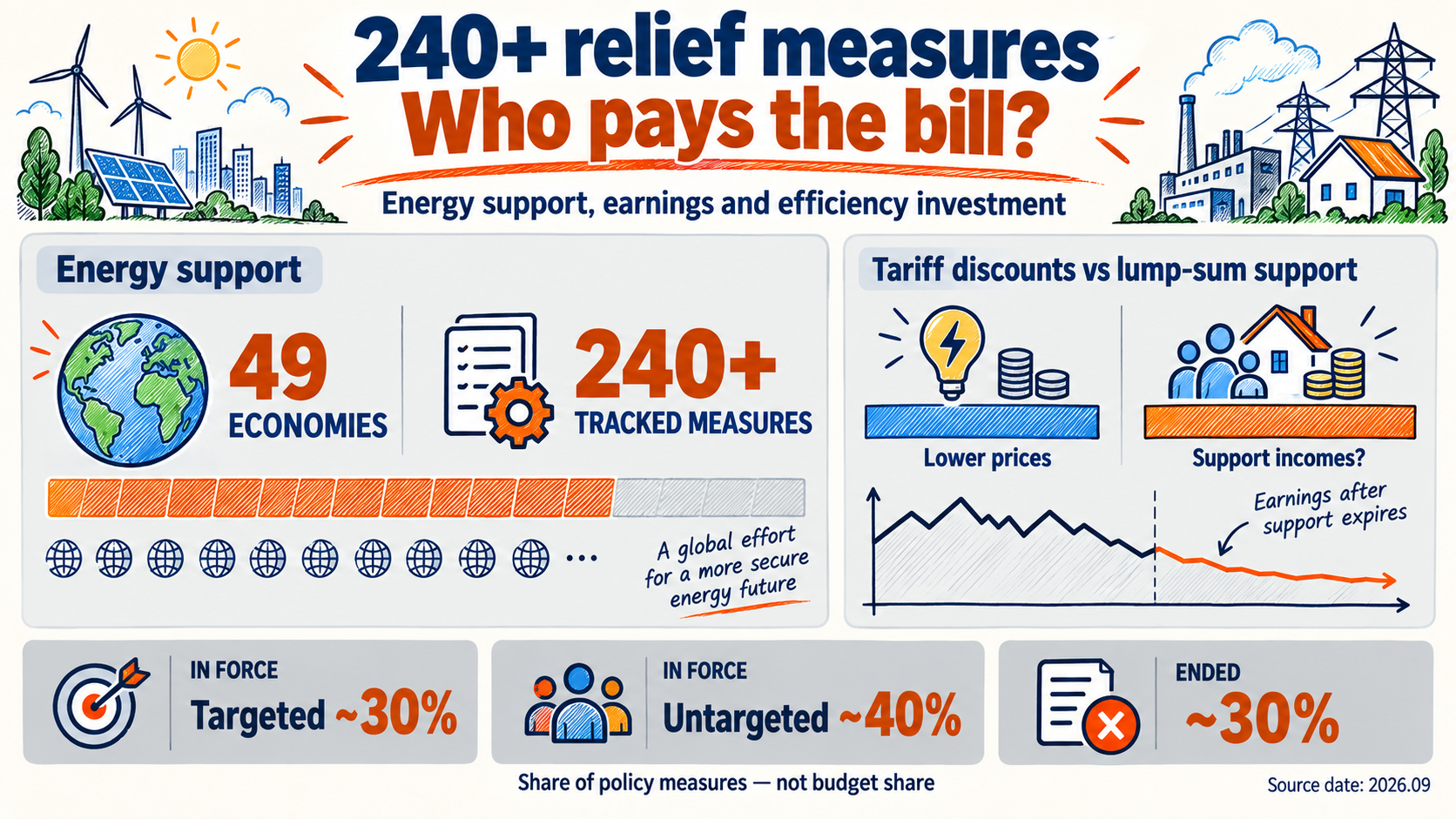
Energy support now spans more than 240 measures across 49 economies in the OECD’s September tracker. But the mechanism matters more than the count. Cutting the price of energy and supplementing a struggling household’s income have different implications for consumption, corporate profits and investment in efficiency. Source: OECD tracker
A discount on a utility bill releases cash immediately. It does not make imported fuel cheaper. Someone must absorb the gap: the budget, the supplier, or customers through later price adjustments. Following that gap helps explain who benefits and for how long.
Energy support: 240 measures are not 240 equal budgets
The tracker describes roughly 30% of all measures as active and targeted, 40% as active and untargeted, and 30% as expired. Targeted means eligibility is limited to particular groups of households or firms. These are shares of policy counts, not spending or benefits received. Source: September tracker
Status of all measures — counts, not budgets. OECD September 2026 tracker. Rounded policy counts, not spending or recipient shares.
One nationwide tax reduction can cost much more than several narrow industry schemes. A large policy count therefore does not establish a large fiscal stimulus. Eligibility, actual payments and timing are the more useful measures of economic impact.
This article uses the tracker page’s rounded categories. It does not combine them with the outlook report’s separately dated figures for expirations and extensions. An expired scheme should not be counted as money still supporting current spending.
Where price relief and income support diverge
A discount proportional to usage gives a larger benefit to a larger energy user. With a fixed transfer, a household keeps more money for other purchases when it saves energy. Both policies ease living costs, but the price of consuming one additional unit is different.
The IMF’s explanation, updated September 14, highlights fiscal costs and the poor targeting of broad energy subsidies. Targeting also needs workable administration: stale income records or complicated applications can exclude people who need help quickly. Source: IMF subsidy overview
Usage-based price discount
Lowers the cost of extra usage
Effect
Trade-off · Larger users receive more
Fixed targeted transfer
Protects purchasing power and saving incentives
Effect
Trade-off · Check exclusions and payment delays
A household whose income has just collapsed may be excluded because last year’s records look comfortable. A scheme that is efficient on paper then fails to protect consumption. Universal relief can arrive faster, but spends money on households that need less help. Speed and accuracy both matter.
For companies, profit and cash can tell different stories
Consider a hypothetical company, not an earnings forecast. Revenue is 100, energy costs are 10 and other costs are 85, leaving operating profit of 5. With prices and output unchanged, a 20% increase in energy costs lifts them to 12 and reduces profit to 3. A cost increase of 2 cuts profit by 40%.
If a subsidy fully reimburses the additional cost of 2, profit returns to 5 in this simplified example. But a delayed payment still leaves the company funding its fuel bill first. The timing gap can require short-term borrowing; actual income recognition depends on the contract and accounting rules.
-
1
Energy cost rises
10 → 12; operating profit 5 → 3
-
2
Assumed reimbursement
Full reimbursement of 2 restores profit to 5
-
3
Before cash arrives
Fuel paid first → possible short-term borrowing
A liquidity loan provides money to buy fuel but does not erase its cost. A temporary cash shortage at a viable business is different from a business that loses money on every sale. Treating both problems alike can delay recognition of persistent losses.
For equity investors, receiving a subsidy is only the start of the analysis. Look at profit excluding support, cash actually collected, and pricing power after expiry. A subcontractor unable to pass on costs may face a different outcome from a supplier with a cost-adjustment clause.
Korea: utility pricing and efficiency investment belong together
For Korea, consider a delay in adjusting utility tariffs when fuel procurement costs rise. Customers initially save money, while the supplier may need cash reserves or borrowing to cover the difference. Customer relief and supplier financing pressure are two sides of the same transaction. This is a transmission analysis, not a report of a newly announced Korean tariff freeze.
The design can also change industrial competition. Prolonged usage-based support can weaken the incentive to replace inefficient equipment. Temporary relief coupled with help for efficiency improvements can preserve operations while reducing future costs. Smaller companies may nevertheless lack the upfront funds to buy new equipment.
The value of efficiency equipment depends on energy saved multiplied by the price the customer actually pays. A broad discount lowers annual savings and lengthens the payback period for the same machine. An energy shock is therefore not automatically good news for efficiency-equipment suppliers: customer tariffs and financing conditions matter together.
Households may cut food or discretionary purchases less when support protects their budgets. Consumption can weaken again if support ends before income catches up. Our earlier article on Related: oil costs reaching Korea traced the original cost shock; this article asks whose balance sheet carries it and for how long.
Why the OECD and IMF insist on exit rules
OECD Secretary-General Mathias Cormann stressed temporary, targeted relief that preserves incentives to save energy in his September 23 remarks. The practical balance is between easing living costs today and preserving the capacity to respond to the next shock. Source: Cormann’s remarks
In the Marshall Islands, the same problem connects imported fuel with public finances. IMF mission chief Ghada Fayad warned on September 17 about the cost of broad relief and weaker incentives to conserve energy, recommending temporary additional support focused on vulnerable households. This staff assessment illustrates the case for targeting. Applying it to Korea requires attention to differences in household incomes and tariff systems. Source: IMF mission statement
The institutional advice converges. The OECD’s September outlook calls for clear exit mechanisms. In their May 20 policy article, Pierre-Olivier Gourinchas and IMF co-authors distinguish household protection from liquidity support for viable small businesses. The choice is whether assistance changes the price itself or the recipient’s capacity to pay. Source: OECD outlook · Source: IMF policy discussion
Borrowed relief money carries an interest bill. Governments protect spending today while committing future budgets to debt service. The effect of additional bond issuance on yields depends on savings, investor demand and monetary policy. For companies, actual borrowing costs matter: higher interest expense can consume part of the earnings restored by relief. Our discussion of Related: bond yields and corporate interest costs develops this connection.
Imagine fuel costs stay unchanged but this month’s bill includes a temporary discount. When the discount expires next month, the same usage costs more. Consumer inflation can reflect that policy change. The key question is whether the increase spreads to prices of other goods and services. Assessing the Fed or Bank of Korea rate outlook requires distinguishing a temporary tariff adjustment from broader inflation pressure. The supplied CNN Fear & Greed reading for September 25 is 37, or fear: higher than a week earlier but still well below the 59.6 reading a month ago, so risk appetite has not fully returned. GoldKimp’s September 22 KOSPI measure is neutral at 55. Different methods and dates limit a direct country comparison. SentimenTrader’s homepage showed blank values on September 28; the latest visible public-post mirror showed Smart Money 0.41, neutral, and Dumb Money 0.35, pessimistic, for September 24. In that backdrop, news of extended relief can bring short-term reassurance, but it should be read alongside the exit conditions the OECD and IMF emphasise so a policy-driven market reaction is not confused with durable profitability.
What to watch in the next earnings release
Start with expiry dates and extension rules. Then ask whether operations generate cash without assistance, whether customers accept price increases, and whether efficiency investment is actually being carried out. A large promised subsidy can coexist with a near-term borrowing squeeze if payment arrives late.
If energy costs decline while relief is phased out predictably, household purchasing power and corporate costs can improve together. If support stops while costs remain high, consumption and profits face a joint squeeze. Repeated extensions can protect sales today while raising questions about fiscal costs and delayed equipment replacement. These are conditional scenarios, not settled forecasts.
A discount on a bill is real help. To understand the economy, follow who pays for it. Durable competitiveness depends on retaining customers and earning a profit when assistance disappears, as well as navigating support while it lasts. This is policy and business analysis, not a recommendation to trade a particular asset.
Ask whether the business can retain customers and profits after support expires.
Sources
- OECD Energy Support Measures Tracker — September 2026
- OECD Interim Economic Outlook — 23 September 2026
- OECD 전망 보도자료 — 23 September 2026
- Mathias Cormann 발표 연설 — 23 September 2026
- IMF — Responding to the Energy and Food Price Shock, 20 May 2026
- IMF Fossil Fuel Subsidies — updated 14 September 2026
- IMF Marshall Islands mission statement — 17 September 2026
For information only — this is not a recommendation to buy or sell any asset.
Comments 0