ETF Guide — Concepts, Korea vs Global Tax & Fees, Top Performers & Outlook
An ETF (exchange-traded fund) is a fund that holds many securities in one basket, then lists shares of that basket on a stock exchange. Most ETFs follow an index — a rule-based list such as KOSPI 200 or the S&P 500 — and trade intraday like a stock, not once a day like many mutual funds.
For Korean investors, where the ETF is listed matters more than the acronym. The same S&P 500 exposure via TIGER (Korea-listed) vs VOO (US-listed) implies different tax, fees, FX, and filing. This article walks through how ETFs work technically, then domestic vs overseas differences, 2026 leaders, and goal-based picks.
Not investment advice. Tax and fees depend on account type (ISA, pension) and date.
What an ETF is — structure
An asset manager builds a portfolio (the basket), then splits it into listed shares. You buy one ticker instead of dozens of stocks.
An index is a rule-based scoreboard — e.g. KOSPI 200 = top 200 Korean stocks by market cap and liquidity. Index tracking means the fund holds the same names in similar weights (KODEX 200, TIGER US S&P 500).
ETFs trade on exchange during market hours. Mutual funds usually price once per day: after the close, assets are valued into NAV (net asset value) = total assets ÷ shares outstanding. That single NAV is often the only buy/sell price until the next day.
ETFs also have NAV, but market price moves all day. Creation/redemption by authorized participants (large brokers swapping stock baskets for ETF shares) helps keep market price near NAV (ICI/Vanguard).
Annual expense ratio is deducted from assets. In Korea, headline 0.00% fees can hide higher all-in cost (실부담비용) — covered in the fees section.
-
1
Index
KOSPI 200·S&P 500
-
2
Manager
Buy to match index
-
3
Portfolio
Basket of stocks
-
4
Listed
Ticker on exchange
-
5
You
Buy like one stock
Mutual fund
Trading · Direct with fund co.
Price · Once-daily NAV
Timing · After close → next day
Intraday · No exchange price
ETF
Trading · On exchange like stock
Price · Intraday market price
NAV · Fair value (calculated)
Gap control · Creation/redemption
Korea vs overseas — tax
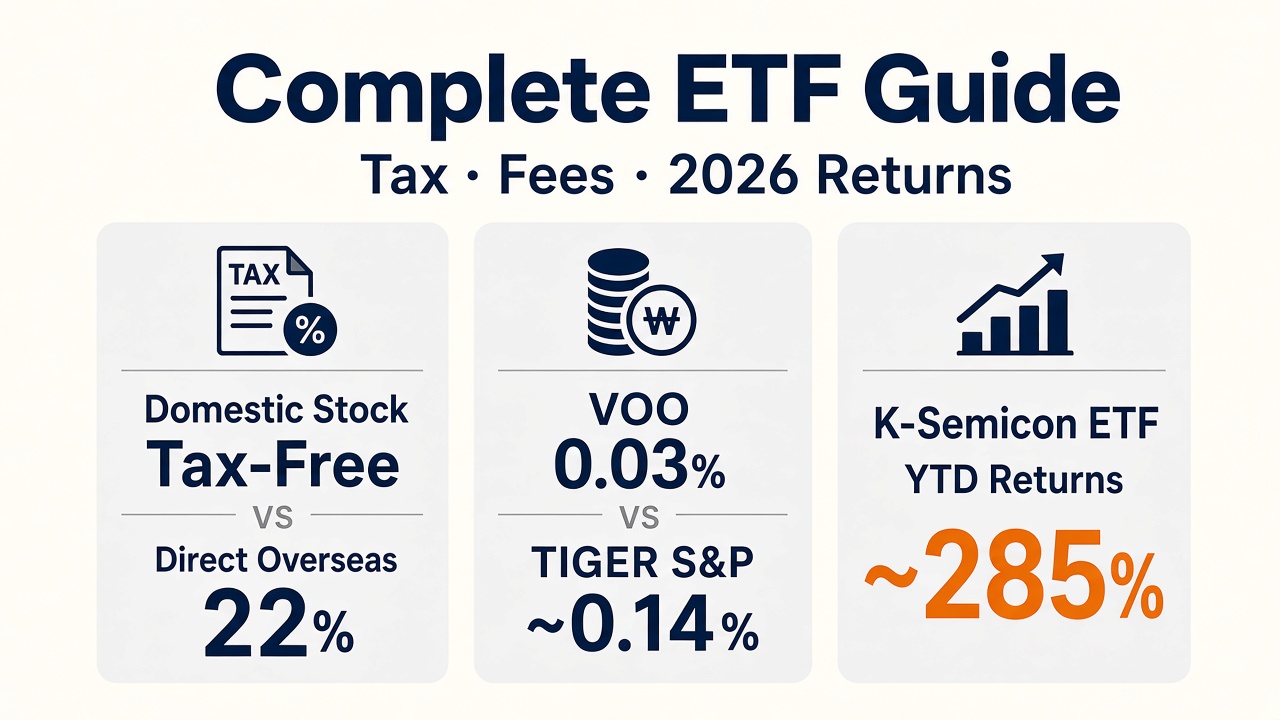
Domestic equity ETF (KODEX 200): trading gains tax-free; distributions 15.4%; securities tax 0.20% on sale (2026).
Korea-listed US exposure (TIGER S&P500): trading gains taxed 15.4% (as dividend income); ISA helps.
US-listed (VOO, SMH): 22% CGT after ₩2.5M/year deduction; US 15% withholding on dividends; May tax filing; FX costs.
Trading gain tax — chart
Domestic vs overseas ETF capital gains tax rates. Trading gain tax rate (%). Korea investor view. Rules vary by account. Not advice.
Fees — headline vs all-in
VOO ~0.03% vs TIGER US S&P500 실부담 ~0.10–0.14% despite 0.0068% headline fee (Asia Today 2026). After-tax, Korea-listed can beat direct US above ~₩8.3M/year trading gains in some models — your mileage varies.
All-in fee — chart
VOO vs Korea S&P ETF fee comparison. Approx. annual all-in cost (%). VOO TER vs Korea S&P 실부담. Not advice.
2026 — what worked (past)
H1 2026 YTD leaders (ex-leverage): HANARO K-semiconductor ~+285%, TIGER 200 IT ~+241%. US SMH ~+52%, SOXX ~+46% (Zacks). Semiconductor concentration in ETF return rankings (Yonhap). Past performance ≠ future.
2026 YTD returns — chart
2026 YTD top ETF returns comparison. 2026 YTD return (%). Non-leverage mix. Past performance ≠ future. Not advice.
Outlook — axes to watch
Core: S&P/Nasdaq via Korea-listed + ISA. Cyclical: SMH/SOXX or KR semi ETFs — hyperscaler capex guidance is the swing factor. Korea beta: KODEX 200 with tax-free trading gains. Avoid confusing leverage products with long-term core.
Picks by goal — three frames
Checklist
Tax class; 실부담비용; ISA/pension; FX hedge; leverage/synthetic; May filing for US direct; liquidity (AUM, volume).
Wrap-up
ETFs are efficient diversifiers, but in Korea listing venue and account drive after-tax outcomes. 2026 rewarded semis/IT; forward, split core index vs chip cycle sleeves.
One line. Match tax, fees, and sleep before chasing last year’s top ticker.
Pick the ETF that matches your tax, fees, and sleep — not just last year’s top ticker.
Sources
- ICI — ETF structure FAQs
- Vanguard — What is an ETF
- SIGLAB — Korea ETF tax 2026
- ETF Index Lab — KR vs overseas listed
- Asia Today — 실부담비용
- Woman Economy — H1 2026 ETF returns
- Yonhap — semi ETF concentration
- Yahoo/Zacks — semiconductor ETFs 2026
- Internal: 2026-06-29-etf-korea-global-guide-session-01.md
For information only — this is not a recommendation to buy or sell any asset.
Comments 0