FOMC Minutes Signal Another Hike: Why Korean Firms’ Dollar Exposure Differs
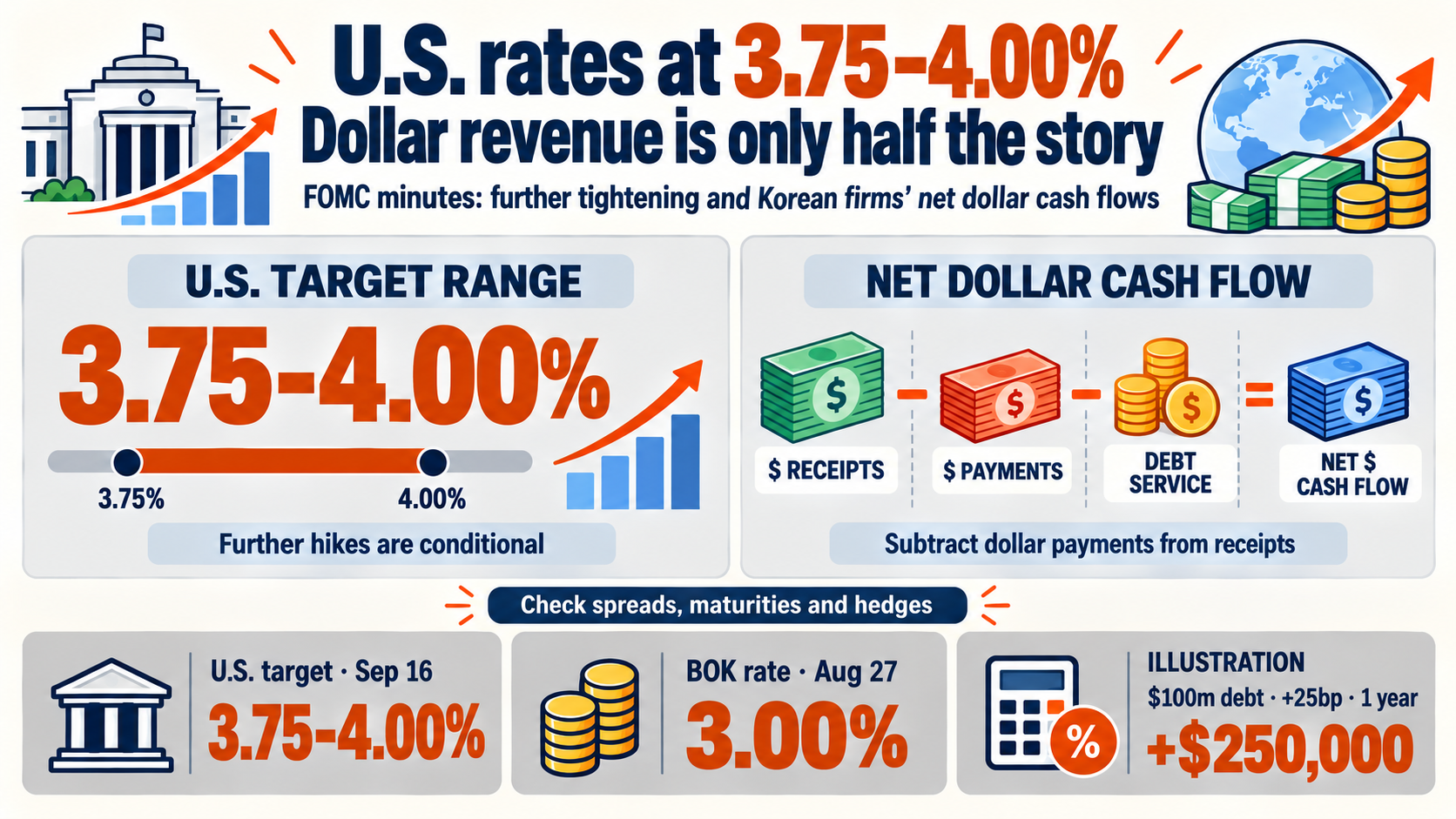
The FOMC minutes released on October 7 point toward another U.S. rate increase by year-end, subject to incoming data. For Korean companies, the practical question is how dollar receipts compare with dollar payments—not simply how much revenue is invoiced in dollars. Source: Federal Reserve — 2026-10-07 의사록 공개 공지 Source: Federal Reserve — 9월 15~16일 FOMC 의사록(PDF, 10월 7일 공개)
The Fed raised its target range by 0.25 percentage point to 3.75–4.00% on September 16. October 7 brought the record of that meeting, not a new rate decision. Keeping those dates separate prevents a stale policy decision from being mistaken for fresh tightening. Source: Federal Reserve — 2026-09-16 FOMC 성명 Source: Federal Reserve — 2026-10-07 의사록 공개 공지
Why the FOMC minutes put more weight on inflation risk
The minutes describe inflation risks as tilted upward and labor-market risks as broadly balanced. That distinction matters: diminished concern about employment gives policymakers more room to address persistent inflation. It does not mean every part of the labor market is overheating. Source: Federal Reserve — 9월 15~16일 FOMC 의사록(PDF, 10월 7일 공개)
How can higher rates help when shortages raise prices? They cannot immediately produce more oil or chips. They can slow demand by making financed purchases and new investment more expensive. If customers become less willing to pay, businesses may find it harder to keep passing rising costs into selling prices.
There is a cost on the other side: higher financing costs can delay factories that would expand supply. Central banks therefore need to judge persistence and economic resilience together. The transmission channels discussed here are economic analysis, not company earnings forecasts.
-
1
Rate expectations
Future financing reprices
-
2
Borrowing costs
New and resetting debt first
-
3
Spending decisions
Delay or reassess returns
-
4
Pricing power
Weaker demand limits increases
Data released after the meeting also matter. On September 30, the Bureau of Economic Analysis reported August PCE inflation of 3.4% year over year and core inflation, excluding food and energy, of 3.0%. PCE tracks prices across household consumption. These published readings should not be mixed with the staff estimates available during the September meeting. Source: BEA — 2026-09-30 발표, 8월 개인소득·지출
August U.S. PCE inflation: year-over-year %. BEA, September 30. Headline and core cover different baskets. · Axis starts at 2.8, not zero
Slower inflation does not mean the price level has fallen. When essential spending grows faster than wages, households can postpone appliances, travel and meals out. Our earlier article on the U.S. consumption–income gap connects to this issue. Export orders can remain firm even as customers become more sensitive to prices.
Warsh, Waller and the Bank of Korea: direction is not a timetable
At his September 16 press conference, Fed Chair Kevin Warsh described the decision as removing some accommodation and said financial conditions were difficult to characterize as restrictive. The implication is that a seemingly high interest rate may still exert limited restraint when companies can readily finance expansion. Source: Kevin Warsh — 2026-09-16 기자회견 전문
On October 8, Governor Christopher Waller said 16 of the 18 participants submitting September rate projections expected at least one further increase this year. He also said increases need not come at consecutive meetings. Those 18 participants are not the number of voters at that meeting, and projections are not a commitment. Source: Christopher Waller — 2026-10-08 The Signaling Value of the Summary of Economic Projections
Waller’s discussion of a 75-basis-point path was a hypothetical example of policy communication. A basis point is one hundredth of a percentage point, so 25 basis points equals 0.25 percentage point. Treating his example as a policy plan would overstate the announced tightening. Source: Christopher Waller — 2026-10-08 The Signaling Value of the Summary of Economic Projections
Korea has its own policy problem. The Bank of Korea raised its base rate to 3.00% on August 27, citing inflation becoming more widespread and financial-stability risks. Its decision cannot be reduced to following the Fed: domestic demand, household borrowing and housing conditions also matter. Source: 한국은행 2026-08-27 통화정책방향 — KDI 공식 정책자료 재게시
Separate the benchmark rate from the credit spread
A Korean company’s dollar bond yield can be viewed as a comparable-maturity U.S. Treasury yield plus a credit spread. The spread compensates investors for issuer risk and trading conditions. A floating-rate loan needs a different check: its contractual benchmark and the date on which the interest rate resets.
These components need not move together. In the intermeeting period described in the minutes, Treasury yields rose while corporate spreads narrowed modestly and the dollar fell. That record does not establish that Korean dollar-credit spreads have since widened or that won depreciation is inevitable. Source: Federal Reserve — 9월 15~16일 FOMC 의사록(PDF, 10월 7일 공개)
Suppose the rate on $100 million of borrowing rises by 25 basis points and stays there for a full year. Annual interest increases by $250,000, assuming immediate repricing of the entire balance. An existing fixed-rate bond does not instantly become more expensive to service; the pressure arrives when debt must be refinanced.
The chart is a sensitivity exercise, not a forecast. If a spread increase adds to the benchmark increase, costs rise further. If stronger earnings reduce the spread, they can offset some benchmark pressure. Credit quality and the maturity schedule therefore matter alongside the rate headline.
Hypothetical $100m debt: extra annual interest ($10,000). Immediate full repricing for one year. Second case: benchmark +25bp and spread +25bp; not a forecast.
Dollar revenue alone does not measure a chip exporter’s exposure
A weaker won can lift the won value of dollar export receipts. But the same company may buy equipment and materials, invest in overseas factories and repay debt in dollars. The useful starting point is the net dollar amount remaining after those payments, and how much of it is exposed to exchange-rate changes.
Consider a hypothetical firm receiving $100 million and paying $60 million in dollar costs plus $20 million of debt principal. It retains $20 million. A rise of KRW 100 per dollar adds KRW 10 billion to translated revenue, but only KRW 2 billion to the translated net cash amount in this simplified example.
Revenue only
$100m
Dollar receipts
Translation gain · KRW10bn
Net cash view
$60m costs + $20m principal
Dollar payments
Retained dollars · $20m
Translation gain · KRW2bn
That KRW 2 billion is not an increase in operating profit or net income: debt-principal repayment is not an income-statement expense. Contracts that fix an exchange rate in advance, as well as differences in payment timing, change cash exposure. Dollars retained for overseas investment may never be immediately sold for won in the domestic spot market.
Differences can widen within an industry. Cash-rich firms with committed orders may keep investing, while suppliers dependent on frequent refinancing are more sensitive to financing costs. Prolonged high rates could translate financing advantages into differences in capacity and bargaining power. This is a conditional industry mechanism, not a claim that a named company has cut investment.
Our earlier discussion of Korea’s uneven export performance provides the industry backdrop. Adding dollar costs, debt maturities and hedging explains why companies in the same chip industry can experience very different outcomes from the same exchange-rate move.
Recovering stocks and sentiment do not remove rate risk
Shares face two competing forces. Orders and pricing can raise expected profits, while higher rates reduce what investors will pay today for profits arriving later. This is the discount-rate effect. Earnings growth can outweigh it, so rising stocks and expectations of rate increases can coexist.
CNN’s Fear & Greed Index stood at 45 on October 9—classified by CNN as Fear, but right at the border with Neutral. It is up about 5 points from a week earlier and 6.8 from a month earlier. That suggests reduced fear, not the disappearance of further-rate-increase risk. Source: CNN Fear & Greed — 제공된 2026-10-09 스냅샷
GoldKimp’s KOSPI measure stood at 61.8, classified as Greed, on October 6. Its label suggests stronger risk appetite than the U.S. reading, but dates and methods differ. Prior-week and prior-month readings for this measure could not be confirmed, so it is too early to say how far Korean sentiment has improved. Source: GoldKimp KOSPI F&G — 제공된 2026-10-06 스냅샷
SentimenTrader’s public post for October 8 showed Smart Money at 0.46 and Dumb Money at 0.45, both Neutral. These are sentiment-model labels, not measured institutional and retail net purchases. They do not establish that large investors are buying. Source: SentimenTrader — Smart / Dumb Money 공식 홈페이지 Source: SentimenTrader 공개 게시물의 TwStalker 재게시 — 2026-10-08 지표
Three things to check before the Bank of Korea’s October 22 meeting
The Bank of Korea’s next policy decision is scheduled for October 22. Further Fed tightening could create pressure through the won and import prices, but the bilateral rate gap alone cannot determine the Korean decision. Relative currency moves, domestic inflation and consumer resilience must be considered together. Source: 한국은행 — 2026년 통화정책방향 결정회의 일정
If U.S. price pressures ease and employment weakens, another increase could be delayed. If demand stays resilient while price increases broaden, the case for tightening strengthens. In either scenario, Korean exporters’ results depend on actual orders and dollar payments as much as the exchange rate.
Three questions make the story concrete: how much debt matures or reprices within a year; how many dollars remain after costs, investment and repayments; and whether customers will accept higher prices. The same 25-basis-point move can be a modest expense for one firm and a reason to reconsider investment for another. This article is economic analysis, not a recommendation to buy or sell an asset.
Sources and references
- Federal Reserve — 2026-10-07 의사록 공개 공지
- Federal Reserve — 9월 15~16일 FOMC 의사록(PDF, 10월 7일 공개)
- Federal Reserve — 2026-09-16 FOMC 성명
- Kevin Warsh — 2026-09-16 기자회견 전문
- Christopher Waller — 2026-10-08 The Signaling Value of the Summary of Economic Projections
- Federal Reserve — 2026-09-16 경제전망(SEP)
- BEA — 2026-09-30 발표, 8월 개인소득·지출
- 한국은행 2026-08-27 통화정책방향 — KDI 공식 정책자료 재게시
- 한국은행 — 2026년 통화정책방향 결정회의 일정
- CNN Fear & Greed — 2026-10-09 기준
- GoldKimp KOSPI F&G — 2026-10-06 기준
- SentimenTrader — Smart / Dumb Money 공식 홈페이지
- SentimenTrader 공개 게시물의 TwStalker 재게시 — 2026-10-08 지표
For information only — this is not a recommendation to buy or sell any asset.
Comments 0