Korea Exchange Rate: What Can Actually Lower USD/KRW?
In June 2026, the Korea exchange rate (USD/KRW) briefly reached 1,561 won per dollar — among the weakest levels since the 2009 crisis. Import prices, travel, and portfolios all feel it.
The question many ask: can authorities actually lower the rate? Here, lowering USD/KRW means a stronger won — fewer won per dollar.
On paper, Seoul has many tools: verbal warnings, FX intervention, National Pension hedges, exporter conversion requests, Bank of Korea rate hikes. So why did 1,500+ persist? This piece maps each method — and where reality gets hard.
An easy analogy: bailing water while the tap is still open. Intervention is a bucket; foreign selling, oil, and a strong dollar are the tap. Reserves (~$427B) are not infinite.
No single answer. Using H1 2026 disclosures, tools to lower Korea’s exchange rate fall into three layers below. Not FX or investment advice.
2026 FX path — why it rose
Ordered in time:
Step 1 — April relief (~1,483)
USD/KRW fell to about 1,483 by end-April as foreign selling eased briefly.
Step 2 — May: 1,500 breaks again
From May 15, 1,500 was retaken. Middle East risk, oil, and foreign outflows dominated.
Step 3 — June spike to ~1,561
Intraday 1,561.5 in early June. Press reports cite ~118 trillion won of foreign net KOSPI selling YTD and Fed hike odds.
Step 4 — 1,550 ‘line’ and intervention talk
Near 1,550, the won bounced; traders suspected dollar-selling intervention. Finance Minister Koo called mid-1,500s excessive vs fundamentals.
Step 5 — Structural dollar demand remains
Markets still price scenarios toward 1,600 (Yonhap, Jun 8). A line in the sand is not the same as a durable downtrend.
Korea FX path — at a glance
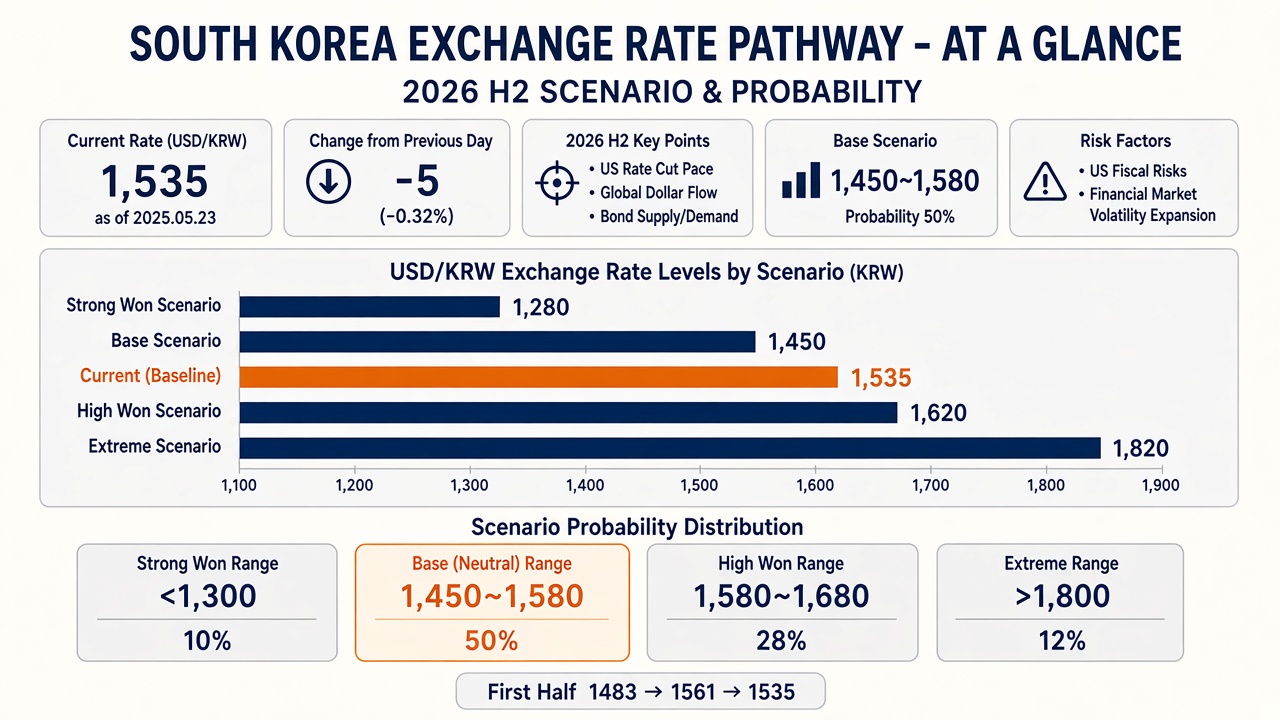
First, the H1 2026 actual path: ~1,483 (Apr) → 1,500+ → ~1,561 (high) → ~1,535 (late Jun).
Korea USD/KRW path April 1483 to June 1561 high. H1 2026 actual path (KRW per USD). Not investment advice. · Axis starts at 1,400, not zero
Four H2 scenarios — turn on the imagination
FX is not one number — it is which events hit, in what order. Below are four “what if” stories for H2 2026. Scenarios, not forecasts — for clarity and a bit of fun.
① “The dollar gets tired” — ~1,280 (<1,300)
Autumn: the Fed opens a cut cycle, Hormuz tension eases and oil drops. Foreigners flip to net KOSPI buying; retail forums fill with “should have sold dollars yesterday.” Airport FX queues shrink; sub-1,300 gets branded “return of the strong won.” With June 2026’s hawkish Fed and ~118T won foreign selling still in memory, four cards must land at once — a tail story.
② “The 1,550 defense drama” — range (1,450–1,580)
July: the BOK hikes and the governor names FX stability. Near 1,550, intervention headlines appear weekly; USD/KRW spars between 1,480 and 1,570. Exporter CFOs debate conversion timing every Monday; authorities say “excessive FX corrected,” but the market keeps 1,600 in the cart. Boring on the surface — often where policy cards linger longest.
③ “The 1,600 retest” — high-FX inertia (1,580–1,680)
Foreign selling does not fade; the Fed signals one more hike. Intraday 1,598, then trader memes: “this time we break 1,600.” Next day 1,602 — headlines scream psychological break; oil, US investment, and chip CAPEX dollar demand all get cited. Travel-app searches jump; YouTube thumbnails say “weak won is the default.” Overlaps the upper band markets already discuss (Yonhap, Jun 8).
④ “The night past 1,800” — stress (>1,800)
A geopolitical shock lifts oil and capital flight together. Intervention headlines run, but the won gaps 30–50 won overnight; “how many weeks of reserves?” tops search trends. NDF positioning debates, emergency meetings, exaggerated “IMF talk” posts — not a 1997 prediction, but the stress-test ceiling traders use. Low odds — but once 1,600 breaks, imagination opens up.
One line to tie them: tired dollar → sub-1,300; defense drama → 1,550 chop; unbroken selling/Fed → 1,600 retest; stacked shocks → past 1,800. Same numbers — different titles depending on who moves first.
Scenario levels — chart
Korea FX scenarios below 1300 above 1800. H2 2026 scenario levels (KRW/USD). Linked to probability section. Not advice.
Probability call — where odds lean
No certainties. Roll the dice once across the four stories above (sum 100%):
• “Tired dollar” <1,300: ~10% — Fed, oil, foreigners, retail mood must align in one shot.
• “1,550 defense drama” 1,450–1,580: ~50% — dull but plausible if intervention, rates, and oil cooperate.
• “1,600 retest” 1,580–1,680: ~28% — if selling and the Fed do not bend.
• “Night past 1,800” >1,800: ~12% — low, but imagination expands after 1,600 breaks.
My lean: more “repeat viewing” around 1,550 than blockbuster extremes — unless 1,600 breaks, when scenarios ③④ gain weight fast. Not a firm forecast.
Scenario probability — chart
Korea FX scenario probabilities H2 2026. Author judgment for H2 2026 (sums to 100%). Not a firm forecast.
Tools authorities use now — limits included
1. Verbal intervention
Cheapest card. June 2026 statements targeted volatility and NDF speculation. Helps sentiment, rarely moves the level sustainably.
2. Spot intervention (sell USD)
High short-term punch (top bar in the chart). Reserves fell to $426.99B by end-May on stabilization measures (BOK). BIS: Korea intervenes to smooth volatility, not to fix a target rate.
3. NPS — $65B FX swap + up to 20% hedge
Swap absorbs NPS spot dollar demand; hedge raises won buying when executed. Hard parts: swaps roll back at maturity; hedge clashes with returns; known trigger levels get front-run.
4. Exporter conversion requests
June 11 meetings urged Samsung, SK hynix and others to convert export dollars quickly (Yonhap). Not mandatory. At high FX, firms profit by waiting — incentive mismatch.
5. BOK rate hike — July signal
Governor flagged hiking before it is too late; July 16 is priced. The hawkish FX signal may matter more than the hike itself — unless Fed stays hawkish too.
Policy tools — relative short-term impact
Korea FX policy tools relative short-term impact index. Relative short-term impact index (100=max). Feasibility discussed in body. Not investment advice.
Chart below ranks near-term help lowering USD/KRW. Feasibility and durability differ — see body text.
Looks powerful — actually hard
Mandatory export repatriation
Forced repatriation was removed in 2017 (Maeil). Reinstating it hits firms, law, and global payment practice — 2026 policy is voluntary urging only.
Capital outflow controls
Would support the won but conflicts with market openness — MSCI cited FX accessibility in keeping Korea in EM.
Slashing NPS overseas allocation
Cuts dollar demand structurally but fights the pension’s return mandate — 2025–26 compromise was higher strategic hedge, not full always-on hedging.
FX target peg
Conflicts with post-1997 float, exporter politics, and manipulator risk.
Near-impossible — yet markets ask
1. Order the Fed weaker. Not in Seoul’s power.
2. Stop foreign equity selling by decree. Flows are price-driven.
3. Reverse the $350B US investment pledge. Structural dollar demand.
4. Unlimited intervention. Reserve depletion and credibility risk.
5. Domestic control of global oil prices. Energy imports still matter for the won.
What to watch
① Intervention near 1,550–1,560 ② July 16 BOK meeting ③ NPS hedge headlines ④ Foreign KOSPI flows ⑤ Fed and oil.
Wrap-up — three layers
Ways to lower Korea’s exchange rate exist — mostly as short buffers, not structural fixes. Intervention, NPS tools, and rates buy time; mandates and controls are largely off the 2026 table.
One-line take. Many cards in the deck — but on hard days Seoul mostly plays ammo cards and speech cards. The rest are locked by law, markets, Washington, and exporter math.
Many cards to lower FX — but ammo and speeches are the ones actually played on hard days.
Sources
- Yonhap — FX authorities June 2026
- Korea Herald — won 16-year low
- JoongAng — foreign selling
- KDI — NPS FX swap
- Asiae — NPS hedge 15%
- Maeil — export proceeds law
- Yonhap — exporter meeting
- Yonhap — FX reserves May 2026
- Internal study: 2026-06-20-krw-exchange-rate-policy-session-01.md
For information only — this is not a recommendation to buy or sell any asset.
Comments 0