Korea September Exports Hit a Record, Up 83.5%: Why Cars Lag Behind Chips
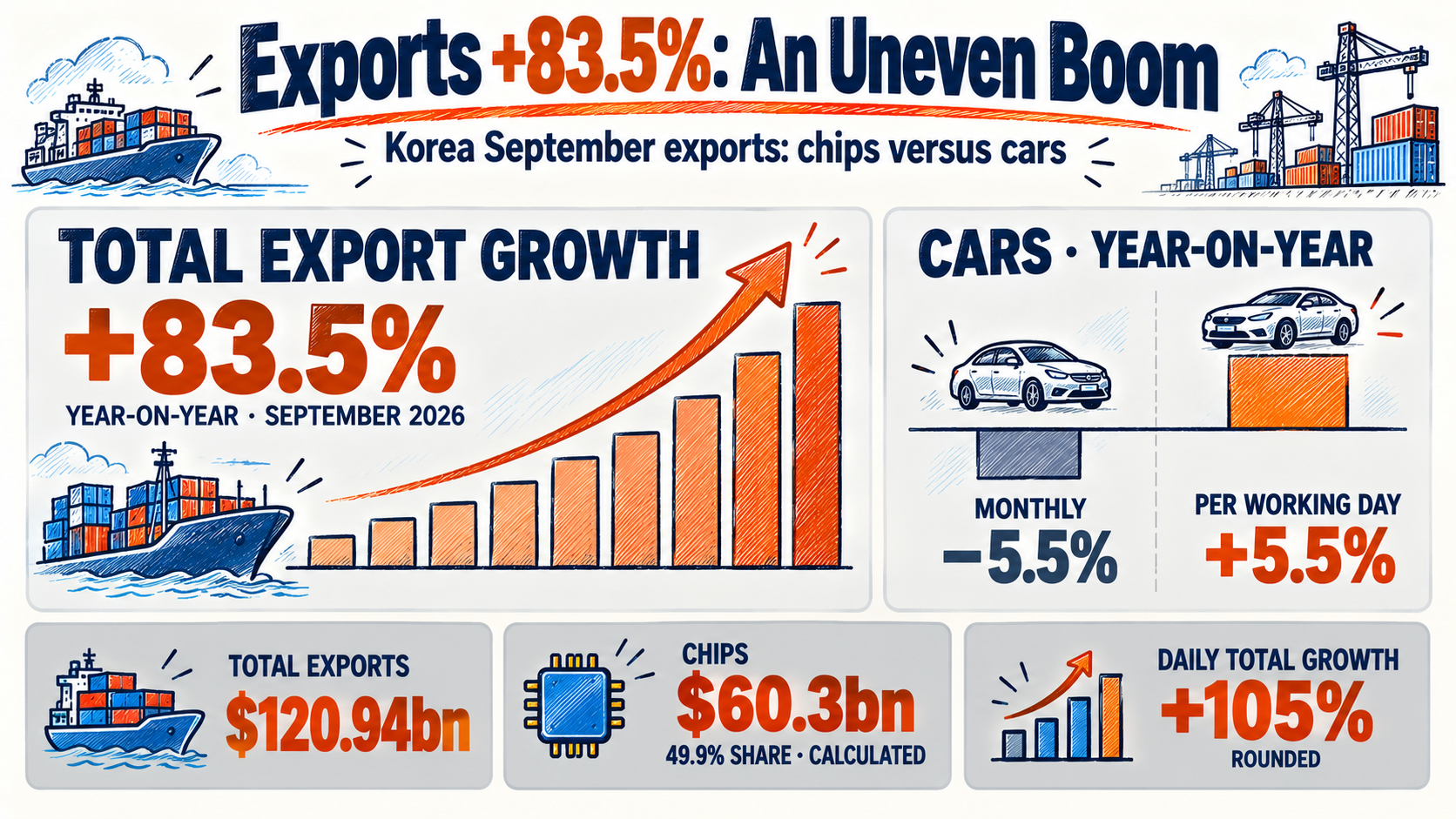
Korea September exports rose 83.5% from a year earlier to $120.94 billion. Chips crossed $60 billion for the first time, while automobile exports fell. To understand that contrast, separate what exporters sold, the prices they received and the working days available. Source: KDI · 산업통상부 발표 요약, 2026-10-01
A record is good news, but export revenue is neither net profit nor money immediately available to households. A chip supplier may receive more orders while another manufacturer postpones investment because of material costs and interest bills. The useful question is how the gains travel through the economy.
The trade figures below are provisional customs data released on October 1. This article is not a recommendation to buy or sell a stock.
Chips made up half of September exports; the other half grew 23% too
Chips accounted for about 49.9% of exports, calculated by dividing $60.3 billion by the total. Non-chip exports also rose 23% in aggregate. Neither “only chips are doing well” nor “every exporter is enjoying the same boom” describes the data accurately. Source: 산업통상부 · 총괄 및 품목
September exports: chips and the rest. MOTIR, Oct 1. Other goods = 1209.4 minus 603, editorial calculation. Values, not growth rates. · Axis starts at 600, not zero
An aggregate follows its largest components. A surge in a category as large as chips can dominate the total even when several smaller industries struggle. The chart shows one product category nearly matching all other goods combined. The second bar includes vehicles, machinery and consumer products, each with different customers and costs.
The same logic applies when reading company results. Korea’s export growth rate cannot simply be pasted into a sales forecast for an individual company. You need its product mix, customer locations and contract repricing schedule before trade data can inform an earnings estimate.
AI investment changes both volumes and the price mix
Chip export growth reflects both shipment expansion and stronger prices. The ministry identifies both channels. Contract-price indicators refer to specified products; they are not an average export price for every kind of semiconductor. Source: 산업통상부 · IT 품목 설명
An AI data center needs memory and storage as well as processors. HBM—high-bandwidth memory—stacks memory chips to deliver data quickly. Selling a larger share of expensive products can lift the export bill much faster than the number of units shipped. This product-mix effect sits alongside changes in like-for-like prices and volumes.
In its July 29 earnings release, SK hynix linked its results to AI infrastructure demand and high-value memory sales. It also reported long-term agreements with around ten customers. That helps assess the durability of demand, but management’s expectation that demand will persist remains a forecast. Source: SK hynix · 2026-07-29
Extra demand does not instantly create production lines, skilled staff or assembly and testing capacity. When supply responds slowly, sellers may gain pricing power. Buyers building servers or electronics face a higher input bill. The same investment cycle can therefore strengthen one company’s margin while squeezing another’s.
This release does not show how much of the increase came from prices and how much from volumes. Treating nominal export growth as an equally large increase in real output would overstate the boom.
Why cars can be down 5.5% and up 5.5% at the same time
Automobile exports were $6.05 billion, down 5.5% year on year, while exports per working day rose 5.5%. The same car exports, with opposite signs. Is one figure wrong? No. The ministry attributed the monthly decline to the shift in Chuseok holidays and weaker used-car exports. Source: 산업통상부 · 모빌리티
There were 21.5 working days, compared with 24 a year earlier. A shop can sell more each day yet report lower monthly revenue if it opens fewer days. Multiply the car-export ratio of 94.5% by 24 divided by 21.5 and the daily ratio is about 105.5%. This is an approximate calculation using rounded inputs. Source: Aju Press · 조업일수, 2026-10-01
Monthly total
−5.5%
Change
Includes · Fewer working days
Per working day
+5.5%
Change
Calculation · Monthly exports ÷ working days
The same calendar adjustment applies to total exports. Reuters reports daily growth of 104.9%; the ministry rounds it to 105%. To me, this is the most striking part of the release: exports hit a record with 2.5 fewer working days. The shorter calendar actually held down monthly growth. Source: Reuters · 2026-10-01
Daily export growth still does not establish that car demand strengthened everywhere. It measures dollars per working day, not vehicle units, a constant new-versus-used mix or a fully seasonally adjusted series. Company earnings also depend on regional sales, discounts and production at overseas factories.
Petroleum export revenue rose 72% while volumes fell: why profits can differ
Petroleum products offer a useful contrast: export revenue rose 72%, but volume fell 6.9%, while crude import prices rose 35.7%. Selling more product and reporting higher revenue because both input and output prices increased are different earnings stories. Source: 산업통상부 · 석유제품 및 수입
A refiner earns the difference between its selling price and the cost of crude and processing. Higher revenue may disappoint if that spread narrows. Chipmakers also face yields, power costs and depreciation. Yield measures how much production becomes usable product; depreciation spreads an equipment purchase over its useful life.
Domestic equipment and materials suppliers face another set of terms. A customer’s higher memory selling price does not automatically raise the supplier’s contract price. New equipment orders, replacement parts and larger deliveries must materialize first. Earnings can arrive at different times even within the semiconductor supply chain.
After the export boom, the test is domestic orders
Trade Minister Kim Jung-kwan praised the export result on October 1 while flagging protectionism and Middle East tensions. In an earlier August 27 press conference, Bank of Korea Governor Shin Hyun-song linked growth to chips and better incomes, while explaining the need to respond pre-emptively to spreading inflation. Strong exports and financing or cost pressures can coexist. Source: 신현송 총재 · 2026-08-27; 김정관 장관 발언은 산업통상부 10월1일 자료 Source: Minister Kim · 2026-10-01
On August 27, the Bank of Korea raised its policy rate from 2.75% to 3.00%, before these September trade numbers were released. One export report cannot predict the next policy decision. It does show why an export boom need not arrive with cheaper borrowing for businesses serving weaker domestic demand. Source: 한국은행 · 통화정책방향, 2026-08-27
For the gains to spread at home, cash retained by exporters must become local factory investment, research or supplier orders, then wages and jobs. Automation can expand capacity with limited hiring, while bonuses can affect spending before new jobs appear.
-
1
Company cash
After costs, taxes and other claims
-
2
Local orders
Factories, R&D and suppliers
-
3
Household income
Wages, jobs and dividends
-
4
Wider spending
After saving and debt repayment
SK hynix’s July statement paired capacity expansion with capital-spending discipline. Even in strong demand, a company need not spend all its cash immediately. Local construction and equipment contracts must be signed and fulfilled for the effects to spread. Households then decide how much extra income to consume, save or use to repay debt. Source: SK hynix · 투자 방침, 2026-07-29
More imported chipmaking equipment is not necessarily bad news. Equipment installed in a Korean factory can build future domestic capacity while raising imports today. But its purchase price does not all become revenue for Korean equipment makers. The location of investment and the supplier’s location are separate questions.
Our earlier discussion of Related: the gap between chip-led growth and jobs follows the same macro story. Beyond the export record, watch whether domestic orders broaden, supplier backlogs become revenue and hiring and local spending follow.
Will a $49.85 billion trade surplus lift the won and stocks?
September’s provisional trade surplus was $49.85 billion. That customs balance does not mean the same amount of dollars was sold for won in the currency market that month. Payment timing, foreign-currency deposits, imported inputs and overseas investment all affect actual conversion demand. Source: Reuters · 무역수지
If exporters sell more dollars to pay domestic wages and construction bills, that can support the won, other things equal. Spending the dollars on foreign factories or equipment weakens that direct conversion effect. Foreign securities flows and Korean purchases of overseas assets also matter. The trade surplus alone cannot establish an exchange-rate target.
A stronger won also has different earnings effects. Dollar revenue translates into fewer won, while dollar-priced inputs can become cheaper. The net result depends on the balance of foreign-currency revenue and costs, plus hedging contracts. This continues the questions raised in our Related: earlier discussion of USD/KRW and capital flows.
Stocks require a distinction between earnings and expectations. The supplied CNN snapshot at 12:24 UTC on October 1 reads 30.7, or Fear, down 5.0 points from a week earlier and 14.1 from a month earlier. GoldKimp’s September 30 KOSPI reading is 59.3, or Greed. Strong exports can coexist with weaker U.S. risk appetite; these readings do not predict which market will rise next. Source: CNN · 제공 스냅샷, 2026-10-01 Source: GoldKimp · 2026-09-30
The indices use different methods and dates, so their numerical gap is not directly comparable. Earlier weekly and monthly readings for the same KOSPI series are unavailable, leaving its trend unclear. Chip shares can fall despite strong results if those results disappoint expectations already embedded in prices.
SentimenTrader’s Smart Money and Dumb Money measures model market optimism using investor behavior indicators. The official homepage did not display current values. The latest accessible mirrored public headline was dated September 24: 41% and 35%. Keep in mind that these are not current official readings. For export stocks, whether earnings beat market expectations matters more than this snapshot. Source: SentimenTrader 공개 게시물 미러 · 2026-09-24 Source: SentimenTrader · 공식 홈페이지
Three things to watch next: volumes, domestic investment and jobs
Start with daily export values and product volumes in the next trade release. Higher volumes could support revenue even as price growth slows. Next, track actual domestic capital spending: are investment plans becoming supplier orders and sales, and are profits holding up after energy, logistics and interest costs? Finally, watch jobs. Hiring, wages and retail sales will show whether export gains are reaching household spending.
The $120.94 billion records the value of goods Korean companies shipped to world markets. It does not flow straight into domestic jobs and consumption. How much firms retain after costs, and where they spend it, will shape how widely the boom is felt.
After the export record, follow retained profits and investment actually made at home.
Sources
- 산업통상부 · 2026년 9월 수출입 동향 · 2026-10-01
- Reuters · September exports rise 83.5% · 2026-10-01
- KDI 경제교육·정보센터 · 산업통상부 발표 요약 · 2026-10-01
- 연합뉴스 · 반도체·자동차 수출 교차확인 · 2026-10-01
- Aju Press · 조업일수 21.5일과 전년 24일 · 2026-10-01
- 한국은행 · 8월 통화정책방향 · 2026-08-27
- 신현송 한국은행 총재 · 8월 기자간담회 · 2026-08-27
- SK하이닉스 · 2분기 실적과 투자 방침 · 2026-07-29
- CNN Fear & Greed · 제공 스냅샷 · 2026-10-01
- GoldKimp KOSPI Fear & Greed · 제공 스냅샷 · 2026-09-30
- SentimenTrader · 공식 페이지 수치 미표시 · 2026-10-01
- SentimenTrader 공개 게시물 재현 · 과거 수치 대체 확인 · 2026-09-24
For information only — this is not a recommendation to buy or sell any asset.
Comments 0