Potash prices — 3 conditions behind the Belarus purchase proposal
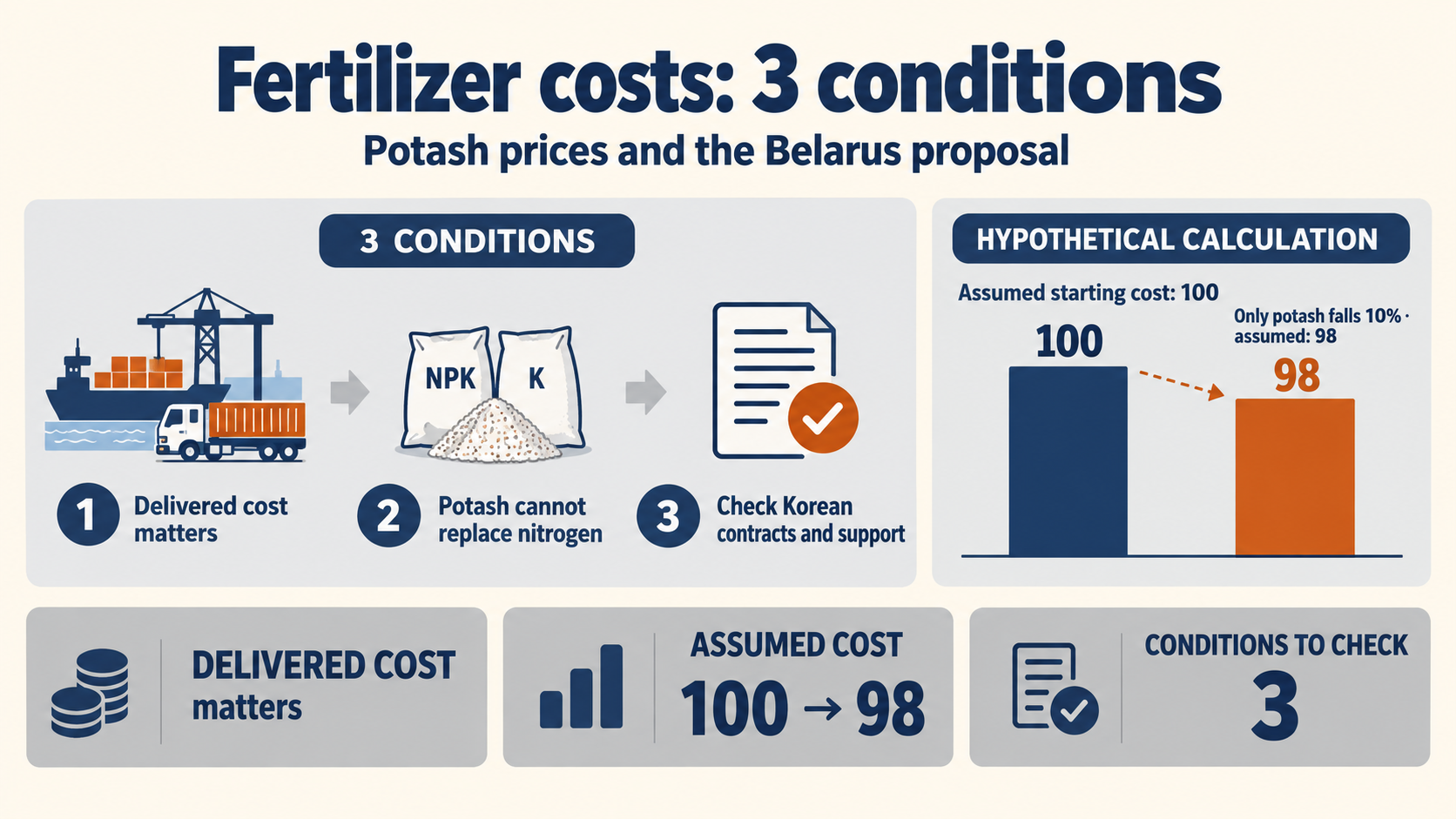
Potash prices are in focus after a new US proposal to buy cheaper fertilizer. Whether Korean farms benefit depends on three things: delivered cost, the nutrient mix and domestic contracts. Several conditions stand between a promise of cheaper purchases and changes in company profits or food prices.
On September 21, Reuters reported that President Trump was pursuing purchases of Belarusian potash at prices below Canadian supplies. The report gives no confirmed volume, unit price or first delivery date. A purchasing proposal is established; realized savings are not. Reuters report
This article uses information reviewed on September 23, 2026. Company forecasts and illustrative calculations are identified separately from reported facts. It does not recommend buying or selling securities.
Potash prices: a cheap contract is only the beginning
An importer compares both the price at the mine and the cost of getting the product to a farm. Freight, insurance, handling and inland delivery can reverse the apparent ranking. Longer transit can also tie up working capital before the fertilizer is available for sale.
Reuters describes transport constraints on Belarusian supplies and Canada’s geographic advantage. A discount at origin therefore cannot establish the size of any saving for US farmers. Reporting on transport constraints
Suppose an identical product costs $30 less per tonne at origin but incurs $40 of extra delivery costs. Its delivered price is $10 higher. These are hypothetical numbers, not current freight estimates. They illustrate why delivery terms matter alongside a negotiated discount.
Global availability is a separate question. Redirecting existing exports to the US does not create more fertilizer worldwide. Restoring production or exports that were previously constrained could have a larger effect on prices. A change of destination and an increase in total supply are different events.
-
1
Contract terms
Volume, price, delivery date
-
2
Delivered cost
Add freight, insurance, financing
-
3
Finished product
Other nutrients, stocks, contracts
-
4
Farmer payment
Distribution and support terms
Three nutrients, three different markets
Fertilizers are not all alike. Potash supplies potassium, one of the three main plant nutrients alongside nitrogen and phosphorus. USGS explains that these nutrients have no substitutes. Adding cheap potassium cannot perform the function of missing nitrogen. USGS explanation
Nutrien’s August 5 release described potash supply as relatively stable, while highlighting trade disruptions and energy costs for nitrogen, and sulfur constraints for phosphate. This is the producer’s assessment, not a definitive measure of conditions in every market. Nutrien release
This distinction matters for companies that blend several nutrients into a finished fertilizer. Cheaper potash can be offset by more expensive inputs elsewhere in the recipe. Investors need to identify the nutrient involved before treating a headline as good news for every fertilizer company.
Take a hypothetical finished-product cost of 100. If potash accounts for 20 and its price falls 10%, total cost drops to 98: a 2% saving. If other nutrients costing 50 also rise 5%, they add 2.5 and total cost becomes 100.5. This is arithmetic using assumed cost shares, not a market forecast or an actual product recipe.
Only potash falls
20 → 18
Potash cost
Other nutrients · Unchanged at 50
Total cost · 98 · down 2%
Other nutrients rise 5%
20 → 18
Potash cost
Other nutrients · 50 → 52.5
Total cost · 100.5 · up 0.5%
The same logic applies to a farm. Lower fertilizer costs do not automatically reduce rent, wages or seed expenses. With yields and crop prices unchanged, savings improve income. If crop selling prices fall by more, farm income can still decline.
Producers and distributors can move in opposite directions
A lower-priced competing supplier can put pressure on potash producers when customers seek better terms. But competition need not spread equally across regions. A producer with economical delivery routes or existing contracts may retain volume or delay some pricing pressure.
In August, Nutrien forecast 2026 global potash shipments of 74–77 million tonnes of product. That is a company forecast, not full-year output already recorded. Proposed Belarusian sales to the US cannot simply be added to it: some may replace shipments to other destinations. Shipment outlook
A blender or distributor may benefit if purchase costs fall while selling prices hold. Expensive inventory creates the opposite risk: market prices can fall before old stock is sold. Volume, margin per unit and inventory levels can therefore be more revealing than revenue alone in the next earnings report.
Investment faces two competing forces. Expectations of persistently lower prices weaken the case for new mines. Facilities that deliver existing output more cheaply or reliably may become more valuable. A single purchasing announcement is insufficient evidence of a coming production or investment boom.
Korean farms experience contracts and subsidies first
MAFRA’s June 8 release illustrates the Korean transmission mechanism. About 97% of inorganic fertilizer supply went through agricultural cooperatives, with prices established through tenders and negotiations with manufacturers. A change in world input prices therefore need not appear in a farmer’s purchase price the next day. MAFRA release
In that announcement, the average selling-price increase per 20kg bag was KRW 3,440. Additional support of KRW 2,560 left an average increase of KRW 880 for farmers. These describe the June measure, with differences across products; they are not current September prices or universal subsidy amounts.
The useful lesson is who bears the change in cost. Old contracts and costly inventories can delay a manufacturer’s savings. Even if the next supply contract is cheaper, the farmer’s net saving depends on support arrangements. Exchange rates, inventory turnover, contract renewal and subsidy terms belong in the same analysis.
For Korean companies paying for inputs in dollars, a weaker won can offset a decline in overseas prices. The world-price trend and the company’s won-denominated cost need not match. Our won–dollar exchange-rate explainer discusses that mechanism; its historical quotes are not used as current exchange rates here.
Food prices and share prices run on different clocks
The following is a conditional economic analysis, not an observed price effect. Cheaper fertilizer could help farms maintain suitable nutrient application and support yields if weather cooperates. Food and feed companies benefit if their actual crop procurement costs subsequently fall. Planting and harvesting take time, and weather can overwhelm the fertilizer effect.
Retail food prices also include processing, packaging, transport and wages. Consumers benefit sooner if competition passes savings through; producers may instead use them to rebuild margins. Household spending power could improve, but this proposal alone does not establish a change in inflation or the path of policy rates.
Equities can react before earnings do. An announcement-day price move is not proof of durable profit changes. Potash producers require scrutiny of realized prices and volume; blenders of input costs and inventory; food companies of crop-purchase contracts. No announcement-driven share-price effect or price target is asserted here.
The next evidence must go beyond the promised discount
An August 31 joint statement involving the World Bank emphasized investment in blending, storage, transport and efficient fertilizer use as well as production. Availability at a mine and timely access at a farm are different problems. Joint statement
Three sets of evidence will clarify the outcome: contracted volume, delivered price and schedule; an actual increase in global availability beyond rerouting; and savings reflected in Korea’s next supply contracts and farmers’ net payments. Undisclosed terms should remain undisclosed in the analysis.
Even if potash becomes cheaper, benefits arrive at different times and in different amounts. The farm’s final bill matters more than the discount at the mine. For Korean businesses, the decisive details are what they buy, when they buy it and the contracts under which they sell. For consumers, the question is whether savings reach food prices.
The saving that matters to a farmer appears on the final bill.
Sources
For information only — this is not a recommendation to buy or sell any asset.
Comments 0