US housing starts rebound 7.6% — why builders keep discounting
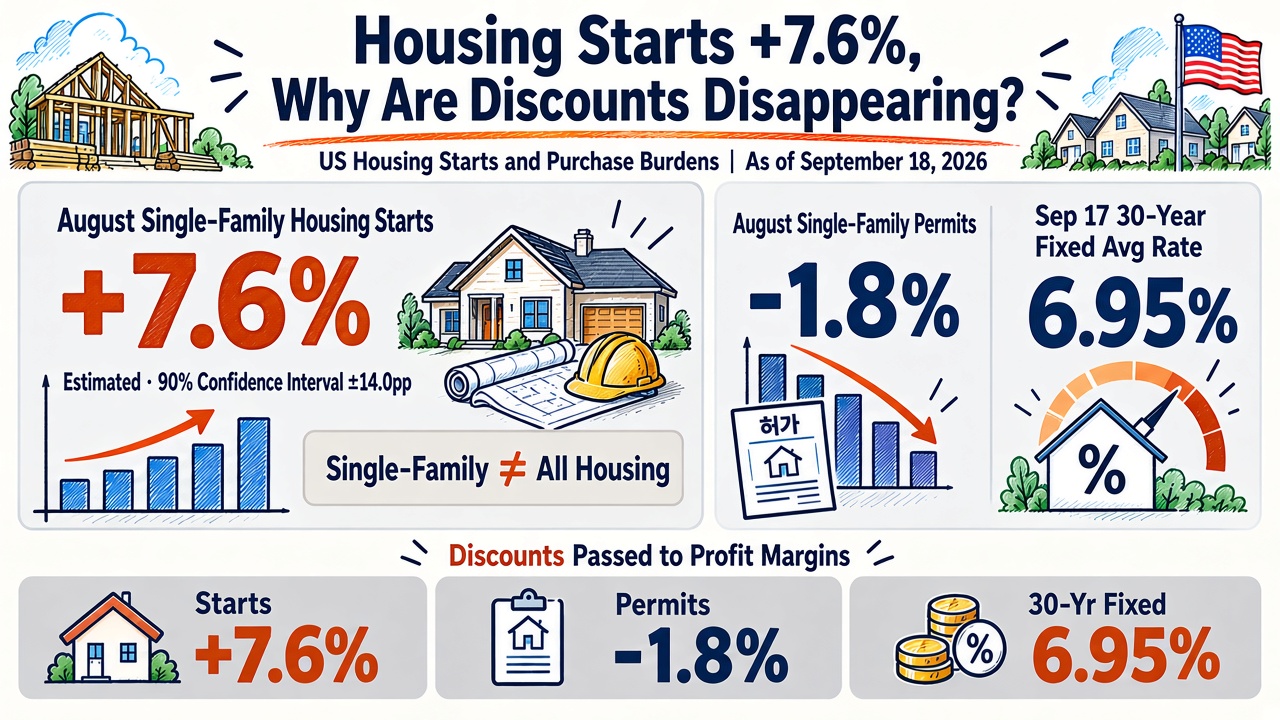
Are US housing starts recovering? Estimated single-family starts rose 7.6% in August, while permits for future construction fell 1.8%. The gap helps explain why builders may have to spend more to sell homes, and how that pressure can reach appliance and building-material suppliers.
The construction figures come from the September 17 Census Bureau and HUD release. Freddie Mac reported a 6.95% average 30-year fixed mortgage rate that day. More single-family projects began in August, but financing a purchase remains difficult.
Information is current as of September 18, 2026. Reported figures are read within their survey scope and statistical uncertainty; calculations and conditional implications for Korean companies are identified separately. This is not a recommendation to buy or sell an asset.
The 7.6% rebound: what the number measures
Single-family starts were 918,000 units and permits 878,000. Both are seasonally adjusted annual rates: estimates of August’s pace expressed on an annual basis after seasonal adjustment. The figures come from the Census and HUD release.
Single-family and total construction moved in different directions. Estimated total starts, including multifamily housing, fell 2.6% from July. The rebound occurred within the single-family segment.
The estimated change carries sampling uncertainty. Its 90% confidence interval is plus or minus 14.0 percentage points, spanning both a decline and an increase. Neither the single-family rebound nor the decline in total starts is statistically significant. Revisions and several months of data will help clarify the direction.
Permits and starts reflect decisions made at different times
A permit authorizes construction; a start means work has begun. A builder can begin previously permitted projects while scaling back new commitments. That timing difference allows permits and starts to move in opposite directions in the same month.
Weather, the regional mix of projects and construction schedules also affect monthly starts. This release shows more single-family projects getting under way alongside fewer new permits. September mortgage data describe subsequent buying conditions.
Even after receiving a permit, builders can postpone work if sales expectations or financing weaken. The pace from authorization to construction and completion changes with the cycle. Permit trends, orders and cancellations together help indicate whether activity can be sustained.
What a 6.95% mortgage does to a household budget
Freddie Mac’s September 17 weekly average was 6.95%, up from 6.76% the previous week and 6.26% a year earlier. It averages eligible mortgage applications; individual rates vary with creditworthiness and loan terms.
Consider an illustrative $400,000 loan repaid in equal monthly installments over 30 years. Principal and interest are about $2,465 at 6.26%, versus $2,648 at 6.95%. The same principal costs roughly $182 more each month. Taxes, insurance and fees are excluded.
Monthly payment on the same $400,000 loan. Illustrative calculation: 360 monthly payments; taxes, insurance and fees excluded. Rates: Freddie Mac, September 17, 2026 and year-earlier comparison. · Axis starts at 2,300, not zero
In the same calculation, keeping the monthly payment budget unchanged reduces affordable principal by about 6.9%. Buyers can add cash, choose a smaller property or postpone moving. Reduced borrowing capacity can weaken transactions first and then prompt sellers to adjust prices.
Mortgage rates reflect long-term yields and compensation for risks in securities backed by home loans. Their timing and magnitude can therefore differ from changes in the central bank’s policy rate. Our article on long-term Treasury yields and financing costs explains the connection.
Builders can defend sales while giving up profit
NAHB’s September survey put builder confidence at 32, down three points. Some 38% of respondents cut prices and 66% used sales incentives. The average 6% cut applies specifically to respondents that reduced prices.
Sales incentives are benefits intended to close a purchase. Builders might help pay to lower the buyer’s mortgage rate or include upgrades. Even with an unchanged headline price, these costs reduce what the builder retains. The burden varies with the package and contract terms.
Profit can fall faster than revenue. In a simplified calculation, a home priced at 100 with a cost of 80 produces a profit of 20. Cut the price by 6% with costs unchanged and profit falls to 14. A 6% price reduction becomes a 30% profit decline in this example.
-
1
Payment burden
Smaller buying budget
-
2
Sales support
Discount and financing costs
-
3
Profit and cash
Margin versus inventory conversion
-
4
Future projects
Possible land and start adjustments
A quicker sale at a discount can nevertheless reduce total costs. Holding a completed home ties up land and construction spending and adds interest and maintenance expenses. Builders weigh the profit surrendered against the cost of holding the home longer. Inventory conversion matters alongside selling prices.
Costs may be difficult to cut. NAHB identifies material expenses and worker shortages as pressures. If buyers resist higher prices while costs stay elevated, builders have a reason to reduce future land purchases or starts. That is an economic inference from the survey, not a measured forecast of investment.
The transmission to Korean suppliers comes with a lag
Refrigerators and washing machines from appliance makers such as Samsung Electronics and LG Electronics make the connection tangible. The following is conditional analysis of the transmission, ahead of any company-specific earnings forecast. Early construction requires structural materials; flooring, kitchen equipment and appliances come closer to completion and occupancy. Changes in starts reach product sales with corresponding lags.
Even for refrigerators, demand for a new home differs from replacing a broken appliance. New-home installations respond to occupancy, while replacements also depend on the age of existing appliances and household spending capacity. Commercial heating and cooling equipment calls for a separate look at office and factory investment.
Distributor inventories can amplify or cushion the effect. If retailers cut stock as sales slow, factory shipments can fall faster than final purchases. With inventories already low, the reduction in new orders could be smaller. Earnings disclosures on US residential demand, channel inventory and promotional costs can help distinguish these cases.
These differences can also change suppliers’ customer mix. Well-funded builders have more capacity to continue financing support and land purchases, while cash-constrained firms may postpone projects. A persistent gap could raise larger builders’ market share. For appliance and materials suppliers, the relevant questions become which builders they serve and how those customers negotiate volumes and discount costs.
A recovery needs confirmation from orders and margins
Slower building can reduce residential investment and related work. Fewer moves can restrain spending on furniture and appliances. Existing fixed-rate borrowers, however, do not immediately pay more just because new-loan rates rise. Pressure initially concentrates on new buyers and households considering a move.
Asset prices can respond ahead of earnings. Housing-related shares may rally on expectations of lower long-term rates, while continuing incentives delay a profit recovery. Rates can also fall because employment and income prospects are deteriorating, leaving buyers reluctant to commit. The reason for falling rates matters.
Watch the multi-month permit trend, new orders and cancellations first. Then check whether incentives per home, margins and completed inventory improve together. More orders can still leave a builder with less profit if the cost of securing each order rises faster.
The evidence shows a rebound in estimated single-family starts, weaker permits and more widespread discounting. A durable recovery remains an open question. My interpretation is that the ability to win orders without increasingly costly concessions will be a better guide to the next earnings cycle than a single month of starts.
After counting starts, follow the profit builders retain after incentives.
Sources
- U.S. Census Bureau·HUD — August 2026 New Residential Construction (2026-09-17)
- Freddie Mac — PMMS, September 17, 2026
- NAHB — Builder Sentiment Falls on Higher Interest Rates and Costs (2026-09-16)
- Reuters — US single-family housing starts rebound in August; building permits fall (2026-09-17, MarketScreener 재전재)
For information only — this is not a recommendation to buy or sell any asset.
Comments 0