World Bank Private Capital Mobilization: Will $112 Billion Turn Into Korean Orders?
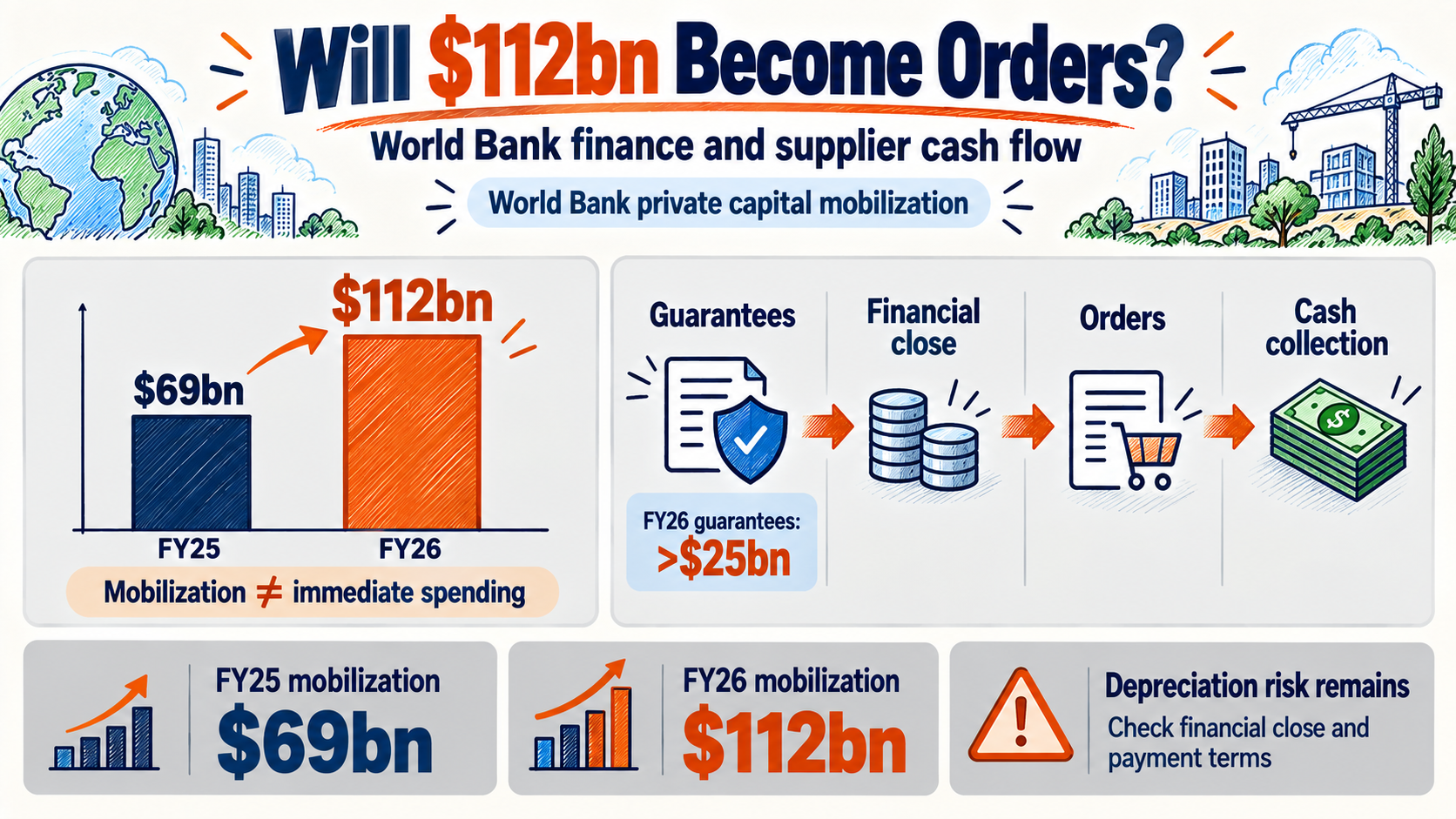
World Bank private capital mobilization reached $112 billion in fiscal 2026. That can broaden financing for projects in developing economies. For Korean suppliers, however, a financing announcement still needs to become a funded contract, a delivery and a payment. Source: World Bank · 9/17
Imagine a power project with capable engineers and potential customers, but no lender willing to commit. If the buyer is a state utility, lenders may worry about whether the contract will survive a change of government. Better equipment cannot resolve that concern. A credible allocation of losses sometimes can.
World Bank private capital mobilization is not the same as spending
Reuters reported on September 17 that mobilization rose from $69 billion in the previous fiscal year to $112 billion in the year ended June. This is an annual financing measure, not an injection made during September. Source: Reuters · 9/17
Private capital mobilization. Reuters, September 17. Annual mobilization, not immediate disbursement.
A financing commitment can precede construction spending by a considerable period. Land acquisition or permits may delay disbursement. Suppliers then face their own delivery milestones and payment terms. A rise in mobilization therefore cannot be used as a forecast for their profit growth.
The World Bank also reported more than $25 billion in guarantees. A guarantee promises protection against specified losses; it is not an equivalent cash disbursement. Adding it mechanically to mobilization would mix different measures. Source: World Bank · guarantees
Removing specific reasons for lenders to say no
MIGA houses the World Bank Group Guarantee Platform. Its menu separates political risk protection from credit and trade finance guarantees. Government contract breaches and restrictions on converting or transferring currency are examples of risks addressed. Coverage depends on the product and contract. Source: MIGA · guarantee products
The mechanism is straightforward, though the outcome is conditional. If a credible guarantor takes specified losses, a lender may consider a lower risk premium or a longer maturity. Financial close means the financing arrangements are completed under the required conditions. That can allow the sponsor to authorize construction.
-
1
Risk sharing
Specified losses allocated to guarantor
-
2
Financial close
Financing and conditions completed
-
3
Orders and delivery
Contracts move into execution
-
4
Cash collection
Payment under agreed terms
Guarantee fees still need to be paid. A modest saving on loan interest may be outweighed by fees and currency protection costs. Sponsors also need equity and a credible customer base. Better risk sharing complements a viable business; it does not create one.
The problem with earning locally and repaying dollars
MIGA explicitly distinguishes an inability to convert or transfer currency from currency depreciation. Its conversion and transfer restriction product does not cover a fall in the currency’s value. Source: MIGA · currency coverage
Conversion or transfer restriction
Legal conversion or transfer is blocked
Problem
Response · Check contractual coverage conditions
Currency depreciation
Local revenue buys fewer dollars
Problem
Response · Not covered by this product
A power producer paid in local currency may struggle to service dollar debt after depreciation even when transfers remain legal. Local currency borrowing or a tariff adjustment clause can change that exposure. Neither is free: the cost may appear in borrowing rates or customer bills.
This connects with our earlier discussion of the won-dollar exchange rate. For an overseas project, the currencies of revenue and debt matter alongside the direction of exchange rates. Korean suppliers also need to distinguish a translation gain on dollar orders from profit earned on the underlying contract. Related: 원달러 환율과 기업의 통화 노출
Households and small businesses face two possible effects. Reliable power can reduce disruptions and the cost of running backup generators. But tariffs designed to recover investment may squeeze spending elsewhere. More infrastructure finance does not automatically mean lower living costs.
A guarantee cannot lower global rates
World Bank Group President Ajay Banga stressed on September 17 that the number matters if the capital creates opportunity and jobs. The useful follow-up is therefore to track real projects and employment, rather than treat the financing total as the final outcome. Source: Ajay Banga · 9/17
In her September 1 G20 statement, IMF Managing Director Kristalina Georgieva explained that rising advanced-economy yields lift borrowing costs elsewhere, while debt service constrains development spending. The IMF’s emphasis on sound policies and reforms complements guarantees: deteriorating sovereign finances can undermine a project’s improved risk profile. Source: Kristalina Georgieva · IMF 9/1
Think of a loan rate as a benchmark plus compensation for specific risks. A guarantee may reduce the second part while leaving the first intact. That extends our earlier discussion of how Treasury yields reach corporate financing costs. Related: 미국 국채금리와 기업 이자비용
The supplied September 29 CNN snapshot reads 31.8, or fear, down from 35.0 a week earlier and 53.7 a month earlier. Such caution helps frame why risk protection may matter, but an equity sentiment index does not measure development-finance pricing. Source: CNN · supplied snapshot
GoldKimp’s September 28 Korean reading is 56.7, or greed. Its methodology and date differ from CNN’s; no comparable Korean weekly or monthly history was supplied. SentimenTrader’s homepage did not expose its live values. An accessible mirror of its September 24 public post shows Smart Money at 0.41 and Dumb Money at 0.35. These are dated fallback readings, not verified current values or measures of cash flows. Source: GoldKimp · supplied snapshot Source: SentimenTrader · official attempt Source: 9/24 public-post mirror
For Korean suppliers, payment terms matter alongside orders
The following is conditional industry analysis, not a report of new Korean contracts. Funded power, grid and water projects can create bidding opportunities for Korean contractors and equipment suppliers. Competition may pass some financing benefits to buyers through lower bids, so a larger addressable market does not ensure higher margins.
Equipment makers need to examine advance payments and balances due on delivery. Buying materials well before collecting payment can consume cash during an order boom. Contractors must also identify who bears delays and cost overruns. Protection against a specified buyer risk does not imply protection against every construction loss.
Firms with financing and contract expertise may gain an advantage in this market. Smaller suppliers can participate through main contractors, yet may have less bargaining power over payment schedules. Investors should ask who benefits from a guarantee and which obligation it covers, rather than stop at the word guaranteed.
The last number to watch is cash collected
Consider an illustrative contract with revenue of 100, delivery costs of 90 and financing costs of 4. The amount left before other expenses and tax is 6. Lower financing costs of 2 raise it to 8, but delivery costs of 93 reduce it to 5. This is arithmetic, not a company forecast.
Lower financing costs can be offset. Hypothetical revenue less delivery and financing costs, before other expenses and tax; not an operating profit forecast.
Asset prices can move before contracts arrive. A stock that already discounts an order boom may not rise on encouraging financing news. Conversely, financial close and advance payments can improve earnings visibility before reported revenue changes much. Contract progress is more direct evidence than a broad sentiment score.
Watch whether financed projects proceed to procurement, whether suppliers collect receivables and whether contracts can withstand currency weakness. Operational projects can support employment and consumption, but the size and timing depend on execution and local sourcing. The economic value of the financing channel will emerge in projects that complete that journey.
Information cutoff: September 30, 2026, Korea time. Dated announcements are distinguished from conditional analysis and hypothetical calculations. This article does not recommend buying or selling a security.
Follow financial close, contract terms and cash collected.
Sources
- 세계은행, FY26 민간자본 유치 발표 · 2026-09-17
- Reuters, 세계은행 민간자본 유치 보도 · 2026-09-17
- IMF, 게오르기에바 G20 발언 · 2026-09-01
- MIGA, 보증 상품과 적용 범위
- MIGA, 환전·송금 제한 보장과 환율 하락 제외
- MIGA, 투자보증 안내 · 2023-05-30
- CNN Fear & Greed · 제공 스냅샷 2026-09-29
- GoldKimp KOSPI F&G · 제공 스냅샷 2026-09-28
- SentimenTrader 공식 홈페이지 · 수치 동적 표시 미확인
- SentimenTrader 공개 게시물 재현 · 2026-09-24 수치
For information only — this is not a recommendation to buy or sell any asset.
Comments 0