Low-carbon concrete durability: a 4-city climate model and potential repair costs
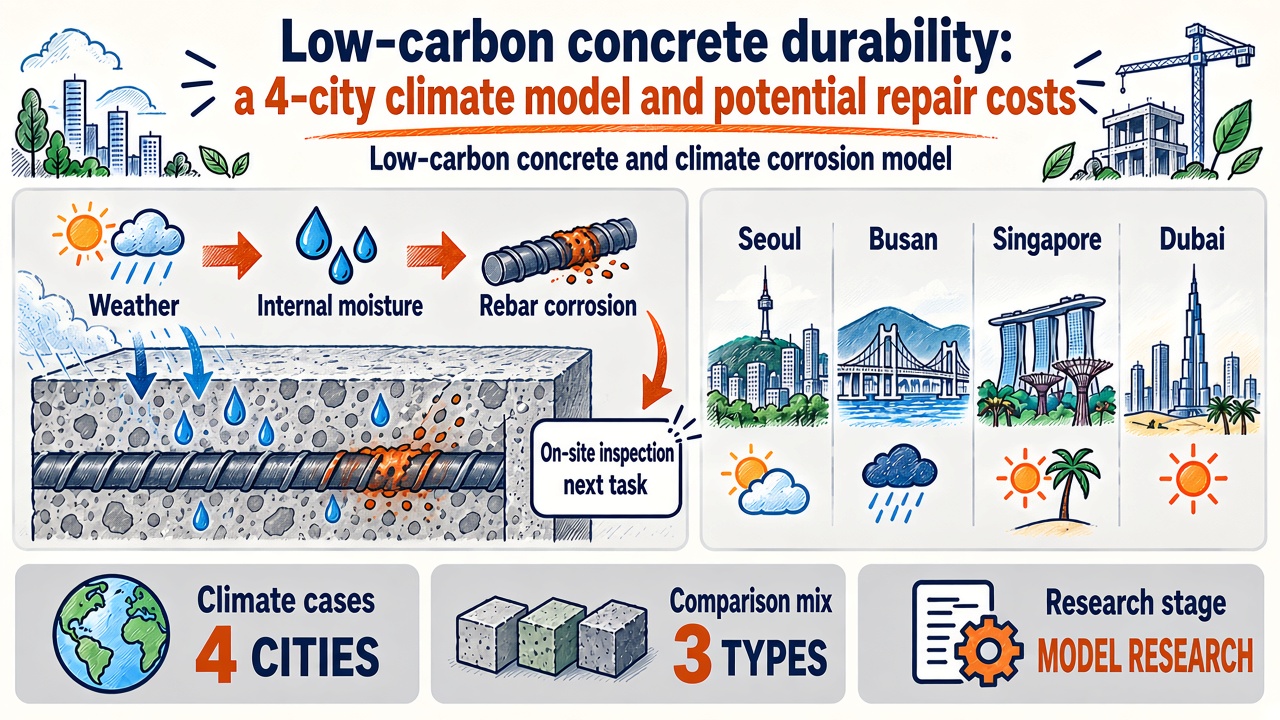
Low-carbon concrete durability depends partly on local weather. ETH Zurich researchers used a model with weather records from four cities to calculate moisture changes around steel and the progress of corrosion. If those predictions hold up in the field, they could change how owners choose materials and budget for repairs. Nature Communications paper
Whether buying an apartment building or a bridge, an owner is purchasing decades of service as well as tonnes of material. A cheap mix becomes expensive if it needs early repairs. An unnecessarily restrictive assessment can also be costly by ruling out a suitable alternative. Those two mistakes make durability prediction an economic problem.
Published on 21 August 2026 in Nature Communications, the paper is available as a peer-reviewed Article in Press; ETH released an explanation on 7 September. It concerns how materials are assessed. It does not announce a commercial cement product. ETH research explanation
Why low-carbon concrete durability raises questions
Cement binds sand and gravel into concrete. Its central ingredient, clinker, is made in a hot kiln. Both the fuel and the chemical reactions release carbon dioxide. Replacing some clinker with other constituents is therefore one established route to lower emissions. IEA cement analysis
Steel reinforcement benefits from the protective film supported by concrete’s high alkalinity. Carbonation—the reaction caused by carbon dioxide entering concrete—lowers that alkalinity. Some low-clinker mixes carbonate faster, raising questions about protection of the embedded steel. Full paper: carbonation and steel protection
Loss of protection and accumulated structural damage are different events. The researchers focus on the interval between them. My interpretation is that a better assessment of this interval could change which materials qualify for the same service requirement.
Calculating corrosion time after carbonation
Earlier models already consider climate. This framework extends the treatment of corrosion after carbonation, linking weather over time, moisture transport inside concrete, and the relationship between saturation and corrosion rate. Full paper: proposed framework and earlier approaches
-
1
Local weather
Rain and humidity over time
-
2
Internal moisture
Water transport through material
-
3
Steel corrosion
Progress after carbonation
The case studies combine three mixes with conditions in Zurich, Bergen, Manaus and Huailai. They are calculations using weather and material data, not decades-long observations of buildings constructed in those four cities. ETH: the four-location comparison
For a designer, the useful question expands from when carbonation arrives to how quickly damage accumulates afterwards. That creates room to assess environmental performance alongside operating conditions. A model calculation alone still cannot guarantee a structure’s lifetime.
Potential savings extend beyond the material invoice
The following economic effects are my conditional analysis, not savings measured in the paper. The first potential change is a broader purchasing choice. If a validated method demonstrates that another mix meets local requirements, an owner can include it in competitive bids.
Lower carbon does not automatically mean lower cost. Transporting substitutes over long distances or processing them can consume the saving. IEA identified local supply, transport and standards as barriers to blended cement deployment in its 2019 innovation analysis; that is structural context, not a current price estimate. IEA: substitute materials and adoption barriers
A second opportunity is better repair timing. Owners pay for inspection, repair and disruption. With reliable predictions, they could direct inspections towards components likely to deteriorate sooner and review whether interventions on healthier components are necessary. This is a proposed use of better information, not an outcome demonstrated by the study.
Consider a repair that closes a bridge. The work invoice is only part of the decision; disruption also matters. A contractor paid solely for construction and an operator responsible for decades of maintenance have different incentives to purchase better predictions. Contract terms determine who has a reason to pay for the tool.
-
1
Validation expense
Collect data and establish errors
-
2
Design and purchasing
Compare qualified alternatives
-
3
Whole-life cost
Material, tests, repair and disruption
A third possibility is more efficient design review. A validated model could help decide which candidate mixes deserve expensive testing. It would be premature to say it replaces required tests. Early adopters may instead face additional spending on data collection, calibration and independent checks.
What Holcim’s 31% figure tells us
There is already a commercial market for lower-carbon concrete. Holcim reported that ECOPact represented 31% of its ready-mix net sales in 2025, versus a restated 26% in 2024. That is a five-percentage-point increase in one company’s sales mix, not global market share or volume share. Holcim FY2025 results
Here is the interesting part: a commercial market already exists while researchers work on better durability assessment. The 2025 sales figures predate the 2026 paper, so they cannot demonstrate its adoption or success. The business question is whether a better assessment method could expand the projects and applications that existing products can serve.
Competition could increasingly include the evidence sold with the material. A supplier offering mix-specific tests and credible local durability documentation may reduce a customer’s review burden. Building that evidence costs money, which may favour larger businesses. Independent laboratories or shared datasets could help smaller suppliers compete; that is a business inference.
Verification services could be an early business opportunity
Potential businesses include software linking weather and material records, laboratory validation, and monitoring that checks model predictions against actual structures. These are possible follow-on services. The research does not establish that the authors have launched those products or won commercial contracts.
Substitution would likely be incremental. Easier qualification and competitive substitute supply could shift some demand away from clinker while increasing demand for testing and quality assurance. A practical starting scenario is a change in the ingredients and services sold by existing suppliers. Wholesale replacement of the cement industry is not established by this work.
A similar discipline applies to other industrial research: examine the assumptions behind the performance claim. Our article on dilute-CO₂ electrolysis explores why a projected production cost requires careful interpretation. Related: cost assumptions in dilute-CO₂ electrolysis
Our screen-printed solar-cell article offers another comparison between a laboratory result and manufacturing economics. For concrete, a business case also has to account for long-term durability. Related: screen-printed solar cells and manufacturing cost
What still needs to happen before local deployment
This is not a ready-to-use design tool. The authors identify limited corrosion data for newer low-carbon mixes and the risk of missing peaks when using average rates. Its scope is carbonation-induced corrosion; it does not validate performance against chloride exposure or freeze–thaw damage. Full paper: scope and data limitations
For a Korean deployment, I would first ask for prediction errors measured against local mixes and real structures, then ask how component-level exposure and construction variability are handled. These are proposed deployment checks. Korea was not one of the four case-study locations.
A concrete business case would need a field-validation report, an accepted qualification route, and a cost estimate including additional tests. Without those, a percentage reduction in maintenance cost remains a planning assumption. This article is an analysis of research and industry economics, not a recommendation to trade any company’s shares.
Wider adoption requires evidence both of lower emissions and of dependable service. The study offers a way to examine those requirements together. The next useful milestone is how well its predictions match actual structures; only then can a credible cost-saving case be built.
Material selection needs evidence of both lower emissions and dependable service.
Sources and further reading
For information only — this is not a recommendation to buy or sell any asset.
Comments 0