Dilute CO₂ Electrolysis in 2026 — Can Formic Acid Reach $0.47/kg Without Purification?
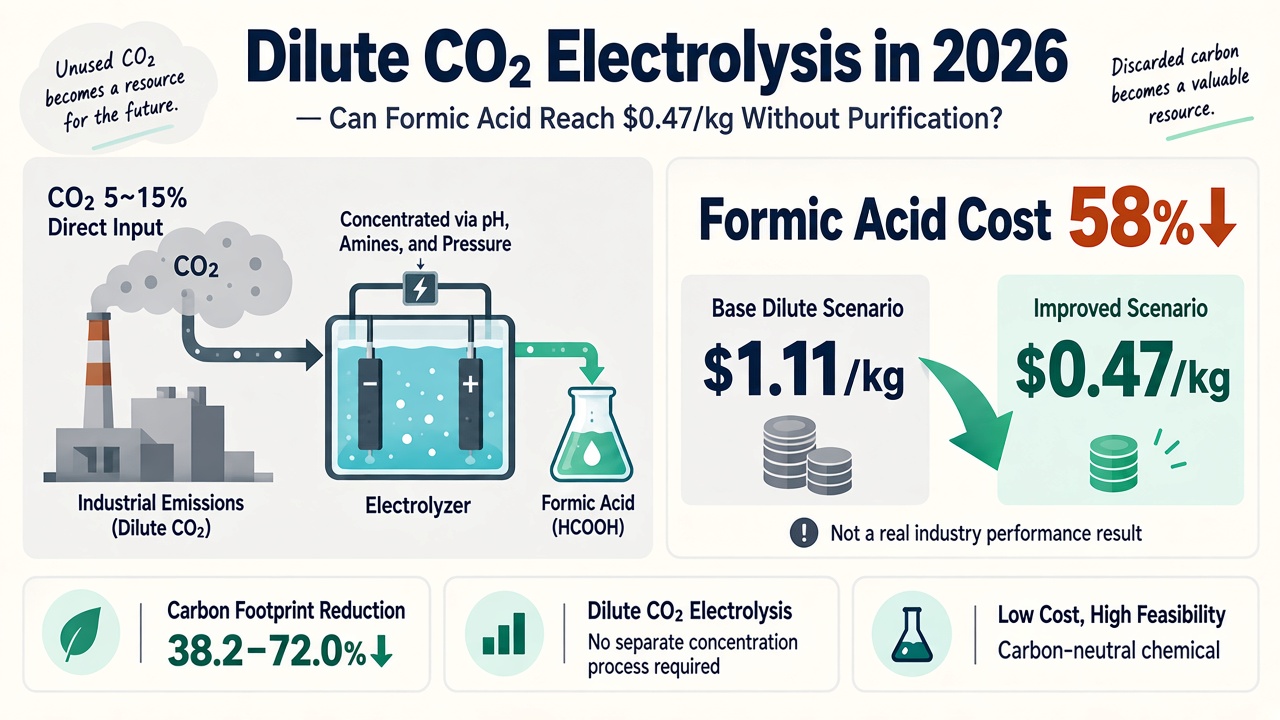
Dilute CO₂ electrolysis could reorder one of the costliest parts of carbon utilization. In a Nature Communications paper published on September 5, 2026, researchers fed gas containing only 5–15% CO₂. When the experimental results were used in a process model, formic-acid cost fell from $1.11 to $0.47 per kilogram. The key change was CO₂ supply immediately in front of the electrode, not simply a new catalyst material.
The $0.47 figure does not come from the accounts of an operating factory. It is a techno-economic estimate based on experiments. Its significance is narrower but still substantial: the study links interface performance to the possibility of shrinking some costly capture, purification and conversion steps.
This article does not recommend buying or selling any technology or company. It separates reported findings from industrial outlook and inference.
What dilute CO₂ electrolysis is trying to remove
Industrial exhaust is not a tank of pure CO₂. It contains nitrogen, water vapor, oxygen and contaminants, while the CO₂ share is often low. Electrochemical CO₂ reduction uses electricity to turn that CO₂ into feedstocks such as carbon monoxide or formic acid. Many laboratory systems, however, are designed to consume purified CO₂.
A conventional chain first captures CO₂ with a solvent. Heat then releases it for purification and compression before it enters an electrolyzer. A 2026 Chinese Chemical Letters review says capture and purification can account for up to 30% of the energy used across the utilization chain. Considerable energy is spent before carbon becomes a feedstock.
Direct dilute-gas electrolysis tries to shorten that chain. Instead of making the feed perfectly clean, it makes the electrolyzer tolerate low concentration. The economic prize appears only if solvent regeneration, compression and contaminant handling also shrink in a real plant.
-
1
Dilute exhaust
5–15% CO₂ plus other gases
-
2
Conventional: capture and purify
Heat, compression and equipment
-
3
Direct: enrich interface
Improve CO₂ supply at electrode
-
4
Formic acid
Liquid chemical feedstock
Why hydrogen takes over when CO₂ is dilute
At the cathode, CO₂ reduction competes with hydrogen production from water. When CO₂ is dilute, too few molecules reach the electrode surface. Electrons do not wait. Abundant water reacts instead, increasing unwanted hydrogen and reducing the share of current that makes the target product.
The paper’s concentration overpotential is the extra voltage caused by this local shortage. Raising voltage increases electricity demand and heat losses. That is why the CO₂ concentration at the catalyst interface can matter more than the concentration in the bulk gas.
Change the millimeter before the catalyst
The team changed interfacial supply in three ways. It adjusted pH to alter the balance of reactive CO₂ species, added amines that hold CO₂ nearby, and increased gas pressure so more CO₂ entered the liquid and electrode region. The catalyst therefore experienced a richer local supply despite receiving dilute exhaust.
Earlier work had already used molecular coatings to create a CO₂-rich microenvironment. A 2024 Dalian Institute of Chemical Physics report described 90% carbon-monoxide selectivity and a 252 mA/cm² partial current density with 10% CO₂. The new study moves beyond one coating record by comparing pH, amines and pressure using common economic and environmental measures.
No strategy
CO₂-starved
Interface
Competing reaction · More hydrogen
pH, amine, pressure
More available CO₂
Interface
Goal · Better selectivity and efficiency
The economics of $0.47 formic acid
In the model, dilute flue gas without an enrichment strategy produced formic acid at $1.11/kg. The optimized interfacial scenario reached $0.47/kg, a reduction of roughly 58%. It also came below the paper’s $0.58/kg comparison case using pure CO₂.
Savings arise twice. Better selectivity wastes less electricity per kilogram of product. Avoiding a highly purified feed can also reduce upstream separation costs. An improvement inside the cell can therefore affect the cost of equipment before the cell.
Modeled formic acid cost comparison of $1.11 $0.47 and $0.58 per kilogram. Nature Communications techno-economic analysis; not commercial plant performance.
The $0.47 estimate should not be treated as a current market quote or proof of commercialization. Plant economics depend on electricity contracts, stack life, catalyst replacement, amine recovery, compression efficiency and product purification. The authors also note that the electricity mix changes absolute results. This number is a map of possibility, not a factory receipt.
Who saves money, and who gains a market?
Cement, steel and chemical plants with dilute emissions are plausible early hosts. Even if purification is not eliminated, smaller equipment could lower steam demand, footprint and transport requirements. Modular units beside a stack might convert carbon into liquid formic acid or formate rather than sending it through a distant pipeline.
Formic acid is used in leather and textile processing, feed preservation, deicing and chemical synthesis. It is also studied as a liquid hydrogen carrier. If CO₂-derived output displaced some methanol-based production, buyers could reduce fossil feedstock use and perhaps carbon costs. But carbon released after use is recycling, not permanent removal.
The third opportunity is equipment and electricity. Dilute-gas electrodes, gas-diffusion layers (porous sheets that spread gas evenly to the electrode), membranes, power electronics, compressors and process-control software would form a new supply chain. Some demand for centralized CO₂ purification and transport could be displaced. The outcome depends on how long direct electrolyzers tolerate real contaminants.
Beyond the lab: how far have companies and public funding moved?
The sector remains closer to demonstration funding than large recurring revenue. Natural Resources Canada is supporting an active C$867,500 project led by CO2L Technologies to advance electrochemical CO₂ conversion toward pre-industrial production of formic acid, formate salts and desiccants. It is separate from the paper, but it shows which products are entering scale-up trials.
IEAGHG identified six CO₂ electrolysis pathways—including carbon monoxide, syngas, formic acid and ethylene—as mature enough above technology readiness level 4 for an initial techno-economic assessment. TRL 4 means components validated in a laboratory environment. It is far from a chemical plant running steadily for years. Investors should watch large-stack operating hours and separation cost before headline efficiency.
Carbon utilization does not automatically mean carbon reduction
The paper’s life-cycle assessment found 38.2–72.0% lower burdens, including climate impact and cumulative energy demand, than dilute flue gas without the strategies. Those results depend on system boundaries and electricity assumptions. Coal-heavy power or rapid release of product carbon can erase much of the climate benefit.
The IEA likewise says benefits depend on carbon source, the incumbent product displaced, power carbon intensity and how long carbon stays in the product. Roughly 230 million tonnes of CO₂ are used globally each year, mainly for urea and enhanced oil recovery. New chemical routes have potential, but still depend heavily on policy and inexpensive low-carbon electricity.
Four numbers that will decide commercialization
A new efficiency record is not enough. Real flue gas contains sulfur oxides, nitrogen oxides, oxygen and particles. A small electrode that works for hours is not the same as a large stack that survives for years.
- Continuous operating hours and degradation rate with realistic contaminants
- Full-cell voltage and electricity consumed per kilogram of formic acid
- Product concentration and energy required for downstream purification
- Amine and electrolyte recovery rates plus large-stack replacement interval
The paper’s most important contribution is a change in the question: from how fast a catalyst runs on pure CO₂ to how much money and carbon an entire process saves with exhaust fed directly. If the $0.47 estimate is reproduced at plant scale, capture could move closer to an on-site chemical business rather than remaining only a cost center. Long-duration operation on real exhaust is the test still waiting behind the number.
Related reading
The real breakthrough starts when plant economics work on messy exhaust, not purified CO₂.
Sources
- Nature Communications: Interfacial engineering strategies and sustainability assessment for direct electrolysis of dilute CO2 streams
- Chinese Chemical Letters: From flue to fuel
- IEA: Carbon capture, utilisation and storage
- IEA: Putting CO2 to Use
- Natural Resources Canada: Electrochemical CO2 Conversion
- IEAGHG: Techno-Economic Assessment of Electrochemical CO2 Conversion Technologies
- Dalian Institute of Chemical Physics: New Strategy Boosts Direct Electrolysis of Dilute Carbon Dioxide
For information only — this is not a recommendation to buy or sell any asset.
Comments 0