Self-Driving Labs 2026: How a US$5,000 Lab and 27.22% Solar Cells Reshape R&D Costs
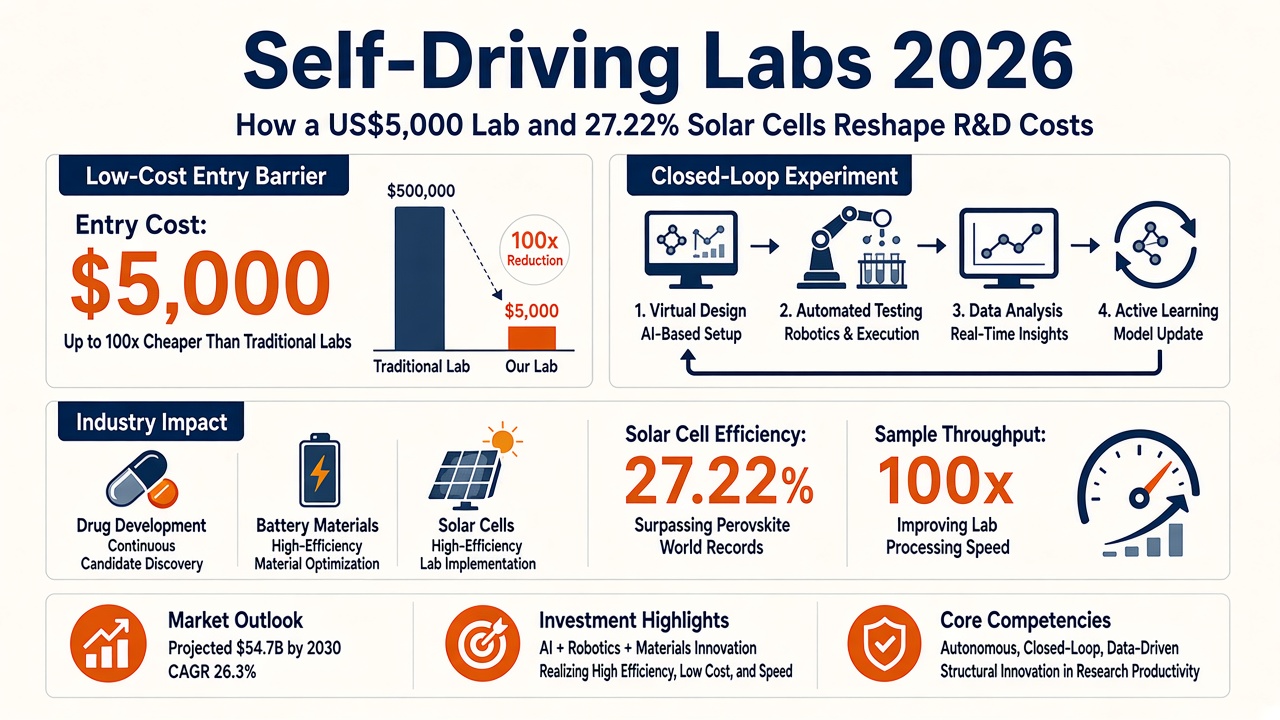
Self-driving labs are no longer a distant idea. Papers published in 2026 already show a low-cost lab built for about US$5,000, a 27.22%-efficient perovskite solar cell made inside an autonomous loop, and a materials workflow that replaced 55,566 search points with 150 experiments.
The key is not the robot arm. The key is the closed loop. The system now chooses the next experiment, runs it, reads the result, and feeds failure back into the next decision. Once that works reliably, R&D becomes less constrained by headcount and more constrained by iteration speed and data quality.
Why self-driving labs suddenly matter in 2026
The timeline matters. On April 13, 2026, Nature Synthesis published RoboChem-Flex, a modular self-driving lab costing about US$5,000. On April 14, 2026, Nature published an autonomous platform that delivered a 27.22% perovskite solar cell. More robotics and materials papers followed in May, and by July, Nature Reviews Chemistry and Communications Materials had framed the field as a coherent research wave.
So 2026 is not just another year of clever automation demos. It is the year in which lower entry cost, real performance outcomes, and field-level synthesis showed up together. As of September 2, 2026, that looks more like early industrialization than a passing curiosity.
What makes it different from older automation
Traditional lab automation usually means a human writes the protocol and a machine repeats it precisely. That is excellent for moving liquids, controlling temperature, and scaling a predefined workflow. But humans still decide which candidate to test next, why a failure happened, and when the objective should change.
Traditional automation
Predefined by humans
Experiment choice
Strength · Repeatability
Limitation · Humans still choose the next step
Self-driving labs
Model narrows the next candidate
Experiment choice
Strength · Reduces the cost and time of failure
Requirement · Robots, sensors, and data must run in a closed loop
Self-driving labs go one step further. Across the latest papers, the shared pattern is goal setting, experiment selection, automated execution, result interpretation, and redesign of the next experiment. In plain language, automation replaces hands, while self-driving labs reduce the order and cost of trial and error. That is why the first economic gain may come less from labor savings and more from cheaper failure.
What 27.22% solar cells and 370x fewer tests actually prove
The most eye-catching case is solar. The Nature paper combined machine-learning-driven materials discovery with automated manufacturing and reported a 27.22% small-area perovskite solar cell and a 23.49% 21.4-cm² mini-module. The bigger point is not the record alone. The platform also delivered efficiency reproducibility nearly five times higher than manual fabrication. In manufacturing, repeatability often matters more than a single best number.
In materials engineering, the ExMech paper is even easier to translate into money. The authors used just 150 mechanical tests to identify the Pareto front, the boundary of best trade-offs, for plate lattice metamaterials, versus 55,566 tests in exhaustive search. That is a roughly 370-fold reduction in experimental workload. In aerospace, tooling, and advanced sporting goods, fewer prototype cycles means less wasted capital.
Bar chart comparing experiment counts in the ExMech study. Values from the Nature Communications ExMech paper.
Breadth matters too. PoLARIS handled double-perovskite nanoplatelets involving up to six elements in an autonomous microfluidic system and pushed beyond optimization into reaction inference. Older automation was often about running a fixed process faster. Recent self-driving labs are increasingly about narrowing a huge search space on their own.
Why this matters scientifically
The most expensive part of science is not always the instrument. It is the experiment that fails without explaining why, the workflow that produces different results from one researcher to another, and the dataset too fragmented for the next team to reuse. The Nature Reviews Chemistry review emphasizes provenance-complete experimentation, meaning complete end-to-end recording of the experimental process, for exactly this reason.
This also explains why self-driving labs are different from general-purpose AI. A text model can answer instantly. A self-driving lab still has to build a sample, break it, measure it, and deal with the physical world. The real bottleneck is therefore not a single model. It is the stack of sensors, robots, interfaces, reagents, power, cooling, and safety rules.
From here, the economic interpretation begins
What follows is interpretation rather than a direct claim from the papers. In my view, the first economic effects of self-driving labs will show up in four places: lower failure cost, shorter development cycles, better yield through higher reproducibility, and a new operating-system market that bundles instruments with software.
-
1
Narrow candidates
Fewer unnecessary combinations and reruns
-
2
Cheaper failure
More search under the same budget
-
3
Better reproducibility
Higher yield and faster validation
-
4
Operating-system market
Bundled sales of hardware, software, and maintenance
First, entry cost. RoboChem-Flex does not replace every premium instrument, but about US$5,000 is enough to weaken the old assumption that autonomous experimentation belongs only to major corporations or national labs. Once entry cost falls, the opportunity expands beyond hardware sales into APIs, data systems, validation, and maintenance.
Second, development productivity. If repeated testing falls sharply, as in ExMech, the same budget can cover more candidates. That does not just speed up papers. It increases pipeline capacity for materials companies, battery makers, and industrial chemistry teams.
Third, incumbent equipment vendors are already large enough to matter. Danaher reported 2025 revenue of US$7.293 billion in Biotechnology and US$7.334 billion in Life Sciences. Thermo Fisher reported US$10.374 billion in Life Sciences Solutions and US$7.554 billion in Analytical Instruments. Agilent is already packaging automated workflows, remote monitoring, cost reduction, and yield improvement as digital-lab products. That suggests early revenue may attach faster to the lab stack than to the model layer.
Bar chart comparing 2025 revenue in key lab-equipment segments. Based on Danaher 2025 Annual Report and Thermo Fisher 2025 Form 10-K.
Fourth, industry substitution. Over time, some contract research organizations, routine analytical services, contract development and manufacturing organizations, and outsourced process-optimization work may face margin pressure. The more realistic change, though, is not the disappearance of scientists. It is a shift in human work toward defining objectives, checking edge cases, and validating conclusions.
Which industries benefit first
Materials sectors should move first: solar, catalysts, batteries, and advanced coatings. The reason is simple. They have huge combinatorial search spaces, and each experiment directly informs the next candidate. Self-driving labs fit that problem unusually well.
Biopharma is the second wave. Regulation slows the path to revenue, but target discovery, assay development, and process optimization are natural fits. Linked with recent work on drug delivery, the same bottlenecks appear again: repeated experimentation and manufacturing reproducibility.
From an investment perspective, it is also worth resisting the obvious narrative. Market attention usually goes first to model companies, but early revenue may attach faster to liquid handling, sensors, analytical instruments, lab-data software, and power and cooling infrastructure. The IEA makes a similar point about AI more broadly: bottlenecks migrate from code to electricity and hardware supply chains.
- Near-term beneficiaries: robotics automation, liquid handling, sensors, lab data software
- Mid-term beneficiaries: materials companies with large search spaces such as solar, batteries, and catalysts
- Long-term industry shifts: bioprocessing, CDMOs, research services, lab-ops SaaS
- Key caution: a strong paper is not the same as immediate commercial revenue
The constraints are still real
There are clear reasons not to get carried away. Every lab still uses different equipment combinations, which makes general software difficult. Robots can repeat workflows, but reagent variability, calibration drift, and exception handling remain hard. In biotech and pharma, record-keeping and safety requirements are even heavier.
So the near-term picture is not a scientist-free lab. It is a lab that can run more experiments with fewer wasted cycles and learn more from each failure. That is already a meaningful economic shift.
The numbers are real, the market is early
The real story of self-driving labs in 2026 is not the slogan that AI will do science by itself. It is that measurable numbers are starting to stack up: a US$5,000 entry point, a 27.22% solar cell, and a roughly 370-fold cut in experimental burden. Even if we stay only with what the papers directly confirmed, the cost structure of R&D is beginning to change. My economic reading is that instruments, software, power, and bioprocess infrastructure may feel the first wave. That interpretation is mine, not the papers’, and it is not investment advice. For a wider science-and-economy frame, see this related post.
The real value of self-driving labs is not replacing scientists. It is making failure cheaper, faster, and more informative.
Sources
- Nature Reviews Chemistry (2026-07-31) — The past, present and future of self-driving laboratories
- Nature (2026-04-14 / VOR 2026-05-13) — Autonomous closed-loop framework for reproducible perovskite solar cells
- Nature Synthesis (2026-04-13) — A flexible and affordable self-driving laboratory for automated reaction optimization
- Nature Communications (2026-03-14) — Experimental mechanician for plate lattice metamaterial discovery
- Nature Communications (2026-05-04) — Autonomous microfluidic experimentation for exploring reaction inference and synthesizing double perovskite nanoplatelets
- Communications Materials (2026-07-08) — Managing autonomous materials labs with multi-agent AI and its implications for the science of science
- npj Robotics (2026-05-16) — The rise of robotics in self-driving labs
- Nature Communications (2025-04-24) — Science acceleration and accessibility with self-driving labs
- IEA (2026) — Key Questions on Energy and AI, executive summary
- Danaher 2025 Annual Report
- Thermo Fisher Scientific 2025 Form 10-K
- Agilent Digital Lab
For information only — this is not a recommendation to buy or sell any asset.
Comments 0