Hypertension and osteoarthritis: Can a 2026 Science study change the cost of care?
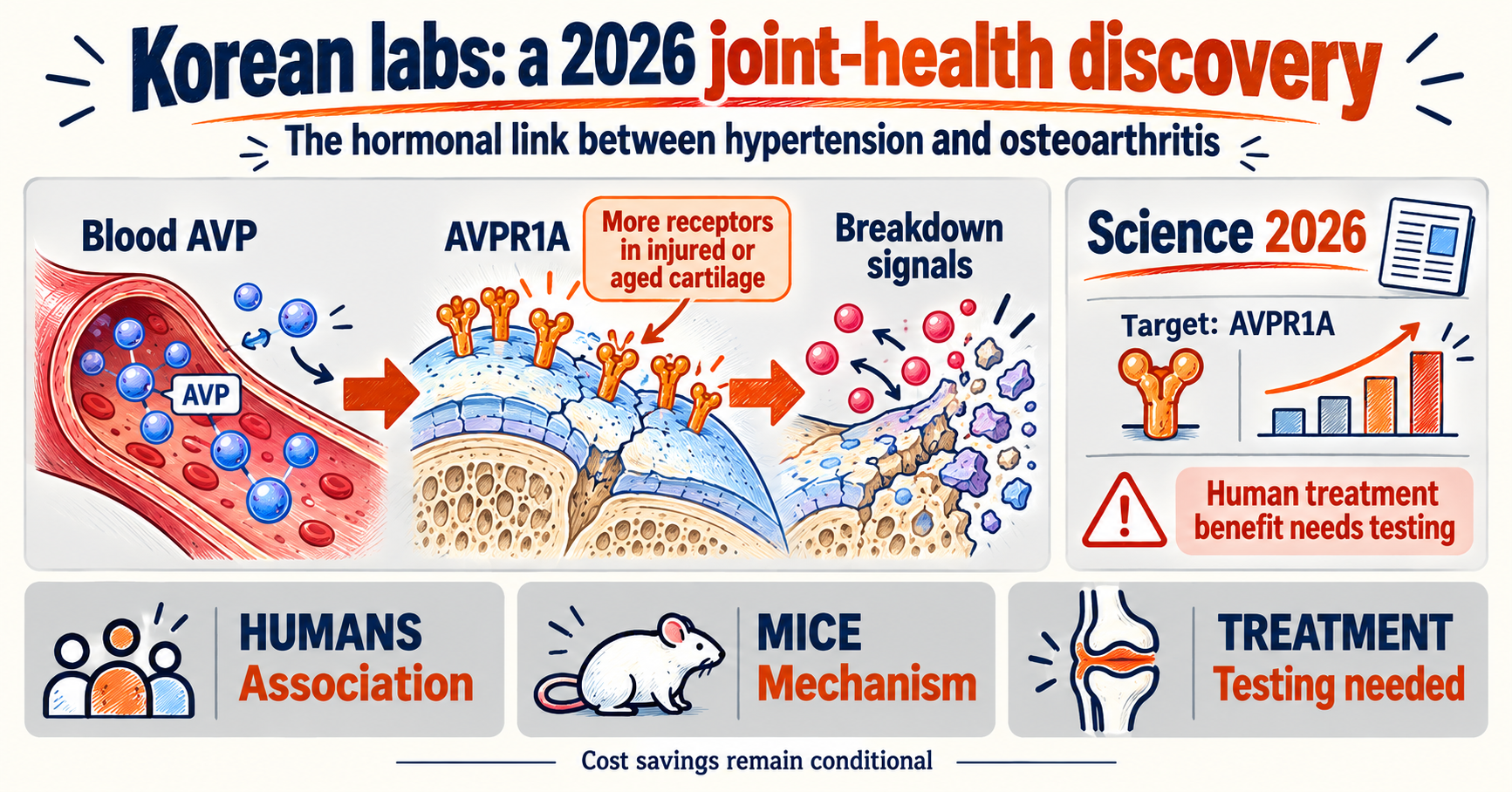
Je-Hwang Ryu of Chonnam National University and Jang-Soo Chun of Inje University have identified a hormonal link between hypertension and osteoarthritis. Their Science study, released on October 1, 2026 in the United States, describes how injured or aged cartilage becomes responsive to circulating vasopressin. The economic question is what must happen before that discovery can lower the cost of care. Source: 전남대 공식 발표
A blood-pressure check and a knee scan may seem like unrelated appointments. Signals carried in the bloodstream can connect the two. That does not mean blood-pressure medication treats osteoarthritis. This is not a clinical trial in patients; the pathway was tested in animals.
Who led the study: Ryu and Chun’s team
Ryu and Chun are the co-corresponding authors. Su-Jin Kim, a postdoctoral researcher at Chonnam, and Hyo-Eun Kim are the co-first authors. The university identifies their shared role in conducting the research without assigning individual experiments to either researcher. Source: 연구진 명단
The senior researchers have a history of studying metabolic influences on cartilage. Ryu and Chun were also corresponding authors of a 2019 Nature paper on a cholesterol-metabolism pathway in osteoarthritis. The new work extends that line of inquiry to blood pressure and neuroendocrine signaling: hormones produced by the nervous system influencing distant tissues through the circulation. Source: Nature 2019 선행 연구
What hypertension adds to the wear-and-tear explanation
Vasopressin, or AVP, is a hormone involved in regulating water balance and blood pressure. AVPR1A is a receptor through which cells receive its signal. Ryu and Chun examined both the circulating signal and the cartilage cell’s readiness to respond.
The paper’s abstract reports increased AVPR1A in OA-primed cartilage cells. Exposure to hypertension-associated circulating AVP amplified breakdown signals and suppressed regulators of cartilage production. Transcriptomic profiling and gene-silencing experiments identified NR4A3 as a downstream transcriptional mediator—a protein that helps control which genes a cell activates. Source: Science 초록 재수록
The condition of the joint matters. Healthy cartilage has little of the receptor, whereas injured or aged cartilage has more. This does not justify saying that hypertension necessarily damages every healthy joint. It points to an interaction between a susceptible tissue and a systemic signal. Source: 연골 상태에 따른 차이
-
1
Circulating AVP
A hormone signal associated with hypertension
-
2
Cartilage AVPR1A
Receptor increases with injury or aging
-
3
Stronger catabolic signaling
Downstream regulation including NR4A3
-
4
Faster degeneration
Acceleration in predisposed joints
Scientifically, the question expands from how much a joint has been loaded to why certain cells react more strongly to the same hormonal message. Mechanical load and body weight remain relevant. The new work adds a molecular target that could influence the pace of degeneration.
Where human association and animal causality diverge
The work involving co-first authors Su-Jin Kim and Hyo-Eun Kim connects population observations with mouse experiments. Official accounts describe two distinct hypertensive mouse models. Observing two conditions together in people and experimentally changing a pathway in animals provide different kinds of evidence. Source: 과기정통부·KDI 연구 요약
Age, weight, activity and medication use can complicate human associations. Residual confounding can remain even after statistical adjustment. In mice, genetic deletion or pharmacological inhibition of AVPR1A protected against hypertension-driven acceleration, strengthening the case for a causal role of the target. That finding does not substitute for evidence of durable benefit in patients. Source: Science 초록의 실험 결과
Human observations
Hypertension–OA association
Finding
Limit · No proof of joint benefit from BP treatment
Mouse interventions
Protection after receptor deletion or inhibition
Finding
Limit · No direct proof of long-term human efficacy
A source limitation matters here. Publisher access was restricted, so this article cross-checks the reproduced paper abstract against official university and government releases. The full paper and supplement were not available for verification of sample sizes, dosing details or effect magnitudes; no percentage improvement or human risk multiplier is asserted.
Relcovaptan is a development lead, not a prescribing answer
Ryu’s team also reported reduced cartilage damage in animals treated with relcovaptan, an AVPR1A inhibitor. This moves the work beyond identifying a target to testing whether a compound can intervene. It does not establish relcovaptan as an approved osteoarthritis treatment or a substitute for a patient’s blood-pressure prescription. Source: 렐코밥탄 동물실험
A developer would need to establish adequate exposure in human joints and the duration of any effect. Systemic and intra-articular delivery pose different exposure and repeat-treatment questions. Long-term safety also matters in older patients taking multiple medicines. These are development requirements, not outcomes established by this paper.
One possible source of development efficiency is patient selection. If hypertension and pathway activity identify a responsive group, trials might avoid enrolling many people unlikely to benefit. Expensive or unreliable selection tests could instead add cost. Blood pressure alone is not yet a validated predictor of response.
Better cartilage images do not automatically lower costs
A useful precedent for assessing Ryu and Chun’s target is the FORWARD trial involving Marc Hochberg and researchers from Merck KGaA and EMD Serono. Its 2019 JAMA report found a cartilage-thickness effect in higher-dose sprifermin groups without significant improvement over placebo in overall symptom measures, including pain and function. This is historical evidence about a different drug, not a prediction that relcovaptan will fail. Source: JAMA FORWARD 임상
The commercial lesson is to measure cartilage preservation, pain and walking ability, and delayed surgery separately. The value proposition to payers strengthens when structural effects translate into practical benefits. Target validation in a laboratory and the clinical evidence needed to justify a treatment’s price are far apart.
WHO estimates that roughly 528 million people had osteoarthritis in 2019. This describes disease burden, not a new drug’s addressable customer base. Eligibility depends on pathway relevance, disease stage and safe use. Multiplying global prevalence by an imagined drug price would bypass the central uncertainties. Source: WHO·2019년 기준
What would change spending in Korean health care?
Consider a conditional scenario in which Ryu and Chun’s findings translate into clinical benefit. Slower progression that prevents operations and hospital stays could reduce direct spending by patients and Korea’s health insurer. Preserved mobility might also reduce family care time and work absence. These are economic inferences, not measured outcomes of the study.
A valid calculation needs the same patient group and time horizon on both sides. Net savings equal avoided medical and care costs minus drug, administration, testing and adverse-event costs. Postponing an operation is also different from avoiding it. A deferred bill cannot simply be counted as a permanently eliminated bill.
-
1
Select eligible patients
Validate predictors of response
-
2
Show clinical benefit
Assess structure, pain and function
-
3
Reduce care burden
Measure operations, admissions and care
-
4
Subtract added costs
Include drugs, delivery, tests and safety
The industrial effects would depend on those conditions. Proven benefit could create a disease-slowing treatment opportunity for pharmaceutical companies and demand for selection and monitoring services. Reduced implant demand is a more distant scenario requiring actual evidence of fewer or later operations. An aging population could still expand surgical volumes alongside a new treatment.
For follow-up development in Korea, human trial design matters before any licensing headline: who is enrolled, whether pain and function are assessed, and whether benefit is added to existing care. The reviewed sources do not establish a company deal or investment amount tied to this study. They also do not justify assigning future revenue to a particular company.
The next test is in human joints
Ryu and Chun’s team has made a systemic signal to the joint into a concrete therapeutic hypothesis. The work involving Su-Jin Kim and Hyo-Eun Kim turns a familiar association into an experimentally testable pathway. The next question is the size and durability of benefit when that pathway is blocked in people.
For readers, the message is a more specific scientific reason to consider blood pressure and joint health together, not an instruction to change medicines. Any change in care costs will depend on less pain, sustained mobility and avoided treatment—not a cartilage image alone.
The economic value of treatment begins with evidence of less pain and sustained mobility.
Sources and further reading
- Science: Hypertension fuels osteoarthritis through neuroendocrine signaling
- Science 논문 초록·저자 명단 — CiteDrive 재수록
- 전남대학교 치의학전문대학원 공식 연구 발표
- 과학기술정보통신부 보도자료 — 정책브리핑
- 과학기술정보통신부 발표 요약 — KDI
- Nature 2019: The CH25H–CYP7B1–RORα axis of cholesterol metabolism regulates osteoarthritis
- WHO: Osteoarthritis
- JAMA 2019: FORWARD randomized clinical trial
For information only — this is not a recommendation to buy or sell any asset.
Comments 0