In vivo CAR-NK: up to 80% mouse NK delivery—where could costs fall?
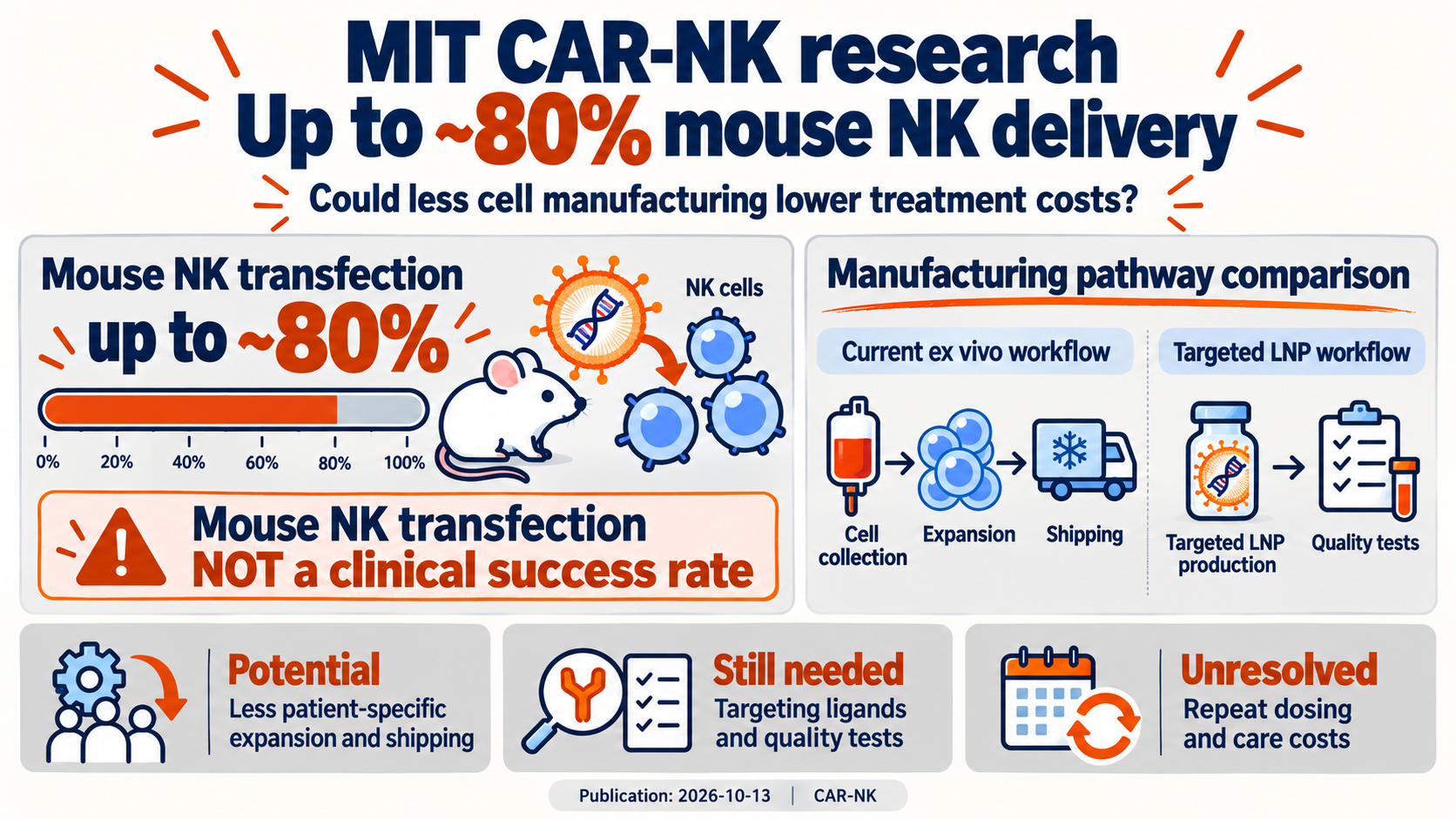
MIT chemical engineer Daniel G. Anderson and colleagues reported NtLNPs for generating CAR-NK cells inside the body. Their October 13, 2026 Nature Biotechnology paper reports up to approximately 80% NK-cell transfection in mice. The economic question is how much patient-specific manufacturing this approach could eventually replace. Source: Nature Biotechnology
That percentage is a preclinical delivery measure, not a patient response rate. It should not be presented as an 80% CAR conversion rate across every experiment. Delivery, therapeutic activity and lasting clinical benefit are separate questions.
The three co-first authors and the Anderson–Langer lab
Co-first authors Yuang Chen, Julia Monkovic and Haseeb Mughal contributed experiments, analysis and writing. Anderson and Robert Langer supervised the project. The public contribution statement does not assign individual experiments to particular co-first authors. Source: Nature Biotechnology
Anderson and Langer also worked on nanoparticles for pulmonary mRNA delivery in 2023. Messenger RNA supplies instructions for making a protein. Their continuing engineering problem is delivering those instructions to the intended cells; this study turns to NK immune cells. Source: MIT News
Why make CAR-NK cells inside the body?
NK cells are natural killer immune cells. A CAR is an engineered receptor that recognizes a chosen marker. Chen and colleagues use NK cells as the carrier of that targeting function. For T-cell diseases, this may avoid the mutual killing that can complicate T-cell-directed CAR-T designs. Source: MIT News
Conventional autologous CAR-T involves collecting a patient’s cells, modifying and expanding them in a laboratory, then returning them by infusion. The NCI describes this pathway. It requires coordination between the individual cell product, manufacturing and the hospital’s collection and treatment schedule. Source: NCI
NtLNPs combine protective lipid particles with engineered biparatopic NK-binding ligands. They deliver mRNA without a viral carrier. Moving this delivery step into the body is the basis for a possible change in manufacturing. Source: Nature Biotechnology
-
1
Targeted particle
Lipids protect the mRNA
-
2
NK delivery
Ligands guide binding
-
3
CAR expression
Cells make the receptor
The engineering challenge is more than producing particles at scale. They must reach the intended cells and support protein production while limiting unwanted activity elsewhere. A simpler manufacturing pathway only helps if the targeting and delivery functions both work.
What the animal evidence establishes—and leaves open
The abstract reports B-cell depletion with CD19 targeting in healthy mice, T-cell depletion with CD3 targeting in autoimmune hepatitis, improved solid-tumor activity through NKG2A targeting, and activity in humanized blood-cancer models. Source: Nature Biotechnology
CD19 marks B cells and CD3 marks T cells; CD3 is not exclusive to diseased T cells. Depleting a target population does not by itself establish preservation of normal immunity. A humanized animal model is also not a human clinical trial.
The next decision-relevant evidence concerns human dose, duration and repeat administration. This article uses the public abstract, author information and MIT’s institutional report. Full subscription text and supplements were not reviewed, so detailed conditions and uncertainty around the maximum delivery figure are not inferred.
Observed scope
Animal and humanized models
Setting
Delivery · NK-targeted delivery
Still needed
Durability and repeat dosing
Clinical benefit
Economics · Total cost per patient
A smaller manufacturing bill does not guarantee cheaper care
Assume Anderson’s approach eventually works adequately in people. The following is economic analysis, not a cost reduction measured in the paper. The opportunity is to replace a manufacturing process restarted for each patient with drug batches potentially serving multiple patients.
That could reduce collection, individual cell expansion, return shipping and scheduling work. Patients might also benefit from fewer manufacturing delays. Hospitals could spend less effort rearranging appointments around product arrivals. Actual reductions in waiting time would still need to be measured.
NtLNP production would still need to meet good manufacturing practice, or GMP. Manufacturers would have to control RNA and lipid inputs, ligand attachment, sterility and functional delivery. Avoiding cell expansion outside the body does not remove factories or quality testing.
Potential reductions
Collection, expansion, return shipping
Individual work
Scheduling · Waiting and rescheduling
Retained or added work
Ligand attachment and potency tests
Drug production
Care · Repeat dosing and immune monitoring
A shared batch spreads testing costs across more doses, but it also concentrates risk: one failed batch can affect supply for many patients. Productivity therefore depends on release-test success and waste as well as gross output. These are manufacturing considerations, not demonstrated NtLNP economics.
At the hospital, observation, immune monitoring and management of adverse reactions determine much of the remaining workload. Frequent repeat dosing could offset savings per vial. A useful comparison is total treatment-pathway cost per patient achieving sustained benefit, rather than the production cost of one injection.
Manufacturing cost and selling price are also different. Development spending, competition, patents and reimbursement negotiations would shape pricing. The available evidence does not support a percentage reduction in the price of treatment.
Korea: new manufacturing work and a different competitive test
Connecting Anderson’s work to Korea requires separating existing capabilities from new qualifications. Samsung Biologics described integrated mRNA drug-substance, fill-finish and storage capabilities in 2022. Those capabilities are relevant background, not evidence of an NtLNP contract or access to this technology. Source: 삼성바이오로직스
A CDMO develops or manufactures drugs for other companies. To turn this direction into business, it would need to reproduce ligand quality and attachment as well as the base formulation. Lipid suppliers could compete on purity, batch consistency and performance in a customer’s process, rather than supply volume alone. This is a conditional opportunity.
GC Cell’s official history lists NK-cell manufacturing patents and a 2023 clinical authorization for AB-201. This establishes relevant domestic experience, not its current trial stage or a partnership with NtLNP’s developers. Source: GC Cell
If in vivo approaches advance, some demand for external cell expansion could decline. Yet expertise in measuring NK function and interpreting responses might transfer to evaluating new delivery products. Existing businesses could face both substitution and opportunities to apply their knowledge to different work.
The benchmark is not only patient-specific CAR-T. Donor-derived products made ahead of treatment also seek economies of scale. NtLNPs would have to compete on duration and consistency between patients as well as availability. Immediate obsolescence of existing manufacturing facilities is not a supported conclusion.
What a $2.1 billion transaction does—and does not—tell us
Commercial interest is visible in a separate transaction. AbbVie announced an acquisition of Capstan for up to $2.1 billion in June 2025 and completed it in August. The acquired platform includes targeted LNPs for in vivo CAR-T. This was not an acquisition or validation of Anderson’s NtLNP technology. Source: AbbVie Source: AbbVie
The transaction shows a large drugmaker committing capital to in vivo cell engineering. Its value is neither a CAR-NK market-size estimate nor a valuation of this study. Addressing T-cell diseases could create additional opportunities, but efficacy and safety must be established for each indication.
Early commercial activity could involve delivery partnerships, process transfers and analytical development before finished-product sales. Hospital adoption and payer acceptance would then depend on usable, durable clinical benefits. Jumping straight from a research result to a company revenue forecast leaves out these development steps.
The next test is the cost of a durable result
Anderson’s work points toward changing where therapeutic cells are engineered. The next questions concern the human dose and schedule, reproducible drug batches, and whether reduced manufacturing delays translate into more patients safely treated by the hospital.
Our earlier article on AGENT and mRNA vaccine distribution concerned storage and transport. Here the question is replacement of patient-specific cell manufacturing. The psCas12f delivery article offers another perspective on separating delivery engineering from treatment economics.
NtLNP’s industrial promise ultimately depends on adequate durability, reproducible production and a lower overall burden of treating a patient. Those results would turn an attractive manufacturing concept into a practical economic advantage. This article explains research and manufacturing structure; it is not investment advice or a treatment recommendation.
Evaluate CAR-NK economics by total care cost per patient achieving sustained benefit.
Sources and further reading
- Nature Biotechnology: In vivo engineering of CAR natural killer cells for immunotherapy using ligand-directed lipid nanoparticles
- MIT News: Reprogrammed NK immune cells target cancer and autoimmune disorders
- MIT News: New nanoparticles can perform gene editing in the lungs
- NCI: T-cell Transfer Therapy
- AbbVie: Agreement to acquire Capstan Therapeutics
- AbbVie: Completion of Capstan acquisition
- 삼성바이오로직스: mRNA 제조 역량
- GC Cell: Our Heritage
For information only — this is not a recommendation to buy or sell any asset.
Comments 0