DRT10, a bacterial defense that makes DNA: 3 conditions for cheaper testing
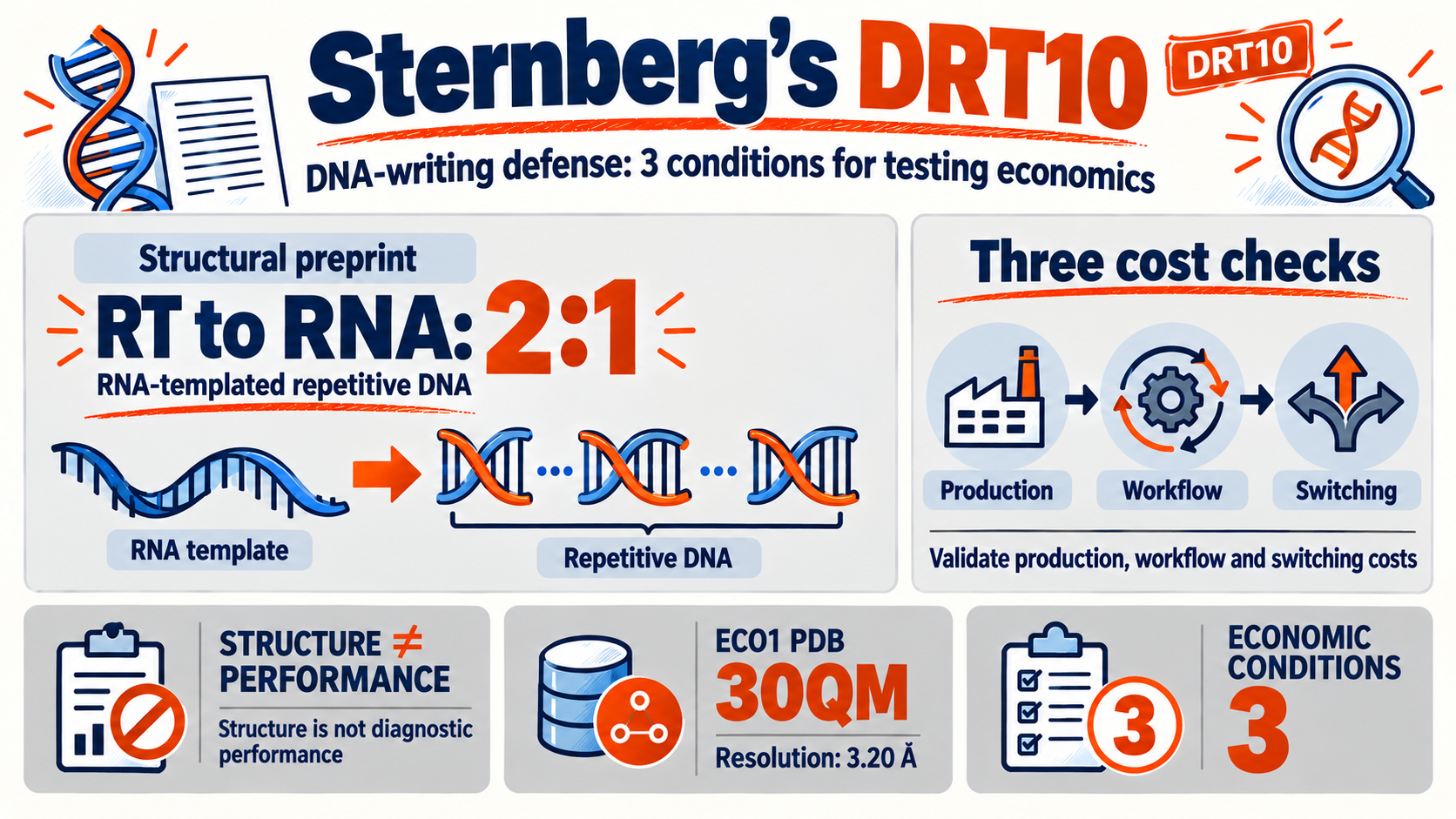
Samuel H. Sternberg’s team at Columbia University has reported DRT10 in Nature, a bacterial defense system that makes repetitive DNA from RNA. For biotechnology companies, the question is whether that chemistry can eventually make experiments and testing less expensive. Source: Columbia University — Scientists Uncover an Ancient Link Between Viral Defense and Chromosome Protection (2026-10-12)
The Nature publication date is October 12. DRT10 function had already appeared in a 2025 preprint, followed by a structural preprint in June 2026. This is a research story reaching formal publication, rather than a diagnostic product arriving overnight. Source: Antiviral immunity via telomerase-like reverse transcription in bacteria — Nature (2026-10-12)
The Sternberg lab researchers behind DRT10
Stephen Tang investigated DRT10 function, Josephine L. Ramirez led the biochemical work, and Qixiang He and Israel S. Fernández led the structural work. Their collaboration under Sternberg linked questions about what the enzyme does with questions about how its components fit together. Source: Columbia University — Scientists Uncover an Ancient Link Between Viral Defense and Chromosome Protection (2026-10-12)
Sternberg’s earlier DRT2 and DRT9 work examined DNA synthesis in bacterial defense. Where familiar CRISPR–Cas defenses attack invading nucleic acids, these systems draw attention to newly synthesized DNA. That research tradition makes bacterial immunity a source of possible biotechnology components. Source: Umeå Infection Symposium 2026 — Samuel Sternberg research abstract
How DRT10 repeatedly reads an RNA template
A reverse transcriptase copies information from RNA into DNA. DRT10 uses a noncoding RNA, or ncRNA, as its working template. The resulting cDNA is DNA synthesized from that RNA. Source: Tang et al. — Antiviral reverse transcriptases reveal the evolutionary origin of telomerase (2025 preprint, PMC)
Tang and colleagues’ public preprint describes an A–B–A′ arrangement, with matching short sequences at A and A′. After one copying pass, the nascent DNA realigns so another pass can extend it. A short template can therefore produce a much longer repetitive product. Source: Tang et al. — Antiviral reverse transcriptases reveal the evolutionary origin of telomerase (2025 preprint, PMC)
The “telomerase-like” in the Nature title refers to exactly this repeated copying. Telomerase, found in human and other eukaryotic cells, adds short DNA repeats to chromosome ends by copying the same sequence again and again from its own built-in RNA template. That resemblance is why Columbia’s announcement describes the work as an ancient link between viral defense and chromosome protection.
-
1
RNA template
Defines the copying interval
-
2
DNA synthesis
Copies RNA information into DNA
-
3
Realignment
Matching sequences enable another pass
-
4
Repeat extension
Extends the product using the same template
The structural preprint by Ramirez and colleagues reports two enzyme molecules associated with one RNA. Stem-loop anchors—folded portions of the RNA—help define the copying interval. Sequence design therefore has to account for RNA shape as well as its letters. Source: Ramirez et al. — Mechanism of tandem-repeat DNA synthesis by an antiviral reverse transcriptase (2026-06-29 preprint)
The public Eco1 complex entry deposited by He and colleagues lists a cryo-EM resolution of 3.20 Å. Cryo-EM reconstructs molecular arrangements from images of rapidly frozen specimens. That number describes structural detail, not diagnostic accuracy or manufacturing yield. Source: RCSB PDB 30QM — E. coli DRT10 RT–ncRNA complex, Eco1 subtype
A defense system still needs engineering to become a diagnostic
Tang’s earlier work required RT, ncRNA and a SLATT protein for defense. Producing repetitive DNA does not by itself create a selective virus test. The earlier manuscript also left open how the DNA product ultimately produces the defensive effect. Source: Tang et al. — Antiviral reverse transcriptases reveal the evolutionary origin of telomerase (2025 preprint, PMC)
A diagnostic must generate a signal selectively when its target is present. If repetitive DNA appears without a target, stronger signal production could simply create more false positives. Target recognition must be coupled to synthesis, with background tested in negative samples. These are requirements for the applications discussed below, not achievements claimed for this study.
Public research
Repetitive DNA production
Synthesis
Structure · RT–RNA complex
Still needs validation
Selective response to a target
Product
Economics · Lower total cost per accepted result
The distinction matters when assessing Sternberg’s contribution. A structure can help narrow the positions worth modifying. It cannot alone establish temperature tolerance, performance in impure samples, or consistent production at scale.
Existing suppliers already compete beyond enzyme chemistry
Any industrial version of Sternberg’s enzyme needs a realistic benchmark. NEB markets a lyophilized Luna RT-qPCR mix for room-temperature shipping and storage, alongside contamination-control and multiplex features. RT-qPCR converts RNA to DNA and then amplifies it for measurement. These are manufacturer descriptions, not an independent comparison with DRT10. Source: NEB — LyoPrime Luna Probe One-Step RT-qPCR Mix with UDG
Buyers compare more than a vial price. Shipping conditions, targets per run and repeat-test rates all matter. Even a useful DRT10 synthesis reaction could initially increase total cost if developers have to rebuild features already bundled into established products.
In April 2026, Seegene introduced STAgora and an enhanced CURECA model: aggregated testing analytics and a vision for automated workflows from preprocessing to results. This is a company development announcement, not a DRT10 adoption case. It illustrates why changing an enzyme and improving laboratory productivity are separate investment decisions. Source: Seegene — STAgora and automated PCR workflows at ESCMID Global 2026 (2026-04-21)
Three hurdles before DRT10 can change testing costs
The following is our industrial interpretation of Ramirez and He’s work. The first condition is usable output. Abundant protein is insufficient if RNA assembly is unreliable or product lengths vary beyond specification. Manufacturers should compare cost per qualified reaction, not simply protein mass per culture volume.
The second condition is total labor. Structure-guided variant selection could allow a small team to spend less time testing poor candidates. Additional RNA stabilization, complex purification or length analysis could offset that gain. Productivity should be measured by time to a validated conclusion, rather than the speed of one reaction.
The third condition is switching cost. Replacing a reagent requires comparative testing and revised procedures. Columbia also disclosed a related patent application. An application does not establish final patent scope or a royalty rate, but commercial planning should include licensing diligence and negotiation. Source: Columbia University — Scientists Uncover an Ancient Link Between Viral Defense and Chromosome Protection (2026-10-12)
-
1
Production
Count qualified reactions
-
2
Workflow
Measure purification, analysis and retesting
-
3
Switching
Include validation, licensing and development
-
4
Comparison
Compare total cost per accepted result
A useful denominator makes the decision clearer. Add reagents, labor, quality control, retesting and allocated development costs, then divide by accepted results. A cheaper enzyme can produce a more expensive result if the acceptance rate falls. Public DRT10 data are insufficient to populate that calculation, so a savings percentage would be premature.
Where a Korean startup might find an initial customer
A venture building on Sternberg’s research might first investigate narrow research demand for repetitive DNA. Custom synthesis, candidate reference materials, and enzyme–RNA design services are possible directions. Reference materials would still require separate characterization of length, concentration and homogeneity. These are business hypotheses, not established products.
Virus surveillance and target screening require more work. Screening means testing many candidates to identify the ones of interest. A DRT10 signal-generation step should be compared with an existing method on the same samples, measuring detection limits, background, turnaround time and retesting. Stronger signal alone would not establish a better workflow.
If those comparisons succeed, opportunities could extend beyond enzymes to design, quality assurance and integration services. Substitution might begin in a specific repetitive-DNA production step. There is no basis yet for projecting wholesale displacement of PCR reagents or diagnostic instruments. Technical novelty and a customer’s reason to switch require separate evaluation.
Sternberg’s team has expanded the repertoire of ways to make DNA. The next useful evidence would be independent replication, consistency across production batches and comparisons in real samples. Those results would make it possible to translate an unusual bacterial defense mechanism into meaningful business costs.
For a related discussion of research performance and validation spending, see RNA fingerprinting and drug-discovery experiment costs. It offers another example of the economic value of narrowing experimental candidates.
Source scope: Columbia’s announcement confirms the Nature publication and researcher roles. Mechanistic explanations also use public preprints, a structural abstract and the PDB record. Access restrictions prevented a complete comparison against the final Nature figures and supplementary experiments.
Evaluate a new enzyme by total cost per accepted result.
Sources and further reading
- Antiviral immunity via telomerase-like reverse transcription in bacteria — Nature (2026-10-12)
- Columbia University — Scientists Uncover an Ancient Link Between Viral Defense and Chromosome Protection (2026-10-12)
- Tang et al. — Antiviral reverse transcriptases reveal the evolutionary origin of telomerase (2025 preprint, PMC)
- Ramirez et al. — Mechanism of tandem-repeat DNA synthesis by an antiviral reverse transcriptase (2026-06-29 preprint)
- RCSB PDB 30QM — E. coli DRT10 RT–ncRNA complex, Eco1 subtype
- Umeå Infection Symposium 2026 — Samuel Sternberg research abstract
- NEB — LyoPrime Luna Probe One-Step RT-qPCR Mix with UDG
- Seegene — STAgora and automated PCR workflows at ESCMID Global 2026 (2026-04-21)
For information only — this is not a recommendation to buy or sell any asset.
Comments 0