Plastic recycling catalyst: 30-minute recovery? Washing costs and factory realities
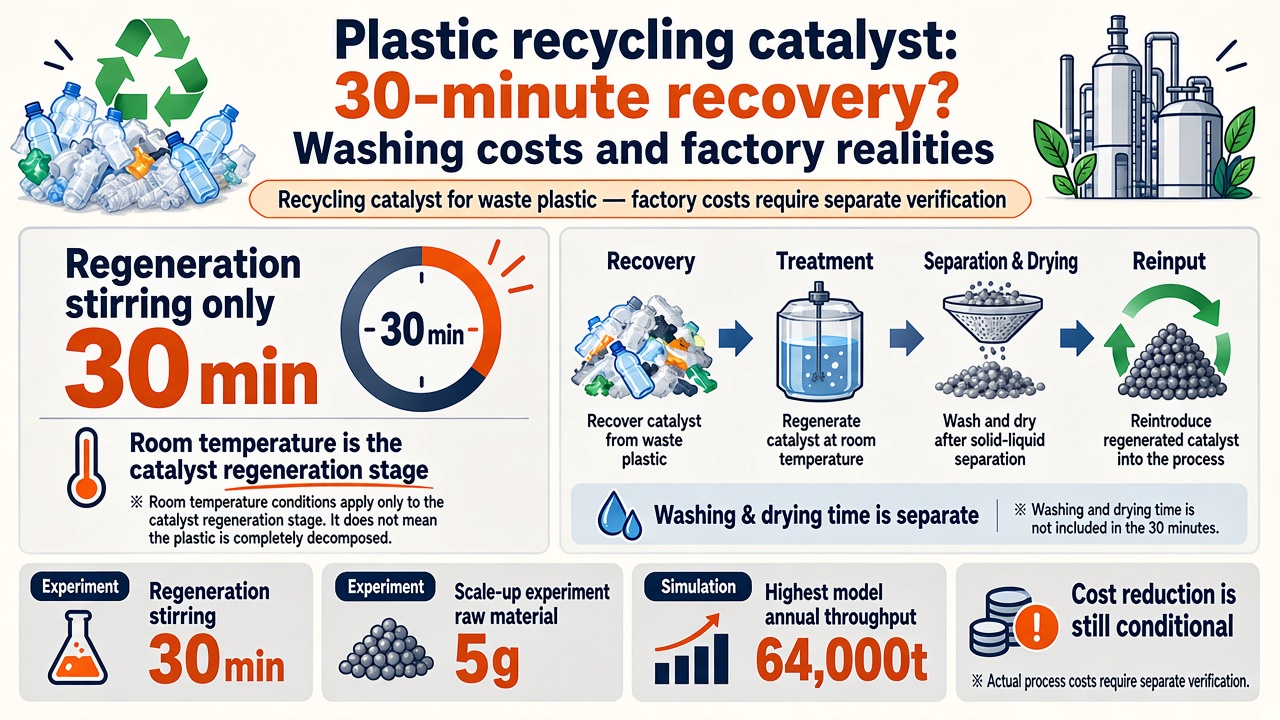
A new study restores a plastic recycling catalyst through a 30-minute treatment at room temperature. The target is a catalyst impaired by chlorine from PVC. That could matter for plant costs, but washing and drying take additional time. Gu et al., Nature Communications (2026), Tackling chlorine poisoning for robust upcycling of PVC-contaminated plastic streams
Imagine a plant turning discarded plastic into usable feedstock. Incoming waste changes from day to day. Buying a good catalyst is only part of the production problem; recovering its performance after contamination matters too.
The September 14 Nature Communications paper by Gu and colleagues addresses that operational problem. It is a peer-reviewed article in press. Turning the laboratory recovery into plant savings will also require keeping separation and washing costs under control. Gu et al., Nature Communications (2026), Tackling chlorine poisoning for robust upcycling of PVC-contaminated plastic streams
Why chlorine matters to a plastic recycling catalyst
A catalyst accelerates a chemical reaction. Here the catalytic metal is ruthenium. Chlorine can occupy its reactive surface and impair its function, a process called catalyst poisoning. Gu et al., Nature Communications (2026), Tackling chlorine poisoning for robust upcycling of PVC-contaminated plastic streams
Polyolefins include polyethylene and polypropylene. Hydrogenolysis uses hydrogen to break their long molecular chains into smaller molecules. PVC is a different, chlorine-containing plastic, making it a problematic companion in mixed feedstocks. Gu et al., Nature Communications (2026), Tackling chlorine poisoning for robust upcycling of PVC-contaminated plastic streams
Industry already pays to manage these contaminants. BASF offers PuriCycle adsorbents for removing halogens, a group that includes chlorine, from waste-plastic pyrolysis feeds to protect downstream equipment. Adsorbents capture unwanted substances. BASF PuriCycle — 폐플라스틱 열분해 원료 정제 제품
The new work adds a recovery option after poisoning. Cleaning the feed and restoring the catalyst perform different jobs. The business question is whether their combination can reduce total cost.
What the 30-minute treatment actually means
The researchers used sodium borohydride, NaBH₄, a reducing reagent that changes chemical states by supplying electrons. The treatment removes chlorine from the catalyst surface and restores reactive sites. Gu et al., Nature Communications (2026), Tackling chlorine poisoning for robust upcycling of PVC-contaminated plastic streams
With 1% PVC in the feed, solid conversion fell from 59.9% initially to below 10% after use, then recovered to 63.8% after regeneration. The comparison reaction used 200°C, 2 MPa hydrogen and one hour. Room temperature describes regeneration, not plastic breakdown. 논문 원문 PDF — 실험·Methods·경제성 시나리오
Solid conversion is a reaction metric. It does not mean the same percentage became finished recycled plastic. Recovering activity and selling a qualified product are separate milestones.
The Methods describe ten washing and centrifugation steps before treatment, followed by 30 minutes of stirring and subsequent separation and drying. Thirty minutes is therefore not a demonstrated plant turnaround time. 논문 원문 PDF — 실험·Methods·경제성 시나리오
-
1
Recover spent catalyst
Washing and separation
-
2
Ambient treatment
Stir with NaBH₄ for 30 min
-
3
Separate and dry
Additional processing time
-
4
Return to reaction
Heat and hydrogen still required
Scientifically, this probes how far a loss of catalytic function can be reversed. Engineering requires that recovery to become a repeatable plant operation. Scaling laboratory separation into reliable industrial handling is a separate challenge.
Count recovery costs before calling it a saving
Extending useful life could reduce catalyst purchases and spent-catalyst handling. That requires small recovery losses and sustained performance over repeated treatments. Losing too much catalyst during recovery would erode the benefit of buying fewer replacements.
Recovery adds reagent, water and solvent purchases, separation and drying equipment, and liquid-waste treatment. Ambient-temperature chemistry still carries upstream reagent and downstream drying energy. Temperature alone cannot establish an overall energy or emissions benefit.
A plant should compare avoided replacement costs plus the margin from extra output against regeneration expenses and downtime losses. A positive balance creates an economic reason to adopt recovery. This paper cannot supply a universal plant-level saving percentage.
Potential avoided costs
Fresh replacement
Catalyst
Operation · Output lost to deactivation
Disposal · Spent-catalyst handling
Recovery costs to include
Reagent, solvent, water
Materials
Equipment · Recovery, separation, drying
Operations · Effluent, downtime, metal loss
Productivity extends beyond instantaneous reaction speed. Long cleaning queues can erase throughput gains. Alternating catalyst inventories might reduce stoppages, but requires additional inventory and recovery equipment. That is a possible plant design, not a demonstrated result.
Between a 5-gram experiment and a 64,000-tonne plant model
The scale-up experiment processed 5 grams of plastic. The economic model assumes 64,000 tonnes per year, 80% conversion, six catalyst replacements annually and idealized separation and recycling. These are fundamentally different levels of evidence. 논문 원문 PDF — 실험·Methods·경제성 시나리오
Feedstock price and facility scale are major drivers in the authors’ model. Our reading is that a catalyst can enable the process while affordable, reliable feed supply still determines much of its commercial viability. 논문 원문 PDF — 실험·Methods·경제성 시나리오
Cheap mixed waste is not automatically attractive. Contamination may increase cleaning and testing expenses or generate off-spec products. Cleaner, more expensive feed can simplify operations while compressing margins. Procurement and processing costs must be evaluated together.
A larger plant spreads fixed costs across more output, yet may need a wider collection area. Transport and storage can consume part of the scale benefit. For a Korean project, local waste composition, supply contracts and product buyers would matter alongside laboratory conversion.
Where a commercial market could emerge first
OECD’s 2022 report estimates 353 million tonnes of plastic waste in 2019, of which 9% was ultimately recycled. This is historical context, not a 2026 recycling rate or an immediately addressable market for this technology. OECD, Global Plastics Outlook (2022) — 2019년 통계
Eastman provides a useful scale reference: its Kingsport polyester molecular-recycling facility began initial production in March 2024 and has stated capacity of 110,000 tonnes annually. Capacity is not actual throughput, and polyester recycling is a different process from the hydrogenolysis discussed here. Eastman Kingsport molecular recycling facility
Our takeaway is that recycling requires a whole operating chain. Collection, feed qualification and sales contracts must align to keep equipment busy. A research announcement alone is weak evidence of an imminent industrial order.
Possible early opportunities include feed testing, catalyst diagnostics and recovery services. A supplier might certify chlorine content or charge for verified catalyst restoration. These are prospective business models, not reported contracts or revenue forecasts.
It would be premature to call this a replacement for BASF’s purification products. Equipment protection and product purity remain requirements even if catalyst performance can be recovered. Integration of feed cleaning and catalyst restoration is a more plausible opportunity in our assessment. BASF PuriCycle — 폐플라스틱 열분해 원료 정제 제품
Replacing fossil inputs requires a defined product
Selling smaller hydrocarbons as fuel differs from returning them to plastic production. Fuel use releases carbon. Making a useful product from plastic does not by itself establish a closed plastic loop.
Some fossil feedstock demand could be displaced if pricing, composition, customer qualification and reliable volume align. Existing petrochemical companies could become competitors, buyers or integration partners. The outcome depends on the saleable product and its route to market.
The next useful evidence would be long-duration operation on complex waste, metal losses during recovery, and measured solvent and effluent costs. Add the total cost per tonne of customer-qualified product, and the economic case becomes much clearer.
The research points toward returning poisoned catalysts to productive use. Its industrial value will depend on the operation that follows: consistent sales-quality output despite changing feed, delivered at a lower total cost.
Sources checked as of September 20, 2026. Company disclosures establish facilities and products, not adoption of this research or direct financial benefits. This article analyses technology and industry structure; it is not investment advice.
Judge catalyst recovery by the total cost of making a saleable product again.
Sources and further reading
For information only — this is not a recommendation to buy or sell any asset.
Comments 0