Quantum memory: could an 8-bit design lower hardware costs?
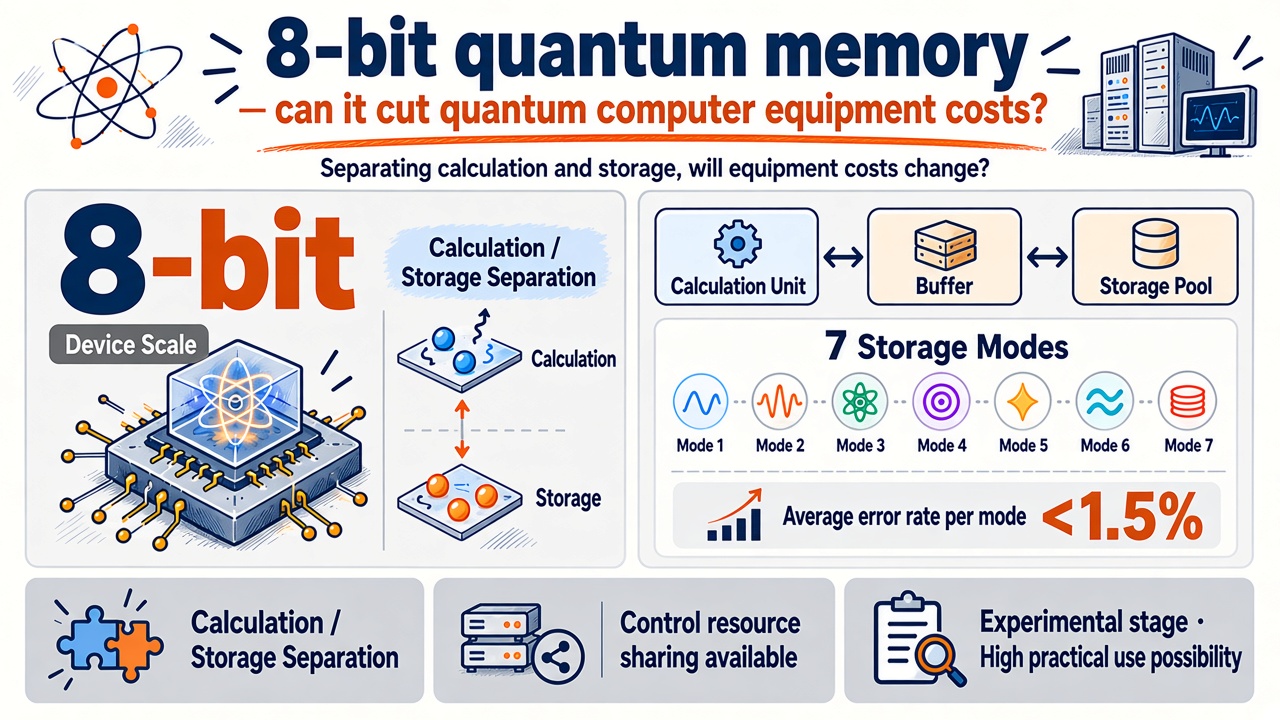
An eight-bit quantum memory experiment points toward separating computation from storage. Published in Nature Physics on September 8, 2026, it raises a practical question: could a small memory module help make a larger quantum computer less expensive? Nature Physics 정식 논문
For readers used to laptop storage, eight bits will sound small. The interesting feature is how one processing unit serves several storage locations. Separating preservation from computation lets engineers design each part around its own requirements. Source
The first preprint appeared in March 2025, followed by journal publication in September 2026. The researchers demonstrated memory operation and control performance. Commercial cost savings still need testing; the economic discussion here assumes that the technology can scale. Source
Why separate quantum memory from the processor?
A qubit can produce a zero or a one when measured, but its computation also depends on preserving relationships between quantum states. Unwanted interactions disturb those relationships. Storing quantum information therefore requires more than retaining a readable classical value. Source
Processing needs controllable interactions; storage benefits from remaining undisturbed. The public manuscript separates these conflicting requirements. That gives engineers a way to improve the processing and storage subsystems independently. Source
A buffer sits between the transmon, a superconducting circuit, and the storage cavity. The cavity holds electromagnetic modes—distinct patterns of oscillation. A selected mode exchanges its quantum state with the buffer, which provides access to the processor. Source
-
1
Processor
Transmon controls states
-
2
Buffer
Stages a state transfer
-
3
Selected storage mode
One of seven storage modes
Random access means choosing storage locations in an arbitrary order. Selection uses classical control. It is distinct from QRAM with coherent quantum addressing, and does not demonstrate reading all data at once or accelerating AI training. Source
Eight bits and seven storage modes need different labels
The published abstract describes an eight-bit device and seven addressable storage modes served by one transmon. The manuscript distinguishes the buffer from the storage bank. Eight independent storage modes would be an inaccurate description of the published result. Source
The reported average infidelity is below 1.5% per mode. Infidelity measures departure from the intended quantum operation. It is not the failure probability of an entire computer or a long algorithm; repeated operations need a separate assessment. Source
The manuscript also examines unwanted interactions among modes. Scaling capacity introduces interactions that must be controlled, not just extra places to store information. A small-module result cannot simply be multiplied into a large-system forecast. Source
The potential saving is in control resources
If every additional storage location requires a matching set of processing and control resources, expansion becomes expensive. Sharing those resources could reduce how much new equipment each increment of capacity needs.
Fewer duplicated components would not automatically mean a cheaper purchase. Buffers, cavities and couplers add fabrication and testing costs. Assembly and calibration also matter. A shared component that disables several locations when it fails could trade component savings for lower manufacturing yield.
Operators face another trade-off. Sharing a processor can create access queues and reduce throughput. Preserving idle states and moving them only when needed could instead improve resource use. The balance depends on the workload and error-correction schedule.
A more useful comparison is total cost per completed computation at the same accuracy. It combines equipment depreciation, operation and control costs, then relates them to useful completed work. The evidence reviewed here does not establish that commercial cost comparison.
-
1
Share control
Potentially less duplication
-
2
Count added costs
Fabrication, tests, queues, correction
-
3
Compare equal workloads
Total cost per useful computation
For example, a lower purchase price can coexist with a higher cost per job if processing slows too much. A more expensive machine can be economical if it avoids enough failed work. These are explanatory cases, not measured outcomes from this experiment.
Other technologies face the same need to connect laboratory performance with manufacturing economics. Our article on solid-state battery electrolyte films examines the conditions for lower manufacturing costs. Quantum memory likewise needs performance and production and operating costs assessed together. 전고체 배터리 전해질 막 — 제조비 절감의 조건
What roadmaps and funding actually tell us
IBM’s roadmap targets 200 logical qubits and 100 million gates for Starling in 2029. Logical qubits are information units protected by error correction; gates are elementary operations on quantum states. IBM 공식 로드맵
IBM presents these figures as future targets. They should not be read as delivered performance or an announcement that it will adopt this memory. The roadmap shows why efficient allocation of storage and control resources matters as systems grow.
Honeywell announced an approximately $600 million Quantinuum funding round in September 2025 at a $10 billion pre-money valuation. Participants included NVentures and Korea Investment Partners. This was a historical financing announcement, not a current valuation or an estimate of the entire quantum market. Honeywell 자금조달 발표
That financing cannot be turned into revenue for this research. The experiment and the funded company are not the same business. Investment in the sector still leaves product qualification and customer contracts between a promising design and commercial demand.
A possible market for modules and control, not a DRAM replacement
If commercialization advances, likely early customers would be quantum-system builders and research institutions. They would evaluate access time, errors and control costs in their own systems. Comparable qualification methods and interfaces would make independent suppliers easier to assess.
Possible product categories include qualified memory modules, precision coupling components and software that schedules access. Adoption might reduce demand for some duplicated control resources. These are conditional business possibilities, not identified winners or booked sales.
The paper acknowledges research support from the Samsung Advanced Institute of Technology. Research support is not a production contract or product commitment, so it cannot be treated as evidence of future memory revenue. Source
This device is not a direct replacement for PC DRAM or AI-accelerator HBM. It stores a different kind of information for a different system. Existing manufacturing experience may help, but product specifications and customer qualification would still have to be established.
The conventional AI-chip supply chain offers a useful comparison for how processing, memory and packaging fit together. Before borrowing that market’s size for quantum memory, identify the function the customer is actually buying. H200 한 장, 31곳 — AI 칩 공급망 해설
Beyond eight bits: scale, error correction and economics
The next questions concern scale and protected operation. More storage locations and modules must remain manageable in both access error and latency. Long computations also need error correction integrated with the storage schedule.
The third question is economic: compare complete systems using the same workload, accuracy and operating conditions. A cheaper bill of materials is not enough if completing the job costs more. Until these tests exist, translating eight bits into revenue or a savings percentage would be premature.
The meaningful change is a more concrete route to optimizing quantum processing and storage separately. Industrial value would follow if that delivered more useful computation with fewer additional control resources. Future demonstrations should report the resources needed to finish the work alongside qubit counts.
Sources were reviewed as of September 18, 2026. This article uses the published abstract and funding statement, the public manuscript and official company disclosures. Published abstract figures take precedence over preprint wording. It is technology and industry analysis, not a recommendation to buy or sell securities.
Judge quantum memory economics by the resources needed to complete a computation at equal accuracy.
Sources and further reading
For information only — this is not a recommendation to buy or sell any asset.
Comments 0