Virtual cell STATE — can 167 million cell observations help cut research costs?
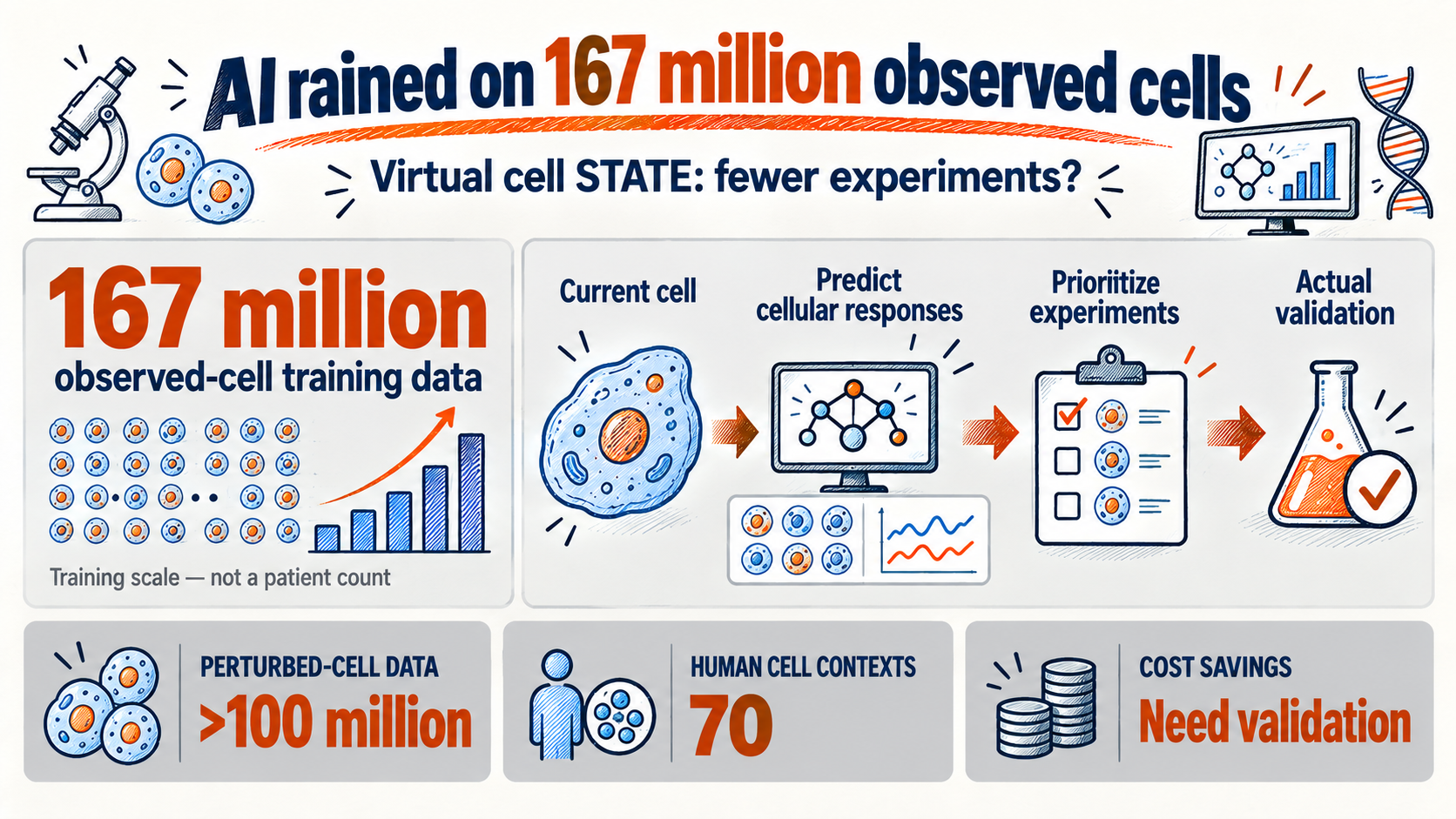
Virtual cell STATE predicts how cells respond to drugs or changes to genes. Its cell-state representation was trained on observations from 167 million cells. The economic opportunity is better experimental prioritization; a reduction in drug-development spending still needs separate evidence. Arc: Virtual Cell Initiative
The study appeared online in Cell on August 31, 2026, and in its September 17 issue. STATE itself was first released in 2025. The new publication adds evidence for evaluating an existing approach, rather than marking the invention of virtual cells. Cell paper abstract and publication record
What does virtual cell STATE actually predict?
RNA carries information transcribed from DNA. Measuring RNA across many genes gives researchers clues about a cell’s current state. This pattern is called gene expression. It is a useful biological readout, rather than a complete description of everything happening inside a cell. Arc: researcher interview
Observational data describe cells as they are. Researchers also want to know what will happen after a deliberate intervention, such as reducing a gene’s activity or adding a drug. Measurements before and after an intervention provide a different kind of evidence from observations alone. Arc: original STATE announcement, 2025
STATE combines a representation of cell state with a module that predicts transitions after intervention. Arc reports using more than 100 million perturbed-cell observations across 70 human cell contexts. A context refers to a cellular or experimental setting, not an individual patient. Arc: Virtual Cell Initiative
An engineering feature is the use of relationships across sets of cells. The original technical announcement describes this as a way to accommodate biological variation and differences introduced by measurements. Such variation matters when combining experiments and transferring predictions to another setting. Arc: original STATE announcement, 2025
-
1
Starting cells
Measure RNA expression
-
2
Intervention
Specify drug or genetic change
-
3
STATE prediction
Predict expression response
-
4
Physical validation
Test selected candidates
An improved prediction metric is not a drug-success rate
The abstract reports more than a 30% improvement in discriminating perturbation effects on large datasets, alongside better identification of changes in gene expression. This is a prediction result. It does not establish a 30-percentage-point increase in treatment success or a 30% reduction in research costs. Cell paper abstract and publication record
Predicting an RNA response and finding a medicine that benefits patients are different endpoints. Researchers still need to test whether the desired biological function changes. The economic analysis here therefore concerns prioritizing early experiments, rather than replacing downstream validation.
Arc’s 2026 challenge tests six cell lines whose perturbation responses are withheld. Participants receive their baseline states and the genes to target. This tests transfer into unfamiliar cellular settings, a harder and more practically relevant task than prediction among familiar examples. Arc: 2026 Virtual Cell Challenge
Where could experimental spending fall?
The following cost analysis is a commercialization scenario, not a measured result from the paper. The first change could be the order of experiments. Testing promising conditions first could let a team examine more hypotheses with the same people and equipment.
The cash benefit comes from experiments that can safely be omitted. Reagents and outsourced analyses may be avoidable costs. Installed equipment and permanent staff generally remain, so fewer assays may initially create spare capacity rather than an equivalent reduction in spending.
Consider an illustrative calculation. At KRW 100,000 of avoidable cost per test, 1,000 tests cost KRW 100 million. Suppose a model selects 400 tests, while data preparation, computation and extra validation cost KRW 30 million. Total spending becomes KRW 70 million, leaving KRW 30 million in savings. None of these assumptions is a measured STATE result.
Illustrative baseline
1,000 × KRW 100,000
Tests
Avoidable spending · KRW 100 million
Illustrative AI selection
400 × KRW 100,000 = KRW 40m
Tests
Data, compute, extra validation · KRW 30 million
Total / savings · KRW 70 million / KRW 30 million
The crucial assumption is that testing only 400 conditions preserves useful discoveries. Rejecting a valuable candidate could cost more than the assays saved. A business evaluation should therefore track both omitted experiments and experimentally validated hits.
The experiments saved must cost more than introducing and validating the AI.
That calculation must include data acquisition, computation, deployment and extra validation. Repeated experiments after failed predictions can erase the benefit. My inference is that a narrow application with relevant training data offers a more credible initial business case.
A $30 million funding announcement puts data in focus
Tahoe Therapeutics announced $30 million in new funding on August 11, 2025, for building data for virtual cell models. Its billion-cell and million drug–patient interaction figures were announced targets. They should not be treated as verified 2026 delivery milestones. Tahoe: funding announcement, 2025
Funding is not proof of customer revenue or profitability. It does reveal an intended use of capital: generating experimental responses for model training. Collecting existing observations and producing new intervention measurements are distinct activities. This distinction matters when asking who might earn revenue.
Myllia states that it supplied single-cell CRISPR screening data for STATE training and validation. Such screening changes gene activity and measures the effects. This company announcement illustrates a division of work between model builders and experimental data producers; it does not establish a particular revenue outcome. Myllia: research contribution
My inference is that opportunities could emerge for suppliers offering disease-relevant cells, reproducible measurements and usable data rights. Buyers would ultimately pay for better decisions in their own research, rather than file size. Specialized datasets, model evaluation and laboratory integration are plausible service markets.
Would this replace experimental services or create more work?
Partial substitution is plausible. Routine exploratory assays might face lower demand if reliable predictions screen them out. Generating data for poorly represented cells and validating candidates could become more valuable. These are prospective effects, not verified changes in industry revenue.
The same question applies to Korean research-service businesses: are they selling assay volume, or hard-to-reproduce evidence for a specific disease program? Drug companies adopting outside models would still need organized internal data and the ability to reproduce results.
Infrastructure suppliers are involved too. NVIDIA, 10x Genomics and Ultima Genomics participate in the 2026 challenge, whose announcement identifies 10x Flex and Ultima UG100 in data generation. This demonstrates ecosystem involvement, not a basis for estimating supplier revenue growth. Arc: 2026 Virtual Cell Challenge
Reproducible results are the next test
STATE raises a scientific question: can information learned from observed cells transfer to responses in another context? The business question is whether those predictions help discover better candidates for the same budget. Each requires its own evidence.
Follow-up studies should first test predictions in unfamiliar conditions. They should then measure validated discoveries and costs that include data preparation and repeat validation. Together, these measures connect scientific performance with laboratory productivity.
A model score alone cannot answer these questions.
The team publishes STATE code and supporting tools. Organizations considering commercial products or paid services should check the applicable terms for code, models and datasets separately. Public availability alone does not settle every commercial-use question. Official STATE repository
The credible near-term opportunity is to consider more candidates and choose physical experiments more carefully. If validated, that could redirect part of research budgets toward better data and prediction testing. This technology and industry analysis uses information checked through September 23, 2026; it is not an investment recommendation.
Judge predictions by validated discoveries and the cost of finding them.
Sources and further reading
For information only — this is not a recommendation to buy or sell any asset.
Comments 0