India GST tax cuts — revenue rises 14.8%, but who benefits? (Views 1)
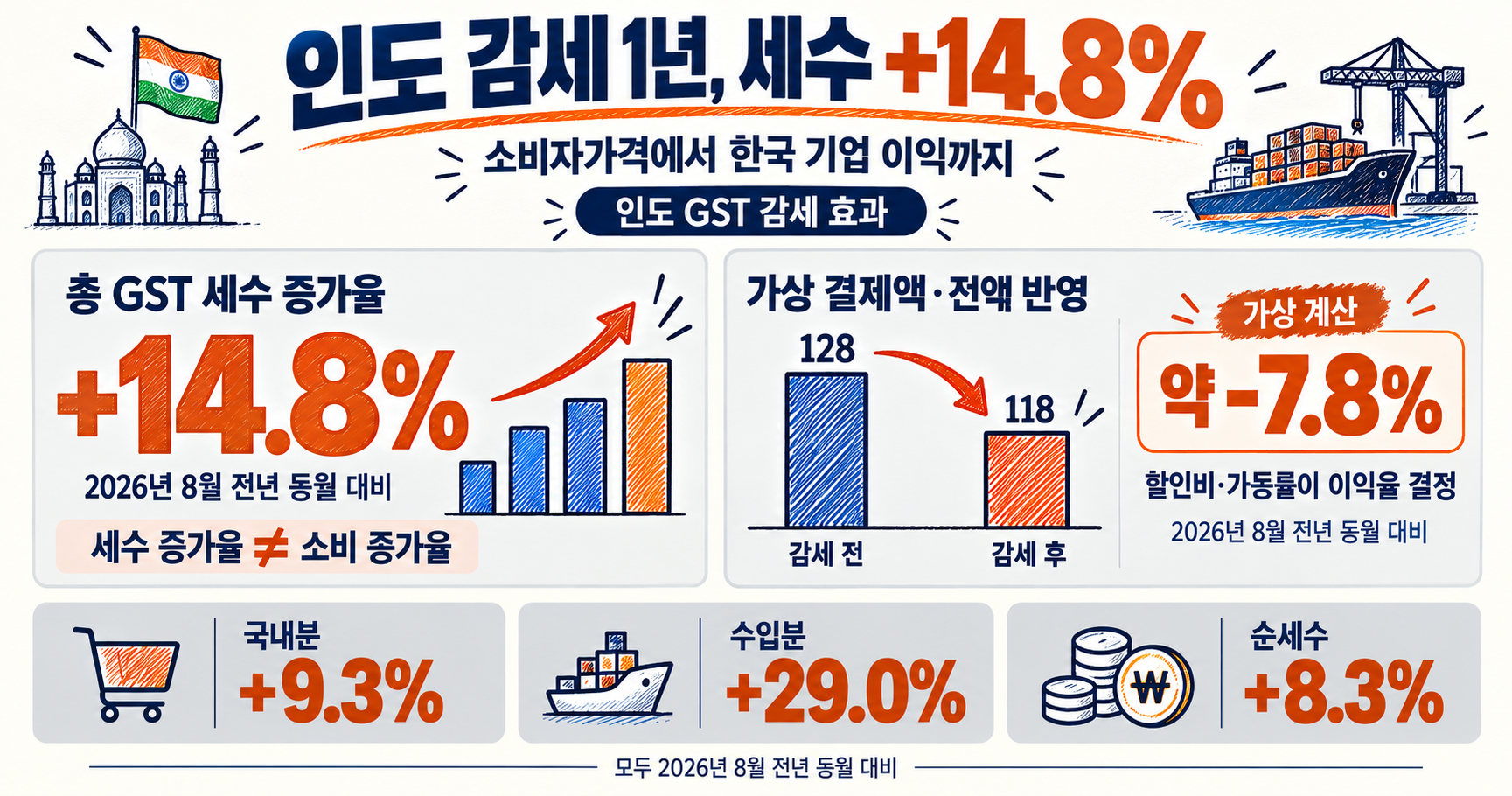
India GST tax cuts are approaching their first anniversary. August 2026 gross collections rose 14.8% from a year earlier, but that is not a measure of consumption growth. The useful question for Korean businesses is how lower taxes reach the checkout price, factory output and, eventually, profit. PTI, September 1.
India lowered taxes on many consumer goods from September 22, 2025. With a year nearly elapsed, the opening discount matters less than whether customers keep buying. An extra car sold in India can mean very different things for its manufacturer, an Indian component supplier and a Korean exporter.
The information cutoff is September 15, 2026. Policy details and reported figures are sourced below. The implications for earnings and economic activity are conditional analysis.
India GST tax cuts: start with the checkout price
GST is an indirect tax on goods and services. The amount a customer pays includes money the seller must remit as tax; it is not all company revenue. Eligible businesses can offset tax already paid on inputs. A lower checkout price therefore need not reduce the manufacturer’s revenue per unit if the price before tax stays unchanged.
The finance ministry’s reform announcement lowered GST from 28% to 18% for air conditioners, certain televisions and small cars, among other products. Rates remain product-specific. Vehicle dimensions, engine size and the old compensation cess also matter when calculating the actual change. Finance ministry reform announcement.
Take an illustrative product priced at 100 before tax, with no other taxes. A 28% GST produces a bill of 128. At 18%, full pass-through brings it to 118. The tax rate falls by 10 percentage points, while the customer’s bill falls about 7.8%. This is arithmetic, not an observed vehicle discount.
A 10-point tax cut reduces the bill by about 7.8%
IllustrationBefore
After
A 10-point tax cut reduces the bill by about 7.8%. Assumes a fixed pre-tax price of 100, no other taxes and full pass-through; not an observed discount.
For a large purchase, that saving can change the decision. A smaller loan principal also means smaller instalments, with other terms unchanged. Yet a household without access to credit, or uncertain about its income, may still postpone the purchase.
Why 14.8% higher tax receipts do not establish a consumer boom
The August breakdown makes the distinction clear: gross receipts rose 14.8%, domestic receipts 9.3% and import-related receipts 29.0%. After refunds, overall net revenue grew 8.3%. These figures were checked against the reproduced government table and reporting by PTI and Business Standard. Revenue table; Net-revenue report.
India: August 2026 GST revenue growth
Year-on-year %India: August 2026 GST revenue growth. Provisional GSTN table reproduced by Taxguru; checked against PTI and Business Standard. Gross, domestic and imports are before refunds; net is after refunds. Bars are not additive.
Tax receipts depend on prices, effective tax rates, the mix of goods and the timing of reporting and payment, as well as transaction volumes. Faster import-tax growth does not mean households bought proportionately more. Machinery and intermediate goods can also be part of the import bill.
Refunds have a separate cash-flow effect. Faster repayments can restrain growth in the government’s net receipts while returning cash to businesses sooner. That may ease the financing of inventories and inputs. A single tax-growth headline misses this distinction.
Nor does rising revenue prove the tax cut paid for itself. That would require estimating receipts in a world without the reform. The release describes nominal collections; it does not isolate the reform’s contribution to economic growth.
The benefit reaches households through actual prices
Pass-through means the share of a tax saving that reaches the customer. Lowering the final bill passes the benefit on. Keeping the bill unchanged while raising the pre-tax price leaves some with the seller. Higher materials or transport costs may absorb that money. The checkout bill is what matters to households.
A March 2026 NIPFP working paper compared consumer-price indices over four months before and four months after the reform. Some durables became cheaper, while results for food and household goods were uneven. It is a descriptive comparison, not a causal estimate, and does not cover August prices. NIPFP Working Paper 444.
The commercial question is how competition works. When customers can compare brands and wait, sellers have a stronger reason to pass savings through. Supply shortages or limited alternatives can let suppliers retain more. Determining which mechanism dominated requires product-level prices and costs, rather than assumptions about an entire sector.
For Korean companies, watch utilisation and discounts after volume
Hyundai Motor India reported August 2026 domestic sales of 54,396 vehicles, up 23.6% year on year. Higher local sales are a reported result. Company sales, however, are distinct from final customer registrations and do not represent consumption across India. Hyundai Motor India release.
But how much did the company keep? The sales figure alone cannot establish either the contribution of the tax cut or the increase in profit.
The route to higher profit is straightforward. More units from the same factory spread relatively fixed expenses, such as depreciation, over a larger output. Suppliers can benefit from additional orders and better use of their existing equipment. This is why capacity utilisation matters alongside sales volume.
How a tax cut can reach corporate earnings
Conditional analysisHow a tax cut can reach corporate earnings. Author analysis; depends on pass-through, final demand and cost control. It does not estimate effect sizes.
Company-funded discounts change the calculation. Unlike a tax reduction, a discount cuts the money the business receives. A shift toward cheaper models or the start-up expenses of a new factory can also limit profit growth. Quarterly volume, average selling price and operating margin should therefore be read together.
Appliance makers with local factories and distribution can also respond to demand. LG announced the start of construction of its third Indian plant in May 2025. That predates the GST reform, so the tax cut cannot explain that initial investment decision. The relevant question is how much future demand fills the capacity already being added. LG construction announcement.
Local production and Korean exports can move differently
A product made and sold in India is different from a finished product shipped from Korea. Local sales may support the parent’s consolidated earnings without increasing output at Korean factories. The domestic spillover depends on the balance between Korean equipment and components and locally sourced inputs.
Sustained demand can make local sourcing more attractive by shortening delivery times and reducing inventories. Indian suppliers and employment could gain while Korean exports of the same components grow less than expected. Equipment makers and suppliers of components that are difficult to source locally could still receive additional orders.
This connects with the distinction discussed in China’s export expansion and Korean industry. A growing foreign market and a larger share of that market for Korean suppliers are separate propositions.
Three checks for equities and the next quarter
A tax cut can bring purchases forward. If a household buys this year instead of next, current sales rise partly at the expense of future demand. Continued purchases beyond the initial response, without excessive dealer inventories, would provide better evidence of a lasting improvement.
If households spend their savings elsewhere, the benefit can extend to restaurants and services. Debt repayment or purchases of imported goods would produce a different domestic response. This transmission is central to the support for domestic demand described in Reuters’ August 2025 reporting on the reform proposal amid trade tensions. Reuters policy background.
For equities, the price paid for expected earnings is another variable. Strong results can produce a muted response if investors already expected more. Indian business exposure, ownership in the local subsidiary and currency translation also affect what reaches the Korean shareholder. No specific post-reform share-price reaction is asserted here.
The next checks are final customer sales alongside dealer inventories; profitability per unit after discounts alongside factory utilisation; and tax collections after distinguishing refunds alongside company cash flow. Agreement across those measures would strengthen the case for an earnings improvement rather than a temporary sales bounce.
The time it takes for corporate gains to reach households and investment also matters in the link between Korean profits and household income. India GST tax cuts will ultimately be judged through actual prices, sustainable sales and the orders that support investment and employment.
This is economic analysis, not a recommendation to buy or sell a security.
A tax cut delivers when customers pay less and businesses sell more without sacrificing their margins.
Sources
- GSTN 2026년 8월 세수표 재수록 — Taxguru, 2026-09-02
- PTI — 2026년 8월 GST 세수, 2026-09-01
- 인도 재무부 — 제56차 GST 위원회 권고, 2025-09-03
- NIPFP Working Paper 444 — GST 2.0과 소비자가격, 2026-03-17
- 현대차 인도 — 2026년 8월 판매 실적, 2026-09-01
- LG전자 — 인도 스리시티 제3공장 착공, 2025-05-08
- Reuters — 인도 소비세 개편 추진 배경, 2025-08-15
- Business Standard — 8월 순 GST 세수 8.3% 증가, 2026-09-01
인도 GST 감세 효과 — 세수 14.8% 증가, 한국 기업의 기회는 어디에 (조회수 1)
인도 GST 감세 효과를 확인하려면 세수와 매장 판매를 함께 봐야 합니다. 2026년 8월 총 GST 세수는 전년보다 14.8% 늘었지만, 이 숫자가 소비 증가율을 뜻하지는 않습니다. 세금 인하가 자동차·가전의 구매가격을 낮추고 한국 기업의 이익으로 이어지는 조건을 짚어봅니다. PTI의 9월 1일 보도.
인도는 지난해 9월 22일부터 여러 소비재의 세율을 낮췄습니다. 이제 관심은 발표 당시의 할인폭보다 그 이후의 구매가 얼마나 이어지는지에 있습니다. 자동차 한 대가 더 팔려도 제조사, 현지 부품사, 한국의 수출업체가 얻는 몫은 서로 다릅니다.
자료 기준일은 2026년 9월 15일입니다. 아래의 정책·발표 수치는 출처를 붙였으며, 기업 실적과 경기로 이어지는 설명은 조건부 분석입니다.
GST는 어떻게 붙고, 감세는 결제액을 얼마나 바꿀까요
GST는 상품과 서비스 거래에 붙는 간접세입니다. 소비자가 낸 결제액 전체가 회사 매출로 남는 것은 아닙니다. 그중 세금은 정부에 납부하며, 기업은 일정 요건 아래 원재료·부품을 살 때 낸 세금을 공제합니다. 그래서 소비자가격이 내려가도 세전 판매가격을 유지했다면 회사의 제품 한 개당 매출은 그대로일 수 있습니다.
인도 재무부의 개편 발표를 보면 에어컨, 일부 TV, 소형차 등의 GST는 28%에서 18%로 낮아졌습니다. 다만 모든 제품에 같은 세율을 적용한 것은 아닙니다. 차량은 크기와 배기량 등에 따라 분류가 다르고, 기존 추가부담금까지 살펴야 실제 인하폭을 계산할 수 있습니다. 인도 재무부의 품목별 개편안.
계산을 단순하게 해보겠습니다. 세전 가격이 100이고 다른 세금이 없는 제품을 가정합니다. GST가 28%면 소비자는 128을 냅니다. 세율이 18%로 낮아지고 판매자가 혜택을 전부 넘겨주면 118을 냅니다. 세율은 10%포인트 내려갔지만 소비자가격 하락률은 약 7.8%입니다. 실제 차종의 할인율이 아니라 원리를 보여주는 계산입니다.
세율 10%포인트 인하, 결제액은 약 7.8% 감소
가상 계산인하 전
인하 후
세율 10%포인트 인하, 결제액은 약 7.8% 감소. 세전 가격 100 고정·다른 세금 없음·전액 가격 반영 가정. 실제 제품 할인율이 아닙니다.
큰돈을 한 번에 쓰는 가전·자동차에서는 이 차이가 구매 결정을 바꿀 수 있습니다. 할부 원금이 줄면 매달 갚는 돈도 줄어듭니다. 반면 대출 승인이 나지 않거나 소득 전망이 불안한 가정에는 가격 인하만으로 충분하지 않을 수 있습니다.
세수 14.8% 증가를 소비 호황으로 읽기 어려운 이유
8월 자료는 그 차이를 잘 보여줍니다. 총 GST 세수 증가율은 14.8%였지만 국내 거래분은 9.3%, 수입 관련분은 29.0%였습니다. 환급을 반영한 전체 순세수 증가율은 8.3%로 낮아집니다. 정부 세수표 재수록 자료를 PTI와 Business Standard 보도에 대조했습니다. 세수표, 순세수 보도.
인도 2026년 8월 GST 세수 증가율
전년 동월 대비 %인도 2026년 8월 GST 세수 증가율. GSTN 표 재수록(Taxguru), PTI·Business Standard 대조. 잠정치. 총액·국내분·수입분은 환급 전, 순액은 환급 후이며 막대를 합산하지 않습니다.
세수는 거래 물량뿐 아니라 가격, 적용 세율, 어떤 상품이 많이 팔렸는지, 신고와 납부가 언제 이뤄졌는지에 따라 달라집니다. 수입 관련 세금이 빨리 늘었다고 인도 가정이 그만큼 더 소비했다고 볼 수도 없습니다. 공장을 짓기 위한 설비나 중간재 수입이 포함될 수 있기 때문입니다.
환급도 따로 봐야 합니다. 앞서 낸 세금을 돌려주는 속도가 빨라지면 정부 순세수는 덜 늘어도 기업 통장에는 돈이 먼저 들어옵니다. 기업 입장에서는 재고와 원재료에 묶이는 자금 부담이 줄 수 있습니다. 세수 증가율 하나로 경기의 온도를 재면 이런 차이를 놓치게 됩니다.
세율 인하 뒤 세수가 늘었다는 사실만으로 감세가 세수 손실을 모두 메웠다고 말할 수도 없습니다. 감세가 없었을 때 걷혔을 세금과 비교해야 하기 때문입니다. 이번 자료는 명목 거래와 세금 수납이 늘었다는 근거이며, 감세의 성장 기여도를 계산한 결과는 아닙니다.
가격표가 내려가야 가계의 구매력이 늘어납니다
감세 혜택이 소비자에게 얼마나 전달됐는지를 가격 전가라고 부릅니다. 세금이 줄어든 만큼 판매자가 결제가격을 낮췄다면 혜택은 소비자에게 돌아갑니다. 결제가격을 그대로 두고 세전 가격을 높였다면 일부는 판매자에게 남습니다. 다만 원재료나 운송비가 올랐다면 그 돈은 늘어난 비용을 메우는 데 쓰입니다.
소비자에게 중요한 것은 결국 계산대에서 내는 돈입니다.
인도 국립공공재정정책연구소(NIPFP)의 2026년 3월 연구는 개편 전후 각각 4개월의 소비자물가지수를 비교했습니다. 일부 내구재에서는 가격 하락이 나타났지만 식품·생활용품의 흐름은 고르지 않았습니다. 다만 다른 가격 요인을 분리한 인과 추정이 아니며, 8월의 가격을 분석한 연구도 아닙니다. NIPFP Working Paper 444.
왜 품목마다 차이가 날까요? 경제적으로는 경쟁의 방식이 중요합니다. 여러 브랜드의 가격을 비교하기 쉽고 구매를 미뤄도 된다면, 판매자는 손님을 놓치지 않으려고 세금 혜택을 가격에 반영할 유인이 커집니다. 물건이 부족하거나 대체 상품을 찾기 어렵다면 가격을 낮출 압력은 약해집니다. 실제로 어느 요인이 작용했는지는 제품별 가격과 비용 자료로 확인해야 합니다.
한국 기업은 판매량 다음에 가동률과 할인비를 봐야 합니다
현대차 인도는 2026년 8월 현지 내수판매가 5만4,396대로 전년보다 23.6% 늘었다고 발표했습니다. 현지 판매를 늘렸다는 점은 확인된 성과입니다. 다만 회사 판매 실적은 최종 소비자 등록대수와 구분해야 하며, 인도 전체 소비를 대표하지도 않습니다. 현대차 인도 9월 1일 발표.
문제는 더 팔고 얼마나 남겼는지에 대한 답입니다. 이 판매 수치만으로 감세의 기여도나 이익 증가 폭까지 알기는 어렵습니다.
이익이 늘어나는 원리부터 생각해 보겠습니다. 같은 공장에서 생산량을 늘리면 임차료처럼 당장 변하지 않는 비용을 더 많은 제품에 나누게 됩니다. 제품 하나가 부담하는 고정비가 줄어드는 셈입니다. 이것이 기존 설비를 더 많이 쓰는 가동률 상승의 효과입니다. 부품 주문까지 늘어난다면 협력사에도 기존 설비를 더 자주 돌릴 기회가 생깁니다.
감세가 기업 이익에 도달하는 경로
조건부 경제 분석감세가 기업 이익에 도달하는 경로. 저자 분석. 가격 반영·실수요·비용 통제가 충족될 때의 경로이며 효과 크기를 추정한 그림이 아닙니다.
할인 비용을 누가 부담하는지도 꼭 따져야 합니다.
제조사가 자체 할인을 크게 늘려 판매량을 끌어올렸다면 이익 계산은 달라집니다. 자체 할인은 회사가 제품을 팔고 받는 돈을 줄이기 때문입니다. 저가 차종이 더 많이 팔리거나 새 공장의 초기 비용이 늘어나는 경우에도 판매 증가율과 이익 증가율은 벌어집니다. 그래서 분기 실적에서는 판매량에 평균 판매가격과 영업이익률을 나란히 놓고 읽어야 합니다.
가전에서는 현지 공장과 판매망을 갖춘 기업이 늘어나는 주문에 대응하기 쉽습니다. LG전자는 2025년 5월 인도 제3공장 착공을 발표했습니다. GST 개편보다 먼저 시작한 투자입니다. 감세 때문에 공장을 지었다는 해석은 시간 순서부터 맞지 않습니다. 앞으로의 관건은 이미 확대하던 생산능력을 수요가 얼마나 채워주느냐입니다. LG전자 착공 발표.
인도 현지 생산이 늘면 한국 수출도 같이 늘까요
인도에서 만들어 인도에서 파는 제품은 한국에서 출하하는 완제품 수출과 다릅니다. 현지 판매가 늘면 한국 본사는 연결 실적을 통해 이익을 얻을 수 있지만, 국내 공장의 생산량은 그대로일 수도 있습니다. 한국에서 보내는 설비·핵심 부품과 현지에서 조달하는 부품의 비중을 따져야 국내 파급효과를 알 수 있습니다.
수요가 지속되면 현지 조달을 늘릴 유인이 생깁니다. 운송기간을 줄이고 재고를 덜 보유할 수 있기 때문입니다. 이 경우 인도 부품업체의 주문과 고용은 늘어도, 한국의 같은 부품 수출은 기대만큼 늘지 않을 수 있습니다. 반대로 현지에서 구하기 어려운 부품과 생산장비 업체에는 추가 주문 기회가 생길 수 있습니다.
이런 차이는 중국 수출 확대와 한국 산업의 경쟁 관계를 볼 때와도 이어집니다. 해외 시장이 커진다는 사실과 한국 업체가 그 시장에서 가져갈 몫은 별도의 질문입니다.
주가와 다음 분기 경기에서 확인할 세 가지
소비세 인하는 구매를 앞당길 수 있습니다. 원래 내년에 살 자동차를 올해 샀다면 당장의 판매는 늘지만 다음 해의 수요 일부를 가져온 셈입니다. 개편 직후의 반응을 지나서도 판매가 이어지고, 판매점 재고가 과도하게 쌓이지 않아야 지속적인 수요 개선으로 해석하기 쉽습니다.
가계가 절약한 돈을 다른 소비에 쓰면 음식점과 서비스업으로 효과가 넓어질 수 있습니다. 빚을 갚거나 수입품을 사는 데 쓰면 국내 경기로 번지는 속도와 크기는 달라집니다. Reuters가 개편 추진 당시 짚었던 대외 통상 불확실성 속 내수 지원이라는 목적도 이런 전달 과정이 작동해야 힘을 얻습니다. Reuters의 2025년 8월 정책 배경 보도.
주식시장에서는 좋은 판매 뉴스와 좋은 투자 성과 사이에 가격이 하나 더 들어갑니다. 투자자가 이미 큰 폭의 이익 증가를 예상했다면 실제 실적이 좋아져도 주가 반응은 작을 수 있습니다. 인도 사업의 비중, 현지법인 지분, 루피 이익을 원화로 바꾸는 환율까지 함께 봐야 합니다. 이 글은 감세 뒤 주가가 특정 방향으로 움직였다는 주장을 하지 않습니다.
앞으로 확인할 자료는 세 가지입니다. 첫째는 최종 소비자 판매와 판매점 재고입니다. 둘째는 할인비를 반영한 제품당 수익성과 공장 가동률입니다. 셋째는 환급을 구분한 세수와 기업 현금흐름입니다. 숫자가 같은 방향으로 움직이는지 보면 단순한 판매 반등과 이익 개선을 구별하기 쉬워집니다.
기업이 번 돈이 가계와 설비투자로 이어지는 속도는 한국 기업이익과 가계소득의 전달 구조에서도 중요한 문제였습니다. 인도 GST 감세 효과 역시 세율표 한 장으로 끝나지 않습니다. 소비자의 실구매가격이 내려가고, 기업이 지나친 할인 없이 더 팔며, 그 주문이 투자와 고용으로 이어지는지에 달려 있습니다.
투자 판단을 위한 경제 해설이며, 특정 종목의 매수·매도를 권하는 글은 아닙니다.
감세의 성과는 소비자가 실제로 덜 내고, 기업이 무리한 할인 없이 더 팔 수 있는지에서 드러납니다.
출처
- GSTN 2026년 8월 세수표 재수록 — Taxguru, 2026-09-02
- PTI — 2026년 8월 GST 세수, 2026-09-01
- 인도 재무부 — 제56차 GST 위원회 권고, 2025-09-03
- NIPFP Working Paper 444 — GST 2.0과 소비자가격, 2026-03-17
- 현대차 인도 — 2026년 8월 판매 실적, 2026-09-01
- LG전자 — 인도 스리시티 제3공장 착공, 2025-05-08
- Reuters — 인도 소비세 개편 추진 배경, 2025-08-15
- Business Standard — 8월 순 GST 세수 8.3% 증가, 2026-09-01
답글 남기기