EU 전기강판 규제 — 철심 톤당 1,140유로, 한국 변압기 수출의 변수EU electrical steel safeguards — a €1,140/tonne core levy changes transformer economics
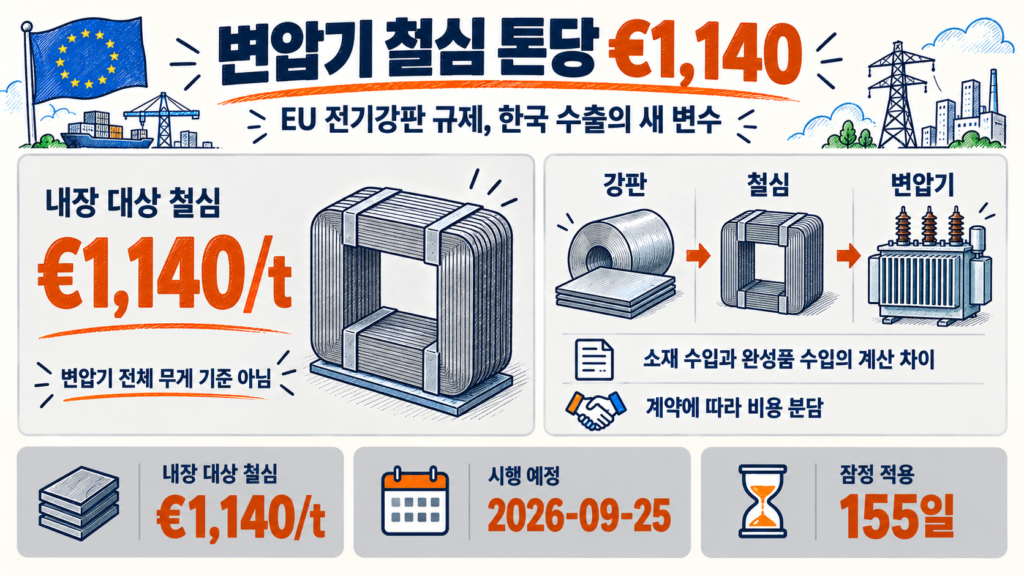
EU 전기강판 규제가 한국 변압기 수출의 새 변수가 됐습니다. 9월 18일 발표된 조치는 변압기에 들어 있는 대상 철심에도 톤당 1,140유로를 부과합니다. 적용은 9월 25일부터입니다. EU 시행규정
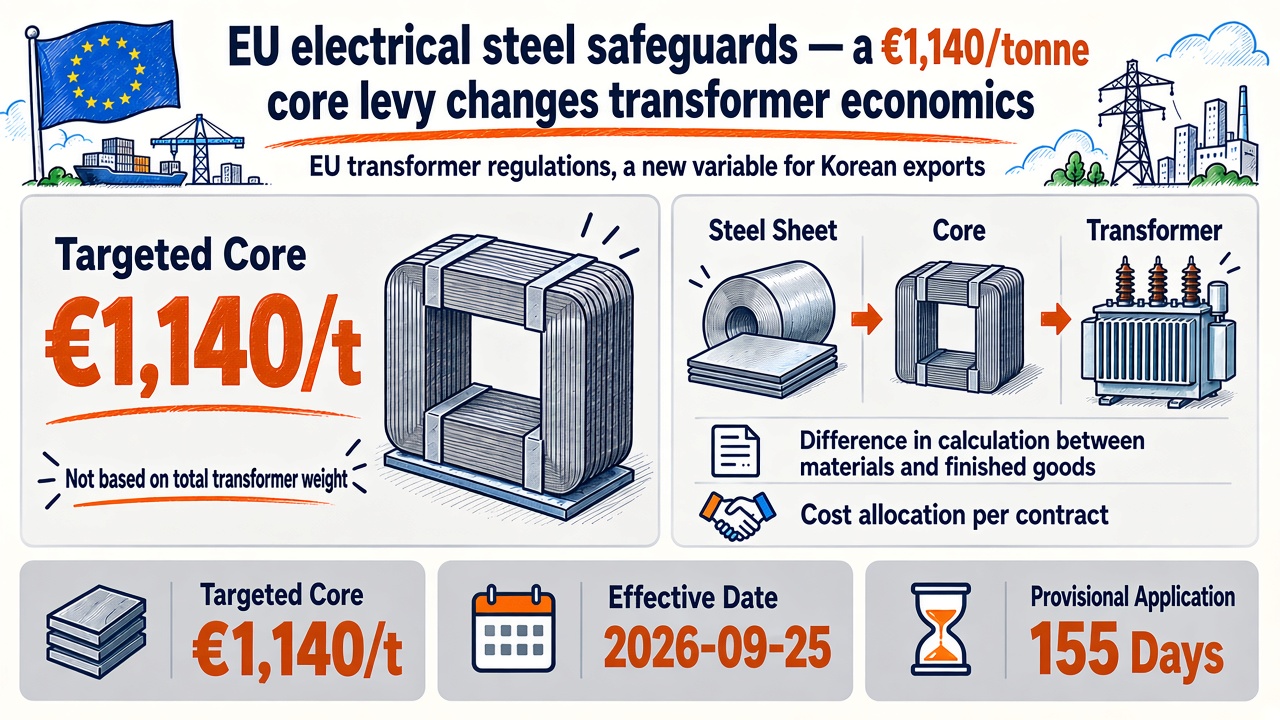
EU electrical steel safeguards introduce a new variable for Korean transformer exports. The measure announced on September 18 charges €1,140 per tonne of covered cores incorporated in transformers, effective September 25. Protecting a steel producer can change the economics of the equipment maker that buys its material. EU regulation
변압기는 전기를 멀리 보내거나 공장·가정에서 쓰기 좋도록 전압을 바꾸는 설비입니다. 그 안에서 자기를 전달하는 철심에는 방향성 전기강판, 영어로 GOES라는 특수강이 쓰입니다. 전력망이 커질수록 이 소재의 안정적인 공급도 중요해집니다. 집행위 발표
철강주와 전력기기주를 같은 방향으로 묶기 어려운 이유가 여기에 있습니다. 소재를 만드는 회사에는 가격 방어가 될 수 있지만, 이를 사서 설비를 만드는 회사에는 구매비 증가가 될 수 있습니다. 아래의 실적·소비·주가 영향은 확인된 정책을 바탕으로 한 조건부 분석이며, 특정 종목의 매수·매도 권유가 아닙니다. 기준일은 2026년 9월 20일입니다.
전력망을 늘려야 하는데, 왜 수입을 막을까?
집행위가 제시한 배경은 세계적인 공급과잉과 기존 수출시장의 폐쇄입니다. 다른 시장에서 팔기 어려워진 물량이 유럽으로 향하면 유럽 생산자는 가격을 낮추거나 주문을 잃게 됩니다. 집행위는 이런 수입 압력이 전략 산업을 위협한다고 판단했습니다. 정책 배경
기업이 느끼는 문제는 매출 감소만이 아닙니다. 공장에는 생산량이 줄어도 계속 나가는 유지비와 인건비가 있습니다. 주문이 줄면 제품 한 톤에 배분되는 고정비가 커지고, 가격 경쟁은 더 어려워집니다. 수요가 있는 산업에서도 특정 지역의 생산 기반이 약해질 수 있는 구조입니다.
실제 기업 발표도 있었습니다. thyssenkrupp는 3월 26일 프랑스 Isbergues 공장의 6~9월 생산 중단 계획을 알렸습니다. 다만 이는 당시 회사가 발표한 계획입니다. 9월 현재의 재가동 여부나 규제 이후 회복을 확인한 자료로 읽으면 안 됩니다. 회사 발표
정책 당국은 당장의 저렴한 수입보다 장기적인 생산 능력 유지에 더 높은 가치를 두는 셈입니다. 하지만 가격을 방어해 준다고 고급 제품의 생산 능력이 곧바로 늘지는 않습니다. 보호 기간에 기업이 설비와 기술에 투자하는지가 정책 효과를 가르게 됩니다.
EU 전기강판 규제, 강판과 완성품의 계산이 다릅니다
Reuters가 보도하고 법령 부속서가 확인한 GOES 기준가격은 쿼터 안에서 톤당 2,800~3,400유로, 쿼터 밖에서는 3,500유로입니다. 쿼터는 낮은 기준가격을 적용받는 수입 물량 범위입니다. 이 숫자는 철강의 실제 시세도, 모든 수입에 그대로 더하는 세금도 아닙니다. Reuters 보도
강판과 별도로 들어오는 철심은 해당 기준가격보다 수입가격이 낮을 때 차액이 부과되는 방식입니다. 반면 변압기에 이미 들어 있는 대상 철심에는 철심 중량을 기준으로 톤당 1,140유로가 적용되며 쿼터는 없습니다. 변압기 전체 무게에 곱하는 것이 아닙니다. 제1조 4~6항
강판·별도 철심
기준가격 미달분
계산
쿼터 · 안·밖 기준가격 구분
변압기 내장 철심
대상 철심 톤당 €1,140
계산
쿼터 · 미적용
가상의 변압기에 대상 철심이 10톤 들어 있다면 이 조치에 따른 금액은 1만1,400유로입니다. 같은 조건의 100대를 수출하면 114만유로가 됩니다. 실제 기업의 제품 중량이나 손실 추정치가 아니라, 과세 단위를 이해하기 위한 단순 계산입니다.
이 비용이 발생한다고 수출기업의 이익이 같은 금액만큼 반드시 줄어드는 것은 아닙니다. 수입자가 부담하는지, 판매자가 가격을 깎아 흡수하는지, 구매자에게 올려 받는지는 계약과 협상에 달렸습니다. 관세 계산과 기업 손익 계산은 구분해야 합니다.
한국 기업은 소재·완성품·현지 생산을 나눠 봐야 합니다
먼저 한국에서 강판을 만들어 유럽에 파는 경우입니다. 원래 판매가격이 기준가격보다 충분히 높다면 직접적인 추가 부담은 작을 수 있습니다. 반대로 가격 차이가 크거나 낮은 기준가격을 적용받는 물량이 소진되면 가격 경쟁력이 약해질 수 있습니다. 고급 소재라는 설명만으로 영향이 없다고 결론 내릴 수는 없습니다.
두 번째는 한국에서 완성한 변압기를 유럽에 파는 경우입니다. 완성품에 들어간 철심도 포함되므로, 소재를 가공했다는 이유만으로 이번 조치를 피할 수 있다고 가정하면 안 됩니다. 새 견적에서는 비용을 반영할 여지가 있지만, 이미 판매가격을 확정한 주문은 부담 조정이 더 어려울 수 있습니다.
세 번째는 유럽 안에서 생산하는 경우입니다. 완성품 수입과는 경쟁 조건이 달라질 수 있지만, 현지 공장이 수입 강판이나 철심을 사 쓴다면 구매비 부담이 남습니다. 현지 생산이라는 한 가지 정보보다 원재료의 출처와 구매가격을 함께 봐야 합니다.
여기서 특정 한국 기업의 승패를 정하지는 않겠습니다. 기업별 유럽 매출, 철심 중량, 통관 품목과 기존 계약 조건을 확인하지 못했기 때문입니다. 같은 전력기기 업종 안에서도 실제 부담은 상당히 달라질 수 있습니다.
원가 상승은 이익보다 현금에서 먼저 보일 수 있습니다
원재료를 먼저 사고 완성품을 나중에 납품하는 제조업에서는 그 사이에 돈이 묶입니다. 이를 운전자금이라고 합니다. 나중에 판매가격을 올려 원가를 회수할 수 있어도, 오늘 더 비싼 소재를 사는 데 필요한 현금은 따로 마련해야 합니다.
예를 들어 다른 조건이 같을 때 구매비가 늘고 고객의 선급금은 그대로라면 차입이나 보유 현금 사용이 늘 수 있습니다. 반대로 고객이 선급금을 더 내거나 납품대금을 빨리 지급하면 부담이 줄어듭니다. 수주 증가율만으로 사업의 현금 사정을 판단하기 어려운 이유입니다.
-
1
구매비 증가
영향받는 수입 소재
-
2
현금 선지출
재고·납품 기간에 자금 묶임
-
3
계약에 따라 분담
판매자 이익 또는 고객 가격
-
4
투자 판단 변화
예산 확대 또는 일정 조정
수익성도 원가 비중과 가격 전가율을 함께 봐야 합니다. 가령 어떤 제품에서 영향을 받는 소재가 원가의 20%이고 그 소재비만 10% 오르면, 다른 조건이 같을 때 전체 원가는 2% 늘어납니다. 소재값 10% 상승을 제품 원가 10% 상승으로 읽으면 충격을 과장하게 됩니다. 이 비율 역시 설명용 가정입니다.
전력망 투자와 소비자에게는 어떻게 전달될까?
유럽의 전력망·변압기 관련 단체들은 이미 6월 공동성명에서 규제에 반대했습니다. 필요한 고급 강판의 역내 공급이 부족하며 조달 제약이 전력망 투자를 지연시킬 수 있다는 주장입니다. 이는 구매자 측의 우려이고, 9월 조치로 실제 발생한 피해를 측정한 결과는 아닙니다. 업계 공동성명
경제적으로 가능한 경로는 두 가지입니다. 전력회사가 같은 예산으로 설비를 덜 살 수도 있고, 투자 규모를 유지하면서 추가 비용을 감당할 수도 있습니다. 전자는 연결 대기 중인 공장이나 발전소의 가동을 늦출 수 있습니다. 후자는 차입과 향후 요금 회수 부담으로 이어질 수 있습니다.
다만 소재 규제 발표가 곧바로 가정의 전기요금 인상으로 이어지는 것은 아닙니다. 전력요금에는 여러 비용이 들어가며 설비 수명과 요금 규제도 영향을 줍니다. 소비에 미치는 영향은 기업·가계가 실제로 지불하는 요금에 비용이 얼마나, 얼마나 늦게 반영되는지에 달렸습니다.
반대 방향의 가능성도 있습니다. 정책이 유럽 내 설비 재가동과 고급 소재 투자를 유도하면 장기적으로 공급 안정성이 개선될 수 있습니다. 결국 단기 구매비 증가를 감수한 만큼 새로운 공급 능력이 생기는지가 관건입니다. 보호 자체와 산업 경쟁력 회복은 같은 결과가 아닙니다.
주가는 수요보다 이익이 남는 계약을 확인합니다
이번 뉴스만으로 전력기기 주가의 방향을 예측하기는 어렵습니다. 주가는 미래 이익에 대한 기대를 반영하므로, 시장이 이미 예상한 비용인지도 중요합니다. 주문이 늘어도 납품까지 필요한 현금과 비용이 더 빨리 늘면 기업 가치에 도움이 되지 않을 수 있습니다.
다음 기업 실적 발표에서는 유럽 주문의 가격 조정 여부, 고객 선급금, 원재료 재고와 영업현금흐름을 함께 확인할 필요가 있습니다. 영업현금흐름은 장부상 이익과 달리 사업 과정에서 실제로 들어오고 나간 현금을 보여줍니다. 회사가 영향을 공시하기 전에는 업종 전체의 이익 감소율을 임의로 붙이지 않는 편이 정확합니다.
이와 관련해 수출기업의 운임·재고자금 분석은 비용 발생과 현금 회수 사이의 차이를 이해하는 데 도움이 됩니다. 미국 국채금리와 기업 이자비용 분석에서는 추가 자금 조달이 기업 가치로 전달되는 경로를 볼 수 있습니다.
EU 전기강판 규제의 다음 확인 시점은 9월 25일 시행과 그 이후 기업들의 계약 조정입니다. 이번 조치는 155일간의 잠정 조치입니다. 장기 투자 판단에서는 영구 규제로 가정하기보다 후속 조사와 최종 조치 여부를 함께 확인해야 합니다. 시행일과 적용 기간
제가 이 뉴스에서 가장 중요하게 보는 것은 철강 가격 자체보다 공급망 안에서 비용을 나눠 부담하는 방식입니다. 소재 회사가 지켜 낸 가격이 설비 회사의 이익 감소로 끝날지, 고객이 비용을 받아들이고 투자를 이어갈지에 따라 산업의 다음 모습이 달라집니다.
관세의 크기와 기업이 최종적으로 부담하는 비용은 계약에 따라 달라집니다.
출처
A transformer changes voltage so electricity can travel long distances and be used by businesses and households. Its magnetic core uses a specialty material called grain-oriented electrical steel, or GOES. A growing grid needs reliable access to that material. Commission announcement
Steelmakers and electrical-equipment suppliers need not benefit together. Protection can support a material producer’s prices while increasing a customer’s input bill. The earnings, spending and market implications below are conditional analysis, not observed outcomes or a recommendation to trade any security. Information is assessed as of September 20, 2026.
Why restrict imports when the grid needs to grow?
The Commission points to global overcapacity and the closure of traditional export markets. When suppliers lose access elsewhere, redirected shipments can intensify competition in Europe. The Commission judged this pressure a threat to a strategic industry. Policy rationale
The economic mechanism extends beyond lost sales. A mill still incurs maintenance and staffing costs when orders fall. Lower output spreads those fixed costs across fewer tonnes, making competitive pricing harder. A market can grow while production in one region becomes less viable.
There is a concrete company example. On March 26, thyssenkrupp announced plans to suspend production at its Isbergues site in France from June through September. That is a dated company announcement, not confirmation of its current operating status or evidence of a recovery following the new measure. Company release
The policy places a value on retaining production capacity beyond the immediate benefit of cheap imports. Yet price support does not instantly create better-grade capacity. Whether producers reinvest in equipment and technology will determine how much resilience the protection actually buys.
EU electrical steel safeguards: material and equipment differ
Reuters reports GOES price thresholds of €2,800–€3,400 per tonne within quota and €3,500 outside it, matching the regulation’s annex. A quota defines the volume eligible for the lower threshold. These figures are neither a market quotation nor a flat tax added to every shipment. Reuters report
For steel and separately imported cores, the duty fills the gap when the import price is below the relevant threshold. Covered cores already incorporated in transformers instead face €1,140 per tonne of core, without a quota. The weight of the entire transformer is not the tax base. Article 1(4–6)
Steel / separate core
Gap below threshold
Calculation
Quota · Different thresholds
Core in transformer
€1,140 / tonne of core
Calculation
Quota · None
For illustration, a transformer containing 10 tonnes of covered core would incur €11,400 under this measure. One hundred identical units would imply €1.14 million. These are arithmetic examples, not actual product weights or an earnings estimate for a manufacturer.
That bill does not mechanically equal the exporter’s lost profit. The importer may absorb it, the seller may concede part of its price, or the buyer may accept a higher final price. Contract terms and bargaining power determine the distribution. Customs arithmetic and earnings arithmetic are different exercises.
Three different exposures for Korean businesses
Consider steel shipped from Korea to Europe. A price already above the applicable threshold may leave little direct additional burden. A larger price gap, or the exhaustion of lower-threshold quota volumes, changes that calculation. Calling a product premium-grade is not enough to establish that it is unaffected.
The second case is a completed transformer shipped from Korea. Incorporating the core into equipment does not by itself remove the exposure. A new quotation may accommodate an additional cost. An existing order with a fixed selling price may leave much less room to renegotiate.
The third case is production within Europe. The competitive position may differ from importing finished equipment, but a local plant buying imported steel or cores can still face higher input costs. Production location must be read together with sourcing and purchase prices.
This does not establish winners and losers among individual Korean companies. Their European sales exposure, core weights, customs classifications and existing contract terms have not been verified here. Businesses in the same sector can have materially different exposures.
Cash can feel the pressure before reported earnings
Manufacturers often pay for materials before delivering finished equipment. The money tied up between those events is working capital. Even if a higher selling price eventually recovers the cost, the business must still fund the larger material bill today.
If purchase costs rise while customer advances remain unchanged, a supplier may need more borrowing or cash reserves. Larger advances or faster settlement can offset that pressure. Order growth alone therefore says little about how comfortably a supplier can finance its production.
-
1
Higher input bill
Affected imported inputs
-
2
Cash paid earlier
Cash tied up before delivery
-
3
Contract allocation
Supplier margin or buyer price
-
4
Investment response
Larger budget or changed timing
Cost shares matter as much as price changes. Suppose the affected material represents 20% of a product’s cost and that material becomes 10% more expensive. Holding everything else constant, total cost rises 2%, not 10%. These percentages are hypothetical and illustrate why an input-price move cannot be applied to the whole product.
How could this reach grid investment and consumers?
European grid and transformer industry groups opposed safeguards in a June joint statement. They argued that regional supply of required high-grade material was insufficient and restrictions could delay grid investment. That is the purchasing industries’ position, not a measurement of damage caused by the September measure. Joint industry statement
There are two plausible economic channels. A utility could buy less equipment within an unchanged budget, or preserve its investment plan and fund the extra cost. The former could delay connections for factories and generation projects. The latter could increase financing needs and future cost-recovery requirements.
A material safeguard does not immediately translate into a household electricity-price increase. Tariffs reflect many costs, asset lifetimes and regulatory decisions. The effect on consumption depends on how much additional cost ultimately reaches bills and how long that transmission takes.
There is also a possible benefit. If protection encourages viable restarts and investment in advanced material, longer-term supply security could improve. The question is whether the short-term cost buys additional productive capacity. Protection and restored competitiveness are not the same outcome.
For investors, demand needs to become profitable contracts
The announcement alone is insufficient to predict electrical-equipment share prices. Prices reflect expectations of future profits, including costs investors may already anticipate. More orders need not create more value if financing needs and delivery costs grow faster.
Useful disclosures include price revisions on European orders, customer advances, material inventories and operating cash flow. Operating cash flow shows cash generated and used in the business, rather than accounting profit alone. An industry-wide earnings haircut would be speculative before companies explain their exposure.
Our analysis of export freight and working capital explains the gap between paying a cost and collecting cash. Our discussion of Treasury yields and corporate interest costs examines how financing needs can affect business value.
The next checkpoints are implementation on September 25 and subsequent contract adjustments. This is a provisional measure lasting 155 days. Long-term investment analysis should track the investigation and any definitive measure rather than assume permanent protection. Effective date and duration
The most consequential question is how the supply chain shares the cost. A price preserved for a steelmaker may become lost margin for an equipment supplier, or a higher bill that a customer accepts while continuing to invest. Those outcomes lead to very different industrial economics.
A duty bill and the cost ultimately borne by a business are different calculations.
Sources
이 글은 정보 제공 목적이며, 특정 자산의 매수·매도를 권유하지 않습니다.
For information only — this is not a recommendation to buy or sell any asset.
댓글Comments 0