Oil Price Drop 2026 — Back to $72, Iran War & Hormuz Reopening Explained (Views 1)

Oil prices dropped in 2026 back toward pre-war levels. On July 6, Brent traded near $72 per barrel and WTI around $69 — close to where they were on February 27, before US–Israeli strikes on Iran. The war is not over, so why did crude get cheaper so fast? This piece walks through the Iran conflict, the Strait of Hormuz, OPEC+ output, and what Korean readers should watch.
In one line: markets stopped pricing an endless war and started pricing backlog crude hitting the water. Talks are interim and transits are still far below normal — the charts below anchor the numbers.
Oil drop 2026 — the numbers now
Brent price path ($/bbl)
Bar chartOil price path 2026 Brent peak vs now. Feb 27 pre-war $72.48; Mar–Apr peak $120–126; Jul 6 $71.88. Not advice.
Brent is the global benchmark. It settled at $72.48 on February 27, spiked toward $120–126 in March–April, then slipped to $72.92 on July 1 and $71.88 on July 6. WTI was near $68.58 the same day.
The reversal is mostly a supply story: Gulf barrels that could not move are moving again. Early in the war, “higher oil” dominated; now the question is how fast stranded inventory clears.
Iran war timeline — what changed
Iran war & oil — four steps
FlowIran war timeline Hormuz MOU oil flow. Late-Feb strikes → Hormuz closure → Jun 17 MOU → backlog release & price drop.
Late February 2026, US–Israeli strikes on Iran shut the Strait of Hormuz — a chokepoint for roughly one-fifth of world oil and LNG. Middle East producers cut real output below OPEC+ quotas as unsold barrels filled storage.
On June 17, Presidents Trump and Pezeshkian signed an interim MOU: Iran allows unimpeded Hormuz transit; the US eases its naval blockade of Iranian ports. Not a final peace deal — but markets reacted to reopening risk first.
Why Hormuz transits press prices down
Hormuz daily transits
Bar chartHormuz daily tanker transits vs pre-war. Pre-war ~130/day; week to Jun 28: 242; Jul 2: 38/day. Not fully normalized.
Before the war, about 130 ships crossed daily. With the strait blocked, crude piled up on tankers and in tanks. After the MOU, Saudi Arabia reportedly more than doubled shipping versus the prior three months combined; Iran pushed roughly 50 million barrels since the blockade lifted.
Normalization is incomplete: 38 transits were counted on July 2 versus ~130 pre-war. Iran warned tankers off approved routes face a “forceful response.” Cheaper oil means lower risk premium, not guaranteed calm.
OPEC+ August hike — paper vs reality
On July 6, seven OPEC+ members agreed to raise targets by 188,000 bpd from August. During the war, many could not hit quotas because Hormuz was closed. Reopening releases backlog as well as nominal supply.
The group can pause or reverse hikes if markets shift — August’s move reads more like adjustment at already-lower prices than a blind supply flood.
Upside risks — what could lift oil again
When oil could rise again
SummaryA Hormuz friction
Tolls or route warnings
- Risk premium returns
B Talks fail
Sanctions and funds unresolved
- 60-day window is key
C Low buffers
806M→734M bbl
- Small shocks reprice fast
Talks, tolls, sanctions, US stocks — concurrent variables. Not advice.
Analysts flag three watch items: possible Hormuz tolls after the toll-free window; unresolved sanctions, frozen funds, and the 60-day talk window; and thinner US commercial + SPR stocks — about 734 million barrels by late June versus 807 million five weeks earlier.
Shipping data firms note sanctioned and “zombie” tankers moved alongside commercial first movers right after the MOU — reopening ≠ normalized shipping norms.
Korea checklist — FX, equities, inflation
Korea imports most of its oil. Lower crude eases energy import bills and fuel-price expectations, but KRW/USD and global liquidity are separate axes — see our Korea FX policy piece. Equities tie to global capital flows and KOSPI volatility history.
Conclusion — cheaper oil, unfinished war
The 2026 oil drop is less “war over” than blockade relief + inventory release. Brent near $72 mirrors pre-crisis levels, but Hormuz, talks, and sanctions can reprice risk quickly. Track calendars, stocks, and diplomacy — not headlines alone.
For information only — not investment advice.
Cheaper oil is not peace — it is blockade relief plus inventory moving again.
Sources
- Euronews — OPEC+ and pre-war oil prices
- Al Jazeera — OPEC+ output and Hormuz transits
- Invezz — risks after oil returns to pre-war levels
- Economic Times — July 6 Brent and WTI prices
- Windward — Hormuz reopening and tanker movements
- Internal: 2026-07-06-oil-price-war-hormuz-session-01.md
유가 하락 2026 — 전쟁 전 $72 회복, 이란·호르무즈가 꺾인 이유 (조회수 1)
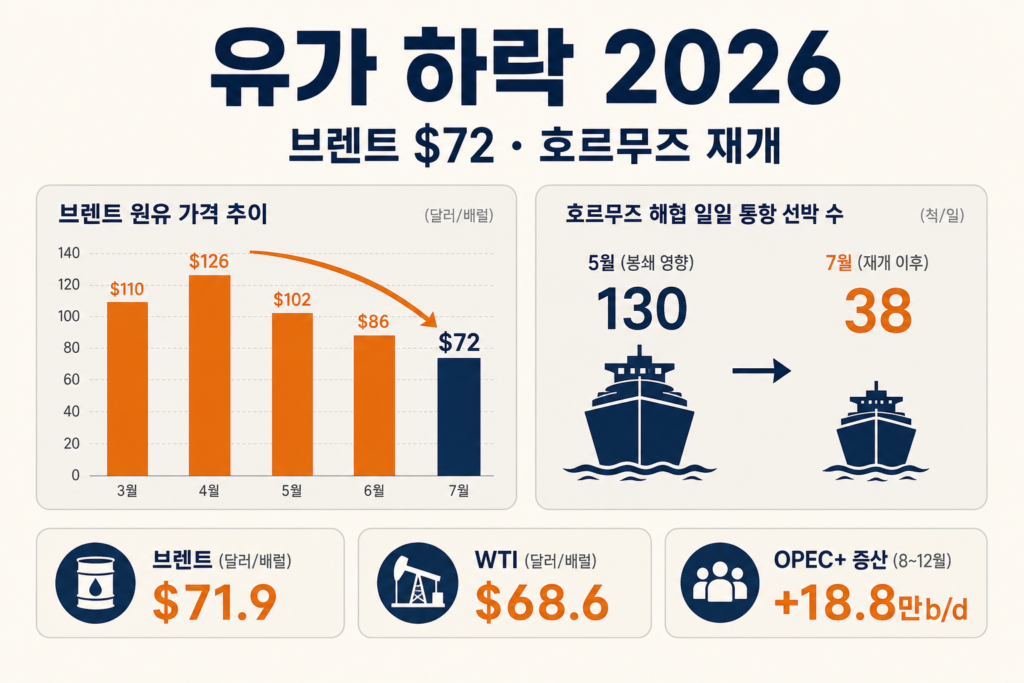
유가 하락 2026이 뉴스 헤드라인을 잡고 있습니다. 7월 6일 기준 브렌트유는 배럴당 약 72달러, 서부텍사스산(WTI)은 69달러 전후입니다. 2월 말 미·이스라엘이 이란을 공격해 전쟁이 시작됐을 때와 비슷한 가격대로 돌아온 셈입니다. 위기가 끝난 건 아닌데, 왜 이렇게 빠르게 싸졌는지 — 이란 전쟁 근황, 호르무즈 해협, OPEC+ 증산, 한국 독자가 볼 체크포인트까지 정리합니다.
한 줄로 말하면, 시장은 “전쟁이 영원히 지속된다”는 가정을 걷어내고, 봉쇄 기간 쌓여 있던 원유가 한꺼번에 풀리는 구간에 들어섰습니다. 다만 협상은 잠정적이고 통항도 전쟁 전의 절반도 안 됩니다. 아래 차트와 타임라인으로 숫자부터 맞춰 보겠습니다.
유가 하락 2026 — 지금 시장이 말하는 숫자
브렌트유 가격 경로 ($/배럴)
세로 막대 그래프유가 하락 2026 브렌트유 가격 경로 위기 정점 대비. 2/27 전쟁 직전 결산 $72.48, 3~4월 위기 정점 $120~126, 7/6 $71.88. Euronews·Al Jazeera·Economic Times. 투자 권유 아님.
브렌트유는 국제 원유 가격의 기준 지표입니다. 2026년 2월 27일, 전쟁 직전 결산가는 배럴당 72.48달러였습니다. 3~4월 위기가 고조되면서 120~126달러까지 올랐고, 7월 1일에는 72.92달러, 7월 6일에는 71.88달러까지 내려왔습니다. WTI도 같은 날 68.58달러 수준입니다.
가격이 이렇게 빠르게 되돌아온 이유는 단순합니다. 공급이 다시 움직이기 시작했기 때문입니다. 전쟁 초반에는 “유가가 오른다”는 이야기가 지배적이었지만, 지금은 “얼마나 빨리 쌓인 물량이 시장에 나오느냐”가 더 큰 변수로 보입니다.
이란 전쟁 타임라인 — 무엇이 바뀌었나
이란 전쟁·유가 — 4단계 흐름
흐름도이란 전쟁 타임라인 호르무즈 봉쇄 MOU 유가 흐름. 2월 말 미·이스라엘 이란 공격 → 호르무즈 사실상 폐쇄 → 6/17 잠정 MOU → 쌓인 원유 출하·유가 하락.
2026년 2월 말, 미국과 이스라엘이 이란을 공격하면서 중동 리스크가 폭발했습니다. 이란은 호르무즈 해협(세계 원유·LNG의 약 5분의 1이 지나가는 수로) 통행을 사실상 막았고, 사우디·쿠웨이트·이라크 같은 중동 산유국은 팔지 못한 원유가 쌓이면서 서면상의 OPEC+ 쿼터보다 훨씬 적게 실제로 생산했습니다.
6월 17일, 도널드 트럼프 미 대통령과 마수드 페제시키안 이란 대통령이 잠정 양해각서(MOU)에 서명했습니다. 이란은 호르무즈를 통한 선박 통행을 제한 없이 허용하고, 미국은 이란 항만에 가한 해군 봉쇄를 완화한다는 내용입니다. 최종 평화 협정은 아니지만, 시장은 “봉쇄가 풀린다”는 신호에 먼저 반응했습니다.
호르무즈 통항이 유가를 누르는 이유
호르무즈 일일 통항 (척)
세로 막대 그래프호르무즈 해협 일일 유조선 통항 수 전쟁 전 대비. 전쟁 전 일 ~130척, 6/28 주 242척(주간), 7/2 일 38척. MarineTraffic·Al Jazeera. 완전 정상화 아님.
호르무즈가 열리면 가격이 내려가는 이유는 직관적입니다. 전쟁 전 하루 평균 약 130척이 지나가던 해협이 막히면서, 중동에서 나온 원유가 창고와 유조선에 그대로 묶여 있었습니다. MOU 이후 사우디는 지난 3개월 합산 출하량의 두 배 이상을 다시 밀어 냈고, 이란도 봉쇄 해제 뒤 약 5,000만 배럴 규모의 원유를 시장에 내놓은 것으로 보도됐습니다.
그런데 통항은 아직 ‘정상’이 아닙니다. 7월 2일 하루 통과 선박은 38척으로 집계됐고, 전쟁 전 130척과는 거리가 있습니다. 이란은 승인 항로를 벗어나는 유조선에 “강력한 대응”을 경고하기도 했습니다. 유가가 싸진 건 완전한 안심이 아니라, 리스크 프리미엄이 줄었다는 뜻에 가깝습니다.
OPEC+ 8월 증산 — 종이와 실제
7월 6일(현지 일요일), OPEC+ 7개국(사우디·러시아·이라크·쿠웨이트·카자흐스탄·알제리·오만)은 8월부터 하루 18만 8,000배럴씩 생산 목표를 올리기로 했습니다. 겉보기엔 공급을 늘리는 결정이지만, 전쟁 기간에는 호르무즈 봉쇄 때문에 목표치를 채우지 못한 나라가 많았습니다. 지금은 봉쇄가 풀리면서 그동안 못 판 물량이 겹쳐 나오는 시기이기도 합니다.
OPEC+는 시장이 급변하면 증산을 멈추거나 되돌릴 수 있다고 밝혔습니다. 즉, 8월 증산은 ‘무조건적인 공급 폭탄’이라기보다, 이미 바닥으로 내려온 가격을 전제로 한 조정에 가깝게 읽힙니다.
유가가 다시 오를 수 있는 조건 — 아직 남은 리스크
유가 다시 오를 수 있는 조건
요약A 호르무즈 마찰
통행료·항로 경고
- 리스크 프리미엄 재부과
B 협상 결렬
제재·동결자금 미해결
- 60일 협상 창이 핵심
C 재고 소진
8.07→7.34억 bbl
- 작은 충격도 가격에 반영
잠정 협상·통행료·제재·미 재고가 동시 변수. Invezz·Windward. 투자 권유 아님.
시장 분석가들이 경고하는 포인트는 세 가지입니다. 첫째, 이란이 호르무즈에 대한 통제권을 국제적으로 인정받고 싶어 하며, MOU에 따른 통행료 면제 기간이 끝나면 통행료를 부과할 수 있다는 점입니다. 둘째, 제재 완화·동결 자금·60일 협상 창 등 핵심 분쟁은 미해결입니다. 셋째, 미국 상업 원유 재고와 전략비축유(SPR)를 합치면 6월 말 기준 약 7.34억 배럴로, 5주 전 8.07억 배럴보다 줄었습니다. 버퍼가 얇으면 작은 공급 차질도 가격에 크게 튈 수 있습니다.
Windward 같은 해운 데이터 업체는 6월 18일 전후 호르무즈에 제재 대상 유조선·‘좀비 선박’이 민간 선박과 함께 움직였다고 짚습니다. 해협이 열렸다고 해서 국제 해운 규범 안에서만 원유가 흐른다는 보장은 없습니다.
한국 독자 체크포인트 — 환율·주식·물가
한국은 원유 수입 의존도가 높습니다. 유가가 내리면 단기적으로는 수입 에너지 비용 부담이 줄고, 휘발유·경유 가격 기대도 완화되는 방향입니다. 다만 원·달러 환율, 글로벌 달러 유동성, 주식 시장 리스크는 별개 축입니다. 원·달러 환율과 한국 정책 수단 글에서 다룬 것처럼, 유가 하락이 곧바로 원화 강세로 이어지지는 않습니다.
주식 시장에서는 에너지·정유·해운은 유가와 민감하게 연동되고, 성장주·기술주는 글로벌 자금이 어디로 이동하는지와 함께 봐야 합니다. 코스피 변동성이 커지는 구간에서는 과거 하락 패턴과 시나리오를 같이 점검하는 편이 낫습니다.
결론 — 싸진 유가, 끝나지 않은 전쟁
유가 하락 2026은 ‘전쟁 끝’ 신호가 아니라, 봉쇄 해제 + 쌓인 재고 출하가 겹친 결과에 가깝습니다. 브렌트 $72 전후는 위기 전 수준이지만, 호르무즈 통항·협상·제재 이슈가 남아 있어 V자 반등 여지도 있습니다. 개인 투자자라면 유가 뉴스만 보지 말고, 환율·재고·협상 일정을 달력에 같이 표시해 두는 것이 좋습니다.
이 글은 정보 제공 목적이며, 특정 자산 매수·매도를 권유하지 않습니다.
싸진 유가는 평화가 아니라 봉쇄 완화와 재고 출하가 겹친 결과입니다.
출처
- Euronews — OPEC+ and pre-war oil prices
- Al Jazeera — OPEC+ output and Hormuz transits
- Invezz — risks after oil returns to pre-war levels
- Economic Times — July 6 Brent and WTI prices
- Windward — Hormuz reopening and tanker movements
- Internal: 2026-07-06-oil-price-war-hormuz-session-01.md
답글 남기기