폐플라스틱 재활용 촉매, 30분 재생은 가능할까 — 세척비와 공장 현실Plastic recycling catalyst: 30-minute recovery? Washing costs and factory realities
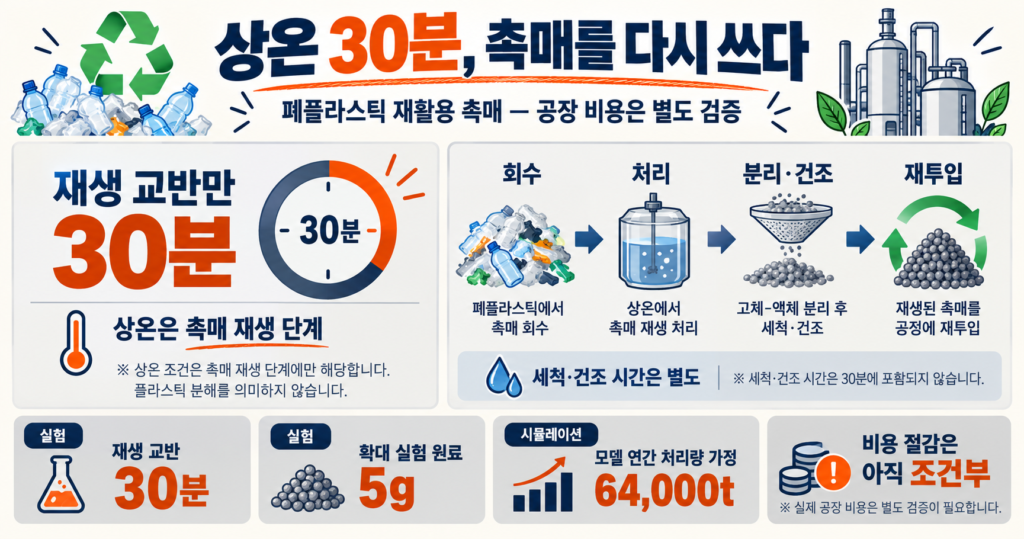
폐플라스틱 재활용 촉매를 상온에서 30분 처리해 성능을 되살린 연구가 나왔습니다. PVC에서 나온 염소 때문에 작동이 둔해진 촉매가 대상입니다. 공장 원가를 낮출 가능성은 있지만, 그 30분에 세척과 건조까지 포함되는 것은 아닙니다. Gu et al., Nature Communications (2026), Tackling chlorine poisoning for robust upcycling of PVC-contaminated plastic streams
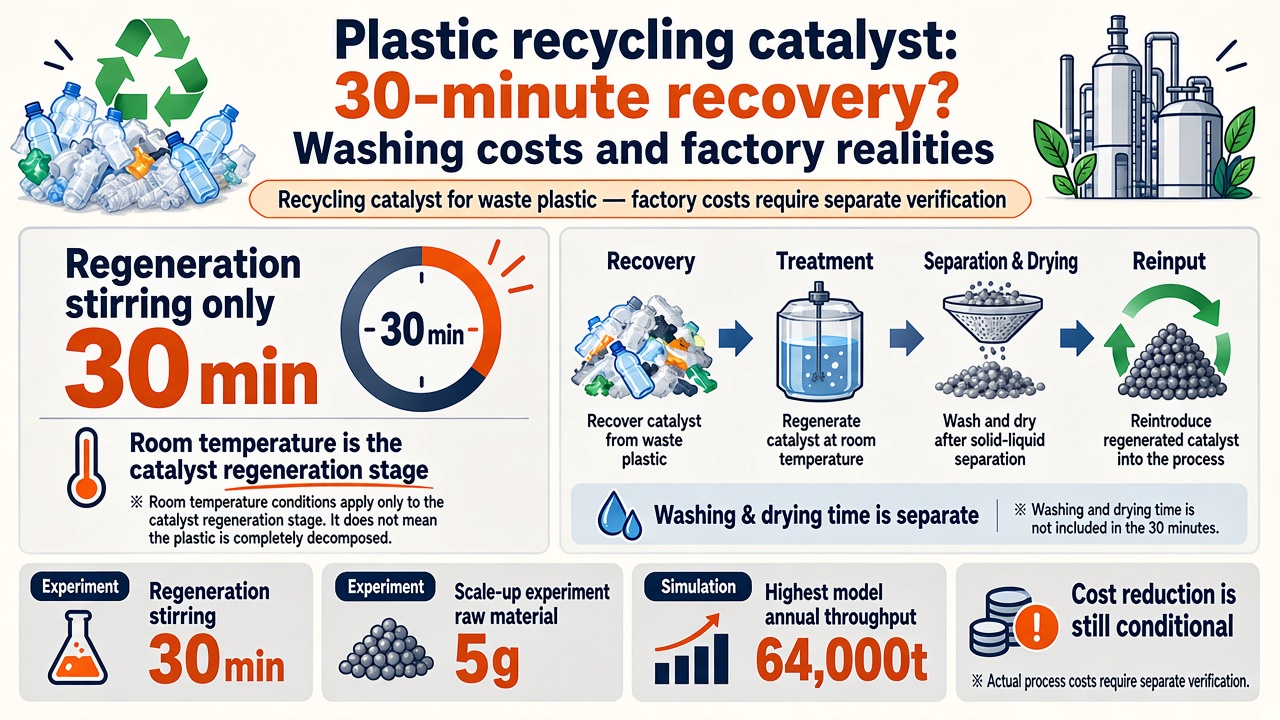
A new study restores a plastic recycling catalyst through a 30-minute treatment at room temperature. The target is a catalyst impaired by chlorine from PVC. That could matter for plant costs, but washing and drying take additional time. Gu et al., Nature Communications (2026), Tackling chlorine poisoning for robust upcycling of PVC-contaminated plastic streams
분리수거한 플라스틱을 다시 원료로 만드는 공장을 떠올려 보겠습니다. 들어오는 폐기물의 품질이 매일 같지 않다면, 좋은 촉매를 사는 것만으로는 생산량을 지키기 어렵습니다. 오염된 촉매를 회수하고 다시 쓰는 과정도 생산 기술의 일부가 됩니다.
9월 14일 Nature Communications에 공개된 Gu 연구진의 논문은 이 문제를 다룹니다. 동료심사를 거친 수락 논문의 조기 공개본입니다. 촉매 성능을 되살린 실험이 공장의 비용 절감으로 이어지려면, 회수와 세척에 드는 부담까지 넘어야 합니다. Gu et al., Nature Communications (2026), Tackling chlorine poisoning for robust upcycling of PVC-contaminated plastic streams
폐플라스틱 재활용 촉매는 왜 염소에 약할까
촉매는 화학반응이 일어나는 속도를 높이는 물질입니다. 이 연구의 루테늄은 그런 역할을 하는 금속입니다. 표면에서 반응을 돕는데, 염소가 그 자리를 차지하면 제 기능을 하기 어려워집니다. 이를 촉매의 피독이라고 부릅니다. Gu et al., Nature Communications (2026), Tackling chlorine poisoning for robust upcycling of PVC-contaminated plastic streams
폴리올레핀은 폴리에틸렌이나 폴리프로필렌 같은 플라스틱을 묶어 부르는 이름입니다. 수소화분해는 수소를 써서 이들의 긴 분자 사슬을 짧게 나누는 반응입니다. PVC는 염소를 포함하는 별도 플라스틱이어서, 혼합 원료에 섞이면 촉매 운전의 변수가 됩니다. Gu et al., Nature Communications (2026), Tackling chlorine poisoning for robust upcycling of PVC-contaminated plastic streams
기존 산업에서도 이 문제를 그냥 두지 않습니다. BASF는 폐플라스틱 열분해 원료에서 할로젠을 제거해 후단 장비를 보호하는 PuriCycle 제품군을 소개합니다. 할로젠은 염소 등을 포함하는 원소군입니다. 여기서 흡착제는 불순물을 붙잡아 제거하는 재료입니다. BASF PuriCycle — 폐플라스틱 열분해 원료 정제 제품
새 연구가 더하는 것은 오염된 촉매의 회복이라는 선택지입니다. 원료에서 불순물을 줄이는 일과 촉매를 되살리는 일은 서로 다른 기능입니다. 둘을 조합해 총비용을 줄일 수 있는지가 사업화의 질문입니다.
30분은 촉매 처리 시간입니다
연구진은 수소화붕소나트륨(NaBH₄)이라는 환원제를 사용했습니다. 환원제는 전자를 제공해 물질의 화학 상태를 바꾸는 시약입니다. 이를 이용해 촉매 표면의 염소를 제거하고 반응할 자리를 다시 확보했습니다. Gu et al., Nature Communications (2026), Tackling chlorine poisoning for robust upcycling of PVC-contaminated plastic streams
PVC 1%를 섞은 실험에서 고체 전환율은 처음 59.9%였다가 사용 후 10% 미만으로 떨어졌고, 재생 후 63.8%로 회복됐습니다. 비교 반응 조건은 200℃, 수소 2MPa, 1시간입니다. 상온은 촉매 재생 단계에 해당하며 플라스틱 분해 온도가 아닙니다. 논문 원문 PDF — 실험·Methods·경제성 시나리오
고체 전환율은 고체 플라스틱이 얼마나 전환됐는지 나타내는 지표입니다. 완성된 재생 플라스틱을 그 비율만큼 얻었다는 뜻은 아닙니다. 성능이 회복됐다는 사실과 최종 제품을 얼마에 팔 수 있는지는 따로 판단해야 합니다.
원문 Methods에는 재생 전에 톨루엔 세척과 원심분리를 10회 반복하는 절차가 나옵니다. 이후 상온에서 30분 교반하고 다시 분리·건조합니다. 따라서 공장 정지 시간을 30분으로 계산할 수 없습니다. 논문 원문 PDF — 실험·Methods·경제성 시나리오
-
1
오염 촉매 회수
세척·분리 필요
-
2
상온 처리
NaBH₄ 교반 30분
-
3
분리·건조
추가 공정 시간
-
4
반응에 재투입
고온·수소 조건 별도
과학적으로 의미 있는 부분은 촉매 성능 저하가 얼마나 되돌릴 수 있는 현상인지 보여줬다는 점입니다. 공학적으로는 그 회복 과정을 생산 설비 안에서 간단하게 반복할 수 있어야 합니다. 실험실의 원심분리기를 그대로 크게 만드는 것만으로 해결될지는 별도 검증이 필요합니다.
비용 절감은 세척비까지 빼고 계산해야 합니다
재생으로 사용 기간이 늘어난다면 새 촉매 구입과 폐촉매 처리 부담을 줄일 여지가 있습니다. 다만 처리할 때마다 잃는 촉매가 적고, 여러 차례 재생한 뒤에도 성능이 유지돼야 합니다. 교체비를 아껴도 회수 과정에서 촉매를 많이 잃으면 이점이 줄어듭니다.
반대편 비용도 생깁니다. 시약과 물, 세척 용매를 구매해야 하고, 분리·건조 장비와 폐액 처리가 필요합니다. 상온 반응이라도 시약 생산과 건조에는 에너지가 들어갑니다. 반응 온도 하나만 보고 공정 전체의 에너지나 탄소배출이 줄었다고 판단하면 계산이 빠집니다.
사업자가 비교할 식은 간단합니다. 촉매 교체를 미뤄 아낀 비용과 더 생산해 얻는 이익에서, 재생 공정의 비용과 정지 중 잃는 이익을 빼야 합니다. 이 값이 양수여야 촉매 재생을 도입할 경제적 이유가 생깁니다. 논문만으로 특정 공장의 절감률을 정할 수는 없습니다.
줄어들 수 있는 부담
새 촉매 교체
촉매
가동 · 성능 저하로 잃는 생산
폐기 · 폐촉매 처리
함께 계산할 부담
시약·용매·물
재료
설비 · 회수·분리·건조
운영 · 폐액·정지·금속 손실
생산성도 순간 반응 속도보다 넓게 봐야 합니다. 촉매가 빨라도 세척 대기 시간이 길어지면 연간 판매량은 늘지 않을 수 있습니다. 예비 촉매를 번갈아 쓰면 정지를 줄일 가능성은 있지만, 여분의 촉매와 재생 설비에 돈을 먼저 묶어둬야 합니다.
5g 실험과 6만4천 톤 공장 모델 사이
이 논문은 확대 실험과 경제성 모델을 모두 제시합니다. 확대 실험은 플라스틱 5g 규모입니다. 경제성 모델은 연간 6만4천 톤, 전환율 80%, 촉매 연 6회 교체를 가정합니다. 이상화한 분리·재순환 조건도 사용합니다. 두 규모를 같은 실증 성과로 읽으면 안 됩니다. 논문 원문 PDF — 실험·Methods·경제성 시나리오
연구진의 모델에서 핵심 비용 변수는 원료 가격과 공장 규모입니다. 이는 촉매가 중요하지 않다는 뜻이 아닙니다. 촉매가 반응을 가능하게 만든 뒤에도, 원료를 얼마에 안정적으로 구할 수 있는지가 사업성을 크게 좌우한다는 뜻입니다. 논문 원문 PDF — 실험·Methods·경제성 시나리오
값싼 혼합 폐기물을 산다고 무조건 유리하지도 않습니다. 오염이 심하면 세척과 검사에 돈이 더 들고, 판매 규격에 못 맞춘 제품이 생길 수 있습니다. 반대로 깨끗한 원료를 비싸게 사면 공정은 편해져도 남는 이익이 줄어듭니다. 구매 단가와 처리 비용을 한 묶음으로 봐야 하는 이유입니다.
큰 공장은 설비비를 많은 생산량에 나눌 수 있지만, 그만큼 넓은 지역에서 원료를 모아야 할 수 있습니다. 운송비와 저장비가 늘면 규모의 이점 일부가 사라집니다. 한국에서 사업을 검토한다면 실험 수율과 함께 주변 폐기물의 조성, 공급 계약, 제품 구매처를 확인해야 합니다.
어떤 시장이 먼저 열릴까
문제의 크기를 보여주는 기준은 있습니다. OECD의 2022년 보고서에 따르면 2019년 세계 폐플라스틱은 3억5,300만 톤이었고 최종 재활용 비율은 9%였습니다. 이는 2026년의 재활용률도, 신기술이 바로 확보할 수 있는 시장 규모도 아닙니다. OECD, Global Plastics Outlook (2022) — 2019년 통계
상용 설비와의 거리는 Eastman 사례로 가늠할 수 있습니다. 회사는 Kingsport 폴리에스터 분자 재활용 시설이 2024년 3월 초기 생산에 들어갔으며 연산 능력은 11만 톤이라고 소개합니다. 이는 실제 연간 처리 실적과 다르고, 이번 폴리올레핀 수소화분해와도 다른 기술입니다. Eastman Kingsport molecular recycling facility
이 사례에서 얻을 산업적 시사점은 재활용이 촉매 한 종류로 끝나는 사업이 아니라는 점입니다. 원료를 모으고 품질을 맞추며 제품 판매 계약까지 연결해야 설비를 꾸준히 돌릴 수 있습니다. 연구 발표가 곧바로 대형 공장 발주로 이어진다고 보기 어려운 이유입니다.
먼저 생길 수 있는 기회는 원료 검사, 촉매 상태 진단, 회수·재생 서비스입니다. 예를 들어 원료의 염소 함량을 확인해 계약 규격을 보증하거나, 촉매 회복 정도에 따라 재생 비용을 받는 방식입니다. 이는 이번 결과를 바탕으로 생각해 볼 사업 형태이며 확인된 계약이나 매출 전망은 아닙니다.
BASF의 정제 제품을 이 연구가 곧 대체한다고 보기도 어렵습니다. 촉매 성능을 회복해도 배관과 후단 설비, 최종 제품이 요구하는 순도는 따로 남습니다. 오히려 원료 정제와 촉매 재생을 함께 설계하는 업체에 기회가 생길 수 있다는 것이 이 글의 해석입니다. BASF PuriCycle — 폐플라스틱 열분해 원료 정제 제품
석유화학을 대체하려면 제품부터 정해야 합니다
작은 탄화수소를 만들어 연료로 판매하는 경로와, 다시 플라스틱을 만드는 원료로 공급하는 경로는 다릅니다. 연료는 사용 과정에서 탄소가 배출됩니다. 플라스틱에서 유용한 제품을 얻었다는 사실만으로 플라스틱이 계속 순환한다고 말할 수 없습니다.
조건이 맞으면 일부 화석 원료 수요를 대체할 가능성은 있습니다. 다만 가격뿐 아니라 제품 조성의 일관성, 고객의 품질 승인, 안정적인 공급량이 필요합니다. 기존 석유화학 업체가 경쟁자가 될 수도 있고, 재생 원료의 구매자이자 공정 통합 파트너가 될 수도 있습니다.
다음에 확인할 것은 복합 오염 원료에서의 장기 운전, 재생할 때 빠져나가는 금속의 양, 세척 용매와 폐액의 처리 비용입니다. 여기에 고객 규격을 만족한 제품 1톤당 총비용이 붙어야 기술의 경제적 가치가 선명해집니다.
이번 연구는 오염된 촉매를 다시 생산에 투입할 가능성을 보여줍니다. 앞으로 공장에서 평가받을 지점은 회복 이후의 운영입니다. 원료가 달라져도 제품을 꾸준히 팔 수 있고, 그 과정의 총비용이 줄어든다면 재활용 기술의 산업적 가치도 커질 것입니다.
자료 확인 기준일: 2026년 9월 20일. 기업 자료는 설비와 제품의 존재를 확인하는 데 사용했으며, 이번 논문의 기술 도입이나 직접 수혜를 뜻하지 않습니다. 이 글은 기술과 산업 구조에 관한 분석이며 투자 권유가 아닙니다.
촉매를 되살리는 기술의 가치는 다시 판매할 수 있는 제품의 총비용으로 평가해야 합니다.
출처와 참고 링크
Imagine a plant turning discarded plastic into usable feedstock. Incoming waste changes from day to day. Buying a good catalyst is only part of the production problem; recovering its performance after contamination matters too.
The September 14 Nature Communications paper by Gu and colleagues addresses that operational problem. It is a peer-reviewed article in press. Turning the laboratory recovery into plant savings will also require keeping separation and washing costs under control. Gu et al., Nature Communications (2026), Tackling chlorine poisoning for robust upcycling of PVC-contaminated plastic streams
Why chlorine matters to a plastic recycling catalyst
A catalyst accelerates a chemical reaction. Here the catalytic metal is ruthenium. Chlorine can occupy its reactive surface and impair its function, a process called catalyst poisoning. Gu et al., Nature Communications (2026), Tackling chlorine poisoning for robust upcycling of PVC-contaminated plastic streams
Polyolefins include polyethylene and polypropylene. Hydrogenolysis uses hydrogen to break their long molecular chains into smaller molecules. PVC is a different, chlorine-containing plastic, making it a problematic companion in mixed feedstocks. Gu et al., Nature Communications (2026), Tackling chlorine poisoning for robust upcycling of PVC-contaminated plastic streams
Industry already pays to manage these contaminants. BASF offers PuriCycle adsorbents for removing halogens, a group that includes chlorine, from waste-plastic pyrolysis feeds to protect downstream equipment. Adsorbents capture unwanted substances. BASF PuriCycle — 폐플라스틱 열분해 원료 정제 제품
The new work adds a recovery option after poisoning. Cleaning the feed and restoring the catalyst perform different jobs. The business question is whether their combination can reduce total cost.
What the 30-minute treatment actually means
The researchers used sodium borohydride, NaBH₄, a reducing reagent that changes chemical states by supplying electrons. The treatment removes chlorine from the catalyst surface and restores reactive sites. Gu et al., Nature Communications (2026), Tackling chlorine poisoning for robust upcycling of PVC-contaminated plastic streams
With 1% PVC in the feed, solid conversion fell from 59.9% initially to below 10% after use, then recovered to 63.8% after regeneration. The comparison reaction used 200°C, 2 MPa hydrogen and one hour. Room temperature describes regeneration, not plastic breakdown. 논문 원문 PDF — 실험·Methods·경제성 시나리오
Solid conversion is a reaction metric. It does not mean the same percentage became finished recycled plastic. Recovering activity and selling a qualified product are separate milestones.
The Methods describe ten washing and centrifugation steps before treatment, followed by 30 minutes of stirring and subsequent separation and drying. Thirty minutes is therefore not a demonstrated plant turnaround time. 논문 원문 PDF — 실험·Methods·경제성 시나리오
-
1
Recover spent catalyst
Washing and separation
-
2
Ambient treatment
Stir with NaBH₄ for 30 min
-
3
Separate and dry
Additional processing time
-
4
Return to reaction
Heat and hydrogen still required
Scientifically, this probes how far a loss of catalytic function can be reversed. Engineering requires that recovery to become a repeatable plant operation. Scaling laboratory separation into reliable industrial handling is a separate challenge.
Count recovery costs before calling it a saving
Extending useful life could reduce catalyst purchases and spent-catalyst handling. That requires small recovery losses and sustained performance over repeated treatments. Losing too much catalyst during recovery would erode the benefit of buying fewer replacements.
Recovery adds reagent, water and solvent purchases, separation and drying equipment, and liquid-waste treatment. Ambient-temperature chemistry still carries upstream reagent and downstream drying energy. Temperature alone cannot establish an overall energy or emissions benefit.
A plant should compare avoided replacement costs plus the margin from extra output against regeneration expenses and downtime losses. A positive balance creates an economic reason to adopt recovery. This paper cannot supply a universal plant-level saving percentage.
Potential avoided costs
Fresh replacement
Catalyst
Operation · Output lost to deactivation
Disposal · Spent-catalyst handling
Recovery costs to include
Reagent, solvent, water
Materials
Equipment · Recovery, separation, drying
Operations · Effluent, downtime, metal loss
Productivity extends beyond instantaneous reaction speed. Long cleaning queues can erase throughput gains. Alternating catalyst inventories might reduce stoppages, but requires additional inventory and recovery equipment. That is a possible plant design, not a demonstrated result.
Between a 5-gram experiment and a 64,000-tonne plant model
The scale-up experiment processed 5 grams of plastic. The economic model assumes 64,000 tonnes per year, 80% conversion, six catalyst replacements annually and idealized separation and recycling. These are fundamentally different levels of evidence. 논문 원문 PDF — 실험·Methods·경제성 시나리오
Feedstock price and facility scale are major drivers in the authors’ model. Our reading is that a catalyst can enable the process while affordable, reliable feed supply still determines much of its commercial viability. 논문 원문 PDF — 실험·Methods·경제성 시나리오
Cheap mixed waste is not automatically attractive. Contamination may increase cleaning and testing expenses or generate off-spec products. Cleaner, more expensive feed can simplify operations while compressing margins. Procurement and processing costs must be evaluated together.
A larger plant spreads fixed costs across more output, yet may need a wider collection area. Transport and storage can consume part of the scale benefit. For a Korean project, local waste composition, supply contracts and product buyers would matter alongside laboratory conversion.
Where a commercial market could emerge first
OECD’s 2022 report estimates 353 million tonnes of plastic waste in 2019, of which 9% was ultimately recycled. This is historical context, not a 2026 recycling rate or an immediately addressable market for this technology. OECD, Global Plastics Outlook (2022) — 2019년 통계
Eastman provides a useful scale reference: its Kingsport polyester molecular-recycling facility began initial production in March 2024 and has stated capacity of 110,000 tonnes annually. Capacity is not actual throughput, and polyester recycling is a different process from the hydrogenolysis discussed here. Eastman Kingsport molecular recycling facility
Our takeaway is that recycling requires a whole operating chain. Collection, feed qualification and sales contracts must align to keep equipment busy. A research announcement alone is weak evidence of an imminent industrial order.
Possible early opportunities include feed testing, catalyst diagnostics and recovery services. A supplier might certify chlorine content or charge for verified catalyst restoration. These are prospective business models, not reported contracts or revenue forecasts.
It would be premature to call this a replacement for BASF’s purification products. Equipment protection and product purity remain requirements even if catalyst performance can be recovered. Integration of feed cleaning and catalyst restoration is a more plausible opportunity in our assessment. BASF PuriCycle — 폐플라스틱 열분해 원료 정제 제품
Replacing fossil inputs requires a defined product
Selling smaller hydrocarbons as fuel differs from returning them to plastic production. Fuel use releases carbon. Making a useful product from plastic does not by itself establish a closed plastic loop.
Some fossil feedstock demand could be displaced if pricing, composition, customer qualification and reliable volume align. Existing petrochemical companies could become competitors, buyers or integration partners. The outcome depends on the saleable product and its route to market.
The next useful evidence would be long-duration operation on complex waste, metal losses during recovery, and measured solvent and effluent costs. Add the total cost per tonne of customer-qualified product, and the economic case becomes much clearer.
The research points toward returning poisoned catalysts to productive use. Its industrial value will depend on the operation that follows: consistent sales-quality output despite changing feed, delivered at a lower total cost.
Sources checked as of September 20, 2026. Company disclosures establish facilities and products, not adoption of this research or direct financial benefits. This article analyses technology and industry structure; it is not investment advice.
Judge catalyst recovery by the total cost of making a saleable product again.
Sources and further reading
이 글은 정보 제공 목적이며, 특정 자산의 매수·매도를 권유하지 않습니다.
For information only — this is not a recommendation to buy or sell any asset.
댓글Comments 0