Korea Nominal GDP Growth Hits 26.4% — Why Profits Rose Before Paychecks
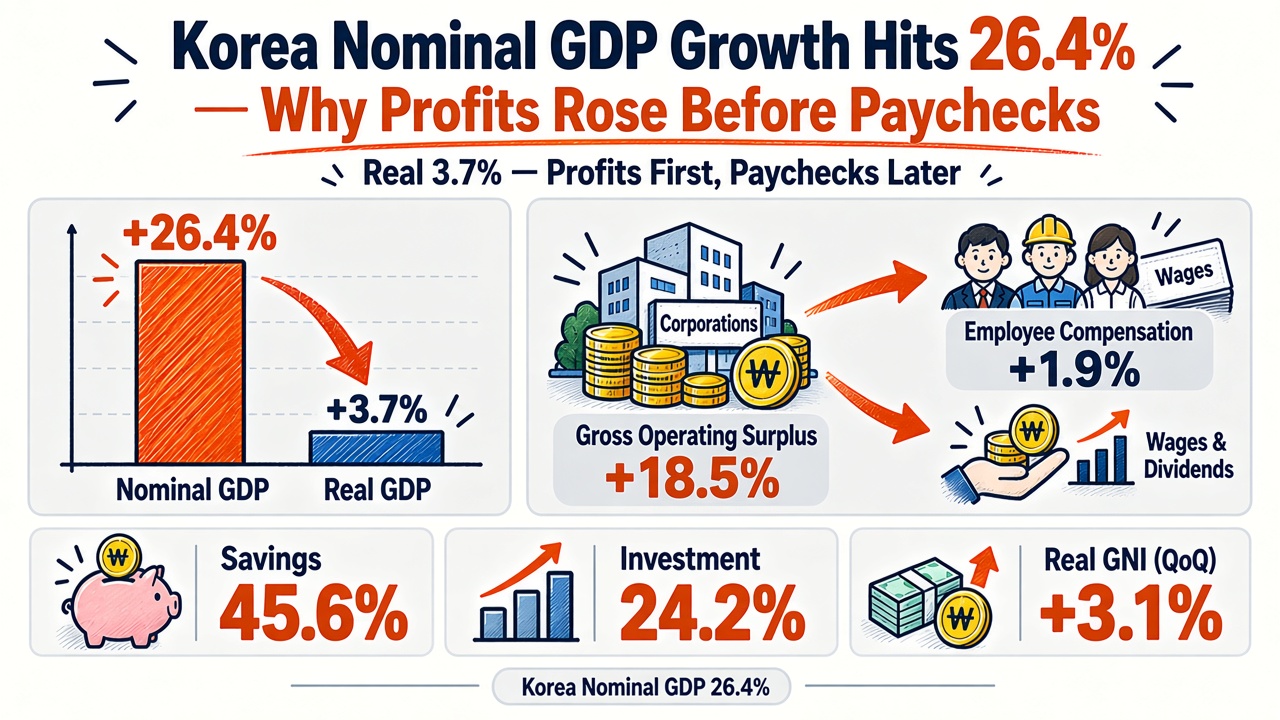
Korea nominal GDP growth of 26.4% does not mean the economy produced 26.4% more goods and services. In the Bank of Korea’s preliminary data for the second quarter of 2026, real GDP rose 3.7% year on year and 0.6% quarter on quarter.
The number is not meaningless. Higher export prices and a lighter relative import bill can leave more income in Korea even when physical output grows modestly. For now, much of that gain remains in corporate accounts rather than household paychecks.
The economic data below are verified BOK figures. Statements about where profits and markets go next are conditional scenarios, not investment advice.
Why Korea nominal GDP growth of 26.4% differs from real growth
Nominal GDP values domestic production at current prices. If a factory sells 100 phones at a higher price without making more phones, nominal output rises. Real GDP applies reference-year prices and removes that price effect, making it the better measure of production volume.
On the same year-on-year basis, nominal GDP rose 26.4% while real GDP increased 3.7%. The ratio implies a GDP deflator increase of about 21.9%. That figure is a calculation derived from the two official growth rates, not a separate BOK inflation forecast.
Nominal GDP +26.4%
Volume + prices
Includes
Best for · Revenue and tax base
Real GDP +3.7%
Price effect removed
Includes
Best for · Production volume
The GDP deflator covers prices of all final goods and services produced domestically. It is broader than consumer inflation, which tracks a household basket. Export prices for chips and ships, as well as their won value, matter greatly. It would therefore be wrong to say household prices rose 22%.
Why higher chip prices mean more income for Korea
The key is the terms of trade: how much a country can import with one unit of exports. When chip export prices rise relative to energy and raw-material import prices, Korea can buy more imports with the same export volume. The country’s purchasing power improves.
That effect appeared directly in income. Real gross national income rose 3.1% from the previous quarter, far above real GDP growth of 0.6%. GNI adds income received from abroad to domestic production income and subtracts income paid overseas. The BOK attributed the gap mainly to larger real trading gains from better terms of trade.
-
1
Export prices rise
Chips and ships
-
2
Corporate profit
Surplus +18.5%
-
3
Pay, dividends, tax
Distributed with a lag
-
4
Spending, investment
The key test
The expansion was not confined to chips. Manufacturing grew 1.4% and services 1.0% quarter on quarter. The BOK said improvement spread into refining, chemicals, machinery, ships and retail. Construction, however, contracted 1.9%. Export factories and building sites are living through very different economies.
Why corporate surplus rose 18.5% while employee pay rose 1.9%
Gross operating surplus, a broad measure close to corporate income, jumped 18.5% from the first quarter. Compensation of employees rose only 1.9%. Export prices enter revenue quickly, while wages adjust through annual contracts and negotiations. The lag is normal. It also means the gain has not appeared on most payslips yet.
Bonuses, wage increases, dividends and taxes are the next channels. If companies distribute profits and the government spends higher tax receipts, household income and consumption can follow. The BOK expects distribution through dividends and taxes to become more visible later in the year. That is an outlook, not evidence that consumption has already surged.
Private consumption grew 0.4% in the quarter. As our article on AI investment and employment explained, capital-intensive chip growth may not create jobs as quickly as revenue. If bonuses and dividends reach a narrow group, the economy-wide spending effect can also remain weak.
A 45.6% saving rate beside a 24.2% investment rate
This combination looks odd at first. The gross saving rate reached a record 45.6%, while the domestic investment rate fell 1.1 percentage points to 24.2%. Gross saving includes retained corporate income and government saving, not just household deposits. The profit jump is the most natural explanation for much of this quarter’s record.
Saving can finance investment, but it does not automatically become factories or jobs. Equipment investment rose just 0.2% and construction investment fell 0.1%. Investment in intellectual property, including research and software, increased 3.4%. Capital moved more readily into technology than buildings.
Korea gross saving rate 45.6% versus domestic investment rate 24.2%. Gross saving and domestic investment rates, BOK.
The gap between the saving and investment rates is 21.4 percentage points. If it persists, income not spent at home is likely to appear in the current-account surplus and purchases of foreign assets. Export surpluses can support the won, while outbound investment creates dollar demand. The currency effect is not one-way.
Where profits flow next — earnings, spending and stocks
For earnings, the question is how far gains spread beyond memory chips. Chip prices help memory makers and their equipment and materials suppliers. High-value ships, cosmetics and pharmaceutical exports, and refining margins also contributed. Domestic companies that import heavily and cannot pass costs to customers may still feel little benefit.
For consumption, wages and dividends are the next signal. Bonuses could lift cars, appliances and travel first. Yet high interest and housing costs may divert extra income toward debt repayment. Companies may also retain cash, leaving the saving rate high and the spending response muted.
For stocks, better earnings expectations for large exporters are supportive, but valuation is a separate question. If investors have already priced in the good news, strong GDP data alone are not enough. Export-price reversals could slow earnings abruptly. China’s expanding supply, discussed in our China exports analysis, is another risk for commodity chips, chemicals and steel.
Four numbers will answer the next-quarter question
First, separate semiconductor export prices from shipment volumes. Second, track the gap between operating surplus and employee compensation. A narrowing gap would show that the boom is reaching household income.
Third, watch equipment and construction investment for evidence that profit is becoming capacity and jobs. Fourth, follow the terms of trade. Falling export prices or a larger oil import bill could reverse the surge in real income.
My reading is that 26.4% is not a fake number; it is a number that has not yet been widely distributed. Export prices and corporate profits moved first. If income flows into pay, dividends, taxes and investment, the recovery can broaden. If it does not, Korea may be left with a hot semiconductor sector and a much cooler domestic economy.
The 26.4% is not fake; it has not yet been widely distributed. The next question is whether profits move into pay, dividends and investment.
Sources
- Bank of Korea — Q2 2026 Gross National Income (preliminary)
- KDI / Bank of Korea — 2026 Q2 national income details
- Yonhap — nominal GDP growth reaches a 47-year high
- Bank of Korea — Q2 2026 corporate business analysis
- World Bank — Global Economic Prospects, June 2026
- IMF — G20 finance ministers statement, September 2026
- 내부 글 — AI 투자와 고용의 엇갈림
- 내부 글 — 중국 수출 급증의 한국 산업 영향
- 내부 글 — 유가와 한국 기업 비용
For information only — this is not a recommendation to buy or sell any asset.
Comments 0