US 10-Year Treasury Yield Near 5% — The Shock Reaching Korean Earnings and Stocks
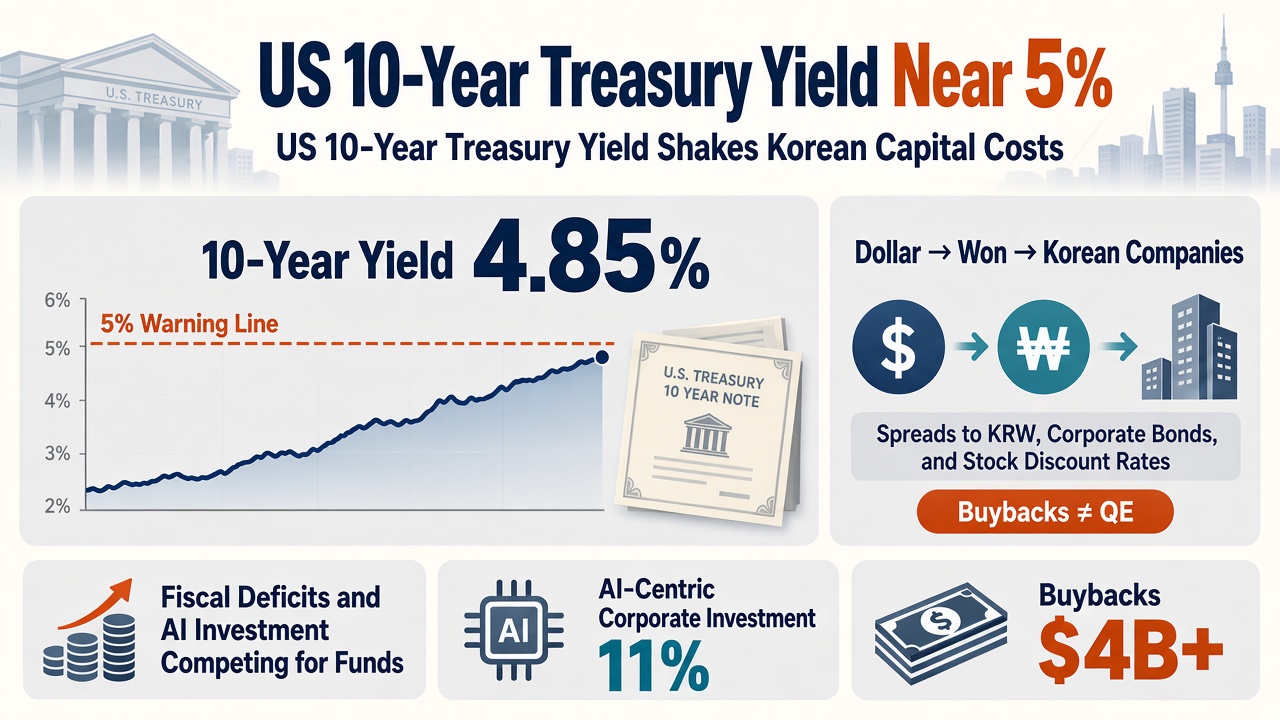
The US 10-year Treasury yield is again approaching 5%. It reached about 4.85% intraday on September 9, 2026, the highest level since October 2023. The number matters far beyond the bond market: large federal borrowing, stubborn inflation risk, and an AI infrastructure boom are all competing for long-term capital, with consequences for Korean funding costs, the won, and equity valuations.
On the same day, the US Treasury began larger buybacks of older 10-to-30-year securities, lifting the maximum size per operation from $2 billion to at least $4 billion. That can look like monetary easing. It is not. Understanding the distinction is essential to reading the market signal correctly.
The facts below are sourced; future paths are presented as scenarios. This is analysis, not a recommendation to buy or sell securities.
Why the US 10-year Treasury yield can diverge from the policy rate
The Federal Reserve sets the price of overnight money. A 10-year yield is the return investors demand for lending over a decade. It therefore reflects expected future short rates, expected inflation, and compensation for uncertainty over a long holding period—the term premium.
-
1
Expected short rates
Expected Fed path
-
2
Expected inflation
Compensation for lost purchasing power
-
3
Term premium
Compensation for decade-long uncertainty
That is why long yields can rise without an immediate Fed hike. Energy risk matters in September 2026, but it is not the entire story. Reuters also highlighted federal debt above $40 trillion and a deficit near 6% of GDP. The IMF separately warned that global public debt is close to 100% of GDP and that rising advanced-economy yields can spill across borders.
Fiscal deficits and AI investment are competing for the same capital
When government spending exceeds tax revenue, the gap is funded with Treasury issuance. More supply may require a higher yield to attract buyers. At the same time, technology companies are issuing debt to build data centers, power systems, and semiconductor capacity. Public and private borrowers are bidding for the same pool of long-term savings.
Federal Reserve data show the scale. US business fixed investment grew 5.5% in 2025 and accelerated to an 11% annual rate in the first quarter of 2026. The Fed judged that most of the strength was connected to AI infrastructure. Investment-grade net bond issuance was also strong, partly because large technology firms financed AI expansion with debt.
-
1
Federal deficit
More Treasury issuance
-
2
AI capex
More bond and loan demand
-
3
Higher capital demand
Upward pressure on yields
-
4
Broader economy
Higher discount and lending rates
Productive investment can still push rates higher today. Data centers may raise future output, but land, electricity, chips, and financing are required before the productivity gains arrive. Large firms with cash and bond-market access can keep spending. Smaller firms that depend on bank loans face a tighter constraint.
Treasury buybacks are not quantitative easing
A buyback allows the Treasury to repurchase securities it previously issued. This program targets off-the-run bonds—older issues that trade less actively—to improve market functioning. The Treasury raised the per-operation cap for the 10-to-20-year and 20-to-30-year sectors from $2 billion to at least $4 billion. It then set a $6 billion ceiling for the September 10 operation in the 10-to-20-year sector.
Quantitative easing is different. The Federal Reserve creates reserves and purchases assets to ease monetary conditions. A Treasury buyback is debt management, and the government can repurchase old bonds while continuing to issue new ones. It may reduce a liquidity premium, but it does not erase deficits, inflation risk, or the demand for investment capital.
Treasury buyback
Actor: US Treasury
·
· · Goal: improve old-bond liquidity
· · Does not automatically shrink total debt
Quantitative easing
Actor: Federal Reserve
·
· · Goal: ease financial conditions
· · Expands central-bank reserves
The path from higher yields to earnings and consumption
First, borrowing and refinancing become more expensive, reducing net income and cash flow when revenue is unchanged. Second, companies raise the required return on new projects. Marginal factories, software projects, and hiring plans may be delayed. Third, mortgage and auto financing costs squeeze household budgets, eventually weakening consumption and corporate sales.
Equities react faster because higher discount rates reduce the present value of future profits. Long-duration growth stocks can lose more value even if earnings forecasts are unchanged. Banks may benefit from some rate moves, but slower growth and credit losses can offset that advantage.
Three transmission channels to Korea
Foreign exchange is the most immediate channel. Higher US yields can attract demand for dollar assets. A weaker won raises the local cost of imported energy and materials, pressuring margins and inflation.
Next comes domestic bond pricing. Korean government and corporate bonds compete for global and local capital, so higher US yields create upward pressure on required Korean returns. The Bank of Korea has identified US policy uncertainty and domestic bond supply as variables affecting Korean long-term yields.
The last channel is divergence within the equity market. Korean semiconductor companies can gain revenue from AI infrastructure demand while simultaneously facing a higher global discount rate. Firms with improving orders, pricing power, and cash flow may absorb the pressure. Companies with heavy debt and valuations built mainly on distant profits face a different outcome.
Watch the reason for the yield increase, not only the 5% line
In a constructive scenario, AI investment raises productivity, profits, and eventually tax revenue. Higher yields are then partly the price of stronger growth. In a prolonged-high-rate scenario, capital demand stays strong but productivity arrives slowly and inflation remains sticky; smaller firms, housing, and consumption weaken first.
A third scenario is fiscal-risk repricing. If investors demand a larger term premium because of debt supply rather than growth, bonds and equities can fall together and currency volatility can rise. Buybacks alone would not solve that problem.
Productivity
Higher AI profits
·
· · Better growth and revenue
Higher for longer
Sticky inflation
·
· · Pressure on SMEs and consumers
Fiscal repricing
Higher term premium
·
· · Stocks and bonds weaken together
To distinguish these paths, watch inflation expectations, Treasury auction demand, corporate credit spreads—the extra yield companies pay over government bonds—and AI companies’ cash flow alongside the 10-year yield. If yields rise while profit expectations do not, the move looks more like a warning. If productivity and profits rise too, it may be a by-product of growth. The reason matters more than the round number.
The price of money can reorder industries
The approach toward a 5% US 10-year yield is not merely a bond-market headline. It signals that heavy public borrowing and the AI investment boom are simultaneously demanding scarce long-term capital. Treasury buybacks can improve trading conditions, but they do not remove that structure.
For Korean investors, the useful questions are which companies generate enough cash to overcome higher funding costs, whether won weakness raises costs faster than revenue, and whether AI spending is becoming profit. In my view, the current rise blends economic strength with fiscal strain, making debt maturities and investment payback periods more useful than a single index forecast.
The reason yields rise matters more than the 5% line: is it the price of growth, or the price of debt anxiety?
Sources
- Reuters — Five spots to watch as the bond market creeps up on 5%
- U.S. Treasury — Increased long-end liquidity support buybacks
- Reuters — Treasury sets a $6 billion September 10 buyback ceiling
- U.S. Treasury — August 2026 Quarterly Refunding Statement
- Federal Reserve — Monetary Policy Report, July 2026
- Federal Reserve — Financial Accounts, June 2026
- IMF — G20 statement, September 1, 2026
- 한국은행 — 통화신용정책보고서 2026년 3월
- Associated Press — U.S. 10-year yield reaches 4.85%
- 내부 글 — AI 고용 충격과 한국 기업
- 내부 글 — 중앙은행 금 보유 재편
For information only — this is not a recommendation to buy or sell any asset.
Comments 0