Central Bank Gold Shift 2026 — 86 Tonnes to London, Cracks in Dollar Reserve Trust
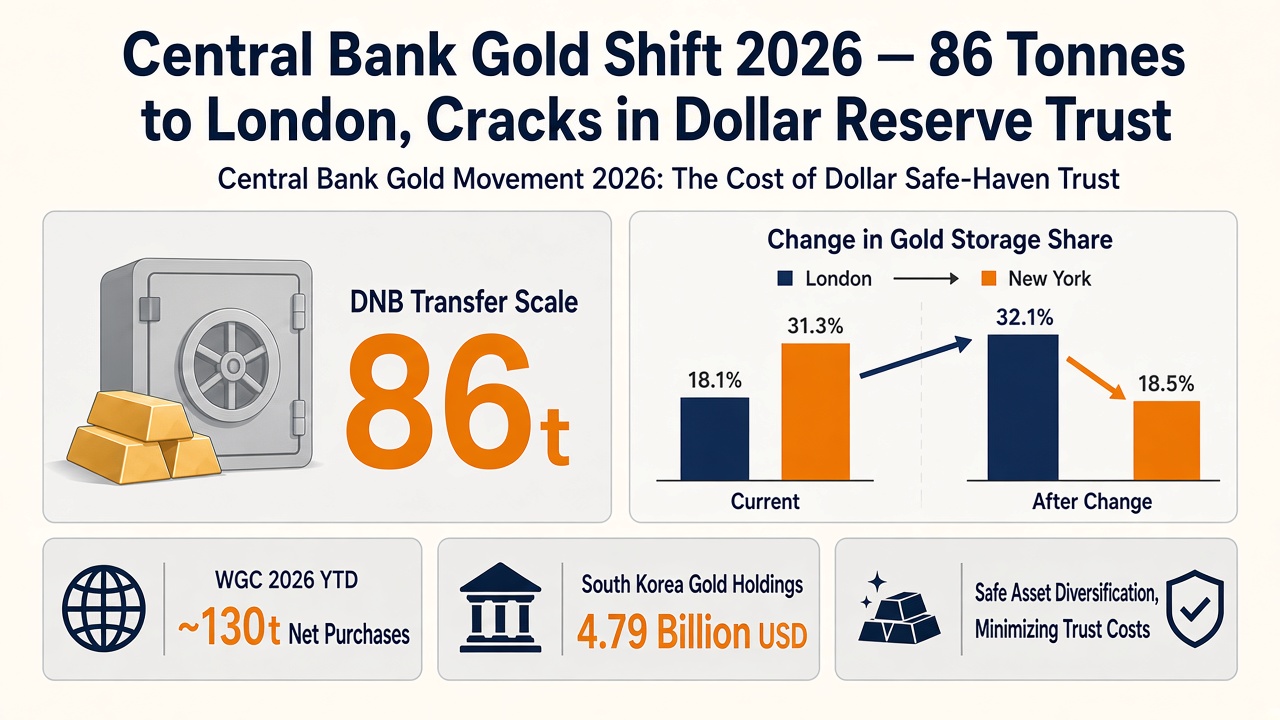
Central bank gold shift 2026 is back in the market conversation. On September 2, De Nederlandsche Bank said it moved about 86 tonnes of gold from the United States and Canada to London between March and August 2026. This is not just a story about a higher gold price. It asks a simpler question: what kind of reserve asset can be used immediately in a crisis?
On the surface, this is a vault-location story. For a central bank, location is also liquidity. Money in your bank account is useful only if you can actually move it. Gold works in a similar way. The same bar can carry different practical value depending on where it sits and how quickly it can be traded.
This is market-structure analysis, not investment advice.
Central bank gold shift 2026: what exactly did the Netherlands change?
DNB changed the map. It transferred roughly 86 tonnes out of about 313 tonnes held in North America to London. After the move, London’s share rose from 18.1% to 32.1%. New York fell from 31.3% to 18.5%, and Ottawa moved from 19.7% to 18.5%.
The total amount of gold did not increase. The Netherlands still holds 612.4 tonnes, valued at EUR 72.2 billion at the end of 2025. The point was not to buy more gold. It was to place more of it where it can be mobilized faster in a severe crisis.
Bar chart showing Dutch central bank gold custody shifting toward London. Based on DNB’s official release. After the move, London became the largest overseas custody location.
The operation was not only a physical shipment. DNB sold about 59 tonnes in New York and bought London-standard gold. It also physically moved more than 27 tonnes from North America to Zeist in the Netherlands, while sending a similar amount of internationally tradable gold from Zeist to London. That reduced transport risk and avoided unnecessary remelting.
Why London, not New York?
London is not just another storage point. Gold held with the Bank of England is tied directly to the global physical bullion market. DNB said London gold is the most readily available for crisis use. In reserve management, the speed at which an asset can become usable money matters almost as much as the asset itself.
Same gold. Different location. Different crisis value.
There are three economic reasons behind the move. The first is geopolitical risk. Wars, sanctions, and unstable alliances make central banks more cautious about concentrating too much value in one financial network. The second is liquidity. In a crisis, a reserve manager wants collateral that can be traded now, not merely an asset with a good long-run return. The third is the cost of trust. Even among allies, policy uncertainty creates an insurance premium.
Gold
No coupon
Yield
Strength · Not someone else’s liability
Watch · Sensitive to rising real yields
U.S. Treasuries
Coupon income
Yield
Strength · Deep dollar market
Watch · Sanctions and policy-risk exposure
That does not mean the dollar era is over. A September 2026 Federal Reserve FEDS Notes article pushed back against the claim that gold has truly displaced Treasuries. Much of the rise in gold’s reserve value came from higher gold prices and large legacy holdings. IMF COFER data also put the dollar share of global foreign exchange reserves at 57.13% in the first quarter of 2026. The dollar remains central. But the cost of trusting the center has risen.
Why are central banks still buying gold?
The World Gold Council estimated that central banks bought a net 23 tonnes of gold in July 2026, taking year-to-date net purchases to about 130 tonnes. China bought 20 tonnes and Poland bought 8 tonnes in July, while Russia sold 6 tonnes. The flows are not uniform, but the official sector is still making room for gold inside reserve portfolios.
Central banks do not buy gold for yield. Gold pays no coupon. They buy it because it is not someone else’s liability. A Treasury bond is a promise by the U.S. government. A bank deposit is a promise by a bank. Gold sits outside that promise chain.
-
1
Geopolitical stress
War, sanctions, policy uncertainty
-
2
Custody reshuffle
New York, London, domestic vault mix
-
3
Higher trust cost
Insurance against dollar-asset concentration
-
4
Market effects
Gold, Treasuries, FX, miners
That distinction becomes important in stress. If sanctions hit or payment networks freeze, an asset can exist on paper and still be slow to use. Gold has custody and transport costs, but it is less tied to a single political promise. The WGC survey showing average central-bank purchases of around 1,000 tonnes a year over the past four years, compared with 500 tonnes in the previous decade, captures that shift.
What pressure does this put on the dollar and Treasuries?
The first pressure is structural. If central banks diversify both assets and custody locations, the old premium enjoyed by dollars and Treasuries can slowly shrink. This does not mean Treasuries collapse tomorrow. It means the United States has to keep proving the trust that used to be taken more for granted.
The second pressure is interest rates. Gold has no yield. When U.S. jobs data are strong and markets price a possible Fed hike, gold can fall. Reuters reported on September 4, 2026 that spot gold slipped to $4,422.91 an ounce after strong payrolls lifted rate-hike expectations. Safe-haven demand helps gold, but higher real yields hurt it.
The third pressure runs through company earnings. A high gold price can support revenue and cash flow for gold miners. It can raise input costs for jewelry, electronics components, and manufacturers that use gold. For financial firms, demand for gold ETFs and commodity products may rise, but so do hedging and risk-management costs.
The fourth pressure is confidence. Gold strength often overlaps with periods when households and companies feel less certain. Consumers delay large purchases. Firms become more cautious with investment plans. That is why the IMF and World Bank keep discussing war shocks, energy prices, inflation, and borrowing costs together in the 2026 outlook.
Korea’s $442 billion reserves — why gold stays at 1%
For Korean readers, this is the key number. South Korea’s foreign reserves stood at $442.28 billion at the end of August 2026, up $14.33 billion from a month earlier. Securities accounted for $387.07 billion, or 87.5% of the total. Gold was unchanged at $4.79 billion. That leaves gold at roughly 1% of reserves.
Why does Korea hold far more securities than gold? The first job of Korea’s reserves is to supply dollar liquidity when the won comes under pressure. For that job, highly liquid Treasuries and dollar deposits are easier to deploy than gold. Gold is a long-term trust asset. It is not usually the fastest tool for stabilizing the USD/KRW market day by day.
Still, the question is getting sharper. How large are reserves, how concentrated is the currency mix, and how much can actually be used in a crisis? For the FX side, see our USD/KRW explainer. For the energy shock backdrop, see the Hormuz and oil-price article.
Three numbers to watch next
First, watch central-bank net buying. A soft month matters less than whether the post-2022 buying pace stays elevated. Second, watch custody changes. Even without new purchases, shifts among New York, London, and domestic vaults reveal how central banks think about trust. Third, watch U.S. real yields. When inflation-adjusted yields rise, gold faces pressure.
The confirmed facts are clear: the Netherlands moved 86 tonnes to London, central-bank gold buying continues, and Korea’s reserves remain securities-heavy. My interpretation is narrower than the de-dollarization headline. Gold is not replacing Treasuries outright. It is becoming a bigger insurance line against political and sanctions risk inside reserve portfolios.
Gold does not rise only when economies break. It also gains room when institutions begin to trust one another a little less. That is why this central bank gold shift 2026 story is less about vault geography and more about the rising price of trust.
This is not just about where gold sits. It is about how expensive trust has become.
Sources
- De Nederlandsche Bank — DNB improves tradability of gold reserves
- World Gold Council — Central Bank Gold Statistics, September 2026
- World Gold Council — Central Bank Gold Reserves Survey 2026
- Federal Reserve FEDS Notes — Gold and Treasury securities
- Yonhap — South Korea foreign reserves, August 2026
- IMF — World Economic Outlook Update, July 2026
- World Bank — Global Economic Prospects
- Reuters via Kitco — Gold slides after robust US payrolls
- Wall Street Journal — Netherlands moves gold from New York to London
- Financial Times — Dutch central bank moves gold bars out of New York
For information only — this is not a recommendation to buy or sell any asset.
Comments 0