Oil Price Drop 2026 — Back to $72, Iran War & Hormuz Reopening Explained
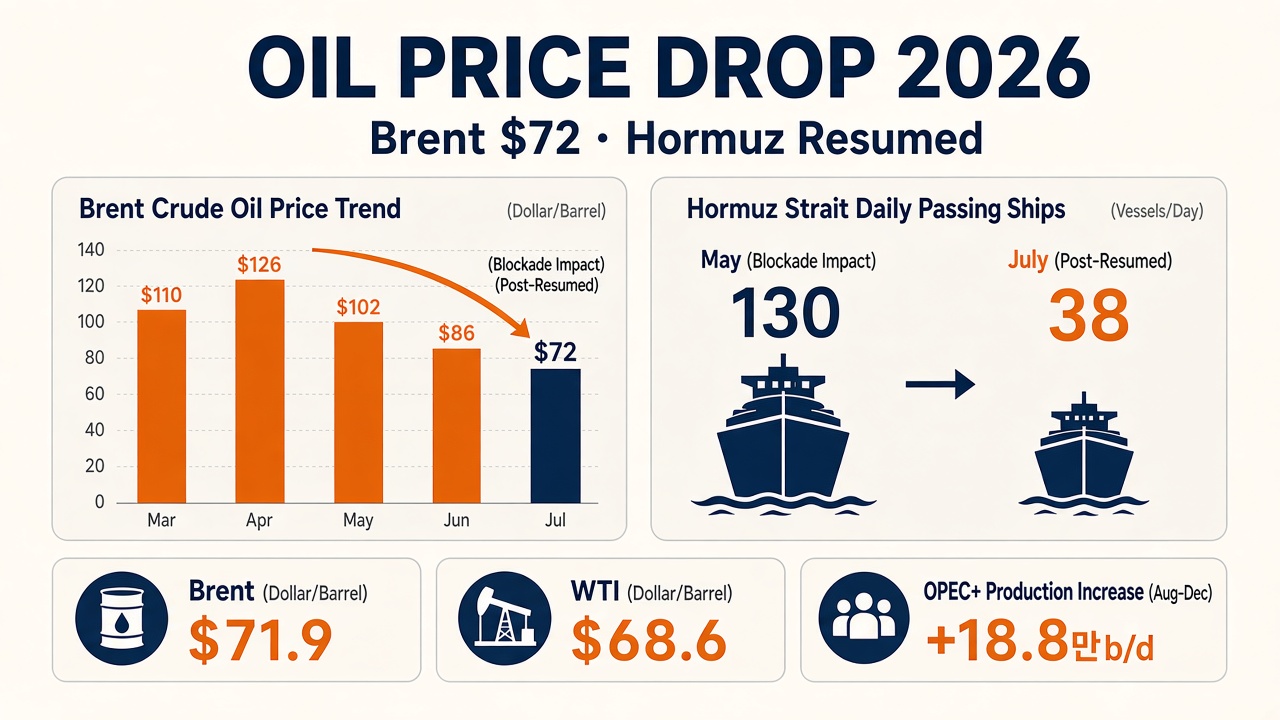
Oil prices dropped in 2026 back toward pre-war levels. On July 6, Brent traded near $72 per barrel and WTI around $69 — close to where they were on February 27, before US–Israeli strikes on Iran. The war is not over, so why did crude get cheaper so fast? This piece walks through the Iran conflict, the Strait of Hormuz, OPEC+ output, and what Korean readers should watch.
In one line: markets stopped pricing an endless war and started pricing backlog crude hitting the water. Talks are interim and transits are still far below normal — the charts below anchor the numbers.
Oil drop 2026 — the numbers now
Oil price path 2026 Brent peak vs now. Feb 27 pre-war $72.48; Mar–Apr peak $120–126; Jul 6 $71.88. Not advice.
Brent is the global benchmark. It settled at $72.48 on February 27, spiked toward $120–126 in March–April, then slipped to $72.92 on July 1 and $71.88 on July 6. WTI was near $68.58 the same day.
The reversal is mostly a supply story: Gulf barrels that could not move are moving again. Early in the war, “higher oil” dominated; now the question is how fast stranded inventory clears.
Iran war timeline — what changed
-
1
Feb strikes
Price spike
-
2
Hormuz shut
Gulf cuts
-
3
Jun 17 MOU
Partial reopen
-
4
July
Pre-war price
Late February 2026, US–Israeli strikes on Iran shut the Strait of Hormuz — a chokepoint for roughly one-fifth of world oil and LNG. Middle East producers cut real output below OPEC+ quotas as unsold barrels filled storage.
On June 17, Presidents Trump and Pezeshkian signed an interim MOU: Iran allows unimpeded Hormuz transit; the US eases its naval blockade of Iranian ports. Not a final peace deal — but markets reacted to reopening risk first.
Why Hormuz transits press prices down
Hormuz daily tanker transits vs pre-war. Pre-war ~130/day; week to Jun 28: 242; Jul 2: 38/day. Not fully normalized.
Before the war, about 130 ships crossed daily. With the strait blocked, crude piled up on tankers and in tanks. After the MOU, Saudi Arabia reportedly more than doubled shipping versus the prior three months combined; Iran pushed roughly 50 million barrels since the blockade lifted.
Normalization is incomplete: 38 transits were counted on July 2 versus ~130 pre-war. Iran warned tankers off approved routes face a “forceful response.” Cheaper oil means lower risk premium, not guaranteed calm.
OPEC+ August hike — paper vs reality
On July 6, seven OPEC+ members agreed to raise targets by 188,000 bpd from August. During the war, many could not hit quotas because Hormuz was closed. Reopening releases backlog as well as nominal supply.
The group can pause or reverse hikes if markets shift — August’s move reads more like adjustment at already-lower prices than a blind supply flood.
Upside risks — what could lift oil again
Analysts flag three watch items: possible Hormuz tolls after the toll-free window; unresolved sanctions, frozen funds, and the 60-day talk window; and thinner US commercial + SPR stocks — about 734 million barrels by late June versus 807 million five weeks earlier.
Shipping data firms note sanctioned and “zombie” tankers moved alongside commercial first movers right after the MOU — reopening ≠ normalized shipping norms.
Korea checklist — FX, equities, inflation
Korea imports most of its oil. Lower crude eases energy import bills and fuel-price expectations, but KRW/USD and global liquidity are separate axes — see our Korea FX policy piece. Equities tie to global capital flows and KOSPI volatility history.
Conclusion — cheaper oil, unfinished war
The 2026 oil drop is less “war over” than blockade relief + inventory release. Brent near $72 mirrors pre-crisis levels, but Hormuz, talks, and sanctions can reprice risk quickly. Track calendars, stocks, and diplomacy — not headlines alone.
For information only — not investment advice.
Cheaper oil is not peace — it is blockade relief plus inventory moving again.
Sources
- Euronews — OPEC+ and pre-war oil prices
- Al Jazeera — OPEC+ output and Hormuz transits
- Invezz — risks after oil returns to pre-war levels
- Economic Times — July 6 Brent and WTI prices
- Windward — Hormuz reopening and tanker movements
- Internal: 2026-07-06-oil-price-war-hormuz-session-01.md
For information only — this is not a recommendation to buy or sell any asset.
Comments 0