BOK Rate Hike 2026: Why Exports Up 68.7% and CPI at 3.1% Are Moving Together
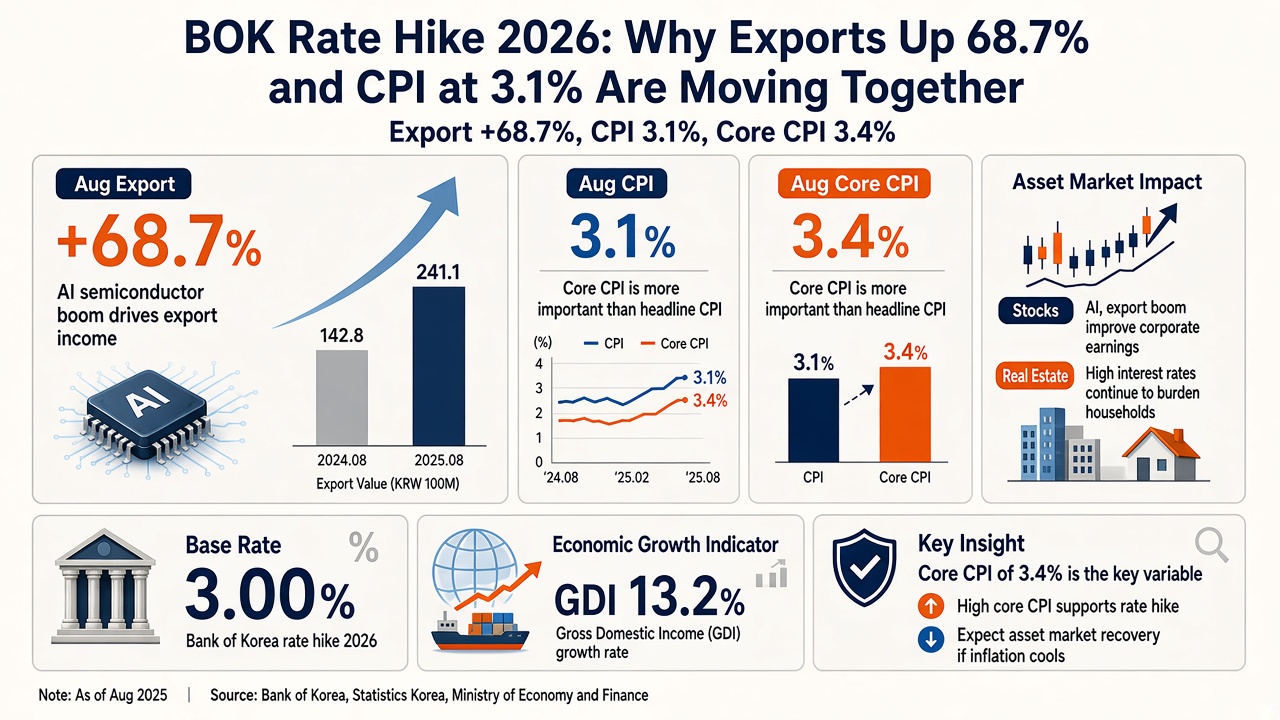
The BOK rate hike 2026 story is only half visible if you look only at the August 27, 2026 decision to lift the policy rate to 3.00%. After that move, August exports jumped 68.7% year over year in data released on September 1, 2026, while August CPI came in at 3.1% and core CPI at 3.4% in data released on September 2, 2026. This post explains why those numbers belong to the same story, and how that change can affect corporate earnings, consumption, investment, and asset markets.
The common driver is global AI investment and Korea’s role in memory chips. Rising chip prices lift export income first. Then come bonuses, capex, and stronger spending in selected regions. The Bank of Korea moved because that second-round effect can spread from income into inflation and asset prices.
Why did the BOK raise rates in August?
In its August 27, 2026 statement, the Bank of Korea said exports were strong, domestic demand was recovering, inflation would stay above the 2% target for a considerable time, and financial stability risks still mattered. This was not a rescue move. It was a cooling move meant to slow the spread of heat from one booming sector into the rest of the economy.
The important point is that this was not only an oil story. In the BOK’s English release, July 2026 CPI was 2.8% and core inflation was 2.6%. What worried policymakers was that underlying inflation was already firming before the August rebound. When prices excluding food and energy move up, it usually means demand pressure is spreading more deeply through the economy.
Why would demand pressure rise? Because higher semiconductor prices mean Korea earns more income from the same export machine. The BOK said first-quarter GDP rose 3.8% year over year, but gross domestic income rose 13.2% because terms of trade, meaning export prices relative to import prices, improved sharply. Once export gains turn into income gains, they eventually show up in spending power and asset demand. The rate hike looks like an attempt to lean against that second-round effect before it broadens.
-
1
Global AI capex
Data-center and server buildouts accelerate
-
2
Memory demand jumps
HBM and memory pricing move higher
-
3
Korean exports and income rise
Corporate earnings and terms of trade improve
-
4
Consumption and price pressure
Bonuses, capex, and regional spending push demand higher
Exports 68.7%, CPI 3.1% — what the August data is saying together
The trade numbers were hot. In its September 1, 2026 provisional release, the Korea Customs Service said exports rose 68.7% from a year earlier to $98.26 billion, while the trade surplus reached $34.75 billion. It also said August marked a record high for the month and for semiconductor exports. Bloomberg and the Wall Street Journal both pointed to AI memory demand as the core driver. Korea’s external engine is running very hard.
Inflation was more nuanced. KOSTAT said on September 2, 2026 that August CPI rose 3.1% year over year and core CPI rose 3.4%. Reuters reported that public-service prices were pushed up by a 26.7% increase in mobile fees because the comparison base from a year earlier was unusually low. The government said inflation would have been around 2.5% without that one-off effect. So the 3.1% headline number alone would overstate the structural part of the inflation story.
But stopping there would miss the more important signal. In July 2026, headline CPI was 2.8% and core CPI was 2.6%. One month later, headline inflation was up 0.3 percentage point and core inflation was up 0.8 point. That is harder to explain away with a telecom base effect alone. It suggests chip-led income gains are starting to feed services demand and inflation expectations, while energy and import-cost pressure are still working through the system.
The global backdrop adds to that pressure. In a September 1, 2026 statement after the G20 meetings, the IMF said global growth was still holding around 3%, but AI investment and geopolitical energy shocks were creating very uneven inflation and growth outcomes across countries. The World Bank had already warned in June 2026 that a worse energy shock could pull global growth down to 1.3%. Reuters reported that Brent crude settled at $94.65 a barrel on September 1, 2026, while the U.S. BLS said on September 4, 2026 that nonfarm payrolls rose by 162,000 in August. If oil stays high and U.S. labor data stays firm, the Fed has less room to turn dovish quickly, and that also limits how comfortable the BOK can be.
May 2026
2.6% in 2026, 2.1% in 2027
GDP growth
Inflation · Underlying pressure looked more contained
Policy mood · Closer to waiting and assessing
August 2026
3.3% in 2026, 2.9% in 2027
GDP growth
Inflation · 2.7% CPI and 2.5% core inflation forecast
Policy mood · Shifted toward preemptive tightening
Bar chart comparing recent key Korean export and inflation readings. Different indicators, but each shows the recent intensity of Korea’s macro backdrop.
Why doesn’t an export boom feel like a boom for everyone?
Because semiconductors create enormous value added without instantly creating broad employment. A fab can generate very large profits, but it does not hire the way services or construction do. That is why export strength and corporate earnings can improve much faster than everyday labor-market conditions.
The BOK’s August 18, 2026 note on youth employment makes that gap concrete. Over the past four years, 285,000 youth jobs disappeared, and 268,000 of them were in industries with high AI exposure. Productivity gains do not automatically translate into entry-level hiring. That helps explain why households can hear about strong GDP without feeling stronger themselves.
That does not mean there is no spillover. In its August 31, 2026 regional note, the BOK estimated that consumption in semiconductor-heavy regions such as Icheon, Hwaseong, and Cheongju was up to 4% higher after bonus payments, with cumulative extra consumption reaching about 1.7 trillion won through end-2026. The sequence matters: profits first, wages and bonuses second, broader jobs later. Right now the front end of that chain is much stronger than the back end.
Improves first
Chip prices and volumes show up quickly
Exports
Corporate profit · Concentrates first in large exporters
Bonus-led spending · Rises first in specific regions and income groups
Improves later
Can stay weak in high-AI-exposure sectors
Youth jobs
Service spillover · Spreads with a lag
Household feel · Feels broader only later
Where does chip money go first? Earnings, investment, and policy
The first earnings winners are likely to be semiconductor companies and the surrounding supply chain. If memory prices and shipment volumes rise together, profit recovery at core companies such as Samsung Electronics and SK Hynix can be fast. SK hynix said on July 29, 2026 that it posted record second-quarter revenue of 79.3187 trillion won and operating profit of 60.5426 trillion won, and that it had finalized long-term agreements with around 10 customers. AI server investment does not stop at the chip. It pulls through a supply chain from semiconductors to equipment, materials, packaging, cooling, and power.
The harder question is distribution. Customs data on trade by firm size showed that large firms accounted for 75.2% of exports in July 2026, compared with 12.8% for mid-sized firms and 11.8% for SMEs. Rising exports do not mean gains are being shared evenly. A prolonged large-cap boom can widen earnings, wage, and investment gaps across the economy.
That is also why industrial policy keeps leaning so heavily toward semiconductors. The sector matters not only for export value, but also for tax revenue, capital expenditure, the won, equities, and regional spending. The same breadth of influence also means a later slowdown would spread widely.
Bar chart showing export shares by firm size. Export shares by firm size for July 2026.
Why do consumption and asset markets react differently?
Consumption is already reacting in selected places and categories. Bonus-heavy regions are seeing stronger spending on cars, appliances, and department stores. But that is still different from saying the whole consumer economy has recovered. It looks more like a targeted income wave than a broad national rebound.
Investment is more direct. If companies believe AI chip demand is structural rather than temporary, they will be reluctant to delay capex even after rates move higher. That means semiconductor-linked investment can remain strong while domestic and debt-sensitive sectors feel pain much sooner. One rate hike can produce very different outcomes across industries.
Asset markets split three ways. Equities may keep rewarding the supply chain from semiconductors to equipment, materials, and power. The won can benefit from export strength but still stay volatile because of dollar strength and oil risk. Housing and household debt face a clearer brake from a 3.00% policy rate. The same macro boom can be positive for some stocks, negative for property, and only selectively positive for consumption.
Three numbers to watch — core CPI, export breadth, jobs
- First, core CPI. Even if headline inflation eases, core inflation near 3% would keep the BOK from sounding comfortable.
- Second, export breadth. A real broad recovery would mean gains spreading beyond chips into machinery, chemicals, services, and smaller firms.
- Third, jobs. Bonus-led consumption matters, but the more important test is whether youth employment and service hiring begin to improve.
What the chip boom has confirmed — and where the uncertainty sits
A fair amount is already confirmed. The Bank of Korea raised the base rate to 3.00% on August 27, 2026. Customs data released on September 1, 2026 showed August exports up 68.7%. KOSTAT then reported on September 2, 2026 that CPI rose 3.1% and core CPI 3.4%. BOK research has also shown first-quarter GDP growth of 3.8%, GDI growth of 13.2%, and stronger consumption in semiconductor-heavy regions. So the income effects of the export boom are no longer a theory. They are visible in the data.
The uncertainty starts with what happens next. The BOK’s official outlook put core inflation at 2.5% in both 2026 and 2027, yet actual core inflation in August 2026 was 3.4%. It is still unclear whether that gap closes quickly once one-off factors fade, or whether the chip boom keeps pushing services inflation and asset markets higher. It is also possible that exports remain strong while broad jobs and domestic demand stay slow, leaving Korea with strong earnings but uneven lived conditions.
- Inference: If chip demand stays strong, corporate earnings and capex can keep rising, but the BOK may struggle to fully close the door on further tightening.
- Inference: Over the next few months, Korea may keep living with strong exports and uncomfortable inflation at the same time, with bigger gaps across sectors, regions, and households.
This rate hike looks less like a move to crush growth and more like an attempt to cool a chip-driven income boom before it spreads too far into prices and leverage. Strong exports do not mean everyone benefits right away, and higher inflation does not always come from one cause. The fastest way to read Korea’s next cycle is to watch where semiconductor income is spreading and where it is getting stuck.
This article is economic analysis, not investment advice.
A rate hike is one decision, but the real story is who is earning, who is spending, and where inflation is actually spreading.
Sources
- Bank of Korea — 통화정책방향 (2026.8.27)
- Bank of Korea — Monetary Policy Decision & Opening Remarks (August 27, 2026)
- Bank of Korea — BOK 이슈노트 2026-16
- Korea Customs Service — 2026년 8월 수출입 현황 [잠정치]
- Korea Customs Service — 2026년 7월 월간 수출입 현황 [확정치]
- Korea Customs Service — 2026년 7월 기업규모별 수출입 현황
- KOSTAT — 2026년 7월 소비자물가동향
- KOSTAT — 2026년 8월 소비자물가동향
- Reuters — South Korea inflation quickens on one-off factor
- Financial Times — South Korea raises interest rates to 3% to tame AI-fuelled inflation
- Wall Street Journal — South Korea's Exports Extend Chip-Led Growth in August
- Bloomberg — South Korea's Exports Gather Pace as Chip Boom Powers Ahead
- IMF — World Economic Outlook Update, July 2026
- IMF — G20 statement, September 1, 2026
- World Bank — Global Economic Prospects press release
- Bank of Korea — BOK 이슈노트 2026-20
- Bank of Korea — BOK 이슈노트 2026-19
For information only — this is not a recommendation to buy or sell any asset.
Comments 0