US PPI Jumps 1.3%: Can Korean Firms Pass Higher Costs to Customers?
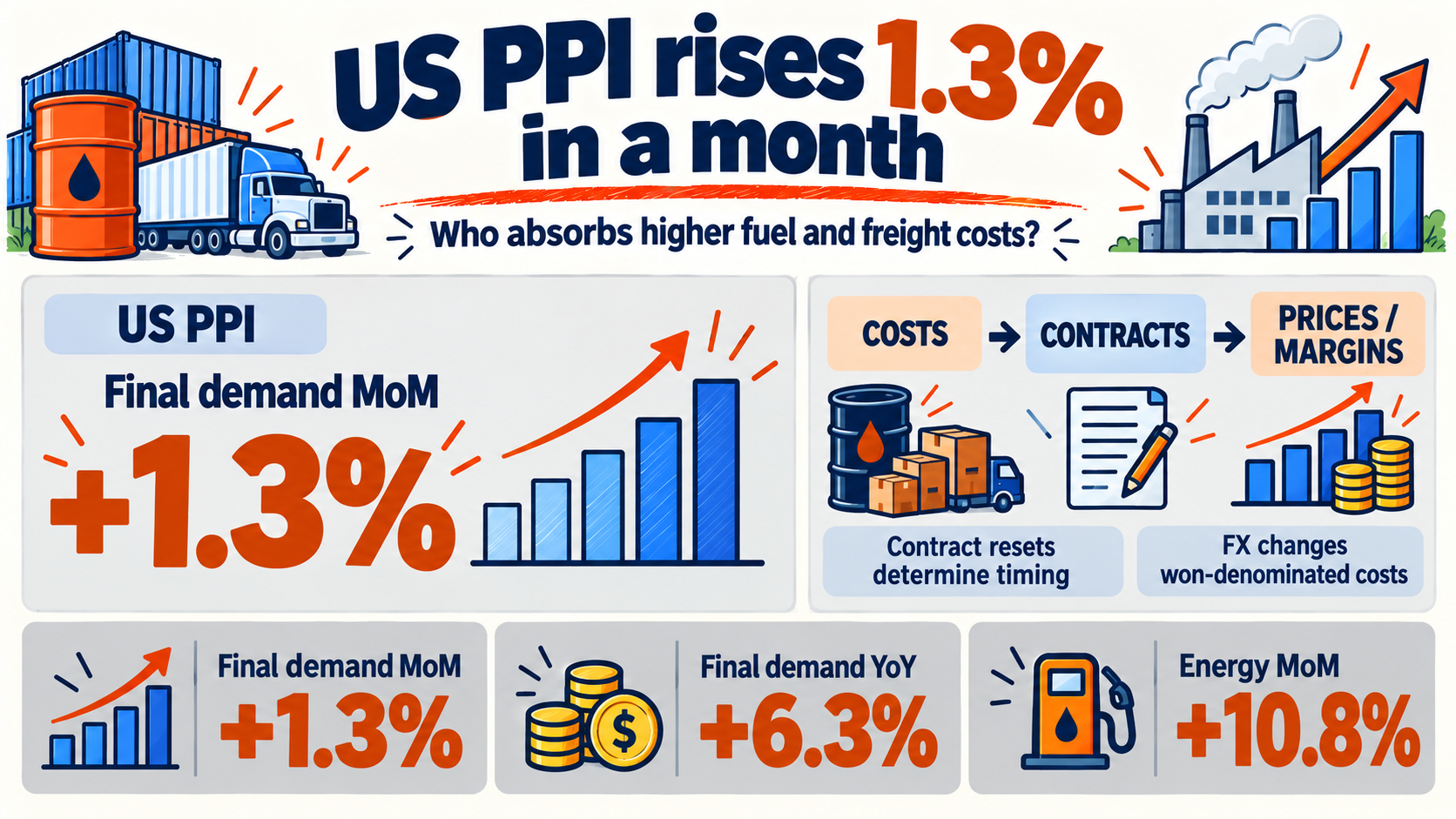
US PPI rose 1.3% in September. For Korean businesses, the question extends beyond US inflation: can higher fuel and transport bills be passed to customers, or must profits absorb them first? Source: BLS 9월 PPI
The October 15 release put annual inflation at 6.3%. WSJ also confirmed that the monthly gain was the largest since March 2022. Monthly figures are seasonally adjusted; annual figures are not. The Korean earnings implications below are conditional analysis, not reported outcomes. Source: BLS Source: WSJ
US PPI: energy and transport costs rise together
Energy rose 10.8%, transportation and warehousing 3.4%, and trade-service margins 1.4%. Excluding food, energy and trade services, prices rose 0.5%. Energy dominated, but the remaining price basket was not flat. Source: BLS 세부 항목
September producer prices: monthly change (%). BLS Oct 15; seasonally adjusted monthly changes, not contributions. Last bar excludes food, energy and trade services.
More expensive fuel puts pressure on freight costs. A carrier with a fuel-surcharge clause can adjust invoices; a fixed-price contract may leave it absorbing the increase. Warehouses also pay for electricity, labor and space. The joint rise signals overlapping pressures, but does not prove that fuel caused the entire transport increase.
Trade-service PPI measures the gap between buying and selling prices rather than the full price of merchandise. It is neither consumer-price inflation nor a retailer’s net-profit growth rate. Higher operating expenses can still reduce earnings.
Why PPI is not a forecast of next month’s CPI
BLS defines PPI as selling prices received by domestic producers. CPI measures prices paid by consumers, with different coverage and weights. Imports, taxes and distribution costs are treated differently. Producer prices may foreshadow retail changes, but there is no fixed one-month lead. Source: BLS 지표 정의
Pass-through means handing a cost increase to the next buyer. Inventories purchased earlier can delay the impact. Contract renewal creates an opportunity to reprice, but competitors and weaker orders can limit bargaining power. A stable selling price can conceal deteriorating supplier cash flow.
-
1
Inputs
New purchases cost more
-
2
Inventory
Stocks and contracts set the delay
-
3
Repricing
Demand and competition limit recovery
-
4
Outcome
Higher prices or lower profit
The contract’s reference index matters. BLS describes PPI-based price adjustment, but a rise in aggregate PPI does not authorize an identical increase in every supply contract. The specified product index, reset frequency and caps determine the invoice. Source: BLS 계약 조정 활용
Korean import costs add currency and contract exposure
The 1.3% US PPI gain cannot be plugged into Korean import costs. For US inputs, the relevant link is the dollar contract price of the specific product. Imports from elsewhere depend more directly on global benchmarks and local supply. US PPI is a clue to shared energy pressures.
Won import expenditure roughly equals the dollar unit price multiplied by KRW per dollar. If the dollar price rises 10% and KRW per dollar rises 5%, expenditure rises 15.5%, since 1.10 × 1.05 = 1.155. This hypothetical excludes freight, duties and hedging; it is not September’s observed change.
A company exposed to shipping should not treat US transportation and warehousing PPI as its ocean freight rate. Route, cargo type and responsibility for fuel surcharges matter. Our separate piece on container freight and Korean exporters’ margins covers how actual ocean rates hit earnings. Insurance is another possible contract cost, but this release does not establish that Korean firms’ premiums increased.
The same shock can split refining and chemical earnings
Refiners buy crude and sell fuels. If product prices outpace crude costs, the refining spread can improve. Yet outages or falling sales volumes may offset that benefit. A wider spread alone does not guarantee better earnings.
Chemical producers may struggle to raise selling prices when demand is weak, even as feedstock becomes more expensive. BLS reported declines in thermoplastic resin prices and chemical-wholesaling margins. Higher energy prices do not establish a broad recovery in chemical pricing power. Source: BLS 품목별 방향
Consider a hypothetical firm with revenue of 100, costs of 90 and operating profit of 10. A 10% rise in an exposed cost bucket of 30 adds 3 to expenses. With volume and other costs unchanged, profit falls to 7 without pass-through, or 8.5 if half the extra cost is recovered through prices.
Hypothetical operating profit after a cost shock. Arbitrary units. Revenue 100, costs 90, exposed costs 30 rise 10%. Volume and other costs fixed; not a forecast.
Even successful pass-through has consequences. Consumers buy less with the same income, and businesses may tie up more cash in inventory and receivables. If price increases reduce orders, profits can undershoot the illustration. Sales volume, operating margin and inventory turnover matter alongside revenue growth.
Persistent pressure can put cash preservation ahead of new capacity. Large firms able to reprice and secure long-term supply may gain an advantage over smaller suppliers with weaker bargaining power. Energy-saving equipment, however, can become more attractive as avoided costs rise. Investment need not fall uniformly.
Fed and IMF on the energy shock: containing inflation can weaken demand
In a May 27 speech, Fed Vice Chair Philip Jefferson described higher energy prices from the Middle East conflict as a downside risk to growth and an upside risk to inflation. This predates September PPI; it explains the mechanism rather than reacting to the release. Source: 제퍼슨 연설 · 2026-05-27
On October 7, IMF Managing Director Kristalina Georgieva highlighted refining constraints and disrupted Gulf gas and transport supply. The implication is that cheaper crude alone may not immediately normalize fuel and logistics costs. The IMF linked its policy discussion to cautious monetary tightening and energy security. Source: IMF 총재 발언 · 2026-10-07
The Fed’s September minutes discussed the risk that price increases originating in energy and AI demand could broaden into persistent inflation. One PPI release cannot determine the next rate decision. Continued pass-through can add tightening pressure; limited pass-through can squeeze profits and investment. Source: FOMC 의사록 · 공개 2026-10-07
Our earlier article on FOMC minutes and Korean companies’ dollar exposure connects these pressures. Higher funding costs compound the burden of financing inventory. Investors need to examine earnings revisions as well as interest rates.
CNN's Fear & Greed Index read 24.0 on October 19, in extreme fear: down 22.3 points from 46.3 a week earlier and 6.4 points from 30.4 a month earlier. GoldKimp’s October 16 KOSPI reading was 68.1, greed. Different methods and dates prevent a direct flow comparison; comparable Korean weekly and monthly changes were unavailable. Source: CNN 제공 스냅샷 Source: GoldKimp
SentimenTrader was checked on October 20, but its public Smart Money and Dumb Money Confidence fields lacked values and dates, so neither direction is inferred. Korean optimism is not proof of immunity to cost pressure. Earnings reports revealing failed pass-through could still change expectations quickly. Source: SentimenTrader 확인 시도
What to watch next: retained profit, not just higher prices
If the shock fades, watch for fuel and freight quotes to stabilize. Firms that already repriced may recover margins, although competitor discounts can erode the gain. If pressure persists, contract resets, surcharge collection and customer orders become decisive.
In Korea, comparing import prices in contract currency and won helps separate commodity pricing from currency effects. At company level, dollar revenue, dollar expenses and hedge expiry dates are useful. This article does not substitute estimates for current Korean import-price or company-profit data.
The useful question from this US PPI release is who absorbs higher costs, when, and by how much. A price increase alone says little without sales volume and cash flow. This is economic analysis, not a recommendation to trade any asset.
Sources and references
- BLS September 2026 PPI · 2026-10-15
- BLS PPI definition and contract uses
- WSJ September wholesale inflation
- Federal Reserve September 15–16 minutes · released October 7
- Philip Jefferson speech · 2026-05-27
- Kristalina Georgieva IMF speech · 2026-10-07
- CNN Fear & Greed · supplied October 19 snapshot
- GoldKimp KOSPI sentiment · October 16 observation
- SentimenTrader · checked October 20, values unavailable
For information only — this is not a recommendation to buy or sell any asset.
Comments 0