Bank of Korea October Preview: Would a 3.00% Hold Ease the Loan Burden?
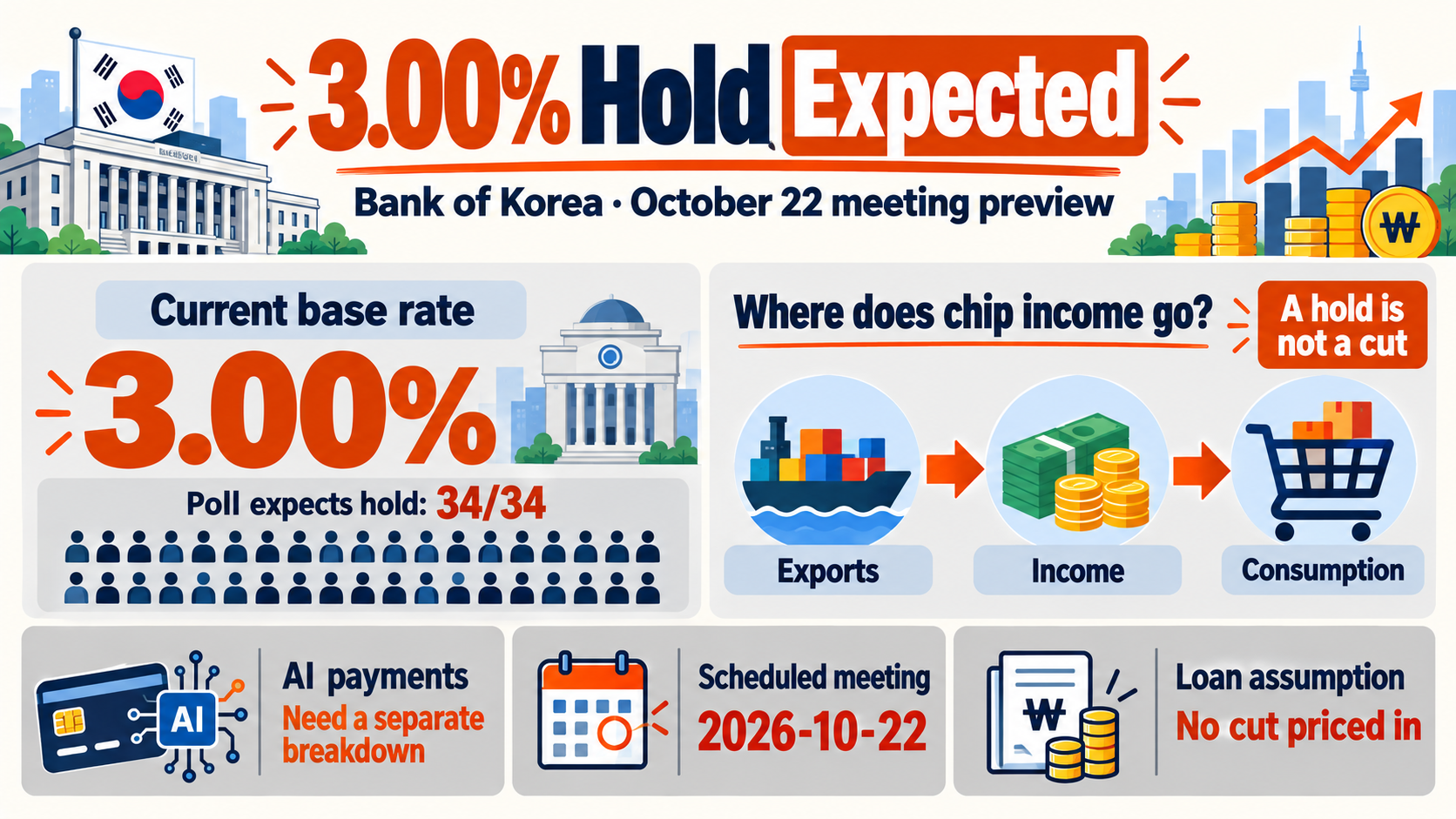
The Bank of Korea’s October 22 meeting is widely expected to leave the base rate at 3.00%. All 34 economists in Reuters’ October 20 poll expected a hold. That would not promise cheaper loans. The question is how far semiconductor income and earlier rate increases have reached households and businesses. Source: Reuters 금통위 전망 조사(2026-10-20, MarketScreener 재전재)
This preview uses information available on October 21, 2026, before the decision. Past decisions, survey forecasts and our analysis of their economic transmission are distinguished throughout.
A Bank of Korea hold would still leave borrowing costs elevated
The BOK raised its base rate from 2.75% to 3.00% on August 27, following July’s increase. The policy rate influences short-term funding costs and, through them, deposits and loans. A borrower’s contractual rate does not necessarily move on the same day or by the same amount. Source: 한국은행 통화정책 결정·총재 모두발언(2026-08-27)
A pause stops a further increase; it leaves the existing rate in place. Floating-rate loans reset on contractual dates, while fixed-rate debt may become more expensive when refinanced. Some households therefore feel a larger squeeze months after a policy increase.
For illustration, a KRW 300 million loan would incur KRW 750,000 more annual interest after a fully passed-through 0.25 percentage-point increase, or KRW 1.5 million after 0.50 points. This assumes an unchanged principal and excludes fees and amortization. It is a sensitivity calculation, not a forecast of anyone’s bill.
Extra annual interest on KRW 300m. Full pass-through, unchanged principal; not a forecast of loan rates.
Banks need not benefit automatically from a pause. Interest received on loans must be weighed against deposit costs and provisions for troubled borrowers. Cash-rich exporters and domestic businesses refinancing debt may continue to face very different conditions.
Why chip exports are only the start of the consumption story
Higher chip exports first raise producers’ revenue and cash. Bonuses, dividends and domestic equipment orders can then turn that cash into income for other households and firms. Export growth alone cannot establish that restaurant sales or retail profits are improving at the same pace.
Imported machinery, retained cash and household debt repayment can all limit immediate domestic spending. Broader supplier orders, hiring and wage growth would make the expansion more widely felt. These are transmission channels to monitor, not claims that every step has already occurred.
-
1
Chip exports
Higher revenue and cash
-
2
Domestic payments
Bonuses, dividends, supplier orders
-
3
Household decisions
Spend, save or repay debt
-
4
Prices and activity
Breadth of spending matters
A broad spending recovery would help domestic businesses sell more and pass through costs. For a central bank, that is welcome growth but also a possible source of persistent inflation. If gains remain concentrated in a few exporters, further tightening may instead reach vulnerable borrowers before the export income does.
Our earlier discussion of September exports and sector differences leads to the same question: what happens to domestic orders, wages and consumption after export revenue rises? Applying chipmakers’ profit growth to all domestic industries skips that transmission.
What the governor and the IMF said about a pause
At the October 12 parliamentary audit, Governor Shin Hyun Song said earlier rate increases had bought time to respond, according to Yonhap. That suggests room to assess policy transmission; it does not constitute a commitment to cut rates. Source: 연합뉴스 신현송 총재 국정감사 발언(2026-10-12)
The BOK’s August 27 statement emphasized both inflation spillovers and financial-stability risks. Applied to this meeting, that framework argues against making the decision on exports or equities alone. Housing, household credit and consumption can send different signals. Source: 한국은행 통화정책 결정·총재 모두발언(2026-08-27)
In an October 14 briefing, IMF Asia-Pacific Director Krishna Srinivasan said the technology boom had supported upward growth revisions for Korea and some peers. The IMF also highlighted energy shocks and the need for stronger energy security. Export gains and imported cost pressures can coexist—the combination facing Korean policymakers. Source: IMF 아시아태평양 브리핑(발언 2026-10-14, 게시 10-15)
This connects with our October IMF outlook discussion. Selected Korean exporters can outperform a softer world economy, while strong national exports need not mean every household has recovered purchasing power.
Do AI subscriptions send export income abroad?
At the same audit, Shin discussed improving statistics on overseas AI subscriptions. Yonhap reported that these payments sit within software-related payments but are difficult to isolate. The absence of an AI-only breakdown does not mean the payments are absent from the accounts. Source: 연합뉴스 신현송 총재 국정감사 발언(2026-10-12)
There are two economic effects. Buying an overseas service creates an external payment. If it reduces document-processing or development time, it can also lower a domestic firm’s operating costs. A higher subscription bill alone does not establish a loss to profitability or national welfare.
External payment
Payment for an overseas service
Transaction
Measurement · AI-only breakdown unavailable
Domestic productivity
Lower time and operating costs
Potential gain
Test · Savings relative to the fee
The chip exporter and the AI subscriber need not be the same company. Across industries, some manufacturing income may become revenue for overseas software providers. Domestic service firms’ margins will depend partly on whether they merely resell access or add their own capabilities and customer relationships.
Export receipts converted into won and payments for overseas services can create opposing currency demand. The magnitude depends on invoicing currencies, conversion timing and hedging. Without a verified AI-subscription total, attributing a particular won move to those subscriptions would go beyond the evidence.
Why stocks and bonds may read a hold differently
The Reuters poll’s median forecast put the November rate at 3.25%, alongside the expected October hold. That is an economist forecast, not a BOK promise. Guidance about later tightening could therefore move bonds more than a widely anticipated pause. Source: Reuters 금통위 전망 조사(2026-10-20, MarketScreener 재전재)
Existing fixed-rate bonds generally lose value when market yields rise. Equities face a different balance: stronger chip earnings help, while a higher rate used to value future profits can weigh on prices. Better operating performance and more expensive capital can pull in opposite directions.
Market sentiment gauges place CNN’s US Fear & Greed index at 28.4, or fear, on October 20: down 15.7 points from 44.1 a week earlier and 2.1 from 30.4 a month earlier. GoldKimp’s Korean measure reads 69.3, or greed, for October 19. Different methodologies and dates prevent a like-for-like country ranking. Source: CNN Fear & Greed(2026-10-20 제공 스냅샷) Source: GoldKimp KOSPI F&G(2026-10-19 제공 스냅샷)
US and Korean sentiment: different methods. CNN (Oct 20) and GoldKimp (Oct 19). Not directly comparable or a policy probability. Korean historical trend unavailable.
US risk appetite has weakened over both comparison periods. Matching Korean historical readings were unavailable, so the Korean score does not establish a rising trend. SentimenTrader’s public page displayed neither Smart Money nor Dumb Money Confidence values or an update date when checked on October 21. We cannot infer that professional investors are buying from missing data. Source: SentimenTrader 공개 페이지(수치 미표시)
For the BOK preview, upbeat Korean sentiment alone is insufficient to turn a hold into a stock-market buy signal when overseas risk appetite is weaker. Equally, US fear alone does not establish deteriorating Korean exporter earnings. Operating profits and funding conditions need separate checks.
What to read in the October 22 statement
If the decision is a hold, first examine the assessment of domestic-demand spillovers and inflation. Then look for the treatment of household lending and housing, and any change in language about further increases. The governor’s account of how earlier tightening is working also matters.
An unexpected hike would require reassessing loan resets and corporate refinancing. A hold accompanied by less tightening concern could help bonds; if that shift reflects weaker activity, it may be less favorable for company earnings. One rate number cannot settle the outlook for every asset.
My focus is as much on who receives export income and who pays higher interest first as on the 3.00% rate itself. The pace at which the chip boom becomes consumption and productivity will clarify what a pause means. This is economic analysis, not a recommendation to buy or sell an asset.
Sources and references
For information only — this is not a recommendation to buy or sell any asset.
Comments 0