US Treasury Auction at 5.300%: What a 2.5% Dealer Share Means for Korea
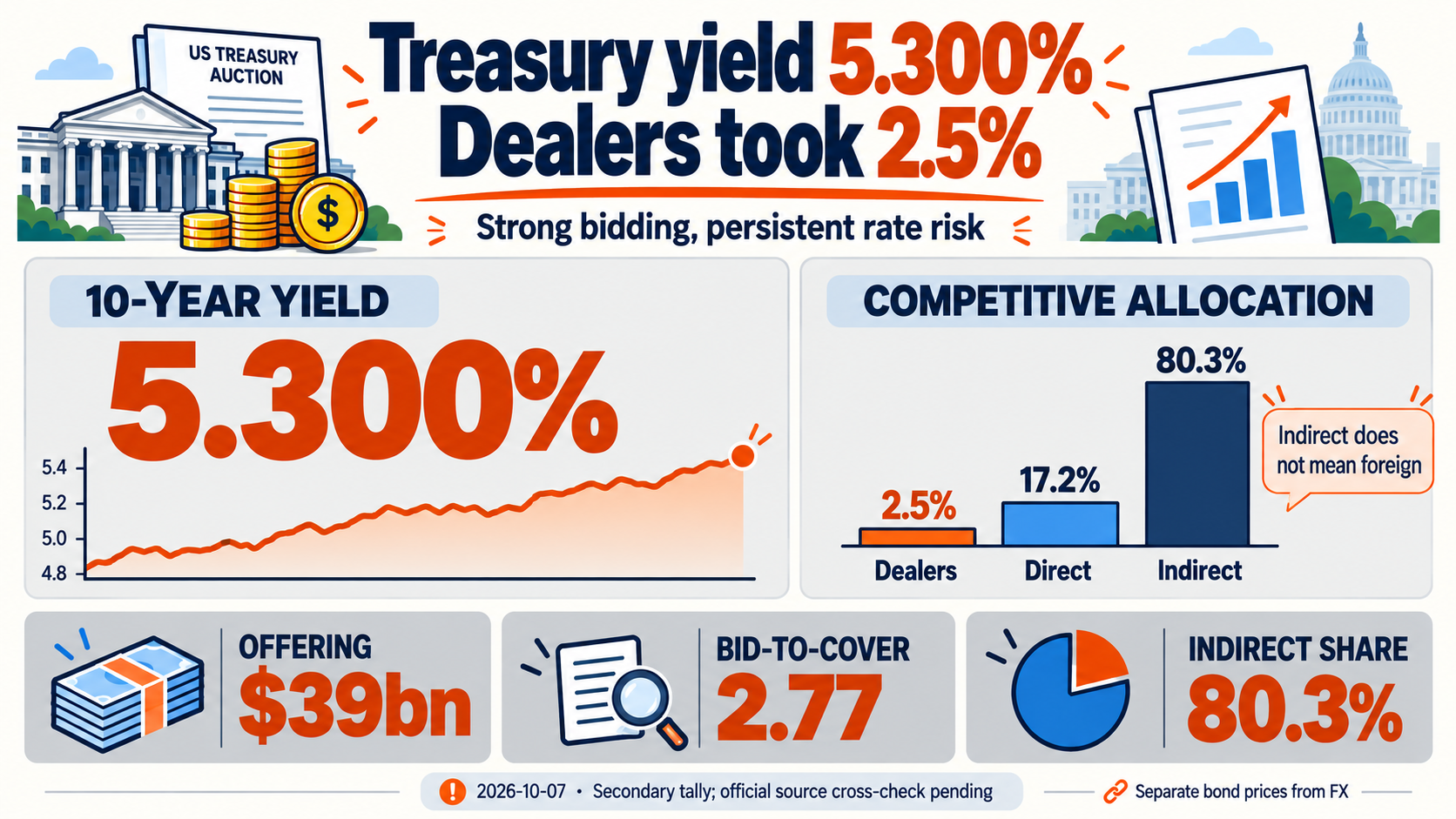
A 5.300% auction yield and a dealer allocation of just 2.5% tell different parts of the same story. At the October 7 reopening of $39 billion in ten-year Treasury notes, buyers outside dealer house accounts absorbed most competitive awards. That does not eliminate price risk for Korean holders of dollar bonds. Source: TFTC — 10년물 입찰 집계 교차확인
Research cutoff: October 19, 2026. Auction figures were cross-checked against 500metrics and TFTC, both of which reproduce Treasury data rather than provide independent underlying observations. Direct retrieval of the official results PDF failed, so primary-document reconciliation remains outstanding. The transmission analysis and numerical examples below are interpretations, not reported outcomes or forecasts. Source: 500metrics — 10월 7일 입찰 원자료 재게시·계산 Source: TreasuryDirect — 2026-10-07 입찰 결과 PDF (직접 열람 미완료)
US Treasury auction: why strong demand still required 5.300%
An auction sells government debt to investors. This reopening added to an existing ten-year note with nine years and ten months remaining. The 5.300% figure is the highest accepted auction yield, not the coupon printed on the security. Source: TFTC — 10년물 입찰 집계 교차확인 Source: 미 재무부 — 입찰 참가자 분류 FAQ
When a bond price falls, its yield to a new buyer rises. A high yield can therefore coexist with strong demand: the lower price may attract buyers. This is an economic interpretation; auction results disclose orders, not investors’ motives.
The preceding September 9 auction stopped at 4.834%. October’s yield was 46.6 basis points, or 0.466 percentage point, higher. Frankly, nearly half a point in a month is not a small move. Bid-to-cover rose from 2.71 to 2.77. Borrowing became more expensive even as bidding covered the sale comfortably. Source: 500metrics — 10월 7일 입찰 원자료 재게시·계산
Ten-year auction high yield (%). 500metrics/TFTC reproduction; +46.6bp versus Sep 9. Official PDF reconciliation pending. · Axis starts at 4.6, not zero
Bid-to-cover relates bids received to the amount awarded under the auction’s reporting convention. It is not a count of buyers per bond. Orders can specify different yields, and some do not win an allocation. Sale size and comparable auctions matter. Source: 미 재무부 — 입찰 참가자 분류 FAQ
Another useful comparison is the auction yield against the same security’s when-issued yield immediately before bidding closed. That quote was not verified here. Neither the median accepted yield nor the day’s closing yield is a substitute.
What a 2.5% dealer share can—and cannot—tell us
Primary dealers are central intermediaries in the Treasury market. The dealer category records their own-account awards. Direct bidders are non-primary-dealer submitters bidding for their own accounts; indirect bidders are customers submitting competitive bids through intermediaries. Source: 미 재무부 — 입찰 참가자 분류 FAQ
Reported shares of competitive awards were 80.3% indirect, 17.1% direct and 2.5% dealers. The denominator is competitive awards, not the headline offering or an allotment total that includes Federal Reserve add-ons. Rounding makes the three displayed shares sum to 99.9%. Source: 500metrics — 10월 7일 입찰 원자료 재게시·계산 Source: TFTC — 10년물 입찰 집계 교차확인
Share of competitive awards (%). Oct 7, 500metrics/TFTC. Categories do not identify nationality; rounded total 99.9%.
Treasury explicitly says that neither direct nor indirect status identifies a bidder’s domicile. Indirect awards can include foreign central banks and domestic customers. These figures cannot reveal how much the Bank of Korea bought or establish a recovery in foreign confidence. Source: 미 재무부 — 입찰 참가자 분류 FAQ
A low dealer share points to ample demand outside dealer house accounts at that price. It may reduce the amount dealers need to redistribute. It does not reveal whether funds will hold the bonds, financed them with borrowing, or plan to sell them soon.
This connects with our discussion of hedge-fund leverage in Treasuries. A successful allocation and investors’ ability to withstand subsequent selling pressure are separate questions.
IMF and Fed warnings: one auction cannot remove fiscal pressure
A long-term yield can be understood as expected future short rates plus compensation for holding interest-rate risk over time. The latter is called the term premium. It is estimated rather than directly observed; a single auction cannot identify how much each component contributed.
The September FOMC minutes, released October 7, linked the intermeeting rise in Treasury yields partly to policy expectations and economic data. Market commentary also cited geopolitical uncertainty and competition for capital. That describes the backdrop, not a causal attribution for auction day. Source: 연준 — 9월 15~16일 FOMC 의사록, 10월 7일 공개
At an October 14 IMF briefing, Fiscal Affairs Director Rodrigo Valdes warned that high debt, higher rates and persistent spending pressures were interacting, with advanced-economy fiscal problems spilling across borders. The same day, Managing Director Kristalina Georgieva said growth alone could not deliver the necessary debt adjustment quickly enough, according to AP. Source: IMF — 10월 14일 Fiscal Monitor 브리핑 Source: AP — 10월 14일 게오르기에바 총재의 부채 경고
Smooth issuance can coexist with a growing interest bill. The IMF’s warning is not evidence that this auction failed. An auction resolves a financing need today; fiscal sustainability depends on years of revenue, spending and debt-service costs.
Our earlier FOMC minutes analysis examined the policy-rate path. This auction adds an actual market-clearing price. The central bank’s next decision and the government’s long-term borrowing cost are connected, but they are not interchangeable.
Korean reserves: low credit risk still leaves price risk
A safe asset does not have a fixed market price. When new bonds offer a higher yield, existing bonds become less attractive at their old price. Rising yields therefore push down their dollar market value. Repayment at maturity and the price available before maturity are different considerations.
The Bank of Korea describes safety and liquidity as its first priorities, with return pursued within appropriate limits. Liquidity means being able to turn assets into usable cash when needed. Higher yields alone are therefore insufficient grounds to extend maturities across a reserve portfolio. Source: 한국은행 — 외환보유액 운용목표
Modified duration approximates a bond portfolio’s percentage price response to a one-percentage-point yield change. For a hypothetical portfolio with duration seven, yield increases of 0.25, 0.50 and 1 percentage point imply approximate price declines of 1.75%, 3.5% and 7%.
Hypothetical price decline (%). Duration 7; parallel shifts and first-order approximation. Excludes income, FX and convexity; not BOK losses.
This is not an estimate of BOK losses. It assumes a parallel yield shift and constant duration, excluding coupon income, currency changes and convexity. Actual maturity structure, hedges and transactions are required to estimate losses. Reinvesting maturing assets at higher yields can subsequently raise income.
Currency effects require a separate calculation. Won depreciation can offset part of a bond-price loss for an unhedged Korean investor measuring returns in won. But dollar-reported official reserves do not automatically shrink when the won weakens. Translation of non-dollar assets, bond prices, investment income and transactions are distinct drivers.
Earnings and investment feel the pressure when financing resets
A Korean issuer’s new dollar-bond yield can be viewed as a comparable Treasury yield plus a spread for credit and other risks. Funding gets more expensive when the benchmark rises even if the spread is unchanged. Risk aversion or strained dollar liquidity can also widen the spread, but that is conditional rather than automatic.
Existing fixed-rate coupons do not reset immediately. Pressure arrives at refinancing or when borrowing for new investment. Higher interest expense reduces net earnings and raises the return a project must earn. Cash-rich companies and firms approaching debt maturities can consequently follow different investment paths.
-
1
Treasury yields rise
Higher funding benchmark
-
2
Refinancing / issuance
Issuer spread also matters
-
3
Reassess projects
Higher interest and hurdle rate
-
4
Orders, jobs, spending
Effects if investment slows
If the gap persists, it can reshape an industry. A well-funded leader may expand capacity while a financing-constrained supplier postpones investment. Delayed equipment orders and hiring can then weaken household income expectations and consumption. These are possible transmission channels, not documented consequences of this auction.
Higher long yields also reduce the present value of future corporate earnings, although stronger profits can offset that valuation pressure. Korean government bonds face global yield competition alongside domestic policy, inflation and local demand. One US auction cannot determine the direction of Korean yields or the won.
Stocks in extreme fear: will Treasury demand hold at the next auction?
Post-auction equity sentiment differs across the two markets. The supplied CNN snapshot reads 17.9, extreme fear, on October 16: down 28.5 points from 46.5 a week earlier and 9.4 from 27.3 a month earlier. Equity anxiety can coexist with demand for Treasury yields. Source: CNN Fear & Greed — 제공 스냅샷 2026-10-16
GoldKimp’s KOSPI measure is 68.0, greed, as of October 15. Its methodology and date differ from CNN’s, so the point gap is not directly comparable. Matching week- and month-earlier KOSPI readings were unavailable. Neither snapshot is contemporaneous evidence explaining the October 7 auction. Source: GoldKimp KOSPI F&G — 제공 스냅샷 2026-10-15
SentimenTrader’s public page displayed no values or update date for Smart Money or Dumb Money Confidence when checked. No inference about institutions buying against retail sellers is drawn. Direct and indirect auction categories should not be mapped onto those sentiment indicators. Source: SentimenTrader — 공개 페이지 조회, 수치·기준일 미표시
For the next comparable auction, watch sale size, bid coverage, dealer awards and pricing relative to the immediately preceding market quote. For Korean portfolios and companies, examine rate sensitivity, dollar refinancing dates and currency hedges. Buyers accepting today’s yield have not promised to absorb tomorrow’s supply at the same price.
This article explains market mechanisms and is not a recommendation to buy or sell particular securities.
Sources and references
- TreasuryDirect — 2026-10-07 입찰 결과 PDF (직접 열람 미완료)
- 500metrics — 10월 7일 입찰 원자료 재게시·계산
- TFTC — 10년물 입찰 집계 교차확인
- 미 재무부 — 입찰 참가자 분류 FAQ
- 연준 — 9월 15~16일 FOMC 의사록, 10월 7일 공개
- IMF — 10월 14일 Fiscal Monitor 브리핑
- AP — 10월 14일 게오르기에바 총재의 부채 경고
- 한국은행 — 외환보유액 운용목표
- CNN Fear & Greed — 제공 스냅샷 2026-10-16
- GoldKimp KOSPI F&G — 제공 스냅샷 2026-10-15
- SentimenTrader — 공개 페이지 조회, 수치·기준일 미표시
For information only — this is not a recommendation to buy or sell any asset.
Comments 0