China drug licensing — what $600m upfront means for Korean biotech
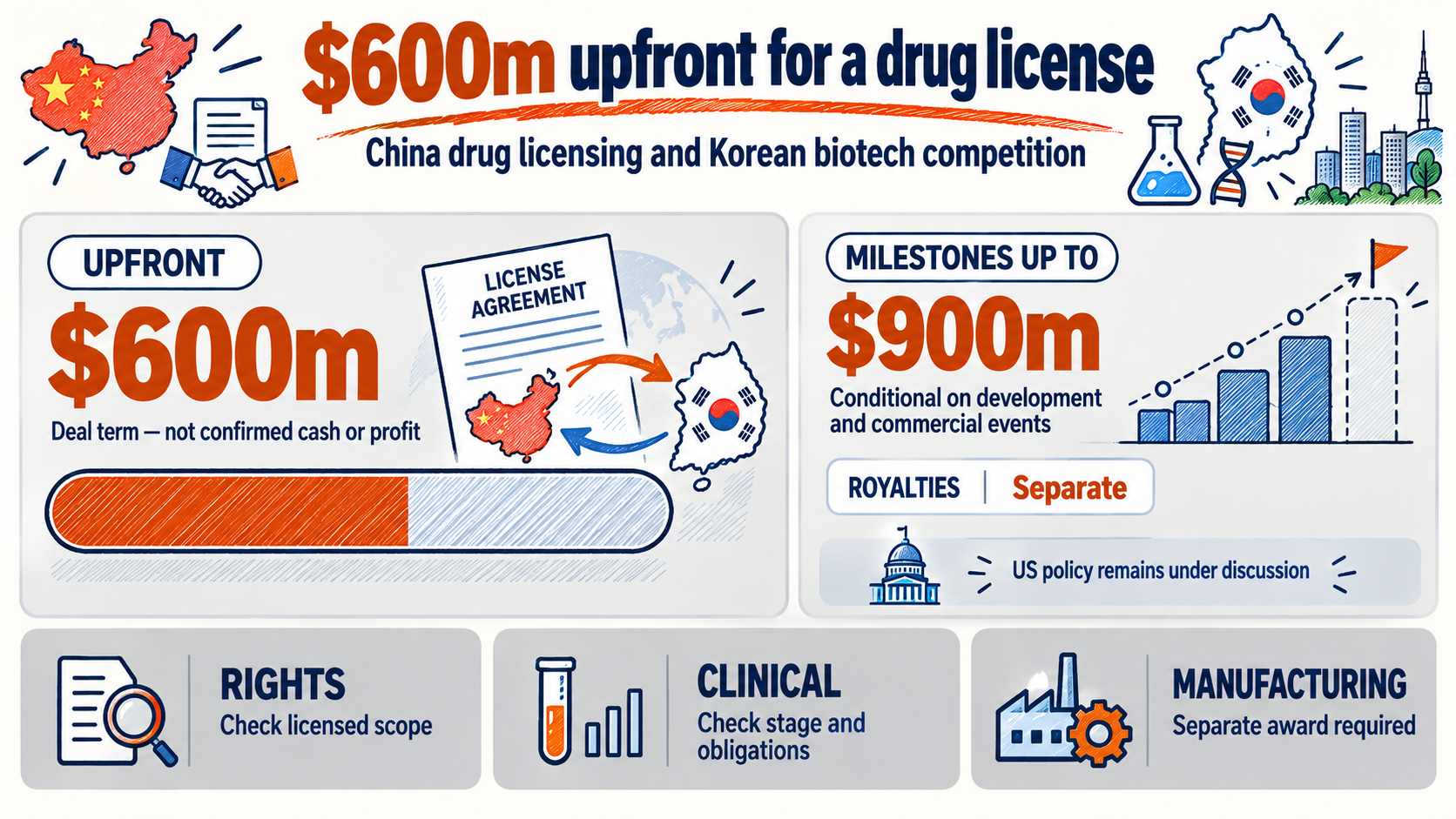
On September 1, AstraZeneca announced that it had completed a deal for Chinese developer Dizal’s lung-cancer drug, with $600 million payable upfront. China drug licensing matters for Korean biotech because it gives buyers more options. For a Korean company developing a similar medicine, that could affect both its negotiating terms and the money available for its next trial. AstraZeneca announcement
On September 18, Reuters reported that US officials were considering rules that would preserve many licensing deals for Chinese medicines. This was a sourced report about deliberations, not a final rule. This article separates that policy uncertainty from completed transactions, using information checked on September 25, 2026. Reuters report
Why global drugmakers want Chinese drug licenses
Licensing is different from shipping boxes of medicine abroad. A developer grants another company rights to develop and sell a drug in specified territories. Early discovery, large trials, regulatory work and commercial distribution can therefore sit in different businesses.
The buyer gets a chance to shorten development by evaluating work already done. The seller can fund its science without building a worldwide sales organization, but gives up some control and future economics in return.
Restricting these transactions could reduce both financing for Chinese developers and the options available to US buyers. Keeping them open could finance another generation of Chinese research. This is an economic interpretation of the structure, not a measured estimate of cost savings or clinical success.
-
1
Early development
Developer builds an asset and evidence
-
2
License agreement
Buyer pays and takes agreed responsibilities
-
3
Trials and sales
Further cost and failure risk remain
-
4
Research reinvestment
Receipts can finance another program
$600 million upfront is different from $900 million contingent
On September 1, AstraZeneca announced completion of its agreement for worldwide development and commercial rights to Dizal’s Zegfrovy. It disclosed $600 million upfront and up to $900 million tied to development, regulatory and sales milestones, plus separate royalties. AstraZeneca announcement
Zegfrovy payments — USD 100 million. AstraZeneca, Sep 1, 2026. Upfront 6; milestones up to 9. Royalties separate. Not cash received or profit.
Add them up and you get $1.5 billion. At first glance, that sounds like the research budget is sorted. The payment terms tell you how much the developer can actually count on: upfront consideration is payable at the start, while milestones depend on specified outcomes. The announcement alone does not establish the exact receipt date or quarterly revenue recognition.
For the seller, upfront funding can support the next trial. Cash collection and reported revenue or profit can occur at different times depending on contractual obligations. Expanding research spending on the assumption that every milestone will arrive can create another funding need if trials slip.
For the buyer, a larger agreement does not automatically mean higher near-term profit. Further trials, manufacturing preparation and commercialization can require additional spending. The relevant question is whether future earnings justify the acquisition price, remaining costs and risk of failure.
A policy discussion does not settle every transaction
Treasury’s FAQ says the existing outbound investment rules remain in effect until regulations implementing the COINS Act are issued. That does not confirm the pharmaceutical approach described by Reuters. The final text must establish which activities and transactions are covered. US Treasury FAQ
A license buys drug rights; an equity investment buys ownership in a company. Pfizer’s 2025 announcement concerning 3SBio included both. These are distinct rights even when negotiated together, so treatment of one component does not automatically establish treatment of the other. Pfizer announcement
AstraZeneca is based in the UK. Its agreement illustrates the international market for Chinese medicines; it is not proof of how a future US rule would apply. Applicability depends on the parties, structure and specific requirements.
Korean biotech faces opportunities and tougher bargaining
So where does that leave Korean developers? Being Korean may not, by itself, command a better price. If buyers retain access to Chinese candidates, they have more alternatives to compare. Similar medicines targeting the same condition could face tougher upfront-payment negotiations. In that scenario, we would expect efficacy, safety, convenience and reliable clinical evidence to carry more weight.
Differentiated technology can still attract buyers. Even if restrictions increase, however, Korea does not automatically capture the displaced spending. Buyers could turn to other countries, invest internally or postpone the program altogether.
Drug developers and contract manufacturers face different economics. A contract manufacturer develops production processes or makes another company’s medicine. More licensing deals need not produce Korean orders if existing manufacturing arrangements remain in place. A separate supplier decision and technology transfer would provide stronger evidence of an opportunity.
Drug developer
Licensing development and sales rights
Revenue driver
Competition · Evidence, differentiation and rights
Evidence needed · Upfront, milestones and remaining R&D
Contract manufacturer
Process development and manufacturing
Revenue driver
Competition · Quality, capacity and timing
Evidence needed · Manufacturing award and tech transfer
For related reading on the distance between research and commercialization, see our ALK molecular-glue article. Our virtual-cell AI article covers early research costs. These are background reading, not evidence for the transactions or policy claims discussed here.
Will cheaper development lower the price patients pay?
Lower development costs need not immediately lower patient bills. Prices also depend on competing treatments, patents, insurance coverage and negotiations. More treatment options and lower out-of-pocket spending are separate outcomes; the latter requires savings to reach patients.
Zegfrovy’s 2025 FDA accelerated approval covered adults with a specified EGFR mutation whose advanced non-small cell lung cancer had progressed after platinum chemotherapy. It was not approval for all lung cancers. Accelerated approval also requires subsequent confirmation of clinical benefit. FDA approval notice; Accelerated Approval Program
The macroeconomic effects are more indirect. Licensing receipts can finance researchers and trials; a manufacturing award could support capital expenditure. A rights transaction alone does not establish higher Korean factory output or household consumption. These announcements do not support a numerical estimate of Korea’s GDP or employment impact.
For biotech valuations, read beyond the headline total
Biotech valuations can depend heavily on money not yet earned. Investors weigh future receipts against remaining research costs, failure risk and the wait for payment. Better deal prospects can help valuations, while tougher competition can lower expected terms. This is a valuation mechanism, not a claim that this report caused a particular share-price move.
Watch the final US rules, disclosed cash receipts and obligations, and subsequent trial and approval developments. Manufacturing claims need manufacturing evidence. AstraZeneca’s stated fourth-quarter US launch is a company plan; actual launch and revenue remain separate checkpoints. Company announcement
An open market for China drug licensing could enlarge the arena in which Korean developers must demonstrate differentiation. The practical questions are how much is payable now and what must be proven to earn the next payment. This is industry analysis, not a recommendation to invest in a security.
How much is payable now, and what must be proven to earn the next payment?
Sources
For information only — this is not a recommendation to buy or sell any asset.
Comments 0