US Fuel Economy Rollback — Why 34.9 MPG Splits Auto and Battery Profits
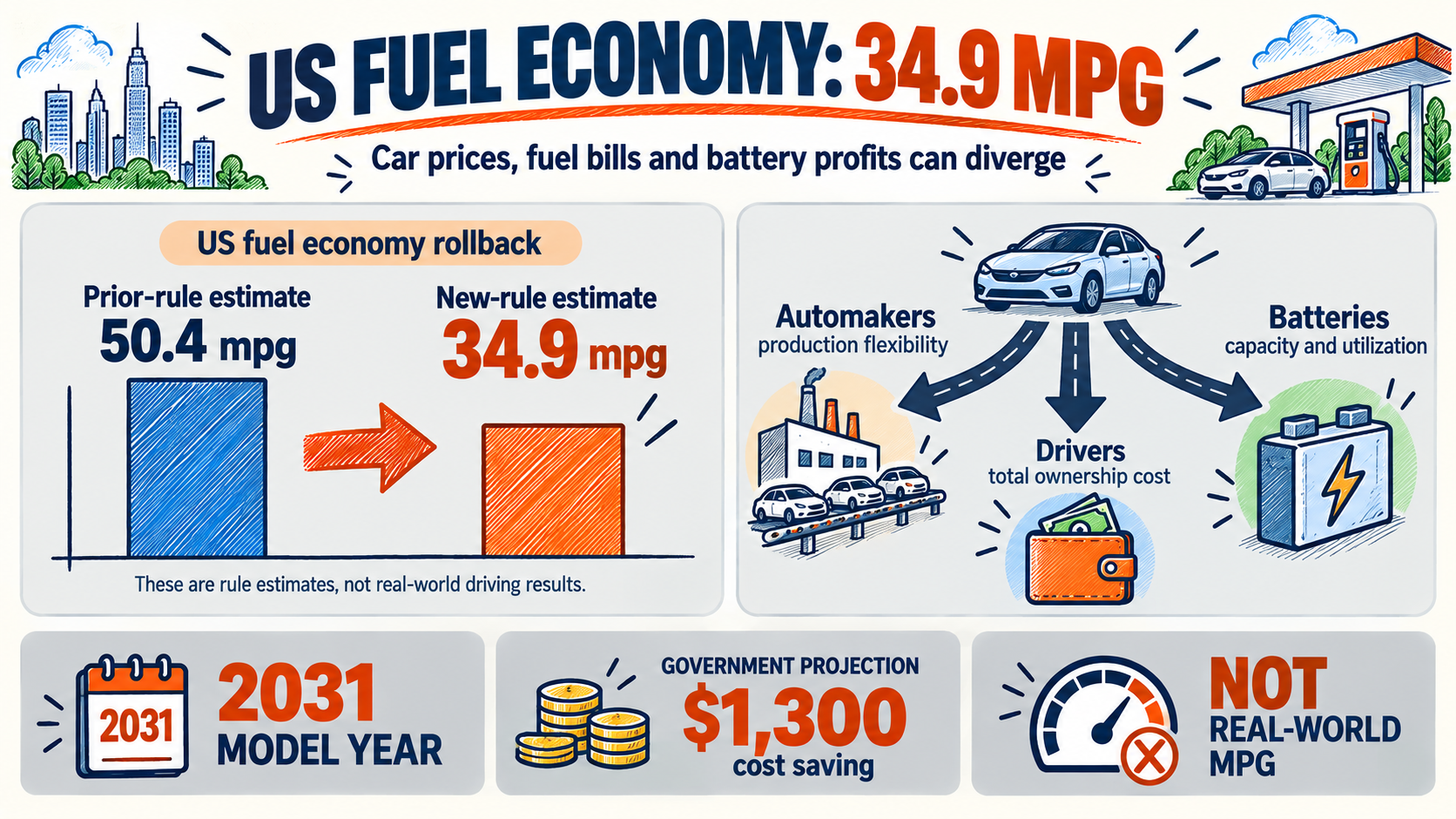
The US fuel economy rollback is final. Rules announced on September 28 project a fleet average of 34.9 mpg for model year 2031. Lower compliance costs could help automakers, while Korean battery factories and drivers face a different calculation. Source: Reuters · 2026-09-28
A lower sticker price sounds welcome. But buying a car more cheaply does not necessarily make it cheaper to own. The useful distinction is between manufacturing cost, the price paid by the buyer and the production volume available to battery suppliers.
US fuel economy rollback: what 34.9 mpg means
CAFE regulates the average fuel economy of a manufacturer’s vehicle fleet. Miles per gallon measures distance travelled on a gallon of fuel; a higher number means less fuel per mile. It is not a single identical requirement for every model. Source: NHTSA · CAFE
NHTSA’s 2024 announcement projected roughly 50.4 mpg for 2031. The new announcement gives 34.9 mpg, about 30.8% lower by simple arithmetic. These are averages under different regulatory assumptions, not a prediction that every car’s real-world efficiency will fall by that amount. Source: NHTSA · 2024-06-07 Source: DOT · 2026-09-28
2031 fleet economy: two rule estimates. Sources: NHTSA, June 7, 2024; DOT, September 28, 2026. Different regulatory assumptions; not individual on-road efficiency.
Nor should these regulatory averages be inserted directly into a household fuel bill. Model mix, testing conventions and driving conditions differ. The household example below therefore uses separate, explicitly hypothetical real-world fuel-economy figures.
Why loosen the rules? Prices, demand and investment
Transportation Secretary Sean Duffy presented the change on September 28 as support for affordability and manufacturing. The department projects a $1,300 reduction in average new-vehicle cost. That is an estimated policy effect, not an observed drop in transaction prices. Source: DOT · Duffy 발언
The Alliance for Automotive Innovation backed the change as better aligned with market conditions and the law. The Sierra Club objected to the burden on drivers at the pump. Reuters reported both positions on the day of the announcement. Source: Reuters · 업계와 환경단체 입장
The economic mechanism is straightforward. If compliance pushes a company to build models it struggles to sell, it can face both investment spending and inventory discounts. Relaxing that constraint may let it shift production toward products with stronger demand. This is an interpretation of incentives, not a claim that all electric vehicles are unprofitable.
Cost savings need not flow entirely to buyers. Heavy inventories and aggressive competition can turn them into discounts. Scarce, popular models may let manufacturers keep more of the benefit. A reduction in cost alone therefore does not establish both higher sales and a higher profit margin.
-
1
Compliance relief
More flexibility in production mix
-
2
Inventory and competition
Discount pressure shapes the split
-
3
Prices or margins
Benefits divided between buyers and earnings
A cheaper purchase can still mean a larger fuel bill
A buyer needs the total cost of ownership: purchase price, financing, fuel, insurance and maintenance, less eventual resale proceeds. If a cheaper vehicle uses more fuel, keeping it longer can erode the initial saving. The balance depends on the buyer’s actual mileage and the specific vehicles being compared.
Consider an illustration, not a forecast: 12,000 miles a year and gasoline at $4 a gallon. A car returning 30 mpg would use $1,600 of fuel annually, versus $1,200 at 40 mpg. The difference is $400 a year. Neither the mileage, fuel price nor efficiency figures are predictions for a specific model.
Illustrative annual fuel spending. Assumptions: 12,000 miles/year and $4/gallon. Miles ÷ mpg × fuel price. Not a policy or fuel-price forecast.
In that illustration, an initial saving of $1,300 would equal about 3.25 years of additional fuel spending. That does not mean every buyer receives the government’s estimated saving. Financing costs and resale values also change the result. A low-mileage household and a long-distance commuter can reasonably make different choices.
This connects with our earlier discussion of how oil prices reach household budgets. Higher fuel spending can leave less for dining out or leisure. A policy that lifts new-car purchases need not lift other consumption by the same amount. Related: How oil prices transmit through Korea’s economy
Why Korean automakers and battery suppliers may diverge
At its August 26 investor day, before this rule was announced, Hyundai outlined North American hybrid expansion and local production. CEO José Muñoz described investment across multiple powertrain options. This was not a new response to the September decision, but it is relevant to the ability to adapt to changing demand. Source: 현대자동차 · 2026 CEO Investor Day
Production flexibility matters to the assembler. Filling a plant with vehicles customers want spreads fixed costs over more units. Better use of existing equipment can help profitability. But expensive retooling or a price war can absorb that benefit. These are conditional effects, not an earnings forecast for Hyundai.
For battery suppliers, the picture changes. Battery suppliers must look at capacity shipped, not just vehicle units. A conventional hybrid combines an engine with a smaller battery; it does not need the same battery capacity as a fully electric car. Electrified-vehicle sales can rise while battery demand falls short of expectations if the mix shifts away from full EVs.
Automakers
Profit per vehicle
Key unit
Opportunity · Align production with demand
Risk to check · Discounts and retooling
Battery suppliers
Capacity shipments and utilization
Key unit
Opportunity · Diversify customers and products
Risk to check · Fixed costs and delayed payback
The distinction becomes sharper when a factory has already been built. Depreciation spreads the equipment’s cost over its useful life; it does not disappear when orders decline. Lower utilization leaves each unit of output carrying more factory cost. Less investment pressure on an automaker does not automatically improve its suppliers’ earnings.
Materials and components suppliers also differ by product and contract. Engine parts, transmissions and battery materials do not share the same demand. Minimum-purchase commitments and firm production schedules can change when revenue becomes cash. It is another version of the cost-versus-profit distinction explored in our freight article. Related: Container freight and exporters’ margins
Why lower costs may not lift share prices
In the IMF’s July 9 outlook briefing, Research Department Deputy Director Petya Koeva Brooks described weaker growth this year followed by a rebound next year. The IMF also warned that disinflation had stalled. This was not a comment on the September auto rule; it provides context for a policy that may lower purchase costs while fuel and financing remain constraints. Source: IMF · July 2026 briefing
The supplied September 28 CNN Fear & Greed reading is 34.8, or fear. It is little changed from 34.2 a week earlier but 19.0 points below 53.7 a month earlier. GoldKimp’s KOSPI reading is 55.0, neutral, dated September 22. Different observation dates and methods prevent a like-for-like ranking. Source: CNN · 제공 스냅샷 Source: GoldKimp · 2026-09-22
US sentiment over the past month. Supplied CNN snapshot, September 28, 2026, 18:14:41 UTC. Korea’s 55.0 is dated September 22 and uses another method, so it is not plotted here.
Comparable weekly and monthly KOSPI history was unavailable. The September 29 check of SentimentTrader’s Smart Money and Dumb Money Confidence page also showed blank values and no update date. It cannot support a claim that sophisticated and retail positioning diverged. The supported observation is that US risk appetite is weaker than a month earlier. Source: SentimentTrader · 수치 미노출
In that setting, investors may demand evidence that policy relief translates into cash earnings. Equity values depend on both expected profits and the price investors pay for them. High financing costs or uncertainty about policy durability can offset cost savings. This is not a buy or sell signal for any stock.
Next earnings: watch profit distribution, not unit sales
The department says CAFE credit trading will end from model year 2028. Credits allow overcompliance to be traded for another manufacturer’s compliance needs. This does not mean every other environmental credit program disappears, or that every related revenue stream vanishes immediately. Source: DOT · 적용 일정
For automakers, read transaction prices alongside incentives: did the company retain the saving, or pass it to buyers to gain volume? For batteries, examine customer model mix, capacity shipments, utilization and actual capital spending. Vehicle-sales headlines alone cannot answer those questions.
The US fuel economy rollback changes how costs are distributed across time and businesses. Greater product flexibility can coexist with slower recovery of battery investment. For Korean companies, the next evidence will come from orders and cash flow, rather than the policy headline alone.
Information cutoff: September 29, 2026, Korea time. Announcements and company plans are documented facts; projected savings are estimates; effects on earnings and consumption are conditional analysis.
Follow vehicle prices, fuel bills and battery utilization separately.
Sources
- 미국 교통부, CAFE 최종 규칙 발표 (2026-09-28)
- NHTSA, 기존 MY2027–2031 규칙 (2024-06-07)
- Reuters, US finalizes new lower fuel economy standards (2026-09-28)
- NHTSA, CAFE 제도 안내
- 현대자동차, 2026 CEO Investor Day (2026-08-26)
- IMF, July 2026 WEO briefing (2026-07-09)
- CNN Fear & Greed, 제공 스냅샷 2026-09-28
- GoldKimp KOSPI, 제공 관측값 2026-09-22
- SentimentTrader, 2026-09-29 조회 시 숫자 미노출
For information only — this is not a recommendation to buy or sell any asset.
Comments 0