Waste-Heat Cooling 2026 — Can a 2.2 K Experiment Challenge Compressors?
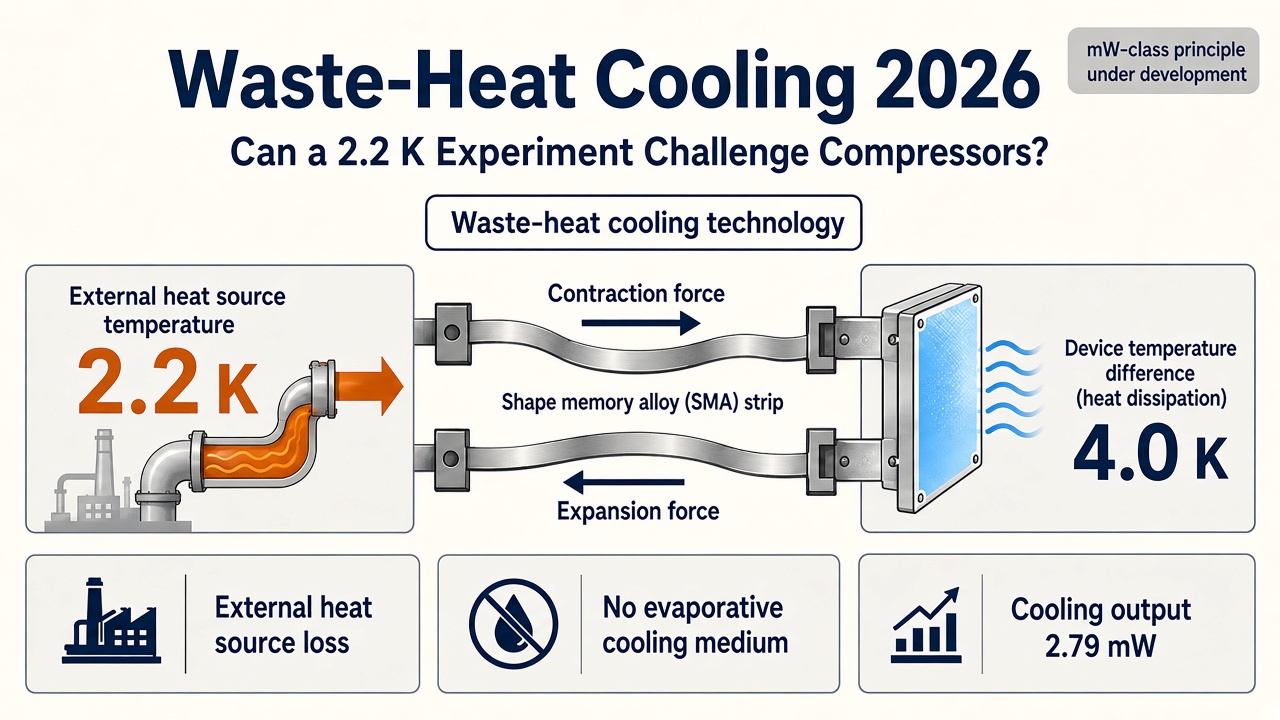
Waste-heat cooling has produced a measurable temperature lift in an integrated laboratory device. A 2026 Nature Energy paper used heat to move shape-memory alloy films and achieved a 2.2 K device-level temperature span with an external heat source. It cannot replace an air conditioner yet, but it establishes a path for turning heat discarded by factories and data centres back into cooling.
The output keeps the claim in perspective. The Joule-heated integrated prototype delivered only 2.79 mW of cooling at zero temperature lift. The important question is therefore not how much it cooled, but what powered the cooling cycle. The answer was heat rather than a conventional electric motor.
How waste-heat cooling turns metal into a refrigerant
Elastocaloric cooling uses the temperature change produced when a material is loaded and unloaded. In a shape-memory alloy, stress rearranges the crystal structure and releases heat. Releasing that stress reverses the transformation and absorbs heat. Instead of evaporating and condensing a fluid refrigerant, a thin metal film moves heat as it stretches and relaxes.
The researchers mechanically coupled two films. A 22 μm TiNi film served as a heat-powered actuator. A 26.5 μm TiNiFe film served as the solid refrigerant. Heating contracts the actuator, which stretches the refrigerant. After the refrigerant rejects heat and is unloaded, it cools and absorbs heat from the target.
-
1
1 Heat input
Heat TiNi actuator
-
2
2 Force transfer
Actuator contracts and loads refrigerant
-
3
3 Reject heat
Loaded film rejects heat
-
4
4 Cooling
Unloading absorbs target heat
How it differs from compressors and thermoelectrics
Most refrigerators and air conditioners use vapour compression. A compressor raises the pressure of a refrigerant that cycles between gas and liquid. It is mature and powerful, but requires a compressor, plumbing and refrigerant management. Leakage can also create a direct climate cost.
Thermoelectric coolers move heat by passing current through a semiconductor. They are compact and have no moving parts, but the paper cites efficiencies of only 10–15% of the reversed Carnot limit—the maximum cooling efficiency thermodynamics permits. Elastocaloric materials avoid volatile refrigerants and have a theoretical ceiling as high as 84% of that Carnot limit. That materials figure must not be confused with the efficiency of a complete machine.
Vapour compression
Fluid phase change
· Compressor and pipes
· Commercially proven
Thermoelectric
Current moves heat
· Compact, no moving parts
· Lower efficiency
Elastocaloric
Solid phase change
· No volatile refrigerant
· Actuation and fatigue hurdles
The real novelty is the heat-powered actuator
Elastocaloric cooling is not new. The persistent bottleneck has been applying hundreds of megapascals of stress repeatedly. Conventional motors and hydraulics are usually designed for long strokes, while a thin-film refrigerant needs high force over a short distance.
The thermal actuator produced a force-to-displacement ratio of 14.5 N/mm, versus 1.1 N/mm for the commercial electromechanical actuator used for comparison. Under Joule heating, the refrigerant film reached a 12.9 K span and the integrated device reached 4.0 K. Replacing Joule heating with an external solid heat source maintained 2.2 K, experimentally closing the chain from heat to motion to cooling.
Why 2.2 K is not a commercial refrigerator
The paper proves that external heat can drive the coupled device. It does not prove competitive cooling cost. The external source was held at 130°C for rapid heating, while the Joule-heated actuator averaged an 86°C peak. The integrated system COP on a thermal-input basis was 0.0853, and long-duration fatigue performance was not demonstrated.
Twenty-cycle steady behaviour is useful for a proof of concept, but products may need millions or billions of cycles. Contact resistance, friction, insulation, alloy fatigue and replacement cost could decide the economics. Those are unresolved engineering questions, not minor details.
-
1
Demonstrated
2.2 K with external heat
-
2
Unproven
Lifetime and mass-production cost
-
3
Early-market inference
Local industrial cooling
-
4
Long-term outlook
HVAC, vehicles, data centres
The economic case begins with where waste heat exists
The IEA expects electricity demand from air conditioning to roughly triple by 2050. Its efficient-cooling scenario estimates up to $2.9 trillion in avoided investment, fuel and operating costs. That is the scale of the global cooling problem, not a revenue forecast for this prototype.
A heat-driven cooler would first make sense where unwanted heat sits close to a cooling load: industrial ovens, fuel cells, power electronics and server racks. If commercialised, it could lower compressor electricity, peak demand and refrigerant service costs. Each saving remains conditional on higher output, long life and mass-production cost.
The first market may not be room air conditioning
Room air conditioners need hundreds of watts to kilowatts of cooling and substantial temperature lift. A milliwatt prototype is far away. Sensors, lasers, control cabinets and power electronics need smaller, local, low-vibration cooling. Thin films may earn their first premium there.
Electric vehicles and data-centre auxiliaries are later possibilities. The IEA says mobile air conditioning can reduce EV range by up to 50% on hot and humid days. This paper did not test either application, so these are engineering inferences rather than demonstrated results.
Commercial activity is emerging. The EU-backed E-CO-HEAT project separately reported 40 kN actuation, 70% mechanical work recovery and early tests above 100 W, alongside two patent filings and spin-off preparation. Germany’s Elastokalorik says it is building an HVAC module prototype in 2026. These are different systems and their best numbers cannot be combined into one imaginary product.
Four numbers that will determine commercial value
- Whole-device COP, including actuation and heat-exchanger losses.
- Cooling power at a useful temperature span, not either metric alone.
- Cycle life and replacement cost after prolonged fatigue.
- Waste-heat temperature and distance—and whether the cost of delivering that heat remains practical.
A past U.S. Department of Energy assessment estimated 40% unit energy-saving potential for commercial cooling, while classifying the technology at TRL 3–4 and flagging upfront cost, staging and maintenance. The 40% figure is a projected potential, not a result measured in this Nature Energy device.
This article does not recommend an investment in any particular technology or company.
Conclusion: changing the energy source of cooling
This study did not build a colder refrigerator. It connected low-grade heat, mechanical actuation and solid-state cooling in one experiment. The performance is small, but the economic question is large: must every unit of cooling begin with another unit of purchased electricity?
My view is that local industrial cooling will arrive before wholesale HVAC replacement. Sites that colocate waste heat and a sensitive thermal load—and place a premium on low noise, low vibration and refrigerant-free operation—offer the most credible starting point. Parallelisation, cascading and fatigue testing must come before claims of compressor disruption.
Sources and further reading
- Nature Energy (2026), Heat-driven elastocaloric cooling with shape memory films — https://www.nature.com/articles/s41560-026-02122-6
- International Energy Agency, The Future of Cooling analysis — https://www.iea.org/news/air-conditioning-use-emerges-as-one-of-the-key-drivers-of-global-electricity-demand-growth
- International Energy Agency, Cities and grids on a heating planet — https://www.iea.org/reports/empowering-urban-energy-transitions/cities-and-grids-on-a-heating-planet
- U.S. Department of Energy, Thermoelastic Active Regenerators — https://www.energy.gov/cmei/buildings/articles/thermoelastic-active-regenerators-giant-deltat
- U.S. Department of Energy (2017), Energy Savings Potential and RD&D Opportunities for Commercial Building HVAC Systems — https://www.energy.gov/sites/default/files/2017/12/f46/bto-DOE-Comm-HVAC-Report-12-21-17.pdf
- European Commission CORDIS, E-CO-HEAT — https://cordis.europa.eu/project/id/101158362/reporting
- Elastokalorik GmbH — https://www.elastokalorik.com/
Related reading
The breakthrough is not colder air yet. It is changing what powers the cooling cycle.
Sources
- Heat-driven elastocaloric cooling with shape memory films
- Air conditioning use emerges as a key driver of electricity demand
- Cities and grids on a heating planet
- Thermoelastic Active Regenerators with Giant DeltaT
- Energy Savings Potential and RD&D Opportunities for Commercial Building HVAC Systems
- E-CO-HEAT project reporting
- Elastokalorik GmbH
For information only — this is not a recommendation to buy or sell any asset.
Comments 0