Screen-Printed Perovskite Solar Cells: Why 21.86% Matters for Solar Economics
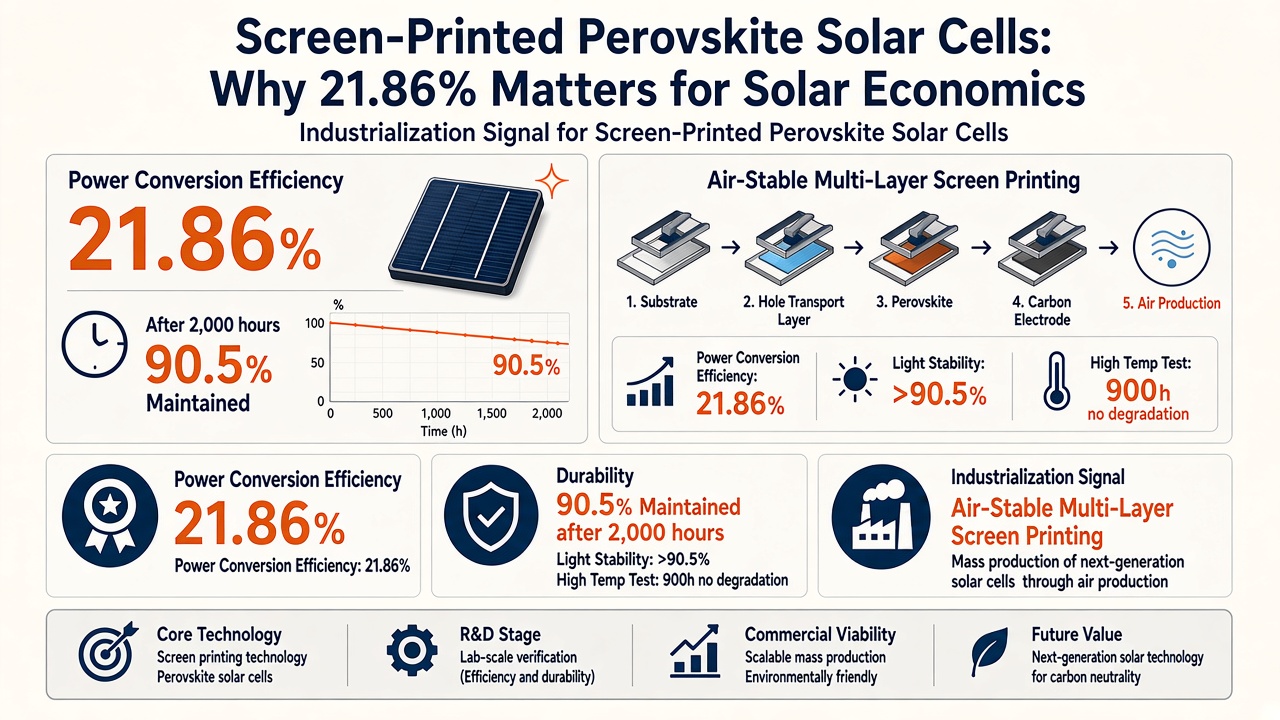
A Nature Photonics paper published on August 27, 2026 put screen-printed perovskite solar cells back in focus. The reason is simple. In an air-processed, fully screen-printed architecture, the team reported 21.86% certified efficiency together with 2,000-hour durability data.
21.86% Certified Efficiency and 2,000 Hours of Durability
That matters because solar economics are not set by record cells alone. If the process is fragile, capex rises, yield drifts, and the final module stays expensive. If factories can reproduce both performance and stability, the cost conversation changes.
- Certified efficiency came in at 21.86%, with a peak result of 22.41%.
- After 2,000 hours of ISOS-L-1 accelerated aging, the cell retained more than 90.5% of its initial performance.
- At 85°C and 50±10% relative humidity, it ran for 900 hours under ISOS-L-3 with no visible degradation.
What Changed Versus Earlier Perovskite Work
Perovskites have long carried a simple promise: high efficiency with low-cost processing. The problem appears when researchers move from elegant small samples to thick, multilayer printed films. Liquid fails to penetrate deeply enough, the top surface crystallizes too early, and defects accumulate.
This paper attacked that bottleneck through fluid motion and crystallization order rather than through a recipe tweak alone. In plain English, the ink was pushed deeper into the stack and allowed to crystallize from the bottom up instead of locking at the top first. The authors say butyronitrile lowered flow resistance and dispersed PbI2 aggregates, which made that sequence possible.
-
1
Old problem
Top surface crystallizes too early
-
2
New co-solvent
Lower flow resistance, disperse PbI2 aggregates
-
3
Bottom-up growth
Crystals form from the bottom upward
-
4
Result
Fewer defects, better transport, higher efficiency and durability
That sounds narrow, but the industrial meaning is broad. Earlier work often optimized the material. This work optimized how the material behaves inside a manufacturable process. That is much closer to what determines line speed, yield, and cost.
Why Factories Care
The classic lab method for perovskites is spin coating, where a substrate is spun at high speed to spread a thin film. It works well for small samples, but it wastes material and scales awkwardly. Screen printing is different. Industry already understands it from paste, ceramic, and electrode processing, so it is easier to picture inside a real production line.
Spin coating
Fast for small-sample research
Strength
Weakness · Material waste and scaling limits
Economics · Hero cells possible, yield remains uncertain
Screen printing
Better fit for thickness control and line integration
Strength
Weakness · Performance wobbles if infiltration and crystallization fail
Economics · Potential capex and yield gains if stabilized
That is why this result sits at the intersection of science and economics. On May 26, 2026, Nature Reviews Clean Technology argued that perovskite PV is now constrained less by raw efficiency and more by scale-up, reliability, factory economics, and bankability. The U.S. DOE makes a similar point when it lists manufacturability and bankability among the core commercialization hurdles.
Where the Economic Leverage Comes From
This does not mean module prices collapse tomorrow. It means the cost curve could bend in a more realistic way. Print-like, lower-temperature processing can cut equipment and energy burdens. Higher efficiency means more electricity from the same roof or land. Stable yields mean the industry can move from isolated hero cells to repeatable production.
Bar chart comparing dollars per watt across silicon, early perovskite, long-run perovskite, and early tandem modules. NREL 2021 minimum sustainable price estimates. Silicon uses the midpoint of the reported 25-27 cents per watt range.
One detail matters here: these are not current market prices. They are NREL’s 2021 minimum sustainable price estimates. In that 2021 framework, crystalline silicon stayed cheapest at about $0.25-$0.27/W. Early single-junction perovskite was estimated at $0.38/W, and early perovskite-on-silicon tandems at $0.31/W. Silicon still wins today. But NREL also estimated that long-run single-junction perovskite could fall to about $0.18/W if performance and manufacturing improve together.
Industry capital is already leaning in. Oxford PV announced on September 5, 2024 that it had started the first commercial shipments of perovskite tandem panels to U.S. customers, with 24.5% module efficiency and up to 20% more energy than standard silicon panels. Then, on August 25, 2026, Tandem PV said it had secured about $7.7 million from ARPA-E SCALEUP Ready and had raised $100 million in total. Money is moving toward manufacturable perovskite, not just record charts.
Which Industries Move First
This section is inference, not a direct claim from the paper. Still, the likely early beneficiaries are fairly clear.
- Materials suppliers come first, especially for additives, barrier films, encapsulation, and solvents that influence yield and lifetime.
- Printing, coating, drying, and inspection equipment makers also matter. As the process window widens, standardization and automation get easier.
- Application markets such as BIPV, lightweight modules, and curved installations could open sooner because silicon is less flexible there.
- The power-system side should not be ignored either. More solar deployment also lifts demand for storage, power electronics, and grid upgrades.
The IEA expects solar PV to add about 600 TWh to global electricity supply growth in 2026, while renewables rise from 33% of generation in 2025 to 37% by 2027. Better solar cells therefore affect more than module makers. They spill into batteries, inverters, grid investment, and land-use economics.
What Still Has to Be Proved
There are still serious hurdles. This is a strong paper, but it is still a paper. Module-scale replication, outdoor field reliability, manufacturing yield, and regulation around lead use remain open questions. Nine hundred hours of hot, humid operation is important, but it is not the same thing as a 20-year project warranty.
The cleanest way to read the result is to split fact from outlook. Confirmed by the paper: a factory-friendlier printed architecture can deliver both high efficiency and meaningful durability. Inferred from the broader market: if that reproducibility survives module scale and mass production, perovskites could lower costs, lift productivity, open new product formats, and rearrange parts of the silicon-centered value chain.
Manufacturing, Not Just Efficiency, Moves the Money
The real story is not just 21.86%. The real story is that perovskites may be getting closer to a process that factories can trust. In solar, that is when science starts to change margins, capex decisions, and eventually market structure.
For related reading, see our earlier piece on science journals and economic ripple effects and our post on self-driving labs. This article is a technology-and-industry explainer, not investment advice.
The important number is not just 21.86%. It is the possibility that a high-efficiency solar cell can be made with a process factories already understand.
Sources
- Nature Photonics (2026-08-27) — Fluid motion and crystallization control enable air-processed fully screen-printed perovskite solar cells
- Nature Reviews Clean Technology (2026-05-26) — Taking perovskite photovoltaics from promise to product
- U.S. Department of Energy — Perovskite Solar Cells
- NREL (2021) — New Reports From NREL Document Continuing PV and PV-Plus-Storage Cost Declines
- IEA (2026) — Electricity Mid-Year Update 2026: Executive summary
- Oxford PV (2024-09-05) — 20% more powerful tandem solar panels enter commercial use for the first time in the US
- Tandem PV (2026-08-25) — ARPA-E SCALEUP Ready Award
For information only — this is not a recommendation to buy or sell any asset.
Comments 0