AI Protein RNA Carriers: STV-C8 Results and the Questions Still Open
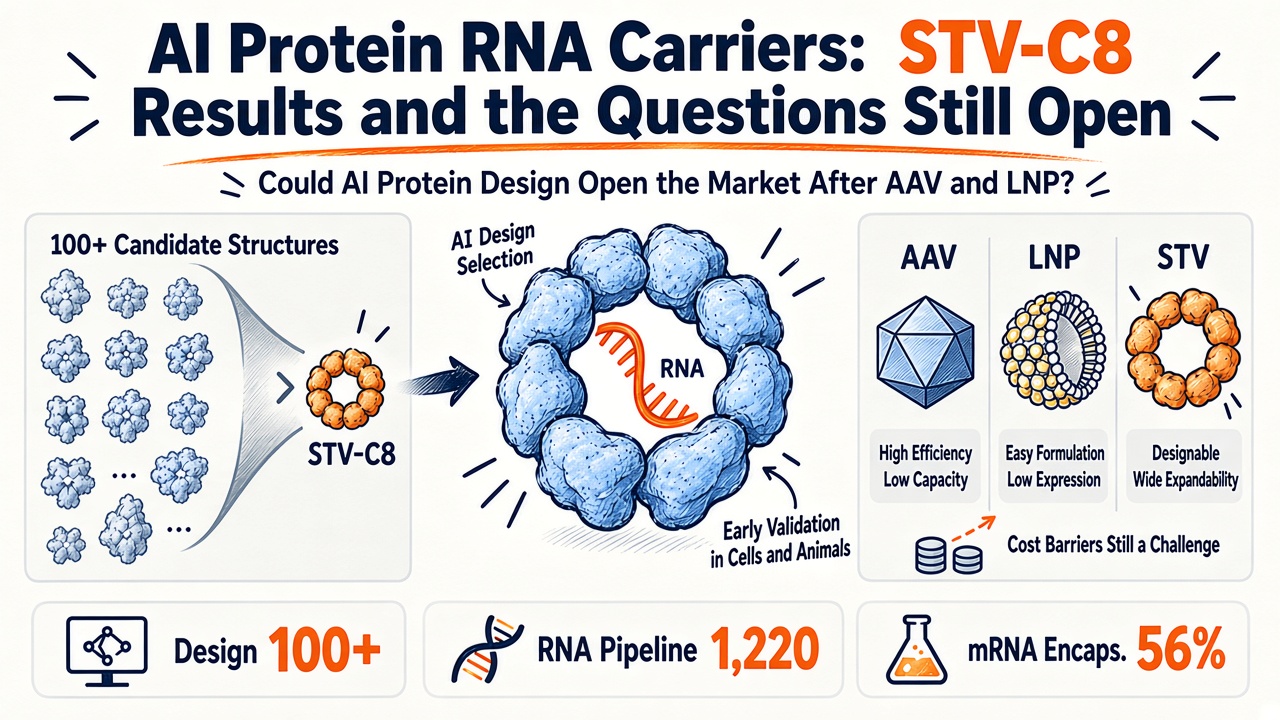
An AI-designed protein RNA carrier has opened a possible new route around gene therapy’s delivery problem. In a Nature paper published on 2 September 2026, researchers built more than 100 non-natural carriers, and STV-C8 delivered RNA several orders of magnitude more efficiently than established vehicles under the study’s test conditions. These are cell and early animal results, not treatment outcomes in people.
RNA is a temporary set of instructions for a cell. Designing those instructions is only half the job. They must survive in the body, reach the right tissue, enter a cell and unpack in the correct compartment. In many genetic medicines, delivery—not the payload—is the harder engineering problem.
What did the AI protein RNA carrier actually create?
STV stands for synthetic transfer vehicle. It is neither a weakened natural virus nor a modest reformulation of a lipid nanoparticle, or LNP. The researchers attached natural membrane-binding, budding and RNA-binding functions to protein assemblies generated with the RFdiffusion design model.
The resulting structures included cyclic and dihedral shapes rarely seen in natural viral capsids. The team built more than 100 designs and screened release, cell uptake and RNA expression together. An unusual flat eightfold ring, STV-C8, emerged as the lead design.
-
1
AI scaffold
Non-natural symmetries
-
2
Add functions
Membrane, budding, RNA binding
-
3
Screen 100+
Release, uptake, expression
-
4
STV-C8
Eightfold-ring lead
AI did not autonomously invent a finished medicine. It expanded the set of physically plausible protein scaffolds. Researchers then added biological functions and selected working versions in wet-lab experiments. This is a combined computational and experimental achievement.
How is it different from AAV and LNP delivery?
AAV repurposes adeno-associated virus as a delivery vehicle. It can support durable gene transfer, but immunity to the capsid may complicate redosing, and high systemic doses can create immune and liver safety risks.
LNPs wrap RNA in lipid droplets. Their large-scale manufacturability was demonstrated by mRNA vaccines, but intravenously administered LNPs often accumulate in the liver. Reliable delivery to organs such as lung or muscle remains a central engineering challenge.
STV-C8 starts with a designed protein scaffold and can add small targeting proteins called minibinders. In mice, intravenous STV-C8 produced strong lung expression without detectable liver expression. That is evidence of a different distribution pattern, not proof that any organ can already be targeted on demand.
AAV
Natural virus
Scaffold
Strength · Durable gene transfer
Challenge · Immunity, dose, redosing
LNP
Lipid particle
Scaffold
Strength · RNA scale experience
Challenge · Liver bias, targeting
STV-C8
AI-designed protein
Scaffold
Strength · Modular target and cargo
Challenge · Unproven clinic and scale
The distance between ‘orders of magnitude’ and a human therapy
The paper says STV-C8 transferred RNA several orders of magnitude more efficiently than clinically used LNPs and natural counterparts. Each order of magnitude is tenfold, so the wording implies at least a hundredfold difference. Yet this was a payload-normalized comparison in defined cells and assays. It does not mean a patient’s dose has already fallen by the same factor.
The animal work is also an opening result. Whole-body clearing let the team map expression in mice at near-single-cell resolution, and measured liver and immune markers showed no clear toxicity signal. Follow-up was short and animal numbers were small, so rare or delayed effects remain unknown.
The Duchenne muscular dystrophy experiment needs equal care. CRISPR-Cas9 RNA in STV-C8 was injected into one muscle site in a single 25-kilogram pig. Exon 51 deletion was detected 72 hours later, and the reading frame was restored in patient-derived muscle cells. DMD affects muscle throughout the body, and the authors explicitly state that local intramuscular delivery is not directly applicable as systemic DMD treatment.
Where could cost savings come from?
The paper does not establish an economic result. It reports no cost per patient, commercial yield or clinical dose. If its delivery efficiency and modular targeting survive human testing, however, three cost pathways become plausible.
The most direct route is dose. A 2026 Gene Therapy cost analysis notes that systemic neuromuscular indications can require around 10^15 AAV vector genomes per patient, with manufacturing cost reaching tens of thousands of dollars per dose even in efficient operations. A more potent carrier could reduce culture, purification and testing loads. Without a human STV dose, that remains a testable hypothesis rather than a quantified saving.
Reuse could matter during development. If one STV scaffold can accept different targeting minibinders and RNA payloads, developers may carry delivery work across several drug candidates. That could turn a single asset into a platform and shorten redesign work after a payload fails.
Manufacturing consistency is the final gate. In the AAV analysis, scaling a transient-transfection process from 50 to 2,000 litres increased volume fortyfold while total cost rose from $1.24 million to $4.53 million. Dividing those figures gives about 3.65-fold. Scale spreads fixed cost, but materials and purification remain. STV-C8 was cell-produced and concentrated by ultracentrifugation; it is not automatically cheap. Reproducible bioreactor yield and purification will be the real economic test.
A platform aimed at 1,220 RNA programs
ASGCT and Citeline counted 1,220 RNA therapies from preclinical through pre-registration stages in Q1 2026, plus 469 open RNA therapy trials. Fifty-six percent of mRNA programs were still preclinical. The field has many payloads, while delivery remains comparatively immature.
Q1 2026 mRNA pipeline: 56 percent preclinical and 44 percent clinical. ASGCT/Citeline, Q1 2026 mRNA pipeline. · Axis starts at 38, not zero
Capital is active too. The same report counted 103 alliance, acquisition and financing deals among gene, cell and RNA therapy companies in Q1 2026. Thirteen seed or Series A rounds raised $388.4 million. In June, Alnylam announced an AI drug-design collaboration with Inceptive. AI-designed RNA and AI-designed protein delivery could become parts of one development stack.
Potential beneficiaries span protein-design software, synthetic DNA, cell-culture equipment, purification and analytics, and contract development and manufacturing. Assets dedicated only to one viral-vector process could face long-run competition. Near term, coexistence is more credible than wholesale replacement: each delivery system may win in different organs and diseases.
Safety comes before the cost curve
Delivery safety is also an economic variable. In November 2025, the FDA added a boxed warning to the AAV-based DMD therapy Elevidys after reports of fatal acute liver failure and restricted use to ambulatory patients aged four and older. Patients require intensive monitoring, while the developer bears regulatory and revenue risk. Sarepta reported $98.1 million of Elevidys net product revenue in Q2 2026.
This history does not prove STV is safer. It defines the standard a new carrier must meet: neutralizing antibodies, redosing, off-target delivery, reproductive-cell exposure and long-term toxicity all matter. High cell-culture efficiency has little commercial value if those questions remain unanswered.
What STV-C8 proved—and what it did not
The proven result is substantial but narrow. More than 100 AI-scaffolded RNA carriers were built. STV-C8 showed high transfer efficiency and programmable targeting, lung expression and short-term safety measurements in mice, and local gene editing in one pig.
The outlook begins after that boundary. If lower dosing, redosing and scalable manufacturing work in people, development time and manufacturing cost could fall, and a platform-licensing market could emerge. If systemic targeting or immunogenicity fails, the technology may remain a research tool or serve a limited set of local-delivery indications.
- Systemic muscle and multi-organ studies beyond a single injection site
- Toxicity and immunogenicity measured over months rather than days
- Consistent particle size, RNA loading and purity under GMP-scale production
- Head-to-head dose, efficacy and cost data against AAV and LNP controls
This article does not recommend buying or selling any security. Investment decisions remain your responsibility.
Related delivery and research-automation themes appear in our BTR targeted drug-delivery analysis and self-driving laboratory overview. The Nature paper’s deepest contribution is a change in the question: from modifying carriers supplied by evolution to designing the carrier a therapy needs. Industry must now answer with reproducible manufacturing and human safety.
Good RNA is not a medicine by itself. Safe delivery to the right cell determines the size of the market.
Sources and further reading
- Nature — Creating bottom-up RNA transfer vehicles from synthetic protein assemblies
- ASGCT/Citeline — Gene, Cell, & RNA Therapy Landscape Report Q1 2026
- Gene Therapy — rAAV production cost analysis
- Nature Biomedical Engineering — Emerging gene delivery platforms
- FDA — Elevidys boxed warning and revised indication
- Sarepta — Q2 2026 financial results
- Alnylam — Inceptive AI collaboration
For information only — this is not a recommendation to buy or sell any asset.
Comments 0