ALK Molecular Glue 2026 — Why Nature’s TRI-611 Could Reshape Resistant Lung Cancer
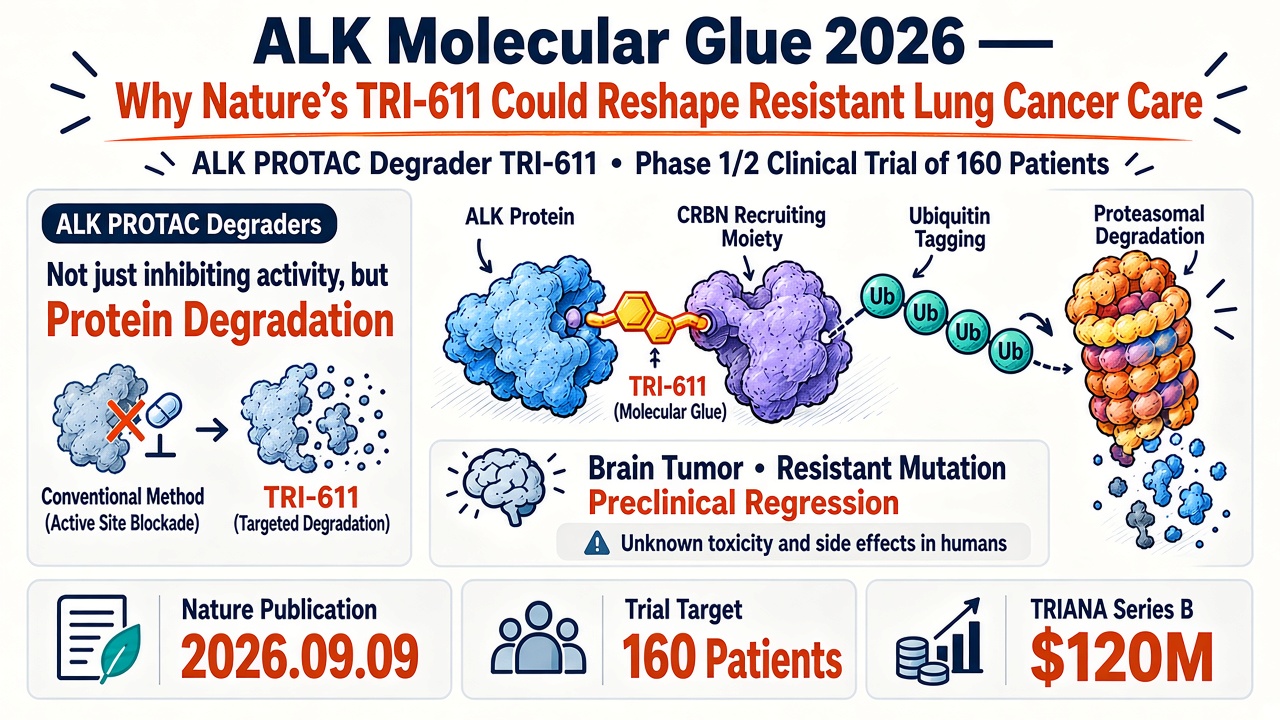
The ALK molecular glue TRI-611 was published in Nature on 9 September 2026. Its central idea goes beyond temporarily blocking a cancer protein. This oral small molecule recruits the cell’s own disposal machinery to destroy that protein. The researchers reported tumour regression in mouse models, including tumours carrying resistance mutations and tumours growing inside the brain.
That is not evidence of efficacy in patients. TRI-611 is now in a 160-participant phase 1/2 trial designed to find a tolerable dose and look for early antitumour activity. This article explains how the drug differs from existing ALK inhibitors, why pharmaceutical companies are committing billion-dollar headline values to molecular-glue platforms, and where verified evidence ends and economic projections begin.
This article does not recommend any stock or drug investment. TRI-611 remains in early clinical development, so every cost and market outlook below is conditional.
How does an ALK molecular glue make a cancer protein disposable?
In ALK-positive non-small-cell lung cancer, the ALK gene becomes abnormally fused to another gene. The resulting fusion protein continuously tells the cell to grow. Today’s ALK tyrosine kinase inhibitors, or TKIs, occupy the protein’s active site and suppress that signal. They work much like blocking a keyhole.
Cancer can change the shape of that keyhole. Mutations accumulate during treatment, weakening drug binding, while other growth pathways can provide detours. The third-generation drug lorlatinib was designed to cover many resistance mutations, but no inhibitor prevents every eventual progression.
TRI-611 takes a different route. It binds ALK while creating a new interface with CRBN, a component of the cell’s protein-disposal machinery. The cell then attaches ubiquitin disposal tags to ALK. Tagged ALK is carried to the proteasome, the cell’s protein-shredding complex, and dismantled.
One analogy is enough. A TKI holds down the power switch on a faulty machine; a molecular glue attaches a disposal label so the machine is removed. In biological terms, an ALK–TRI-611–CRBN complex and the ubiquitin-proteasome system do the work.
-
1
ALK fusion
Cancer growth signal
-
2
TRI-611 binds
Brings ALK to CRBN
-
3
Disposal tag
Ubiquitin attached
-
4
Protein destroyed
Proteasome dismantles ALK
What makes it different from existing TKIs?
The binding location matters most. According to the Nature paper, TRI-611 creates an interface away from the ALK active site occupied by conventional TKIs. That offers a way to approach some mutations that altered the active site and escaped an inhibitor.
Molecular glues also differ from PROTACs, a related class of degraders. A PROTAC links one binding head for the target to another for an E3 ligase, usually creating a larger molecule. A molecular glue is a single small molecule that induces a new affinity between two proteins. Smaller size can support oral dosing and brain penetration, but size alone does not guarantee selectivity or safety.
The paper reports proteome-wide selectivity over known CRBN neosubstrates and other kinases. That is important because hijacking cellular disposal machinery could cause toxicity if unrelated proteins are removed. Proteomic assays in the laboratory, however, cannot substitute for safety data from patients taking the drug over time.
Existing ALK TKI
Action · Blocks active site
Target fate · Protein remains
Resistance · Binding-site mutations
Clinical status · Multiple approved drugs
TRI-611
Action · Recruits disposal machinery
Target fate · ALK protein degraded
Difference · Interface away from active site
Clinical status · Recruiting phase 1/2
Why brain penetration is a product requirement
ALK-positive lung cancer frequently spreads to the brain. The US National Cancer Institute says up to 40% of people develop brain metastases within two years of diagnosis. If a drug controls tumours in the bloodstream but cannot cross the blood-brain barrier, the brain can become a sanctuary for cancer cells.
Existing therapy sets a high bar. In the CROWN trial summarized by NCI, median progression-free survival had not been reached after five years for patients receiving first-line lorlatinib. Among 114 participants who began without brain metastases, only four developed them.
Tolerability is part of that bar. Treatment-related side effects occurred in 77% of lorlatinib recipients, with oedema and elevated cholesterol and triglycerides among the common problems. TRI-611 must show more than tumour shrinkage. It needs durable activity in resistant disease, control of brain lesions, and tolerability during daily dosing.
What the Nature paper proved—and what it did not
The verified result is powerful but bounded. TRI-611 degraded wild-type and multiple TKI-resistant ALK fusion proteins in cellular experiments. It produced regression in subcutaneous and intracranial mouse tumours derived from cell lines and patient samples. Combining it with lorlatinib produced synergistic and durable regressions in preclinical models.
Patient-derived does not mean patients received the drug. It means tumour material from a patient was transferred into an experimental model. Regression in those models supports clinical testing, but it does not establish longer survival or better quality of life in people.
ClinicalTrials.gov spells out the human questions. NCT07491497 is an open-label phase 1/2 study that began in March 2026. Dose escalation will identify a maximum tolerated or recommended phase 2 dose, followed by expansion across three cohorts with different prior ALK-TKI treatment histories. Target enrolment is 160, with primary completion estimated for May 2029.
-
1
Cells
Resistant ALK degraded
-
2
Mice
Body and brain tumour regression
-
3
2026 trial
Phase 1/2, target 160
-
4
2029 estimate
Primary completion
Three ways an ALK molecular glue could change costs
The economic effects are scenarios, not paper results. The study contains no commercial manufacturing yield, per-patient price or hospitalization saving. If efficacy and safety translate to humans, however, costs could move through three channels.
First is treatment sequencing. A drug with a distinct mechanism could be inserted after resistance instead of immediately moving to another TKI or chemotherapy. Delaying brain progression might reduce radiation and hospital use. Total spending would fall only if those savings exceed the drug’s price, which will require comparative health-economic data.
Second is combination therapy. TRI-611 and a TKI do not compete for the same binding site, creating a rationale for using both. Preclinical synergy with lorlatinib is encouraging, but two premium medicines can increase near-term pharmacy costs. Longer disease control, adverse-event management and total care costs must be assessed together.
Third is drug-development productivity. If the repeatable asset is a method for finding interfaces between difficult targets and disposal machinery, one platform could generate multiple candidates. That may reduce repeated discovery work. The larger commercial opportunity is not limited to ALK-positive cancer; it lies in proteins previously considered inaccessible to conventional small molecules.
-
1
Overcome resistance
New treatment sequence
-
2
Delay brain progression
Potentially less hospital and radiation use
-
3
Reuse platform
More discovery productivity
-
4
New target markets
Previously hard-to-drug proteins
Why large drugmakers are paying attention
Capital has already moved. TRIANA raised a $120 million Series B in December 2025 to take TRI-611 through clinical proof of concept and select a second development candidate. Backers included Pfizer Ventures, Regeneron Ventures and other specialist investors.
This is not a single-company wager. AbbVie’s 2025 collaboration with Neomorph offered up to $1.64 billion in aggregate option fees and milestones across oncology and immunology programs. Gilead’s oral CDK2 molecular-glue agreement with Kymera offered up to $750 million in total payments, including up to $85 million in upfront and potential option-exercise payments. Most of these headline values are contingent on development, approval or sales—not cash paid on day one.
The existing ALK market is commercially meaningful. GSK investor materials filed with the US Securities and Exchange Commission estimate more than $3 billion in 2025 sales for marketed ALK TKIs. This is a company estimate used in transaction materials, not an independently certified market statistic, so it should be treated as directional context.
The broad industrial prize is an expansion of the druggable proteome. Conventional discovery favours proteins with deep binding pockets. If molecular glues can create useful interfaces on flatter or more complicated surfaces, previously neglected targets become patentable and licensable assets. Compound libraries, structural biology, proteomics and biomarker businesses could all see more demand.
What would turn this into a real industrial transition?
It is too early to call TRI-611 a replacement for approved ALK drugs. Its first commercial position, if it succeeds, is more likely after TKI progression or in combination. Evidence of tolerability and resistance-breaking activity would then support tests in earlier treatment and other ALK-driven cancers.
- Whether unexpected degradation-related toxicity appears as phase 1 doses increase
- Whether objective responses emerge in TKI-resistant and brain-metastatic disease
- How long responses last and which new resistance mechanisms develop
- How monotherapy and TKI combinations compare on efficacy, toxicity and total care cost
Related parts of the innovation chain appear in our BTR targeted drug-delivery analysis and our article on how self-driving laboratories change drug discovery. Those stories focus on delivering medicines precisely and finding them faster. This study is about reprogramming a disposal system that cells already possess.
My view is that TRI-611’s deepest value is not one regressing mouse tumour. It is a worked example suggesting that a deliberately designed molecular glue can progress into the clinic against an oncogenic fusion. The remaining test is no longer whether the molecular structure is elegant. It is whether the drug works safely for long enough in people and creates better value than established therapy.
The value of a molecular glue will be decided not by the phrase ‘protein degradation,’ but by durable and safe results in patients.
Sources and further reading
- Nature — TRI-611, a selective, brain-penetrant molecular glue degrader of ALK
- ClinicalTrials.gov — NCT07491497 Phase 1/2 study of TRI-611
- NCI — Lorlatinib as initial treatment of ALK-positive NSCLC
- TRIANA — First patient dosed in the TRI-611 phase 1/2 trial
- TRIANA — $120 million Series B financing
- AbbVie — Neomorph molecular-glue collaboration
- Gilead — Kymera option and licence for CDK2 molecular-glue degraders
- SEC — GSK transaction presentation with ALK market estimates
For information only — this is not a recommendation to buy or sell any asset.
Comments 0